What if we non-idealists, realists (or whatever) thought to ourselves not 'idealism, what an absurdity!' but rather 'idealism, what an achievement!'?
What if we took idealism to be not a flawed 'position' to be bombarded but rather an outdated, outmoded achievement ill-suited to the present and its problems?
To acknowledge something as an achievement -- even a glorious achievement -- by no means obliges anything like heartfelt subscription to that thing. However, such an acknowledgement does preclude the naive denunciation that would declare, perhaps subtextually: 'what idiots! who could believe such a thing?!'
Their problems are not yours -- so, why denounce their solutions as absurd? Rejoice in not sharing their problems!
'Ah, but their stupidity is my problem -- how can I live well in a world containing deceived minds?!'
That absurdity is our problem.
Friday, 15 August 2014
Wednesday, 13 August 2014
What is the contrary of 'cosmos'? What, then, is 'cosmopolitics'?
Isabelle Stengers' cosmopolitics is one of those concepts that is oft-cited but rarely examined in any detail. I won't try to explicate it on the basis of Stengers' texts here (though that needs to be done); I'll just ask a simple question: what is the contrary of 'cosmos'? How we answer this question will determine what we take cosmopolitics to be.
It seems to me that many readers take the cosmos in cosmopolitics to be basically equivalent to the everyday meaning of that word; they take it to mean cosmos in the sense of Carl Sagan's Cosmos -- that is, as, more or less, a synonym for the universe. The only possible contrary to 'cosmos' in this sense would be 'non-existence, nothingness.'
Taken this way, cosmopolitics must either mean that politics is a transcendent metaphysical model for existence (i.e. Graham Harman's reading of Bruno Latour's Irreductions); or, cosmopolitics must mean that the entirety of existence must now be subsumed within political contestation (taking the old cliché 'everything is political' to ever more absurd heights). Neither of these interpretations are, in my opinion, especially useful (or even comprehensible).
It'd be helpful to think of 'cosmos' in broader terms. Here's what the etymology dictionary has to say about 'cosmos':
So, we should take note that when Latour uses 'cosmopolitics' in Pandora's Hope, Politics of Nature and later texts he opposes it not to non-existence but to 'kakosmos' (kakos in many contemporary European languages meaning shit and in the Ancient Greek meaning bad or evil). Cosmos is, in this usage, not just a straightforward synonym for existence; it is, like for the Stoics and the other Greeks described in the quotation above, a word meaning a specific kind of ordering, a good, beautiful, agreeable ordering. In this usage there may well be no cosmos! The mere fact that there is existence proves nothing.
Cosmopolitics, in this sense, therefore means not that politics is a transcendent metaphysical principle such that all existence is political in and of itself, nor that the entirety of the cosmos must be brought within previously human-exceptional politics (whatever that would mean). Cosmopolitics is instead the recognition that since both God and Nature are dead then there is only one possible route towards a cosmos and away from a kakosmos: through politics, with all the messiness, compromise and frustration that this word entails.
It is not that the universe is always already political in itself, as though politics were some kind of transcendent metaphysical condition. It is precisely the opposite of that: there is no transcendent metaphysical condition, that's why there must be cosmopolitics.
It seems to me that many readers take the cosmos in cosmopolitics to be basically equivalent to the everyday meaning of that word; they take it to mean cosmos in the sense of Carl Sagan's Cosmos -- that is, as, more or less, a synonym for the universe. The only possible contrary to 'cosmos' in this sense would be 'non-existence, nothingness.'
Taken this way, cosmopolitics must either mean that politics is a transcendent metaphysical model for existence (i.e. Graham Harman's reading of Bruno Latour's Irreductions); or, cosmopolitics must mean that the entirety of existence must now be subsumed within political contestation (taking the old cliché 'everything is political' to ever more absurd heights). Neither of these interpretations are, in my opinion, especially useful (or even comprehensible).
It'd be helpful to think of 'cosmos' in broader terms. Here's what the etymology dictionary has to say about 'cosmos':
c.1200 (but not popular until 1848, as a translation of Humboldt's Kosmos), from Latinized form of Greek kosmos "order, good order, orderly arrangement," a word with several main senses rooted in those notions: The verb kosmein meant generally "to dispose, prepare," but especially "to order and arrange (troops for battle), to set (an army) in array;" also "to establish (a government or regime);" "to deck, adorn, equip, dress" (especially of women). Thus kosmos had an important secondary sense of "ornaments of a woman's dress, decoration" (compare kosmokomes "dressing the hair") as well as "the universe, the world."
Pythagoras is said to have been the first to apply this word to "the universe," perhaps originally meaning "the starry firmament," but later it was extended to the whole physical world, including the earth. For specific reference to "the world of people," the classical phrase was he oikoumene (ge) "the inhabited (earth)." Septuagint uses both kosmos and oikoumene. Kosmos also was used in Christian religious writing with a sense of "worldly life, this world (as opposed to the afterlife)," but the more frequent word for this was aion, literally "lifetime, age."For the Stoics, kosmos meant that existence was divinely ordered; it meant that, to ape Leibniz, we lived in the best and most rational of all possible worlds and for this we owed thanks to God or Nature in all their divinity. It is related to this sense of kosmos as a divinely ordered existence that we get cosmos as simply a synonym for astronomical existence generally (perhaps beginning with Pythagoras). However, the etymology of the term is demonstrably more complex and interesting than that.
So, we should take note that when Latour uses 'cosmopolitics' in Pandora's Hope, Politics of Nature and later texts he opposes it not to non-existence but to 'kakosmos' (kakos in many contemporary European languages meaning shit and in the Ancient Greek meaning bad or evil). Cosmos is, in this usage, not just a straightforward synonym for existence; it is, like for the Stoics and the other Greeks described in the quotation above, a word meaning a specific kind of ordering, a good, beautiful, agreeable ordering. In this usage there may well be no cosmos! The mere fact that there is existence proves nothing.
Cosmopolitics, in this sense, therefore means not that politics is a transcendent metaphysical principle such that all existence is political in and of itself, nor that the entirety of the cosmos must be brought within previously human-exceptional politics (whatever that would mean). Cosmopolitics is instead the recognition that since both God and Nature are dead then there is only one possible route towards a cosmos and away from a kakosmos: through politics, with all the messiness, compromise and frustration that this word entails.
It is not that the universe is always already political in itself, as though politics were some kind of transcendent metaphysical condition. It is precisely the opposite of that: there is no transcendent metaphysical condition, that's why there must be cosmopolitics.


Tuesday, 12 August 2014
The felinocene(?!) -- Cats as invasive species
From a paper published in Nature last year but featured by the BBC today:
Cats are one of the top threats to US wildlife, killing billions of animals each year, a study suggests.
The authors estimate they are responsible for the deaths of between 1.4 and 3.7 billion birds and 6.9-20.7 billion mammals annually.The abstract to the Nature paper concludes:
Un-owned cats, as opposed to owned pets, cause the majority of this mortality. Our findings suggest that free-ranging cats cause substantially greater wildlife mortality than previously thought and are likely the single greatest source of anthropogenic mortality for US birds and mammals. Scientifically sound conservation and policy intervention is needed to reduce this impact.A nice reminder in yet another ecological arena that anthropogenic doesn't mean 'human controlled.' The perturbatory ripples issuing out from our actions rapidly attain shapes, patterns and magnitudes almost unrecognisable to us as they are amplified by processes and agents with aims and objectives entirely their own.
Friday, 8 August 2014
'We Moderns' versus 'The Moderns'; or, The weight of our ancestors
One persistent source of disagreement during the AIME project was the precise meaning of 'Moderns.' This was captured most notably by Annemarie Mol during her presentation for the final seminars (I believe that this will be made available here but does not appear to be there at present) when she refused to speak in the name of any such entity. She asked that we focus instead on localised, specific issues that require no overarching or underlying group identity. To speak of a Big 'We,' it was suggested, is inherently oppressive and dangerous.
(What follows is one way, one attempt to rationalise ex post facto what actually happened during these events. In the midst of them there was an irreducible uncertainty.)
It seems to me that 'Moderns' has been used in at least two ways within AIME.
First, 'We Moderns' (the 'new nous,' as someone put it) are those who were performatively called into being by the project itself. The aim of AIME, it now seems to me (though I claim no authority on such matters!), was to produce a definition of 'Moderns' to which those assembled by the event would be willing to subscribe -- that is, not to self-identify with an already existing 'we' but to create a new ontological identity to which membership is not at all overarching but, rather, voluntary. This usage of 'Moderns' does not, then, indicate an actually or historically existing population. On the contrary, it is precisely because we have never been modern that such a performative creation is necessary.
However, secondly, Annemarie was right to point to a conflation of this performative and highly localised meaning of 'Moderns' with something rather broader and more historical. 'The Moderns' often seems to be used, additionally, as shorthand for 'those-who-though-they-were-modern'; in other words, 'The Moderns' also means the ancestors and kin of those assembled by the project -- a quite different ontological proposition.
Here is where it gets interesting: We (participants) were attempting to take responsibility for our ancestors. Latour, in his opening remarks, emphasised the importance of the fact that the event was taking place in a lecture theatre named after Albert Caquot, a famous French engineer and über-modern. Caquot, of course, echoes the Greek kakos meaning 'bad' or 'evil.' The Moderns, it was suggested, thought that they were building a 'cosmos' (a divine order of existence) but all too often they were establishing a kakosmos (a nasty, broken order).
'We Moderns' (the new nous) and 'The Moderns' (those-who-thought-they-were-modern) converge on this point: We (participants) were obligated, due to our rather ignoble family history, to attempt to formulate a new definition of 'Modern,' a definition to which we would be happy to subscribe -- that was the challenge. We were obligated to perform this act precisely because (a) those-who-thought-they-were-modern were never modern (in the sense that they understood that term) and because (b) we still live in the house that they built.
Here it is important to contrast history with ancestry. To speak of 'ancestors' is to acknowledge a deep debt to and responsibility for those who came before us. To speak of history is, contrariwise, to suggest a broadly impersonal process that we just happen to find ourselves at the end or in the midst of. Ancestry entails an unavoidable familial commitment. History is what has made you; ancestry is, to some degree, what you are.
Here is where I would disagree with Annemarie's refusal to speak the phrase 'We Moderns': we have a responsibility for those who came before us because they still live among, through and around us; we are not free of our ancestors just because they are in the ground. They cannot simply be disavowed; saying 'I am not...' is insufficient.
If a child of disreputable parents were protesting 'but I am not my father, I am not my mother -- I have nothing to do with them' we might have to reply: 'but you still live in their house, they still feed you and put clothes on your back, you still speak their words; you walk like them, you talk like them; you exist through their modes of existence!'
We are children of contemptible predecessors but we still live in the house that they built (when we're in the Amphitheatre Caquot, more or less literally!). They thought that it was a grand, glorious palace; we now know that it was, in many ways, a tumbledown structure built on slavery and brutality. But we live there nevertheless.
We Moderns are unlike The Moderns in one crucial respect: The Moderns believed that they were standing on the shoulders of giants; we fear that we may be standing on the shoulders of tyrants. What we share is the predicament that none of us can dismount; there is no 'down there'; we have, instead, to find a way to modify our precarious situation, to stand a little differently.
We participants of AIME were assembled, first, as descendants of those-who-thought-they-were-modern and, second, as the future ancestors of our own offspring (thanks to Stephen Muecke for this point). The 'We Moderns' invoked by AIME was an opt-in performance of identification. We cannot say that this invitation to subscribe lacked 'informed consent'! Ultimately we failed to produce a definition to which those assembled could all sign up. However, this does not detract from the validity of the effort. An enduring Modern legacy is the pursuit of impossibles...
Permanently opting-out of such identity-challenges might seem superficially progressive and 'right on' but this, I believe, dissolves upon a deeper consideration of the predicament. Such an attitude of 'tune in, drop out, call me when there's something specific to talk about' is quintessentially Modern inasmuch as it implies a supersessive logic of history where we can gesture to a past that makes us but is not us; a past that we can shed like clothing. A logic of ancestry entails a commitment to more thoroughly reconsider the house that our ancestors built, the house in which we have no option but to continue living -- and to gradually renovate, wall by wall, brick by brick.
This is not a conservatism. It is not that we must 'honour' our elders -- far from it! -- but we must recognise that we cannot distance ourselves from them by mere renunciation. The only distance that we can put between ourselves and our less than salubrious predecessors is by differentiation, by becoming otherwise -- and that requires considerable attention to what we are and why we are what we are.
'The progressive composition of the common world'; or, the progressive renovation of our inherited abode. Either way, the important concept here is obligation.
Our burden is not that of the White Men of History. Theirs was not really a 'burden' at all but a gift to be passed on to the underdeveloped 'others,' whether they wanted it or not. Perhaps it is false to say that we are 'standing on the shoulders' of anyone; perhaps it is more like that they are standing on us. We are no longer 'burdened' with the obligation to spread our wisdom freely around a world that is simply open, empty and waiting to be filled by rationality. Instead, the world is now thinkable as being always already meaningful, always already rational but differently rational. Our true burden is finding our place in a world that doesn't need us -- and doing so with full cognisance of our ancestry.
Whatever we choose to name ourselves after we cease to be White Men, we cannot outrun our past. AIME solved nothing but it posed some important questions for what is ahead. A planetary negotiation? Negotiation has an interesting double meaning: the sense of parlay and the sense of navigation. 'Icebergs ahoy!'
To navigate the coming century without shipwreck -- are we not all in the same boat at least in this much?
(What follows is one way, one attempt to rationalise ex post facto what actually happened during these events. In the midst of them there was an irreducible uncertainty.)
It seems to me that 'Moderns' has been used in at least two ways within AIME.
First, 'We Moderns' (the 'new nous,' as someone put it) are those who were performatively called into being by the project itself. The aim of AIME, it now seems to me (though I claim no authority on such matters!), was to produce a definition of 'Moderns' to which those assembled by the event would be willing to subscribe -- that is, not to self-identify with an already existing 'we' but to create a new ontological identity to which membership is not at all overarching but, rather, voluntary. This usage of 'Moderns' does not, then, indicate an actually or historically existing population. On the contrary, it is precisely because we have never been modern that such a performative creation is necessary.
However, secondly, Annemarie was right to point to a conflation of this performative and highly localised meaning of 'Moderns' with something rather broader and more historical. 'The Moderns' often seems to be used, additionally, as shorthand for 'those-who-though-they-were-modern'; in other words, 'The Moderns' also means the ancestors and kin of those assembled by the project -- a quite different ontological proposition.
Here is where it gets interesting: We (participants) were attempting to take responsibility for our ancestors. Latour, in his opening remarks, emphasised the importance of the fact that the event was taking place in a lecture theatre named after Albert Caquot, a famous French engineer and über-modern. Caquot, of course, echoes the Greek kakos meaning 'bad' or 'evil.' The Moderns, it was suggested, thought that they were building a 'cosmos' (a divine order of existence) but all too often they were establishing a kakosmos (a nasty, broken order).
'We Moderns' (the new nous) and 'The Moderns' (those-who-thought-they-were-modern) converge on this point: We (participants) were obligated, due to our rather ignoble family history, to attempt to formulate a new definition of 'Modern,' a definition to which we would be happy to subscribe -- that was the challenge. We were obligated to perform this act precisely because (a) those-who-thought-they-were-modern were never modern (in the sense that they understood that term) and because (b) we still live in the house that they built.
Here it is important to contrast history with ancestry. To speak of 'ancestors' is to acknowledge a deep debt to and responsibility for those who came before us. To speak of history is, contrariwise, to suggest a broadly impersonal process that we just happen to find ourselves at the end or in the midst of. Ancestry entails an unavoidable familial commitment. History is what has made you; ancestry is, to some degree, what you are.
Here is where I would disagree with Annemarie's refusal to speak the phrase 'We Moderns': we have a responsibility for those who came before us because they still live among, through and around us; we are not free of our ancestors just because they are in the ground. They cannot simply be disavowed; saying 'I am not...' is insufficient.
If a child of disreputable parents were protesting 'but I am not my father, I am not my mother -- I have nothing to do with them' we might have to reply: 'but you still live in their house, they still feed you and put clothes on your back, you still speak their words; you walk like them, you talk like them; you exist through their modes of existence!'
We are children of contemptible predecessors but we still live in the house that they built (when we're in the Amphitheatre Caquot, more or less literally!). They thought that it was a grand, glorious palace; we now know that it was, in many ways, a tumbledown structure built on slavery and brutality. But we live there nevertheless.
We Moderns are unlike The Moderns in one crucial respect: The Moderns believed that they were standing on the shoulders of giants; we fear that we may be standing on the shoulders of tyrants. What we share is the predicament that none of us can dismount; there is no 'down there'; we have, instead, to find a way to modify our precarious situation, to stand a little differently.
We participants of AIME were assembled, first, as descendants of those-who-thought-they-were-modern and, second, as the future ancestors of our own offspring (thanks to Stephen Muecke for this point). The 'We Moderns' invoked by AIME was an opt-in performance of identification. We cannot say that this invitation to subscribe lacked 'informed consent'! Ultimately we failed to produce a definition to which those assembled could all sign up. However, this does not detract from the validity of the effort. An enduring Modern legacy is the pursuit of impossibles...
Permanently opting-out of such identity-challenges might seem superficially progressive and 'right on' but this, I believe, dissolves upon a deeper consideration of the predicament. Such an attitude of 'tune in, drop out, call me when there's something specific to talk about' is quintessentially Modern inasmuch as it implies a supersessive logic of history where we can gesture to a past that makes us but is not us; a past that we can shed like clothing. A logic of ancestry entails a commitment to more thoroughly reconsider the house that our ancestors built, the house in which we have no option but to continue living -- and to gradually renovate, wall by wall, brick by brick.
This is not a conservatism. It is not that we must 'honour' our elders -- far from it! -- but we must recognise that we cannot distance ourselves from them by mere renunciation. The only distance that we can put between ourselves and our less than salubrious predecessors is by differentiation, by becoming otherwise -- and that requires considerable attention to what we are and why we are what we are.
'The progressive composition of the common world'; or, the progressive renovation of our inherited abode. Either way, the important concept here is obligation.
Our burden is not that of the White Men of History. Theirs was not really a 'burden' at all but a gift to be passed on to the underdeveloped 'others,' whether they wanted it or not. Perhaps it is false to say that we are 'standing on the shoulders' of anyone; perhaps it is more like that they are standing on us. We are no longer 'burdened' with the obligation to spread our wisdom freely around a world that is simply open, empty and waiting to be filled by rationality. Instead, the world is now thinkable as being always already meaningful, always already rational but differently rational. Our true burden is finding our place in a world that doesn't need us -- and doing so with full cognisance of our ancestry.
Whatever we choose to name ourselves after we cease to be White Men, we cannot outrun our past. AIME solved nothing but it posed some important questions for what is ahead. A planetary negotiation? Negotiation has an interesting double meaning: the sense of parlay and the sense of navigation. 'Icebergs ahoy!'
To navigate the coming century without shipwreck -- are we not all in the same boat at least in this much?
Clive Hamilton and Toby Tyrell on Gaia
Clive Hamilton made two wonderful contributions to the final AIME colloquia/diplomatic summits held the week before last. Both have now been published on his website. First, Gaia Does Not Negotiate; second, When Earth Juts Through.
The latter begins:
With the arrival of the Anthropocene we must now be suspicious of all ideas developed in the last 10,000 years. That includes James Lovelock’s notion of Gaia which, it turns out, is a child of the Holocene. In his recent book, On Gaia, Toby Tyrell shows that since Lovelock put his idea into the world some 30 years ago our understanding of the Earth system has changed dramatically.
As Earth scientists have found means of taking a more fine-grained view of Earth history, especially through the analysis of ice-cores, the trajectory of Earth appears much more wild and unpredictable. There is no built-in stabiliser; life does not bring the planet back into equilibrium. Gaia is based on old science.(I love that first line!) Now, I haven't read Tyrell's book but I think one point needs to be made: while Earth system science has moved on in the past thirty years so has Lovelock's take on Gaia. It is true that the original hypothesis posited the Earth as a homeostatic system but that notion of homeostasis has long since been abandoned. 'Gaia' has evolved. Lovelock now well understands that there is no equilibrium as such, only an indefinitely large range of quasi-stable states within a complex system; strange attractors and so on. This is not the same thing as 'homeostasis.' The possibility of a sudden and massive system state shift in response to a relatively minor degree of perturbation is precisely the point of his more recent works. That is why Gaia is 'vengeful.'
Here is how Lovelock differentiates the hypothesis and the theory in the glossary to Revenge of Gaia (p.208):
Gaia Hypothesis
James Lovelock and Lynn Margulis postulated in the early 1970s that life on Earth actively keeps the surface conditions always favourable for whatever is the contemporary ensemble of organisms. When introduced it was contrary to the conventional wisdom that life adapted to planetary conditions as it and they evolved in their separate ways. We now know that both the hypothesis as originally stated and the conventional wisdom were wrong. The hypothesis evolved into what is now Gaia Theory and the conventional wisdom into Earth System Science.
Gaia TheoryThe hypothesis is not the theory and while I am in no position to scientifically defend either this is worth noting.
A view of the Earth that sees it as a self-regulating system made up from the totality of organisms, the surface rocks, the ocean and the atmosphere tightly coupled as an evolving system. The theory sees this system as having a goal—the regulation of surface conditions so as always to be as favourable as possible for contemporary life. It is based on observations and theoretical models; it is fruitful and has made ten successful predictions.
While, as I say, I've not read Tyrell's book, this interview on his publisher's website makes for interesting reading. Tyrell makes the case, albeit briefly, that Gaia is simply anthropocentric wishful thinking and should be rejected as a scientific idea:
Q: If the Gaia hypothesis is not the reason, then why did the Earth remain habitable for such an enormously long interval of time?
A: This may relate partly to the weak Anthropic Principle, whereby we logically cannot observe any facts that preclude our own existence. So however infrequent it may be in the universe for a planet to remain continuously habitable over billions of years, we happen to be on just such a planet. According to this way of thinking, Earth may just have been lucky, with no sentient observers having evolved on other planets which were not so lucky, i.e. where conditions became sterile at some point. Another possible explanation for extended habitability in the absence of Gaia is a predominantly inorganic thermostat, such as has been suggested for silicate weathering.This is a provocative and contestable claim. However, his concluding remarks are if anything more revealing than his central thesis:
Q: Are there any implications for the current era of global change?
A: Yes, it is suggested that belief in the Gaia hypothesis can lead to excessive complacency about the robustness and resilience of the natural system. Gaia emphasizes stabilising feedbacks and protective mechanisms that keep the environment in check. If Gaia is rejected, however, we are left with a less comforting view of the natural system. Without Gaia it is easier to appreciate that the natural system contains lines of weakness and other susceptibilities. One such line of weakness that has already been demonstrated is the ozone layer depletion by CFC’s. I have argued in the book that there is no over-riding Gaia to protect our planet’s life support system. Maintaining the Earth’s environment is up to us [emphasis added].Who is the Modern here? I don't think that it's Lovelock... To suggest that Gaia is a 'comforting' theory is to be a few decades out of date. Yes, the original might have encouraged worshipful idleness and Nature-absorbed complacency but that is not at all the image of Gaia that is now presented to us. In Gaia Does Not Negotiate Hamilton quotes Latour who is in turn ventriloquising Gaia:
I am not your Mother, nor your protector. … So figure out the enigma of my presence.The motherly vision of Gaia as homeostatic über-regulator is surely a holocenic fable that has long passed its sell-by-date. However, while, as I've mentioned recently, Lovelock is a tricky ally to enrol I'm not sure that Tyrell is a better option.
Without Gaia what planetary imagery are we left with? 'Spaceship Earth'? Again?...
Thursday, 7 August 2014
The focus of thought: 'positions' versus 'problems'; of turf-wars and earth-wars
One thing that the AIME workshops encouraged me to think about a little more carefully was the status of the 'problem' as that which gathers, focuses and motivates thought. (I must thank Isabelle Stengers for reminding me of this.)
It seems to me that 'problem' should be contrasted with 'position.' These words represent two entirely different ways of arguing and thinking.
To argue from a 'position' (in the sense of 'that is my position,' 'I agree with your position on X but...') is to reason like a General; it is to make concepts into little tin soldiers, planes and tanks that are pushed around a map of philosophical terrain (probably a map of somewhere near the border of France and Germany!). Thinking is thus a war; there are enemy positions to be routed and strongholds to be fortified. The modest and realistic general will surely concede that outright and total victory is impossible in practice but the Prince of 'in principle' dictates that the goal must always be total domination.
However, at least as important as this inherent will-to-power is the continuity and identity that are thus stitched into the philosophical process. Any given conversation or argument becomes but a campaign, a battle, a skirmish in a longer war, an epic saga. Positions are always related to an author -- He who 'holds' them with chest-jutting pride. Sequences of positions mark out the 'careers' not of thoughts but of authors. Position-thinking always comes back to the ego of the author who 'holds' whatever bit of terrain at whatever time. It is ego-centric.
To think from (or rather around) a 'problem' is quite a different process. Every conversation is an event, a creative re-gathering of the past in service of whatever is presented. That which energises the philosopher here is not the vainglorious dream of conquering the world (whether by 'hard' or 'soft' power) but rather the pragmatic desire to settle the issue at hand. The philosopher's skill is no longer that of dominating the other but rather of re-gathering that which has always and necessarily dispersed since the last time, and differently. Her focus is not the safe, secure ground that she defends but the shaky, uncertain space that she must somehow weave.
Thinking from problems makes one less like a General and more like a herdsman. Every time a shepherd wishes to achieve something with his flock he must assemble it as a flock once again. As though Heraclitus was a shepherd: One cannot gather the same flock twice. Of course, there is continuity between assembly-events inasmuch as the shepherd doesn't go out and buy or steal a whole new set of animals each time. He responds to each problem he is faced with by working with the set of resources that he has at hand. There is a momentum built up through his day-in, day-out responsiveness to problems; a fragile, pragmatic identity. He never builds his flock from scratch at dawn -- if he is presented with such a need he is surely destitute. However, sheep get sick; they are born; they get lost; they age; they are selectively bred; they break their legs; they are eaten; they are traded; they are made into peace offerings, bribes... After every event the flock disassembles and it will never assemble in quite the same way again.
This is not a pacific, pastoral world; it is cold, harsh and offers no safety net; life and death hinges upon adequate or inadequate responses to problems. There are no soft-handed shepherds but more than a few Generals with immaculate cuticles [okay, it's a terrible metaphor but you probably get the point].
So, yes, concepts are a little like sheep -- more like sheep than like tin figurines being pushed around a map, anyway. Of course I am saying nothing in the least bit original here, I am just trying to assemble my own rather tired and skinny-looking herd in my own way!
The military/herding metaphors are illustrative if inelegant; they tell only a tiny little part of the story. Where the herding metaphor, in particular, breaks down is in the suggestion of isolation and individuality. Herds of thoughts are in fact chaotic, overlapping, intermixing thickets and soups rather than isolated, clumped dots on a hillside. We are all tangled up in each other's thoughts, utterances, things and concepts. We are all herders, weavers, world-makers -- but we make worlds together.
This entanglement destroys any possibility of a simple binary friend/enemy distinction. Silly declarations like 'realism vs. anti-realism' have no meaning here. These are tribal affiliations in old-fashioned turf wars. They are of no use in the infinitely more complex, problem-centred earth wars.
It seems to me that 'problem' should be contrasted with 'position.' These words represent two entirely different ways of arguing and thinking.
To argue from a 'position' (in the sense of 'that is my position,' 'I agree with your position on X but...') is to reason like a General; it is to make concepts into little tin soldiers, planes and tanks that are pushed around a map of philosophical terrain (probably a map of somewhere near the border of France and Germany!). Thinking is thus a war; there are enemy positions to be routed and strongholds to be fortified. The modest and realistic general will surely concede that outright and total victory is impossible in practice but the Prince of 'in principle' dictates that the goal must always be total domination.
However, at least as important as this inherent will-to-power is the continuity and identity that are thus stitched into the philosophical process. Any given conversation or argument becomes but a campaign, a battle, a skirmish in a longer war, an epic saga. Positions are always related to an author -- He who 'holds' them with chest-jutting pride. Sequences of positions mark out the 'careers' not of thoughts but of authors. Position-thinking always comes back to the ego of the author who 'holds' whatever bit of terrain at whatever time. It is ego-centric.
To think from (or rather around) a 'problem' is quite a different process. Every conversation is an event, a creative re-gathering of the past in service of whatever is presented. That which energises the philosopher here is not the vainglorious dream of conquering the world (whether by 'hard' or 'soft' power) but rather the pragmatic desire to settle the issue at hand. The philosopher's skill is no longer that of dominating the other but rather of re-gathering that which has always and necessarily dispersed since the last time, and differently. Her focus is not the safe, secure ground that she defends but the shaky, uncertain space that she must somehow weave.
Thinking from problems makes one less like a General and more like a herdsman. Every time a shepherd wishes to achieve something with his flock he must assemble it as a flock once again. As though Heraclitus was a shepherd: One cannot gather the same flock twice. Of course, there is continuity between assembly-events inasmuch as the shepherd doesn't go out and buy or steal a whole new set of animals each time. He responds to each problem he is faced with by working with the set of resources that he has at hand. There is a momentum built up through his day-in, day-out responsiveness to problems; a fragile, pragmatic identity. He never builds his flock from scratch at dawn -- if he is presented with such a need he is surely destitute. However, sheep get sick; they are born; they get lost; they age; they are selectively bred; they break their legs; they are eaten; they are traded; they are made into peace offerings, bribes... After every event the flock disassembles and it will never assemble in quite the same way again.
This is not a pacific, pastoral world; it is cold, harsh and offers no safety net; life and death hinges upon adequate or inadequate responses to problems. There are no soft-handed shepherds but more than a few Generals with immaculate cuticles [okay, it's a terrible metaphor but you probably get the point].
So, yes, concepts are a little like sheep -- more like sheep than like tin figurines being pushed around a map, anyway. Of course I am saying nothing in the least bit original here, I am just trying to assemble my own rather tired and skinny-looking herd in my own way!
The military/herding metaphors are illustrative if inelegant; they tell only a tiny little part of the story. Where the herding metaphor, in particular, breaks down is in the suggestion of isolation and individuality. Herds of thoughts are in fact chaotic, overlapping, intermixing thickets and soups rather than isolated, clumped dots on a hillside. We are all tangled up in each other's thoughts, utterances, things and concepts. We are all herders, weavers, world-makers -- but we make worlds together.
This entanglement destroys any possibility of a simple binary friend/enemy distinction. Silly declarations like 'realism vs. anti-realism' have no meaning here. These are tribal affiliations in old-fashioned turf wars. They are of no use in the infinitely more complex, problem-centred earth wars.
Lovelock, Singapore and Techno-Superorganicism
James Lovelock's most recent book, A Rough Ride to the Future (2014), backtracks from his previous apocalypticism and, to some degree, from his repeated suggestion that the human global population needs to be reduced to a few hundred million in order to ensure the survival of the species. In this latest work he instead argues that what is needed is a massive and rapid increase in urbanisation and technological development. It is only, he argues, in densely populated mega-cities that humans can keep a low enough ecological profile per capita not to throw Gaia into a wholly hostile state. That is the claim.
Interestingly, the model he holds up for these futuristic urban utopias/dystopias is Singapore -- a city-state often credited as exemplary by futurists in large part due to its success in marrying economic and consumer freedoms with political and social authoritarianism. As a model for authoritarian capitalism in a hot, wet and massively urbanised environment it surely has few rivals.
The epigraph to A Rough Ride comes from Daniel Dennett:
Which brings me to a very interesting (if somewhat toothless) article (accompanied with some beautiful animations) in Foreign Policy today; the headline:
With regards to Lovelock the phrase 'Curate's Egg' springs to mind. He is troublesome; but perhaps that is what makes him so important. His potentially genocidal predictions with regard to human population reduction have been heavily criticised but less attention has been given, so far, to his latest thoughts. It is frankly impressive that at 95 years of age Lovelock has flip-flopped from apocalyptic catastrophism to what is basically a qualified capitalist techno-utopianism. But then again, how far apart are these visions?
It would seem a wise bet that our future lies somewhere between the two Lovelocks: between mass eco-death and mass techno-urbanism; perhaps both together.
Interestingly, the model he holds up for these futuristic urban utopias/dystopias is Singapore -- a city-state often credited as exemplary by futurists in large part due to its success in marrying economic and consumer freedoms with political and social authoritarianism. As a model for authoritarian capitalism in a hot, wet and massively urbanised environment it surely has few rivals.
The epigraph to A Rough Ride comes from Daniel Dennett:
The planet has finally grown its own nervous system: us.Lovelock thus redoubles his penchant for superorganismic metaphors to describe human society. We are and must become more like ant colonies, he argues. It is only with such technically efficient social organisation that we can hope to survive. Fortunately, we undertake this improbable task endowed with certain gifts. Humans are exceptional Gaians inasmuch as we are the only species able to wire her neurons, to become her mind. We thus have not only the capacity but the duty to undergo this intensive self-systematisation -- 'for Gaia!'
Which brings me to a very interesting (if somewhat toothless) article (accompanied with some beautiful animations) in Foreign Policy today; the headline:
The Social Laboratory: Singapore is testing whether mass surveillance and big data can not only protect national security, but actually engineer a more harmonious society.I won't repeat its arguments here but it deserves reading -- both in its own right and in light of the above.
With regards to Lovelock the phrase 'Curate's Egg' springs to mind. He is troublesome; but perhaps that is what makes him so important. His potentially genocidal predictions with regard to human population reduction have been heavily criticised but less attention has been given, so far, to his latest thoughts. It is frankly impressive that at 95 years of age Lovelock has flip-flopped from apocalyptic catastrophism to what is basically a qualified capitalist techno-utopianism. But then again, how far apart are these visions?
It would seem a wise bet that our future lies somewhere between the two Lovelocks: between mass eco-death and mass techno-urbanism; perhaps both together.
Tuesday, 5 August 2014
When 'men of science' became 'scientists'
There is a very interesting post by Melinda Baldwin, author of Making Nature: The History of a Scientific Journal (due out in 2015), at the consistently excellent The Conversation blog.
I was well aware that 'science' in its modern meaning is of relatively recent provenance and that most of those early moderns we anachronistically call 'scientists' were known amongst themselves as 'natural philosophers'; however, I was unaware of how recently it was that 'scientist' became accepted as a professional title, at least in Britain.
In 1894 the word 'scientist' was considered positively vulgar with 'man of letters' being the preferred term. Until 1924 Nature had a policy of forbidding the use of 'scientist.' Even after Nature removed this policy many refused to adopt the term.
I was well aware that 'science' in its modern meaning is of relatively recent provenance and that most of those early moderns we anachronistically call 'scientists' were known amongst themselves as 'natural philosophers'; however, I was unaware of how recently it was that 'scientist' became accepted as a professional title, at least in Britain.
In 1894 the word 'scientist' was considered positively vulgar with 'man of letters' being the preferred term. Until 1924 Nature had a policy of forbidding the use of 'scientist.' Even after Nature removed this policy many refused to adopt the term.
[In the 1920s] The eminent naturalist E. Ray Lankester protested that any “Barney Bunkum” might be able to lay claim to such a vague title. “I think we must be content to be anatomists, zoologists, geologists, electricians, engineers, mathematicians, naturalists”, he argued. “‘Scientist’ has acquired – perhaps unjustly – the significance of a charlatan’s device”.
[...]
In the end, Gregory [the journal's editor] decided that Nature would not forbid authors from using “scientist”, but that the journal’s staff would continue to avoid the word. Gregory argued that “scientist” was “too comprehensive in its meaning … the fact is that, in these days of specialised scientific investigation, no one presumes to be ‘a cultivator of science in general’”.
Nature was far from alone in its stance. As Gregory observed, the Royal Society of London, the British Association for the Advancement of Science, the Royal Institution and the Cambridge University Press all rejected “scientist” as of 1924. It was not until after the World War II that [the physicist Norman] Campbell would truly get his wish for “scientist” to become the accepted British term for a person who pursued scientific research.It's interesting that detractors of 'scientist' feared that such a generic term would lack the requisite respect and authority. Today many philosophers of science argue against the monolithic designation 'Science' and for a more pluralistic 'the sciences.' Perhaps we should regret that Norman Campbell got his way in the end! If only scientists [sic] were "content to be anatomists, zoologists, geologists, electricians, engineers, mathematicians, naturalists".
Friday, 1 August 2014
"We used to look up at the sky and wonder at our place in the stars, now we just look down and worry about our place in the dirt"
The hype around Christopher Nolan's Interstellar is rather excessive for a film that isn't due out for several months. However, it's has all the makings of an interesting one. The plot is simple enough: astronauts travel through a wormhole into deep space in order to search for habitable planets. So far so sci-fi; however, there's a hint of desperation to the endeavour that very much speaks to our anthropocenic moment.
As the protagonist, played by Matthew McConaughey, put it:
Of course, it's unlikely that we will be denied a happy, life-affirming ending. This is a Hollywood blockbuster, after all:
Regardless, the trend towards quasi-middle-brow, more-or-less geocentric sci-fi blockbusters is an interesting cultural development. In the past ecological issues cropped up in science fiction as a romantic or aesthetic tragedy -- 'alas, look what we evil all-too-humans have done.' Now we are beginning to see that it is a tragedy that is considerably more existential, mortal -- a tragedy that threatens not the pastoral beauty of a world that is meekly prostrate before our mastery but a thoroughly active and reactive world that may very well be preparing to extinguish us like the pests that we have become.
That is something rather different. To realise that the Earth will never be mastered and that we are simply earthbound organisms with overly high estimations of ourselves -- that is galaxies away from science fiction's past imagined futures.
To what extent Interstellar will follow that ontological detour of course remains to be seen. It seems likely that the power of love will overcome all and we'll all go home either enraptured or nauseated. (Still thinking in terms of AIME, this would be an interesting category mistake: it is as if [rel] could keep us breathing [rep]!)
As the protagonist, played by Matthew McConaughey, put it:
We used to look up at the sky and wonder at our place in the stars, now we just look down and worry about our place in the dirt.This is, of course, following on precisely from the sentiment of Gravity, where Sandra Bullock's protagonist fights tooth and nail to return to the life-giving dirt of planet Earth. There can be no more geocentric film than Gravity and Interstellar in its very title revives the imagined possibility of human expansion into 'the final frontier.' However, the ontological shift that these films both presuppose is obvious. Final frontierism is no longer the obvious logical consequence of a rational civilisation benignly rolling out into the endlessly fertile emptiness of existence; it is the final act of the desperate and depraved, a last frantic lunge into the improbable.
Of course, it's unlikely that we will be denied a happy, life-affirming ending. This is a Hollywood blockbuster, after all:
At Comic Con in San Diego last week, Nolan told the audience Interstellar was "about what it is to be human, and what our place is in the universe," adding: "The further that you travel out into the universe, the more you realise it's in [your heart]." Hathaway's astronaut seems to be saying something similar in the trailer: "Maybe we've spent too long trying to figure all this out with theory. Love is the one thing that transcends time and space."Nothing with that much schmaltz is going to be especially austere with its ultimate estimation of 'the human spirit,' etc. etc. Interestingly, the romantic kitsch is contrasted to the 'hard science' -- yes, there's something for all the family:
If that all sounds a bit gooey, there are hard science facts (or at least theories) at the centre of the movie, which is based on ideas about wormholes posited by the American theoretical physicist Kip Thorne. Nolan told Comic Con the conversations between film-maker and scientist were "intense" and even admitted: "It actually made my head hurt a bit. I actually said to Kip, 'Well, I don't want to understand this stuff too much because I have to be able to explain it to the audience.'"Sit back and prepare to be explained to, kids (but don't worry, mum, there'll be a mushy love story too). And I imagine that at some point something will probably go !!BANG!!, in order to keep dad awake.
Regardless, the trend towards quasi-middle-brow, more-or-less geocentric sci-fi blockbusters is an interesting cultural development. In the past ecological issues cropped up in science fiction as a romantic or aesthetic tragedy -- 'alas, look what we evil all-too-humans have done.' Now we are beginning to see that it is a tragedy that is considerably more existential, mortal -- a tragedy that threatens not the pastoral beauty of a world that is meekly prostrate before our mastery but a thoroughly active and reactive world that may very well be preparing to extinguish us like the pests that we have become.
That is something rather different. To realise that the Earth will never be mastered and that we are simply earthbound organisms with overly high estimations of ourselves -- that is galaxies away from science fiction's past imagined futures.
To what extent Interstellar will follow that ontological detour of course remains to be seen. It seems likely that the power of love will overcome all and we'll all go home either enraptured or nauseated. (Still thinking in terms of AIME, this would be an interesting category mistake: it is as if [rel] could keep us breathing [rep]!)
Thursday, 31 July 2014
Blogging after the ether: knowing your audience
Prior to the past week and a half I had met only a handful of people who read this blog. It was interesting, then, to find that seemingly about half of my readers were at the AIME workshops/seminars! (Not that we're talking huge numbers here, of course, but still.)
Writing this now, knowing (a significant part of) my audience, is a very different experience to before. In the past my words just disappeared into the ether to be read by I-know-not-whom. The readers had neither faces nor voices. Now they have fully rounded personalities. And they're all really bloody clever!
But this is good. The reason for my writing this blog is not that I have such profound things to say that the world must be urgently presented with my words. I am not that vain (or stupid!). The experience of writing a public journal focuses the mind in a way that a private one does not.
And now that the experience is even more public than before I feel compelled to focus my mind much more intently!
Writing this now, knowing (a significant part of) my audience, is a very different experience to before. In the past my words just disappeared into the ether to be read by I-know-not-whom. The readers had neither faces nor voices. Now they have fully rounded personalities. And they're all really bloody clever!
But this is good. The reason for my writing this blog is not that I have such profound things to say that the world must be urgently presented with my words. I am not that vain (or stupid!). The experience of writing a public journal focuses the mind in a way that a private one does not.
And now that the experience is even more public than before I feel compelled to focus my mind much more intently!
Saturday, 26 July 2014
After the summit, the fatigue!—A first reflection on the final AIME workshop
This past week I was fortunate enough to participate in An Inquiry into Modes of Existence's final Diplomatic Writing Workshop.
I don't think that I'm yet able to articulate my reflections on the past week intelligently (and not just because of the overpriced Parisian alcohol that's still in my system). After the five days of debating and writing (and rewriting and rewriting and re-debating and arguing!) I feel mentally, physically, emotionally and existentially exhausted—in a good way, but still...
As the only non-francophone in attendance there was a formidable language barrier. I was greatly aided by the kindness of my co-writers who spoke English when they could. I'm especially grateful to Cormac O'Keeffe and Stephen Muecke for their brilliant on-the-fly translations and interpretations, not to mention their moral support.
Apparently the best way to learn a language is to be dropped in at the deep end. This end was deep more ways than one!
As an experiment in collective thought it was a strange and intense experience. An undoubtable success, albeit with many problems, flaws and internal failures of diplomacy. Peace was not achieved but this was never the expectation.
Next week, on Monday and Tuesday, AIME goes public with the final ceremonial assembly before the appointed charges d'affaires. Perhaps the most difficult thing with this experiment has been the fact that seemingly everyone taking part had a slightly different interpretation of what the protocols were and what was to be achieved. To over-(or badly-)philosophise the point, this past week has been thoroughly pre-individual. I look forward to Monday to find out what we've been doing all this time!
I don't think that I'm yet able to articulate my reflections on the past week intelligently (and not just because of the overpriced Parisian alcohol that's still in my system). After the five days of debating and writing (and rewriting and rewriting and re-debating and arguing!) I feel mentally, physically, emotionally and existentially exhausted—in a good way, but still...
As the only non-francophone in attendance there was a formidable language barrier. I was greatly aided by the kindness of my co-writers who spoke English when they could. I'm especially grateful to Cormac O'Keeffe and Stephen Muecke for their brilliant on-the-fly translations and interpretations, not to mention their moral support.
Apparently the best way to learn a language is to be dropped in at the deep end. This end was deep more ways than one!
As an experiment in collective thought it was a strange and intense experience. An undoubtable success, albeit with many problems, flaws and internal failures of diplomacy. Peace was not achieved but this was never the expectation.
Next week, on Monday and Tuesday, AIME goes public with the final ceremonial assembly before the appointed charges d'affaires. Perhaps the most difficult thing with this experiment has been the fact that seemingly everyone taking part had a slightly different interpretation of what the protocols were and what was to be achieved. To over-(or badly-)philosophise the point, this past week has been thoroughly pre-individual. I look forward to Monday to find out what we've been doing all this time!
Sunday, 13 July 2014
Diplomacy as theory; theory as diplomacy—excerpts from Constantinou's On the Way to Diplomacy
Further to my last post, which provided some excerpts from Costas Constantinou's On the Way to Diplomacy on the subject of diplomacy itself, here are some more, this time concentrating on the etymology of 'theory' and its relation to diplomatic and metaphysical practice.
This word theoria was used in ancient Greek to designate, among other things, an old type of embassy, the solemn or sacred embassy sent to attend religious festivals and games, discharge the divine obligations of the polis, and consult the oracle. This particular ancient meaning has been lost in the modern, Anglicized use of the term theoria, as is the case with the modern Greek term. (p.52-53)
Firstly, theoria is derived from the words theos (god) and orao (to see). It had the meaning ‘to see god’ and particularly referred to this aspect of eyeing god in the shrine. Orao also relates, however, to the word hora (time, hour), and so theoria can be understood as the moment of god or the moment devoted to god. The sight and time of the theoria invoked therefore a specific truth-making process. (p.53)So, long story short, the Greeks before and around Plato provided the linguistic and conceptual basis for the kind of theoretical diplomacy that Bruno Latour is now seeking to practice; however, Plato being Plato, this promising beginning was immediately sundered by Transcendence.
Later, in the biblical tradition, theoria was given a special theological significance, for it was specifically used to describe the view of Jesus at the cross, that is, bearing witness to the moment of sacrifice. But the root word theo in Ancient Greek also meant—depending on the emphasis—to run and to look. […] From this root theo- (run), theoria acquired the meaning of a journey, of traveling abroad to see the world. This meaning is especially important, for it refers to the first known use of the word theoria by Herodotus. It was employed to designate the journey of Solon, the lawgiver of Athens, to Egypt and other ‘far away’ places. The importance of the timing of Solon’s journey points to the significance of hora, the reaching of a certain moment in one’s private or political lifetime for going on a theoria. (p.54)
[There is also a link with theatre,] the theatron itself being the place where theoria was practiced. (p.54)
The sacred ambassadors [sent to religious events and oracles] were called theors or theoroi and were specially chosen. (p.55)
Theoria then was an embassy to god or truth (tied to divine sanction and authority), and theors were ambassadors, peripatetic ‘theorists,’ charged with the discovery of what was right or true. In theoria, therefore, one can view embassy as theory and theory as embassy. (p.55)
[…] theory at its Platonic conception was the mirror image of the very diplomatic process it [i.e. diplomatic theory] now seeks to explain. (p.56)
In Phaedo, Plato employed theoria to describe the solemn embassy sent to the Delian oracle ‘in honour of the god’ Apollo and to commemorate Theseus’s journey to Crete. In The Republic, there are instances where Plato’s theoria can be understood more generally as participation in any kind of festival or campaign. In Crito, theoria is used as a journey, and in the Laws, in addition to voyage, as view and careful observation. In another instance, it has a more specific meaning when it refers exclusively to the Dionysian celebrations. Finally, Plato employs the word theoria to denote the contemplation of the divine, and in his most common usage as speculation and philosophical reasoning. (p.56)
[…] in order to see reality, the philosopher is required to ascend out of the cave. Plato thus describes the return of the philosopher to the cave as a theoria. The return of the philosopher signifies the conclusion of a contemplative journey, a journey that equips the philosopher with theoretical knowledge subsequently communicated for the benefit and education of the people. Theoria constitutes, therefore, the philosophical journey out of the cave of ignorance. But it is important to note that this is not a journey of any kind. It is not simply a theoria, as understood by Herodotus […]. It is a theoria meant for divine contemplations. Just like the sacred embassy, it is sent to contemplate the metaphysical. (p.57)
Platonic philosophical thinking, therefore, appears [at first] to resemble ancient Greek diplomatic practice. (p.58)
[In the Laws, ambassadors and theors have a key pedagogical role. They are to educate the] youth concerning the laws and affairs of the polis. This was a role traditionally reserved for the man of philosophy, but Plato appears also to expect pedagogical responsibility from the man of diplomacy. (p.58)
[This granting of power required strict rules—infringement of which would be punishable by death.] Plato begins by establishing certain conditions under which a citizen could travel abroad. First, nobody under the age of forty would be permitted to do so under any circumstances. Second, nobody would be permitted to go abroad in a private capacity—only in a public one, which involves the sending of heralds, embassies, and theorias […]. The information and knowledge acquired by such theorias is then to be communicated to the citizens of the model polis so to confirm the rightness of its laws or to amend the deficient ones. […] Theoria is therefore charged with the discovery of the good and held responsible for the perfect condition of the polis. Of course, that was precisely the role saved for the philosopher-ruler in The Republic. In the Laws, consequently, the Platonic republic attains its full metaphysical significance. It becomes a political cave. (p.58-9)
It is typical of Platonic irony that Socrates, the nontravelling philosopher, becomes a model of the theoretician. Socrates is a philosopher who contemplates aporia and yet he himself is an aporos (without passage or way), one who has never crossed to the beyond (peras). (p.59-60)
[Eventually, ideas win out over journeys.] Plato demotes and marginalizes the journey out of the cave. Once the light is encountered, once the truth is revealed, once reality is viewed, the quest is passé and the path that led there loses its significance. […] the Platonic idea becomes an idol (eidolon) in the mirror of which theoria is now immediately discharged. (p.60)
From the beginning of the AIME project I've felt that diplomacy was an undertheorised concept. The above (and the previous two posts on the subject [one two]) might provide the possibility of a more thorough conceptuual consideration of diplomacy.
Credit must go, however, to Costas Constantinou whose wonderful little book I've so ruthlessly pillaged here. (It deserves a proper read; these excerpts do it no justice.) I took his class on diplomacy during my final year of undergraduate study at Keele University and it's the one thing I learned at that time theory-wise that really stuck with me.
See also:
Articles
Costas Constantinou's Between Statecraft and Humanism: Diplomacy and Its Forms of Knowledge (pdf)
On Homo-Diplomacy (pdf)
Between Statecraft and Humanism: Diplomacy and Its Forms of Knowledge (pdf)
Constantinou & Der Derian's Sustaining Global Hope: Sovereignty, Power and the Transformation of Diplomacy (pdf)
Books
Noé Cornago's Plural Diplomacies: Normative Predicaments and Functional Imperatives
James Der Derian's On Diplomacy: A Genealogy of Western Estrangement
Iver B. Neumann's At Home with the Diplomats: Inside a European Foreign Ministry
'Diplomacy does not exist'—diplomats are servants of the diplomatic frame
From Costas Constantinou's On the Way to Diplomacy:
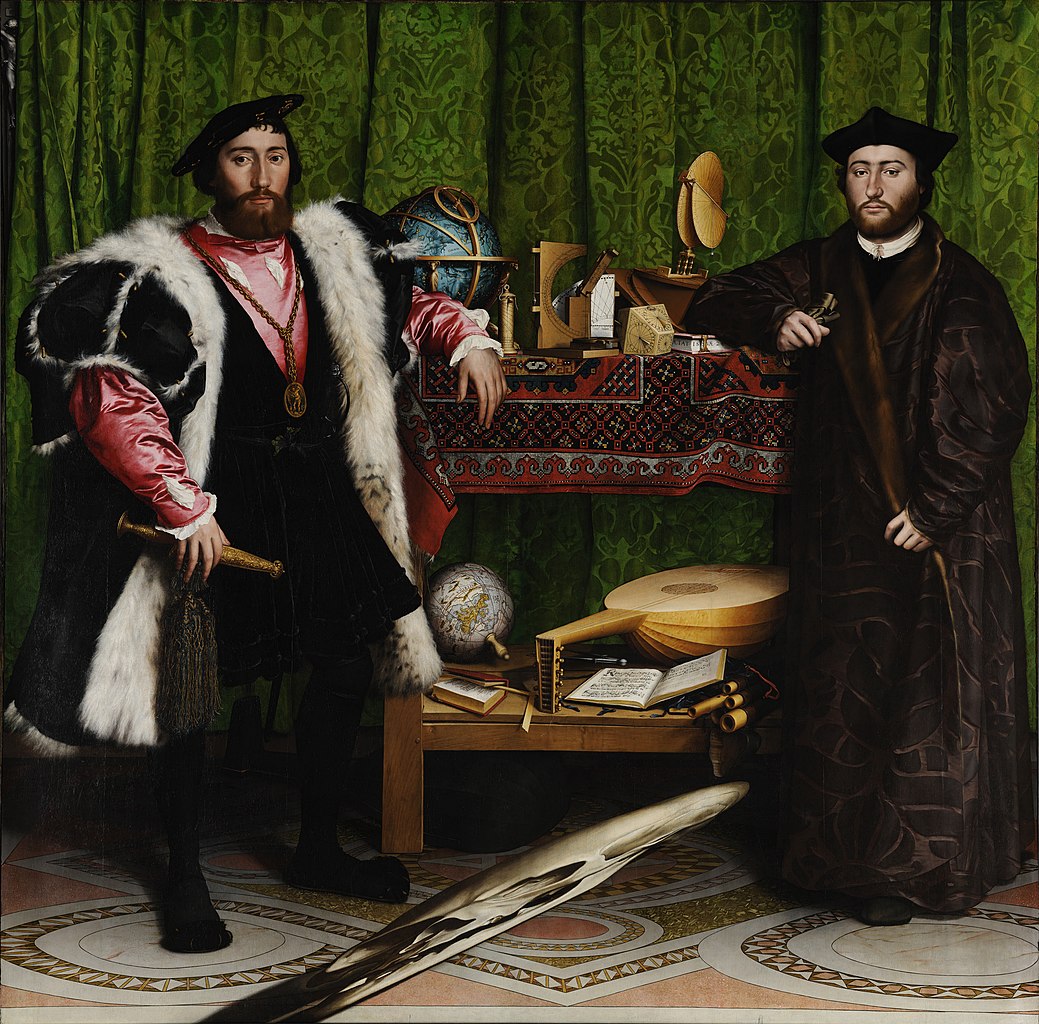
[…] diplomatic representation functions through simulation, for simulation is traditionally also the art of diplomacy. Simulation is an art, a technique that involves a secret and a challenge. The secret is that diplomacy does not exist. The challenge is to make diplomacy appear. In diplomatic representation, consequently, there is an ironic and fatal alliance, an inaugural quid pro quo between all the subjects involved […] The reality of these diplomatic representations is, therefore, self-referential. It is based on metaphysical rationality that produces its own closure. It involves the capacity to produce a metaphysical picture, to paint articulations, and to frame presences and absences. (p.21)
Modern ambassadors are trained to make present the unrepresentable and to see what cannot be seen. They are trained to get the picture and to get into the picture. That is why the ambassadors are enframed, worked in a similar way to those of "The Ambassadors [see below]." (p.22)
Ambassadors are part of and responsible for the diplomatic frame-up—the very construction and animation of the diplomatic world they live in. In and through their confident diplomatic representations, ambassadors normalize the frame-up as the framework. Working within this so-called normal framework they are claimed by their representations and so enter into a power relationship, a relationship of discursive and historical servitude. (Note that the word ambassador stems from the Latin word ambactus, meaning servant.) (p.22)
The primary role of this incredible service is to make credible representations. For diplomatic representation always involves an act of faith (in the picture). It needs to be accredited. Just as ambassadors are required to present their credentials before they can represent, diplomatic representation also needs to be credited itself with establishing a sovereign presence. (p.22)
Sloterdijk on the non-existence of 'Religions'
From You Must Change Your Life:
Religion, in this iteration, becomes fully relativistic and thus fully secularisable and is, therefore, a better diplomatic proposition (from my godless point of view) that the one Latour proposes as [rel].
European Enlightenment—a crisis of form? An experiment on a slippery slope, at any rate, and from a global perspective an anomaly. Sociologists of religion put it quite bluntly: people keep believing everywhere else, but in our society we have glorified disillusionment. Indeed, why should Europeans be the only ones on a metaphysical diet when the rest of the world continues to dine unperturbed at the richly decked tables of illusion?
[...] a return to religion is as impossible as a return of religion—for the simple reason that no 'religion' or 'religions' exist, only misunderstood spiritual regimens, whether these are practised in collectives—usually church, ordo, umma, sangha—or in customized forms—through interaction with the 'personal God' with whom the citizens of modernity are privately insured. Thus the tiresome distinction between 'true religion' and superstition loses its meaning. There are only regimens that are more and less capable and worthy of propagation. The false dichotomy of believers and unbelievers becomes obsolete and is replaced by the distinction between the practising and the untrained, or those who train differently. (p.3)In contrast to Latour's translative theology, Sloterdijk's concentration on "regimens that are more and less capable and worthy of propagation" refocuses attention entirely away from the past. Religious truth conditions become entirely presentist: is this regimen worthy or not? It doesn't matter, in and of itself, how many years hermeneuts have agonised over this or that crumb of biblical dogma. There is no prejudice against the nouveau riche of religiosity. If these stratified ponderings upon ponderings going back millennia have generated a rich, beautiful, jumbled jungle of immuno-psychic possibilities then great! However, that is merely the means to the end of the successful religious dispositif, not the end itself.
Religion, in this iteration, becomes fully relativistic and thus fully secularisable and is, therefore, a better diplomatic proposition (from my godless point of view) that the one Latour proposes as [rel].
Friday, 4 July 2014
Diplomas, diplomacy and theory – the folding and unfolding of objects
The diplo- in ‘diplo-macy’ derives from “the ancient Greek verb diploun (to double), and from the Greek noun diploma”[1]; “diplo = folded in two + suffix ma = object” [2; see also]. According to Costas Constantinou, ‘diplomas’ were documents “written on parchment and … papyrus [...] handed over to heralds [and] carried as evidence of their status and authority.” The word diploma later “came to mean a letter of recommendation,” a passport or “an order enabling a traveller to use the public post” [3].
It was only towards the end of the seventeenth century that 'diplomacy' began to attain the meaning we attribute to it today. In 1693, Gottfried Leibniz published his Codex Juris Gentium Diplomaticus, a collection of treaties and official documents which attributed “to the adjective diplomatic the meaning of something related to international relations” [4]. Other European powers followed suit in commissioning large archiving activities such as this; the diploma thus became organised and was a vital resource for statecraft.
However, it wasn't until 1796 that we find 'diplomacy' in its modern form in the writings of Edmund Burke who spoke of the ‘diplomatic body,’ and used “‘diplomacy’ to mean skill … in the conduct of international intercourse and negotiations” [5]. In seventeenth-century Italy, diplomatic agents had become known as “orators” and in most of Europe “ambassadors were still legati” [6].
While the basic elements of the practice of diplomacy may therefore be as old as human being, the word and concept are of quite recent genesis. It's informative to mention at this point the origin of 'theory':
The diplomat was once the bearer of the diploma, the emissary that the folded document confirmed. The issues which motivated his journey were borne otherwise; the purpose of the diploma was to authenticate the authority of the received utterances [the science dedicated to the authentication of official documents: 'diplomatics']. It was crucial to the mission but was not its cause.
The folded object remains central to 'cosmopolitical' diplomacy but takes on a different role to one of mere passport. The diploma now does not simply authenticate the diplomat's right to speak but forms precisely the foundation of the entire endeavour.
If the heart of diplomacy remains the diplo-ma – the folded object/document, the duplex entity – then what does this make the diplomat? The diplomat is not the folder of objects (its sovereign – its public – is that which has folded the object and dispatched the envoy). The diplomat is the unfolder of objects that cannot be unfolded by one party. It is as though the causal issues were a giant bed-sheet impossible to fold or unfold by one person alone. The cosmopolitical diplomat is a burdened traveller in search of unfolding that can only come with the meeting of an other.
The diplomat is the one who arrives bearing the folded object but, unlike a mere herald, messenger or legati, is greeted, is subject to elaborate ceremonial attachment to the receiving community and who becomes resident so as to work through the matters at hand – the matters present-at-hand, we might say (the essence of the diploma qua passport was its very unproblematic, indubitable readiness-to-hand).
The duplex character of the diplomatic matter indicates its issue-hood, its status as a matter of concern, of contestation, of disagreement, dissensus, discord. Diplomacy always begins in duplicity; if successful it ends not in unity but in settlement.
The diplomat of this procedure is a transformed character, a theôros – a philosopher, indeed!
------------
[1] Costas Constantinou, On the Way to Diplomacy, p.77.
[2] José Calvet de Magalhães, The Pure Concept of Diplomacy, p.58.
[3] Constantinou, On the Way to Diplomacy, p.77.
[4] Magalhães, The Pure Concept of Diplomacy, p.58.
[5] Ernest Mason Satow, A Guide to Diplomatic Practice, p.3.
[6] Garrett Mattingly, Renaissance Diplomacy, p.130.
[7] Roxanne L. Euben, Journeys to the Other Shore: Muslim and Western Travelers in Search of Knowledge, p.21.
It was only towards the end of the seventeenth century that 'diplomacy' began to attain the meaning we attribute to it today. In 1693, Gottfried Leibniz published his Codex Juris Gentium Diplomaticus, a collection of treaties and official documents which attributed “to the adjective diplomatic the meaning of something related to international relations” [4]. Other European powers followed suit in commissioning large archiving activities such as this; the diploma thus became organised and was a vital resource for statecraft.
However, it wasn't until 1796 that we find 'diplomacy' in its modern form in the writings of Edmund Burke who spoke of the ‘diplomatic body,’ and used “‘diplomacy’ to mean skill … in the conduct of international intercourse and negotiations” [5]. In seventeenth-century Italy, diplomatic agents had become known as “orators” and in most of Europe “ambassadors were still legati” [6].
While the basic elements of the practice of diplomacy may therefore be as old as human being, the word and concept are of quite recent genesis. It's informative to mention at this point the origin of 'theory':
… the Greek practice theôria [is] the etymological precursor to the English word theory. In George Rawlinson's translation of Herodotus, theôria is rendered only as "to see the world," yet theôros has multiple meanings, including a spectator, a state delegate to a festival in another city, and someone who travels to consult an oracle. Theôria is itself a compound of different etymological possibilities: the first half of the word suggests both vision (thea, meaning sight/spectacle) and God (theos), while -oros connotes "one who sees." Unsurprisingly, then, theôrein is the verb meaning "to observe" and is connected to sightseeing and religious emissaries. This etymology posits a link among theôria, travel, direct experience, and vision, but it is in Herodotus's Histories that such practices are tied specifically to the achievement of knowledge: in one of the earliest known uses of the word theôria in the ancient world, Herodotus describes Solon the Lawgiver's journey from Athens for (among other reasons) the sake of theôria and explicitly links theory and wisdom (sophia) to travel across vast terrain (1.30.2). Herodotus reiterates the association among theory, travel, and knowledge when he describes Anacharsis the Scythian (4.76.2) as one who "had traversed much of the world on a theôria and throughout this had given evidence of his great wisdom." [7]The practical precursor of diplomacy might have been theory (Constantinou makes this point extensively). We could call the 'diplomacy' articulated by Isabelle Stengers and Bruno Latour, therefore, a fittingly theoretical diplomacy. Wisdom, travel, religion and interpolitical relations are all tied up in this web of connections. However, diplomacy, as Stengers and Latour deploy the concept, is rather different to its historical precursors.
The diplomat was once the bearer of the diploma, the emissary that the folded document confirmed. The issues which motivated his journey were borne otherwise; the purpose of the diploma was to authenticate the authority of the received utterances [the science dedicated to the authentication of official documents: 'diplomatics']. It was crucial to the mission but was not its cause.
The folded object remains central to 'cosmopolitical' diplomacy but takes on a different role to one of mere passport. The diploma now does not simply authenticate the diplomat's right to speak but forms precisely the foundation of the entire endeavour.
If the heart of diplomacy remains the diplo-ma – the folded object/document, the duplex entity – then what does this make the diplomat? The diplomat is not the folder of objects (its sovereign – its public – is that which has folded the object and dispatched the envoy). The diplomat is the unfolder of objects that cannot be unfolded by one party. It is as though the causal issues were a giant bed-sheet impossible to fold or unfold by one person alone. The cosmopolitical diplomat is a burdened traveller in search of unfolding that can only come with the meeting of an other.
The diplomat is the one who arrives bearing the folded object but, unlike a mere herald, messenger or legati, is greeted, is subject to elaborate ceremonial attachment to the receiving community and who becomes resident so as to work through the matters at hand – the matters present-at-hand, we might say (the essence of the diploma qua passport was its very unproblematic, indubitable readiness-to-hand).
The duplex character of the diplomatic matter indicates its issue-hood, its status as a matter of concern, of contestation, of disagreement, dissensus, discord. Diplomacy always begins in duplicity; if successful it ends not in unity but in settlement.
The diplomat of this procedure is a transformed character, a theôros – a philosopher, indeed!
------------
[1] Costas Constantinou, On the Way to Diplomacy, p.77.
[2] José Calvet de Magalhães, The Pure Concept of Diplomacy, p.58.
[3] Constantinou, On the Way to Diplomacy, p.77.
[4] Magalhães, The Pure Concept of Diplomacy, p.58.
[5] Ernest Mason Satow, A Guide to Diplomatic Practice, p.3.
[6] Garrett Mattingly, Renaissance Diplomacy, p.130.
[7] Roxanne L. Euben, Journeys to the Other Shore: Muslim and Western Travelers in Search of Knowledge, p.21.
Monday, 30 June 2014
"Resetting Modernity" in Paris
I've just received a flurry of information for the forthcoming 'diplomatic summit' to be held as the conclusion of Bruno Latour's AIME project. It describes the event as (and I paraphrase rather than offering my own mangled translation of the French!) attempting to reflexively redefine the Moderns so that we might present ourselves to Gaia once more under the slogan (and this is given in English) "Reset Modernity." I couldn't help but be reminded of this:

'Designing out crime,' panopticism, etc. etc.
An interesting article today in the Guardian on 'designing out crime' by modifications made to the built environment through planning and design processes:
There's another article from last week about these same practices in Scandinavia. I don't know much about criminology but it'd be interesting to see how this fits in with Scandinavia's generally more progressive approach to crime and punishment. Is it possible to mobilise technical solutions to such problems without this effectively tarmacing over their political causes?
“You want the rooms most regularly inhabited to be in view of any potential criminals,” says Craig. “It’s what we call ‘natural surveillance’: we like ‘active frontages’ to overlook communal areas so that people are seen and can be seen. The more windows overlooking the street and public spaces, the better.” Enforcing clear boundaries is also important, making distinctions between public and private space with fences and hedges.
[...]
The crime figures for the area suggest good design has indeed deterred criminals: between 2011 and 2014, just five burglaries were reported in Greenheys, compared with 76 in the surrounding square kilometre. “The fact the estate looks nice helps a lot,” reckons Craig. “If it looks grim, people behave in an accordingly grim way. I think this development shows that compliance with our recommendations doesn’t stifle innovative design. It’s a challenge to planners and architects, sure, but if it’s done right, there’s still scope for imagination.”There's no doubt that bad urban design (and what mid-twentieth-century architecture in Britain wasn't abominable?) substantially contributes to a poor quality of life – including suffering crime; however, the problem with this is, of course, that it poses a technical fix to essentially political problems. Still, it's an interesting case of the sociology of translation in action.
There's another article from last week about these same practices in Scandinavia. I don't know much about criminology but it'd be interesting to see how this fits in with Scandinavia's generally more progressive approach to crime and punishment. Is it possible to mobilise technical solutions to such problems without this effectively tarmacing over their political causes?
Wednesday, 25 June 2014
On habits and habitats
There's another great write up on the AIME Group blog. This is my favourite bit from chapter 10 on 'Learning to Respect Appearances':
[hab] answers a problem that I've found with Latour's philosophy from the beginning: if everything at every moment is in a perpetual state of perishing and becoming something else (and if this process is essentially discontinuous at each moment) then isn't our everyday experience an illusion? Apparently not; we mostly experience through habit for the most part. If the world seems to flow together smoothly and continuously then this is because, when habitated, this is exactly how it is.
This links nicely with Latour's reading of Sloterdijk's spherology. If spheres seem too smooth and continuous to be incorporated into the ontology of networks then we need only consider that such habitats benefit from regimes of habit. We cannot live in broken, bitty, fractured networks; we can only live in envelopes, blankets and containers that permit implicitation—that allow elements of our environment to be taken for granted (even if they are not God- or Nature-given). Habit permits the connection of these two ontologies: the network and the sphere.
Without habit, we would never have dealings with essences, but always with discontinuities. The world would be unbearable. It is as if habit produced what stays in place on the basis of what does not stay in place. As if it managed to extract Parmenides’s world on the basis of Heraclitus’s. We can say of habit that in effect it makes the world habitable, that is, susceptible to an ethos, to an ethology. (268)Without habits we cannot become habitated, we cannot have habitats (Latin habitare "to live, dwell," frequentative of habere "to have, to hold, possess"). Habits are therefore things to be celebrated, with the proviso that there are good and bad habits, habits that forget being-as-other and those that retain a connection with it.
[hab] answers a problem that I've found with Latour's philosophy from the beginning: if everything at every moment is in a perpetual state of perishing and becoming something else (and if this process is essentially discontinuous at each moment) then isn't our everyday experience an illusion? Apparently not; we mostly experience through habit for the most part. If the world seems to flow together smoothly and continuously then this is because, when habitated, this is exactly how it is.
This links nicely with Latour's reading of Sloterdijk's spherology. If spheres seem too smooth and continuous to be incorporated into the ontology of networks then we need only consider that such habitats benefit from regimes of habit. We cannot live in broken, bitty, fractured networks; we can only live in envelopes, blankets and containers that permit implicitation—that allow elements of our environment to be taken for granted (even if they are not God- or Nature-given). Habit permits the connection of these two ontologies: the network and the sphere.
Sunday, 22 June 2014
More on Clive Hamilton on optimism
Reading the pieces mentioned in my last post reminded me that I've had Clive Hamilton's Earthmasters on my bookshelf for a few weeks now. Finally getting around to read it this weekend I've found it to be an outstanding introduction to the issue of geoengineering. I'm about half way through and just getting into the discussion of how these technologies intersect with geopolitics. Anyway, I particularly enjoyed this section on the follies of optimism as an end in itself:
Some people derive a peculiar sort of pleasure in describing themselves as an 'optimist.' It's a kind of one-upmanship used to shut down those arguing that the evidence shows the future is not rosy. 'Whatever you might say, I am an optimist,' they declare, implying that their interlocutor is somehow not bold enough to take on the challenge. It's not so much passive aggression as sunny aggression firmly rooted in the moral superiority of cheerfulness [...] (104-105)
Friday, 20 June 2014
Clive Hamilton on the 'new environmentalists' and the 'good Anthropocene'; the rough edges of political aesthetics
An important article by Clive Hamilton on the 'new environmentalists' and the so-called 'good Anthropocene':
In another article on the same themes posted only a few days ago Hamilton writes:
I must say that excessive optimism is not a condition not something that we Brits are overburdened with in general.
However, that does not mean that we are not similarly insensitive. Most of us would sooner starve half the world than give up our cars or our South African asparagus (though we would never admit this, least of all to ourselves).
I don't suppose that any of the 'eco-pragmatists' would agree with a word of what I am polemically attributing to them; however, this really does seem to be the unavoidable conclusion of their line of thinking -- how else will they sustain their fantasy if not by exporting disconfirmatory externalities into the bodies and atmospheres of others?
The incapacity to cognise discomforting information as anything other than a falsehood (false because it is discomforting) leads inexorably to chronic insensitivity.
If we're not afraid then we really haven't been paying attention.
Political aesthetics must have rough edges.
[...] almost as soon as the idea of the Anthropocene took hold, people began revising its meaning and distorting its implications. A new breed of ecopragmatists welcomed the new epoch as an opportunity. They gathered around the Breakthrough Institute, a “neogreen” think tank founded by Michael Shellenberger and Ted Nordhaus, the authors of a controversial 2004 paper, “The Death of Environmentalism.” They do not deny global warming; instead they skate over the top of it, insisting that whatever limits and tipping points the Earth system might throw up, human technology and ingenuity will transcend them.
As carbon dioxide concentrations pass 400 ppm for the first time in a million years, and scientists warn of a United States baking in furnace-like summers by the 2070s, Shellenberger and Nordhaus write that by the end of the century “nearly all of us will be prosperous enough to live healthy, free, and creative lives.” The answer, they say, is not to change course but to more tightly “embrace human power, technology, and the larger process of modernization.”
The argument absolves us all of the need to change our ways, which is music to the ears of political conservatives. The Anthropocene is system-compatible.
[...]
In the words of the most vocal eco-pragmatist, the environmental scientist Erle Ellis, “We will be proud of the planet we create.” Ellis speaks of “the good Anthropocene,” a golden era in which we relinquish nostalgic attachments to a nature untouched by humans and embrace the new epoch as “ripe with human-directed opportunity.”By the final quoted paragraph in particular I am reminded of Nigel Clark's thesis in Inhuman Nature (and other writings) where he holds constructivism (particularly of the Latourian variety) as being effectively complicit with the over-statement of human agency in the face of overwhelmingly inhuman forces. I don't agree with parts of his analysis; however, the above clearly demonstrates his wider and more important point: that we must reckon with our finitude -- and fast.
In another article on the same themes posted only a few days ago Hamilton writes:
In the end, grasping at delusions like “the good Anthropocene” is a failure of courage, courage to face the facts. The power of positive thinking can’t turn malignant tumours into benign growths, and it can’t turn planetary overreach into endless lifestyle improvements. Declaring oneself to be an optimist is often used as a means of gaining the moral upper hand: “Things may look bad but, O ye of little faith, be bold and cheerful like me.”There is a point at which optimism starts to become pathological; I think this the point where it is taken to be an end in itself. In a society with a fully-developed pathology one can win an argument simply by being optimistic; one can, with a snide chuckle, merely brush off inconvenient questions simply because they are uncomfortable. One's cognitive comfort (and that of the well-heeled choir to which one preaches) comes first and prevails over and above all dissuasive shrieks and cries. Those who suffer must not only suffer but also do so quietly.
I must say that excessive optimism is not a condition not something that we Brits are overburdened with in general.
However, that does not mean that we are not similarly insensitive. Most of us would sooner starve half the world than give up our cars or our South African asparagus (though we would never admit this, least of all to ourselves).
I don't suppose that any of the 'eco-pragmatists' would agree with a word of what I am polemically attributing to them; however, this really does seem to be the unavoidable conclusion of their line of thinking -- how else will they sustain their fantasy if not by exporting disconfirmatory externalities into the bodies and atmospheres of others?
The incapacity to cognise discomforting information as anything other than a falsehood (false because it is discomforting) leads inexorably to chronic insensitivity.
If we're not afraid then we really haven't been paying attention.
Political aesthetics must have rough edges.
Subscribe to:
Posts (Atom)