I've fallen rather behind on these "monthly" updates over the past few months. Consequently, I will try to write a few posts in the next few weeks to catch up (before I come to the end of the first year of my PhD).
There are several reasons for this un-prolific spell. Principally, the writing of my first chapter has turned out to be a rather more mountainous endeavour than I had anticipated.
As last I wrote, I was in the process of collating and condensing my notes, annotations, plans and ideas in anticipation of putting pen to paper (so to speak). What I had underestimated – in a good way, really – is just how much material I had amassed over recent months. The sheer scale of information is difficult to either organise or cognise. However, going back over everything also revealed to me, or reminded me of, various things that I should have also read and digested! The weaving strands continue to extend and spiral ever outwards.
With all that, it also became quite apparent that the < 20,000 word aim for this chapter was hopelessly lowballing it. I really have no idea, at this point, how long it will end up being. Fortunately, however, this shouldn't be a major issue for the thesis. I have my starting point, I know how the narrative develops, I may simply not get as far as I had originally intended (before either running out of time or, more likely, hitting the word limit).
The basic purpose of the thesis remains more or less the same as it has been in the past: to narrate the genesis of "environment" (and its cognates) as an aesthetic, scientific, philosophical and political concept (or, rather, set of concepts), starting in the late 18th century. This, I hasten to add, is in no way the earliest point at which such a narrative could begin. On the contrary, it is rather the latest point, I think, at which this narrative, as I wish to write it, can begin.
And so, the original plan to bring things right up to the present may be unrealistic (at least for the thesis, hopefully not in the long-term). However, I am really pleased with how it is all coming together. The plot is unsummarisable but the threads do, in the end, mesh together.
Showing posts with label PhD diary. Show all posts
Showing posts with label PhD diary. Show all posts
Tuesday, 6 September 2016
Thursday, 14 July 2016
PhD diary #9: 14/07/2016
I've struggled to find something to write about this month. So, I suppose that I will just say a little bit about what I'm working on at the moment and how I'm going about organising my work (possibly a bit boring but may be of some use to someone!).
My current thesis plan consists of six chapters and my schedule, deriving therefrom, is divided into three-month blocks. In each block I am dividing my time roughly equally between reading and thinking about the thesis as a whole and working, in a more concentrated fashion, on one chapter in particular. At the end of each quarter, I should have a first draft of that chapter and, over subsequent three-month periods, I will return to already written chapters as I develop a better grasp on how the thesis holds together as a whole.
I'm just coming to the end of the first of these periods (May to July). Consequently, I'm about to start writing my first chapter (besides the introduction). This chapter, as I've written about here recently, uses the life and works of Alexander Humboldt (1769-1859) as a focal point for understanding the development of geological and, to speak anachronistically, ecological sciences in the early 19th century while, at the same time, serving as a point of contrast with the much longer history of climatic and geographical knowledges (e.g. the importance of air, water and location in Hippocratic medicine) as these were being reproduced or replaced around this time.
I will end up talking about Humboldt's "cosmic geopolitics" – the cosmopolitan vision of development, progress and both natural and anthropological unity that his synthesis of enlightenment and romantic values achieved, particularly in his great work Cosmos. This will then give me a way into the second chapter, which will pick up on the consequences of Darwin's Origin of Species (published a few months after Humboldt's death), Herbert Spencer's sociological and psychological appropriation and popularisation of "environment" as a term of art and, finally, the development of what is understood in the context of the history of geography as "geopolitical" thinking towards the end of the century.
I have a pretty good idea of how these things fit together in broad strokes. However, arranging the details and then getting the words flowing is much trickier! I probably won't meet my self-imposed deadline of the end of the month for this first draft. Nevertheless, it should materialise in some form over the next few weeks.


Monday, 6 June 2016
PhD diary #8: 06/06/2016
Alexander von Humboldt's Cosmos – a book more often cited than read (aren't they all?). Over the past couple of weeks I've managed to plough through all 1100 pages of the three volumes (to be precise, the English translation, of which the first two volumes were published in 1848 and the third, posthumously and incomplete, in 1859).
The scientist (and 25th Prime Minister of France) François Arago once remarked,
Nevertheless, while Humboldt's science was already somewhat eccentric by 1850 and although his politics were, at best, naive, his is an impressive bundle of intellectual energy to spend some time with.
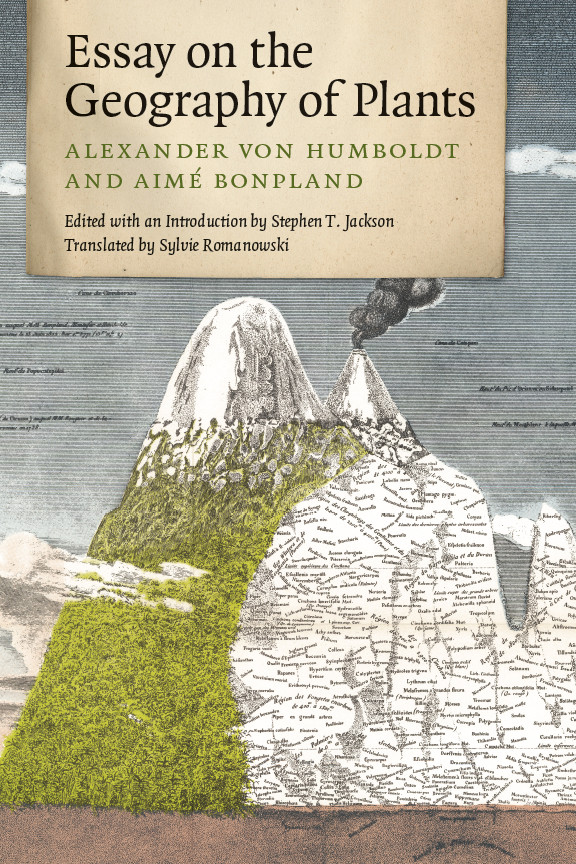
Next up is his Essay on the Geography of Plants from 1807. This was the first major publication following his famous voyage from 1899 to 1804 (and, as such, although it was written by Humboldt, it is co-credited to his travelling partner, the botanist Aimé Bonpland).
It's interesting to look at this early text after Cosmos, which was the magnum opus supposed to cap off his career. There are substantial continuities between the two; indeed, much of the grand, synthetic vision of a universal cosmography was apparent to Humboldt by the early 1790s. Nevertheless, some of the (from a contemporary point of view) stranger geological ideas are more pronounced in the earlier work.
Humboldt went to his grave just a few months before Darwin's The Origin of Species was published and he never quite accepted (due to, in his view, insufficient evidence) the extent of earthly deep time necessary to make sense of the thesis of natural selection. His was an old earth but not to the extent that ours is, post-Darwin. On the question of whether the Earth had a history (in the sense of experiencing many eras of gradual or sudden transformation or remaining more or less in its current processual state from the beginning), in 1807 at least, the burden of proof was very much on the historicists. Likewise, his journey dissuaded him from the Neptunism of his former teacher Abraham Gottlob Werner but he was tentative in abandoning its hypotheses.
I have the next four weeks or so to continue delving into Humboldt's works (and still other works on them). There is no hope whatsoever for any kind of completism; however, that should not be necessary. I am essentially interested in Humboldt as a figure who, in a sense, typifies the naturalism of one era while, at the same time, setting up another. The kind of "cosmic geopolitics" that emerge in his final major work is, I think, a very interesting way into the history of ideas and transformations that my thesis chapters 2 to 6 will explore.
The scientist (and 25th Prime Minister of France) François Arago once remarked,
"Humboldt, you really don't know how to write a book. You write endlessly, but what comes out of it is not a book, but a portrait without a frame."He was not wrong. To read Humboldt's work is to face down a deluge of information, poured out as if uncontrollably. The several hundred pages of the first volume roll on and on without so much as a section break.
 |
| Astronomical illustration from the atlas accompanying the German version of Kosmos |
Nevertheless, while Humboldt's science was already somewhat eccentric by 1850 and although his politics were, at best, naive, his is an impressive bundle of intellectual energy to spend some time with.
Next up is his Essay on the Geography of Plants from 1807. This was the first major publication following his famous voyage from 1899 to 1804 (and, as such, although it was written by Humboldt, it is co-credited to his travelling partner, the botanist Aimé Bonpland).
It's interesting to look at this early text after Cosmos, which was the magnum opus supposed to cap off his career. There are substantial continuities between the two; indeed, much of the grand, synthetic vision of a universal cosmography was apparent to Humboldt by the early 1790s. Nevertheless, some of the (from a contemporary point of view) stranger geological ideas are more pronounced in the earlier work.
Humboldt went to his grave just a few months before Darwin's The Origin of Species was published and he never quite accepted (due to, in his view, insufficient evidence) the extent of earthly deep time necessary to make sense of the thesis of natural selection. His was an old earth but not to the extent that ours is, post-Darwin. On the question of whether the Earth had a history (in the sense of experiencing many eras of gradual or sudden transformation or remaining more or less in its current processual state from the beginning), in 1807 at least, the burden of proof was very much on the historicists. Likewise, his journey dissuaded him from the Neptunism of his former teacher Abraham Gottlob Werner but he was tentative in abandoning its hypotheses.
I have the next four weeks or so to continue delving into Humboldt's works (and still other works on them). There is no hope whatsoever for any kind of completism; however, that should not be necessary. I am essentially interested in Humboldt as a figure who, in a sense, typifies the naturalism of one era while, at the same time, setting up another. The kind of "cosmic geopolitics" that emerge in his final major work is, I think, a very interesting way into the history of ideas and transformations that my thesis chapters 2 to 6 will explore.
Sunday, 1 May 2016
PhD diary #7: 01/05/2016 – On stupidity
Among the questions commonly asked of PhD candidates concerning their research, there are two that I think are closely related: the "so what?" question and the "what are your normative commitments?" question. The first asks for some justification, by unspecified criteria, as to the project's general worth and validity. The second might be attempting to elicit some sort of political or tribal affiliation – as is an academic's wont; or, it might be asking largely the same thing as the first question but slightly more specifically: what are the political or moral commitments that make this a worthy, valid project to be undertaking?
With a project as broad, abstract, philosophical and, therefore, as "academic" as the one that I am working on, these questions can be tricky – not least because these are the sorts of questions that keep PhD students up at night, quite apart from any summary, collegial interrogation! Particularly, working in the field of International Relations, there is often an implicit sense that the intellectual validity of your work is directly proportional to the directness with which it is concerned with grotesque amounts of horrendous violence and death – actual or possible.
Of course, I have many normative and political commitments, some of which might even be relevant to this specific instance. Likewise, there are many ways in which I think that I could respond to the "so what?" question with regard to this or that nugget of academic debate. However, the stronger answer that I am inclined to give, even if this might be seen to indulge in a certain intellectualism, is to say: what I am against, what I am resisting, what I am seeking to undo, displace or contradict is, most fundamentally, stupidity.
Now, of course, that is the kind of word that requires immediate qualification.
In Isabelle Stengers' recent (or, rather, recently translated) book In Catastrophic Times (2015, Andrew Goffey trans. [Au temps des catastrophes, 2009]), she describes stupidity [bêtise] as follows:
For my purposes, stupidity is not so much inadequacy of understanding or inability to respond intelligently to a problem as an inability to recognise such inadequacy as inadequacy and, therefore, a wilful, active inability to recognise this thing as a "problem" at all.
It is in this sense a second order inability. The proper response to stupidity is neither problematisation as an end in itself nor an attempt to fix or solve the problem once and for all. Rather, it is to attempt to respond better, by some metric relevant to the immediate situation. General metrics can only lead to further and deeper stupidity.
A failure to think where thinking is necessary. (Of course, everything rests on this "necessary.")
In whichever way you cut it, there is a great deal of stupidity with regard to how we think (or do not think) about issues of environment and geopolitics, today. Both the purposes and the commitments of the project therefore derive from a determination to, in however minor a fashion, ease the pressures imposed by the stupidity of the moment.
With a project as broad, abstract, philosophical and, therefore, as "academic" as the one that I am working on, these questions can be tricky – not least because these are the sorts of questions that keep PhD students up at night, quite apart from any summary, collegial interrogation! Particularly, working in the field of International Relations, there is often an implicit sense that the intellectual validity of your work is directly proportional to the directness with which it is concerned with grotesque amounts of horrendous violence and death – actual or possible.
Of course, I have many normative and political commitments, some of which might even be relevant to this specific instance. Likewise, there are many ways in which I think that I could respond to the "so what?" question with regard to this or that nugget of academic debate. However, the stronger answer that I am inclined to give, even if this might be seen to indulge in a certain intellectualism, is to say: what I am against, what I am resisting, what I am seeking to undo, displace or contradict is, most fundamentally, stupidity.
Now, of course, that is the kind of word that requires immediate qualification.
In Isabelle Stengers' recent (or, rather, recently translated) book In Catastrophic Times (2015, Andrew Goffey trans. [Au temps des catastrophes, 2009]), she describes stupidity [bêtise] as follows:
"Stupidity does not here refer to stupor, to paralysis, or to impotence. Stupidity is active, it feeds on its effects, on the manner in which it dismembers a concrete situation, in which it destroys the capacity for thinking and imagining of those who envisaged ways of doing things differently, leaving them stunned, a stupid and nasty argument may well leave you stunned with the mute perplexity of a “he may be right but all the same,” or enraged, which confirms it in turn: you see, with these kinds of people, there’s always violence."The concept has a particular meaning in the context of her overall argument, which particularly concerns how to deal with (or not) the "guardians" that take it upon themselves to govern us. My meaning is slightly different, although perhaps adjacent.
For my purposes, stupidity is not so much inadequacy of understanding or inability to respond intelligently to a problem as an inability to recognise such inadequacy as inadequacy and, therefore, a wilful, active inability to recognise this thing as a "problem" at all.
It is in this sense a second order inability. The proper response to stupidity is neither problematisation as an end in itself nor an attempt to fix or solve the problem once and for all. Rather, it is to attempt to respond better, by some metric relevant to the immediate situation. General metrics can only lead to further and deeper stupidity.
A failure to think where thinking is necessary. (Of course, everything rests on this "necessary.")
In whichever way you cut it, there is a great deal of stupidity with regard to how we think (or do not think) about issues of environment and geopolitics, today. Both the purposes and the commitments of the project therefore derive from a determination to, in however minor a fashion, ease the pressures imposed by the stupidity of the moment.
Thursday, 31 March 2016
PhD diary #6: 31/03/2016
Six months through. Depending on how you look at it, that's 1/8 of the time until the thesis has to be submitted, 1/6 of the time until my funding runs out, 1/5 of the time until I plan to submit, and 1/4 of the time until I plan to have a first draft written. "Plan," then, being the operative word. (Saying it out loud makes it more real.)
In the past month, I've mostly been thinking about the sixth and final chapter – that is, where I need to end up, both narratively and in terms of work schedule. The rise of Earth system science, complexity and resilience over the past fifty years or so and the modes of geopolitics and geogovernance that have co-developed over this period. Right now, I feel that I am in the middle of two grand narratives, both of which I find be increasingly incomplete and unsatisfactory.
First, the coming to fruition of something like reflexive modernity or the risk society. This grand narrative has been strongly challenged from an historical point of view, as I've discussed recently. Second, the narrative produced by (mostly) Foucauldian critiques of resilience and complexity ontology. To put it rather simplistically: this ontology, we are led to believe, bears some essential relation (and therefore complicity) with neoliberalism (because networks).
Where both these narratives fall down is in their historical simplicity. However, there is a point that derives from both, albeit not quite in the same spirit that I am taking it, which I think is valuable. There has been a presumption for some time that overcoming the "bifurcation of nature" is the foremost conceptual challenge of the present. I accept that to a large degree. However, this is only one challenge among others.
Critics of the first narrative point out that various sorts of "environmental reflexivity" have existed in the past and have been suppressed. Promoters of the second narrative point out that non-dualistic ontological presumptions (or at least those that style themselves as such) are evident throughout all sorts of deeply questionable contemporary geogovernmental practices. These promoters, in turn, tend to ignore the monistic ontologies that have been powerful and prominent in the past.
And so, there is clearly an important dialogue to be had here. One that is interested in the relevant novelty of the present but is not obsessed by it. One that is interested in the relevant conceptual questions but can see beyond them. It is a difficult net of nettles to grasp but I think that I am on the right track, so far.
Monday, 29 February 2016
PhD diary #5: 29/02/2016
Coming into this PhD project five months ago, I had a clear (albeit speculative and provisional) plan for what I wanted to do. I had it worked out down to a chapter structure:
1. Earth and Cosmos
2. Geopolitics and Environment
3. Spherology and Fortification
4. Diplomacy and Territory
5. Possibilism and Possession
6. Geohistory and Geodesy
The basic idea was to have each chapter concentrate on a particular group of concepts and then the flow of the thesis as a whole would work these things through historically, reaching a synthesis by the conclusion.
It is perhaps most telling that I found it easier to work out this structure than to write a title. The interconnections between these concepts and their historical trajectories remains what interests me. However, I have had to – and this was entirely expected from the beginning – set aside or background one or two ideas and rejig the rest, while at the same time identifying a particular and singular common thread and purpose running through the whole apparatus. (I finally managed this, I think, about six weeks ago.)
Abandoning, then, the idea that I would structure the chapters around concepts, I have instead decided to configure them in an historical sequence such that each chapter approximately follows from the previous, while each also has a focal point that develops the ideas crucial to the overall argument. It looks something like this:
Introduction: Traces (1610/1964)
Chapter 1: Cosmos (1798-1859)
Chapter 2: Life (1855-1911)
Chapter 3: Travel (1874-1942)
Chapter 4: War (1915-1956)
Chapter 5: Revolution (1956-1984)
Chapter 6: Earth (1957-2018)
Conclusion: Epochs (12,700 BP)
The title: An Historical Ontology of Environmental Geopolitics. It is, then, a history of the relationship between conceptions of environment and of geopolitics, not only tracing these words and ideas in their genealogical specificity but, at the same time, situating them in relation to various sorts of crucial world events – geopolitical, geological, scientific, technological, and so on. The key concept tying this together is that of ontology as the distribution of agencies.
By understanding these intellectual historical changes, on an abstract level, in terms of variable distributions of agency unfolding over time, I think that it will be possible to better understand certain political and philosophical questions (raised by issues such as the concept of the Anthropocene) without either underestimating their novelty or obsessing over it. In other words, it is a matter of better understanding the past in order to better think the present – this present, I would suggest, being rather maltreated in this respect of late.
Friday, 29 January 2016
PhD diary #4: 29/01/2016
"An Historical Ontology of Environmental Geopolitics." This is the title that I seem to have settled on. By "ontology" I mean "distribution of agencies." So, in contrast to Michel Foucault or Ian Hacking, who have employed the same phrase in the sense of "an historical ontology of ourselves," I mean to understand this not so much in the sense of subject-making as in that of world-making, in a thoroughly "material" way (this term will also require some explication).
In adopting this sort of historical project, I am unavoidably drawn to the concept of "conditions of possibility." However, I think that it is entirely possible to put clear blue water between this and any Kantian transcendentalism. But also from any unreformed materialism. Material, as I'm using it here, is taken to signify that which is a substantial precondition of some process, practice or procedure. It is therefore a relative term – more a sociological concept than a metaphysical one. Clay is material to a brick-maker; bricks are material to a brick-layer.
The crucial concept, philosophically, here for me is what Alfred North Whitehead calls a "cosmic epoch." In Process and Reality (1929), he writes:
As Richard Grove has written in his Green Imperialism (1995), the colonial appropriation of small tropical islands and the co-emergent proliferation of botanical gardens, populated with the produce of these same trade routes, were crucial to the development of ecological thinking in Europe.
Somewhere in all these connections, I am in the process of drawing out a thesis.
In adopting this sort of historical project, I am unavoidably drawn to the concept of "conditions of possibility." However, I think that it is entirely possible to put clear blue water between this and any Kantian transcendentalism. But also from any unreformed materialism. Material, as I'm using it here, is taken to signify that which is a substantial precondition of some process, practice or procedure. It is therefore a relative term – more a sociological concept than a metaphysical one. Clay is material to a brick-maker; bricks are material to a brick-layer.
The crucial concept, philosophically, here for me is what Alfred North Whitehead calls a "cosmic epoch." In Process and Reality (1929), he writes:
"Evidently new propositions come into being with the creative advance of the world. For every proposition involves its logical subjects; and it cannot be the proposition which it is, unless those logical subjects are the actual entities which they are. Thus no actual entity can feel a proposition, if its actual world does not include the logical subjects of that proposition. The proposition 'Caesar crossed the Rubicon' could not be felt by Hannibal In any occasion of his existence on earth. Hannibal could feel propositions with certain analogies to this proposition, but not this proposition." (259)The notions of proposition and epoch are explicated here in terms of language. However, precisely the same conceptual apparatus is applicable to electrons and neutrons, the experience of colour, and so on. We might recall the unfortunate fate of the dodo bird in these terms. Nothing in the cosmic epoch of the dodo prepared it for the invasive Europeans and their predatory pets. Nothing in what these entities proposed could make the dodo "feel" the response "flee!"
As Richard Grove has written in his Green Imperialism (1995), the colonial appropriation of small tropical islands and the co-emergent proliferation of botanical gardens, populated with the produce of these same trade routes, were crucial to the development of ecological thinking in Europe.
Somewhere in all these connections, I am in the process of drawing out a thesis.
Sunday, 27 December 2015
PhD diary #3: 27/12/2015
If I've learned anything in the last month, it is this: respect your wrists. I've had problems with RSI and carpal tunnel syndrome before, but it's never gotten bad enough that I couldn't work or function. I am on the mend but dictation software is a necessity for the foreseeable future! So far, so irritating. But it works well enough to get by.
I am currently about halfway through the 700 pages of Clarence Glacken's Traces on the Rhodian Shore. It's a book that I've been meaning to read for a long time. It's regarded as something of a classic in the history of geographical ideas. And rightly so, it turns out. It's an absolute masterpiece and will, I think, form a large part of the basis of my Ph.D. thesis.

Glacken ends his narrative around the year 1800, about the time I intend to take up mine.
I am currently about halfway through the 700 pages of Clarence Glacken's Traces on the Rhodian Shore. It's a book that I've been meaning to read for a long time. It's regarded as something of a classic in the history of geographical ideas. And rightly so, it turns out. It's an absolute masterpiece and will, I think, form a large part of the basis of my Ph.D. thesis.
Glacken ends his narrative around the year 1800, about the time I intend to take up mine.
Two men, Herder and Humboldt, it seems to me, are representatives of ideas held toward the earth as a whole in the late eighteenth and early nineteenth centuries. Herder represents […] the best in the old that was now to vanish, with hints of the new. Humboldt represents an approach to nature study which leads into nineteenth-century thought. (537)I think that I'm quite close to being able to specify precisely what my project now involves. I'm not quite brave enough to lay this out right now, however I feel that I'm getting there.
Tuesday, 24 November 2015
PhD diary #2: 24/11/2015
It may be a banal and nominalistic thing to write but until 1827 no one lived in an 'environment.' Even then, when the Scottish writer Thomas Carlyle coined the term in order to translate Goethe's use of the German Umgebung, this word did not quite chime with present understandings.
How did environment come to have the meaning it has today, what were its precursors and parallels and what was the significance of these changes for political, and particularly geopolitical, thought? These are things that I have been thinking about over the past few weeks. I've yet to reach an agreeable statement of a research question but I feel that I am getting there.
Philosophically, I am beginning to settle on the term 'speculative pragmatism' to describe the position that I wish to articulate. Historiographically, I am caught between 'historical ontology,' which has a previous life particularly in the works of Michel Foucault and Ian Hacking, and 'historical metaphysics,' which, to paraphrase Nietzsche, having less history is therefore more apt to be redefined. Of course, 'metaphysics' is likely to set even more eyes rolling, among the philosophically unpredisposed, than 'ontology.' But, then again, perhaps that's not altogether a bad thing.
Certainly, historical metaphysics seems as peculiar a combination of words as speculative pragmatism. A contradiction in terms? I'd prefer a contrast in terms. A tension not 'as yet unresolved' but rather maintaining a provocative interstice.
Wednesday, 21 October 2015
PhD diary #1: 21/10/2015
Officially, it is one month to the day since I began my PhD studies at Aberystwyth University. A lot has happened in these past few weeks – miles travelled, people met, words written. Far too many things to recount (and to do so would be rather tedious for those who have not experienced them).
I owe the idea for this post (and the few dozen that will follow it) to a presentation I heard at the Millennium conference in London last weekend by Erzsebet Strausz of Warwick University (formerly also of Aberystwyth). Reading out excerpts from her own thesis, she reflected on the process of writing and related it to the panel's theme: in a word, Foucault.
I missed Erzsebet's talk at the EISA conference in Sicily a few weeks ago but I did go to a couple of sessions organised by new friends and co-students here at Aber on research methods. Not nearly as dry as it might sound, we talked at length about creative writing, reflexivity and the importance of laying the workings of the research process bare – in other words, incorporating the messiness of research into the finished product rather than stripping it all out and polishing it all away (see John Law for more details). Megan Daigle (of Aber until a couple of years ago) talked about how she wrote up her fieldwork in Cuba more or less chronologically, structuring it around a narrative of her own journey. We also complained, as any people with a shared vocation do when they get in a room together, about the strictures and rigmaroles of university research training – and of the university in general. (That can all stay in the room.)
I don't think that I have Erzsebet's talent for self-reflection, nor does my less travel-oriented project really lend itself to Megan's approach to writing. Nevertheless, sitting in that stuffy room, on that uncomfortable chair at the LSE, I was brought to ponder: What is a preface for? To set up what needs setting up, to preempt what needs preempting, to give thanks to whoever or whatever needs to be given it. Although it always sits at the very front of a work (in older books it might even be before the contents page), it is usually the very last thing to be written. But why not, I thought, write this often rather perfunctory document as I go? Why not allow this usually withered and forgotten organ to become something more interesting?
And so, and I do not mean to give this great fanfare as I'm sure that someone else has done it before, I decided to write the preface to my thesis as a series of monthly diary entries, the overall number to be determined simply by when I finish the damned thing.
There is, of course, quite a risk in committing to this this! I feel somehow exposed even writing these words. Do I really want to commit right now to the words (these very words!) that will open my PhD thesis in three years time? It goes against every instinct towards perfectionism that I have (and I have a few). And yet that is precisely the reason why I should finish this post, click 'Publish' and send it out into the world (or onto the screens of my, shall we say, select readership, at least). If I am this pretentious at this point, I am unlikely to be less so after 36 months of breathing inside an academic bubble. So, why not?
It seems fitting given that I had been pouring thousands of words after thousands of words on this blog for several years before ever setting foot on the west coast of Wales. If anything prefaces the academic work that I have now thrown myself into, it is this.
I don't have much to say about the progression of the thesis so far other than what was obvious all along. My initial plan was acknowledgedly over-ambitious and I plainly need to peel away large slabs of it until I arrive at something more direct and manageable. My supervisors, if they are reading this, may be relieved to hear such sense being spoken. How they are feeling about my somewhat impulsive decision to write (and, more to the point, to commit to) the first few hundred words of my text so far ahead of time, I do not know.
But that, I am sure, will be fine. The real challenge will be to avoid the fate of almost every diary that anyone has ever started to write: fatigue, disinterest and abandonment.
We shall see, we shall see…
Subscribe to:
Posts (Atom)