Showing posts with label William James. Show all posts

Tuesday, 14 February 2017

Isabelle Stengers on becoming a philosopher with Deleuze and Whitehead

Further to my last post on why I wouldn't feel comfortable calling myself a philosopher, Isabelle Stengers' recent essay in Roland Faber and Andrew Goffey's The Allure of Things is very interesting. She writes:
"I learned that I would become a philosopher when reading Deleuze and I experienced that philosophy is worth existing only if it accepts the risk of existing in the teeth of other practices, producing its own demanding concerns without needing to weaken theirs." (p.195)
That is more or less exactly my frustration with so many excessively pious and all-encompassing readings of 'geophilosophy.' She adds:
"If I learned what it feels to become a philosopher with Deleuze, it is with Whitehead that I learned what it means to answer this challenge by practicing philosophy as an openly speculative adventure."(p.196)
I must admit that I continue to feel un-carried away by Deleuze. The aspects of his thought I find compelling are those I find in either Stengers or Latour after him or James or Whitehead before (and with less intellectual indigestion). It may well be my failing.

Sunday, 31 May 2015

William James on the conciliation of religion and science; also, mathematics and pragmatism

I'm presently reading William James' Varieties of Religious Experience. Like much of James' writing, some of it can be rather pedestrian and ponderous but then certain sections jump out like great glowing epiphanies. I like this section from the end of lecture 5 on "The religion of healthy-mindedness" in particular:
The experiences which we have been studying during this hour (and a great many other kinds of religious experiences are like them) plainly show the universe to be a more many-sided affair than any sect, even the scientific sect, allows for. What, in the end, are all our verifications but experiences that agree with more or less isolated systems of ideas (conceptual systems) that our minds have framed? But why in the name of common sense need we assume that only one such system of ideas can be true? The obvious outcome of our total experience is that the world can be handled according to many systems of ideas, and is so handled by different men, and will each time give some characteristic kind of profit, for which he cares, to the handler, while at the same time some other kind of profit has to be omitted or postponed. Science gives to all of us telegraphy, electric lighting, and diagnosis, and succeeds in preventing and curing a certain amount of disease. Religion in the shape of mind-cure gives to some of us serenity, moral poise, and happiness, and prevents certain forms of disease as well as science does, or even better in a certain class of persons. Evidently, then, the science and the religion are both of them genuine keys for unlocking the world’s treasure-house to him who can use either of them practically. Just as evidently neither is exhaustive or exclusive of the other’s simultaneous use. And why, after all, may not the world be so complex as to consist of many interpenetrating spheres of reality, which we can thus approach in alternation by using different conceptions and assuming different attitudes, just as mathematicians handle the same numerical and spatial facts by geometry, by analytical geometry, by algebra, by the calculus, or by quaternions, and each time come out right? On this view religion and science, each verified in its own way from hour to hour and from life to life, would be co-eternal. (99-100)
This brief note on mathematics reminds me of Isabelle Stengers' regular insistence on the importance of the fact that A. N. Whitehead was a mathematician. Far from granting transcendent access-authority to a higher realm of ideas, in this understanding mathematics heightens only one's capacity for perspective-shifting—that is, for pragmatism.

Thursday, 5 February 2015

Diplomacy and cosmopolitics

In response to my last post, dmf writes:
see I thought diplomacy was about the negotiating workable (extra-military) relations between competing interests. more William James than Kant...
It certainly is much more James than Kant. I didn't mean to suggest that the goal is synthesis as such. That would be unanimity rather than plurality and is emphatically not the goal of diplomacy as either Stengers or Latour articulate it.

[What follows is a thinking-out-loud. Consider yourselves warned.]

There are and must be indefinitely multiple cosmoi. And diplomacy is the "technology of belonging," to use Stengers' words, that renders these cosmoi "contrasting rather than contradictory." It turns either/or into and/and, as she puts it.

This becoming-coexistent requires an openness of all parties to change. It is a political technology and by no means the only one.

When you share an atmosphere, in the Sloterdijkian sense of the word, then you share a kosmos/kakosmos. A progressive composition of a common world means a collective air-conditioning of that atmosphere. And this requires the same diplomatic openness. The same detachment in a very precise sense: not disinterest or any kind of neutered neutrality but detachment from a fixed, permanent, absolutised self that could only ever dominate, be adopted, be enforced, be destroyed or be 'tolerated.' A diplomat's detachment is a unique and extreme case. But that doesn't mean that the rest of us can go around living out our inner perfections.

Is diplomacy just the negotiation between cosmoi or is it also the name of the political technology at work in conditioning and composing the cosmoi from within?

Well, mereologically speaking, once the notion of cosmos is radically pluralised, we are constantly within, between and butting up against the cosmoi of others. We are in a world of foam, in Sloterdijk's imagery. And yet when we find ourselves 'in the same boat' as another—whether that other is a hungry tiger or not—veritably it is not a matter as simple as maintaining border relations (although that is unavoidably part of it). When we share an infrastructure that is toxifying the very air that we breathe then we surely have no option but to negotiate the terms of our coexistence in a rather more intimate sense.

And when this 'air' is conceptual then the ground of the negotiation is a philosophical one. Calculemus!

So, the AIME project, as I understand it, was about attempting to negotiate the composition of a shared atmosphere: a conceptual, philosophical atmosphere. In its participatory stages it was about collectively writing the design specifications that would construct the problem to which the philosopher(s) will respond.

Not everyone or everything is inside this particular 'hothouse.' There are many other abodes. And yet 'the Western philosophical tradition' is not a meaningless designation. Too simple, certainly, but it passably signifies the shared atmosphere in question; an atmosphere that undoubtedly has its toxicities and yet that we cannot simply forego breathing all of a sudden—we cannot simply step out into the void. Hence 'inheritance' and the inevitable problems of translating between generations.

If we suppose that diplomacy pertains to the inter-cosmic and cosmopolitics to the intra-cosmic then that would be an elegant enough distinction. However, as far as I can see, the difference is not one of polarity but of intensity. The pressure of coexistence is relative to the pressure of the atmosphere and the pressure increases relative to the toxicity experienced by the occupants who format the existential space itself—pressure is a function of the tension experienced by those who collectively constitute the tensegretic milieu. And even hostile parties share a space formatted by that very non-indifference.

So, while there are undoubtedly other political technologies besides the diplomatic metamorphosing of contradictions into contrasts and while there are vastly more kinds of atmospheres than the merely conceptual and while diplomacy as a concept obviously suggests a concern with the interrelation of existential spaces that have some sort of mutual exteriority, the capacities, the requirements, the technical competencies required of the diplomat are only an extreme case of what is required of a negotiated coexistence in general. The 'true self' abhors coexistence.

So, pace Kant, it is not synthesis that any kind of diplomacy is working for. There is no 'perpetual peace,' only perpetually negotiated settlements. There are no shortcuts. But, equally, this is not an atomising gesture. It does not function to fracture the foam into ever smaller bubbles. Co-occupancy is not a choice and toxicity is not a mere metaphor.

The goal is not synthesis and yet if we are co-occupant then we will soon realise it. Plurality does not mean disentanglement. And so becoming-cosmic through a quasi-system, as I have described it, does not presuppose a will to synthesis—only the recognition that this is one possible tool for the negotiation of a co-occupancy that we cannot easily opt out of, nor need we.

Those of us who read and talk philosophy—or simply those of us who speak a European language—are part of a hothouse that we cannot close like a book. It is something that we share and something that we are, something that is part of us.

We speak of becoming-coexistent not becoming-unified. And yet negotiating the shape of the space we occupy necessarily means negotiating the very shape of who we are—and the 'we' is not an idle one because we are something together, 'we are in this together.' Such a statement can never be exempted from scepticism or even refusal but nor can we pretend that we are all mutually exterior and that we don't have collective projects or that we can become-cosmic without some sort of convergence—even if, and here we can inherit a modern classic, every action has an equal and opposite reaction. That is, even if convergence contains its contrary within itself, it is still a necessary motion. Convergence is still something that is built, is still something that can be built better.

Why is cosmopolitics not cosmopolitan? Cosmopolitanism, in its perpetually pacific end state, would have no need of diplomacy since all borders would be dissolved. In a cosmopolitical world—'cosmopolitics' being the recognition that there is only cosmos with politics and only politics with a cosmos, not that these are one and the same but that they are in a state of tension—there would be only varying intensities of the demand for diplomatic detachment that would be adjusted according to relative degrees of estrangement, conflict and pressure. Unity would never be the goal but nor would isolation be anything but a death sentence. Collective writing projects would be commonplace, not because we were striving for a hive-mind but because we would be capable of saying 'that is my writing' even when the words did not conform to 'my true beliefs.' We would recognise our ecstasy, our being outside ourselves. We would recognise ourselves in collective composites, in trace-lattices without a trace of purity.

Our borders would not disappear but their fortification would become ever less urgent.

[P.S. just saw Ex Machina and it left me feeling very philosophical.]

Wednesday, 12 November 2014

James, politics and prescriptive pluralism: part 2

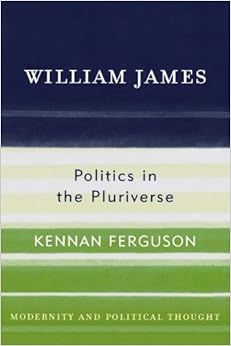
Just to finish off what I raised in my last post now that I've finished that book (Kennan Ferguson's William James: Politics in the Pluriverse).

It's an easy read if a little tame; meek, even. Lightweight in both style and length (only 93 pages). Chapter 3 ('Sovereignty, Self-Determination and the Nation') is interesting as it ties James' pluralist political theory to International Relations literature (this hardly ever happens and so I'm very pleased when it does). Chapter 4 ('La philosophie américaine: James, Bergson, and intercontinental pluralism') does a good job of narrating James' relationship, personally and philosophically, with Henri Bergson. However, there is more to it than this. Particularly intriguing is a point made late in the chapter, specifically that James was popular in Russia around the turn of the century. This, of course, did not last.
For Lenin, of course, pluralism was inadmissible; one could not doubt what actions to take, nor admit to more than one possibly right approach. (64)
This would be an interesting case to develop further. The final chapter ('Onticology recapitulates philosophy') seems at times to posit a kind of 'object-oriented' James (Ferguson does discuss him in relation to object-oriented programming) but doesn't quite follow through; things never quite seem to achieve the status of differences that make differences, they are more like 'always-theres.' However, Ferguson certainly makes the case against the reduction of James to a thinker of 'flows' and 'streams.' In this reading, everything for James, in the end, comes down to the question of plurality—and this is better articulated in terms of things than flows.

Saturday, 8 November 2014

James, politics and prescriptive pluralism: part 1

I'm just starting to read Kennan Ferguson's William James: Politics in the Pluriverse, a book that I've been meaning to get hold of for some time. So far it's a good read.


The early part of the book attempts to dissociate James' pluralism, a term that he popularised in the late nineteenth century, from the course that word took in the twentieth.
James created pluralism as an anti-Hegelian distrust of all universalist systematizing—an anti-teleological ethos that emphasizes the profound and meaningful differences in the worlds of different people. In short, James' pluralism was prescriptive. 
Over the course of the twentieth century, however, the term pluralism came to primarily mean something far different, something merely descriptive. Pluralism is now understood as referring to the fact of human difference, the unpleasant and sometimes unavoidable incommensurability of values that threatens people's abilities to build political institutions, share meanings and even communicate. (15)
Later the book goes into the connections between Continental and American philosophies and a Jamesian 'onticology' of objects.

Friday, 15 November 2013

Between aesthetics and reasoning – Brown reviews Harman and Morton

Terence Blake approvingly posts a review of Harman and Morton by Nathan Brown in Parrhesia. It's definitely an interesting review. I don’t agree with every bit of it but it raises some important points. The general accusation seems to be that of style over substance – aesthetics over reasoning. I like what James says at the start of A Pluralistic Universe: 'the distinctive quality of a philosophical truth is that it is reasoned.' There seems to be a generation of theorists who, one could argue, in rejecting Reason have forsaken reasoning too. It's a matter of rigour in a very specifically philosophical sense. Derrida's writing is notorious for its overstylised self-indulgence but there's no doubt that he was rigorous in his argumentation, in his own way. Rigorous to a fault, if anything! He worked incredibly hard to work through his analyses. His process was exhaustive and exhausting. His 'truths,' whatever their value, were most definitely reasoned.

I wonder whether this new philosophical aestheticism results in some way from Deleuze's claim that philosophy is the creation of concepts. I know that he meant something very specific by 'concept' (he had a rigour of his own) but that definition of philosophy has been taken very loosely by many people. It's seemingly become accepted that philosophy is the creation of concepts any-old-how. I am an unrepentant Jamesian in this respect. A philosophical truth or a philosophical concept must be reasoned. There is no one mode of reasoning called Reason but that doesn't absolve philosophers from the duty of reasoning. Every philosopher must construct their own version of reason and this may be something of a Sisyphian task but it cannot be avoided. No reasoning, no philosophy. Reasoning involves not just a series of utterances outlining an idea but a proliferation and working through of problems. It's not enough to paint a picture, that picture has to be closely scrutinised; the canvas has to be worked over again and again. Philosophy should be hard work. Producing concepts via aesthetics (or “riffs”, as Brown puts it) just seems a bit too easy – and, much more seriously, the end product is compromised as a result.

I suppose I'm a bit of a Platonist too in a very specific, methodological sense. Plato's dialogues are hard work. They are twisting, winding roads. There is no slick, smooth, polished superhighway in a Platonic dialogue (or, at least, there is none until the end – each dialogue is the construction of such a superhighway, a well-oiled cosmic escalator leading out of the cave). Contrasts and disagreements have to be worked through, there's no shortcut. Okay, interlocutors aren't all given a fair hearing, there are clear favourites, the field is tilted and the conclusion of the argument is usually fairly predictable. But the point is that the argument is worked through, it isn't just sketched out and put into circulation. Philosophy is a journey, a process, a travail – it isn't a product or a commodity. Yes, that’s the best word for it: philosophy is a travail in both senses of that word. It takes us back to the days when travel was hard work, when the roads were bumpy, muddy and potholed and, often enough, there were no roads at all. Philosophy qua aestheticism is an ironic, postmodern philosophy that skates about on the surface of concepts without giving a great deal of thought to what made that surface so smooth. It can be exciting, yes. Thrilling, in fact. But it’s like a sugar rush; it quickly gives way to fatigue and regret.

I suppose it would be unfair to hang this ‘philosophy qua aestheticism’ sign on Harman and Morton without a serious caveat. There is reasoning in their texts, undoubtedly. Genuine conceptual creation, too. There is philosophy. But I would agree with Nathan Brown, as I understand him, that there isn’t enough philosophy; that an interesting and suggestive lashing together of this and that is not enough; that difficult questions have to be worked through, they can’t be fobbed off; that superficial iterations of complex ideas is dangerous; that thinking of philosophical texts as objects in circulation does a tremendous disservice to philosophy. Every philosopher may lean on it to some extent but such freeform ice-skating can only go so far. If it isn’t held together by the laborious processes of philosophical reasoning, of whatever kind, then it produces texts that are shallow and misleading. And OOO, I would agree, sometimes skates too much and labours too little. That is what makes it so thrilling and wide ranging but it’s also what makes it oddly unphilosophical at times.

That said, OOOers are certainly not the only ones guilty of this sort of thing. Manuel DeLanda’s A New Philosophy of Society is a stunning book – stunning in part because it contains almost no philosophy whatsoever. Indeed, philosophy seems to be something he desperately tries to get out of the way early on so that he can get on with stitching together these concepts out of various elements of historical sociology. It’s an interesting and conceptually suggestive read but it’s not really philosophy as I'm prepared to understand it – it's more of a prolegomena to a new philosophy of society.

I’m about to read William Connolly’s new book The Fragility of Things (I’ve ordered it but it hasn’t arrived yet). While Connolly’s books are generally enjoyable reads I find them to be quite superficial (see his book Neuropolitics in particular – a text largely undeserving of its title). My preconception of this book is that it will largely follow the philosophy qua aestheticism scheme that I’ve outlined above. So, this isn’t something particular to OOO. I think it may have more to do this specific aspect of Deleuze, far from the best aspect, that has been extracted, simplified and rather impoverished – the idea of philosophy as the creation of concepts any-old-how.

Tuesday, 29 October 2013

Habit: the flywheel of cognition

William James famously called habit 'the enormous flywheel of society.'  He could also have called it the flywheel of cognition.  Levi Bryant links to a really fascinating article in The Atlantic on a study that shows how 'poverty taxes brains' - that is, poverty deprives people of the habits that permit wealthier people the luxury of saving cognitive energy by not having to think about so many things.

For example, if you have to think (and worry) about where your next meal is going to come from then you will expend enormous cognitive and emotional resources on achieving only that goal.  A wealthier person who can breeze through the supermarket without having to stop to think whether or not they can afford what is in their basket is free to think about other things.  If they are really wealthy they needn't even set foot in the shop, they simply bark 'food!' and it appears before them!

The really important thing to realise, as James did well over a century ago, is that habits run deep.  We are plastic beings.  Our brains are plastic, our habits are plastic.  It isn't just that the rich person saves time by not having to consciously recall how much money is in their bank account and then carefully add up every item in their basket in order to ensure that they are not humiliated when they reach the checkout because they are unable to pay.  It runs much deeper than that.  No, these kinds of practices affect the way we are 'wired' at every level - the aforementioned study focuses, of course, on brains but it is a general truth.

So writes James:
What is so clearly true of the nervous apparatus of animal life can scarcely be otherwise than true of that which ministers to the automatic activity of the mind … Any sequence of mental action which has been frequently repeated tends to perpetuate itself; so that we find ourselves automatically prompted to think, feel, or do what we have been before accustomed to think, feel, or do, under like circumstances, without any consciously formed purpose, or anticipation of results.
Habit is self-perpetuating.  The more that we expend our cognitive energies on survival the less energy we have to expend on other things and, over time, the less we are capable we become of thinking about other things.  The more attuned we become to survival thinking the less attuned we become to anything else.  Habits are plastic - they have a structure that yields but not all at once, as James puts it - and so they can be reversed but only with great effort.  Human being is habitual long before it is 'rational.'  Indeed, rationalities are habitual.

This is at odds with pretty much everything economics and psychology have assumed in the last hundred years - and with the entire disciplinary logic of neoliberalism.  The Atlantic article notes that:
The design of these experiments wasn't particularly groundbreaking, which makes it all the more astounding that we’ve never previously understood this connection between cognition and poverty. “This project, there’s nothing new in it, there’s no new technology, this could have been done years ago,” Shafir says. But the work is the product of the relatively new field of behavioral economics. Previously, cognitive psychologists seldom studied the differences between different socio-economic populations (“a brain is a brain, a head is a head,” Shafir says). Meanwhile, other psychology and economics fields were studying different populations but not cognition.
Behavioural economics is only just catching up with the man who died in 1910.  It's utterly shameful, really.  A brain is not a brain, a head is not a head.  A brain without a body is a dead lump of goo.  A body without all its social accoutrements is a dead lump of flesh and bone.  A human being without its habits is moribund.

Assuming perfect, habit-less rationality of human subjects in order to make your sums add up (as this is what modern economics basically amounts to) is criminal in its absurdity.  Latour (following Callon) is right that economics is a discipline and not a science.

Friday, 25 October 2013

A philosophical mode of reasoning?; Finally understanding the religious mode (I think...)

Levi Bryant ponders whether one can conceive of philosophy as a 'mode' or 'sphere' in the senses of Latour or Luhmann.  I don’t have an answer to this question but I think I might have the beginnings of one.

At the start of A Pluralistic Universe James (whose influence on the modes project can hardly be overstated) argues that while any form of discourse can arrive at truths – even common sense, even accidentally – the distinctive quality of a philosophical truth is that it is reasoned.

On its own this is a bit simplistic.  Philosophy must be a distinct mode of reasoning, not reasoning itself.  However, I think it puts us on the right track.  Philosophy is distinct from mysticism because while mysticism may, in a way, concoct wisdom by concealing – it may instigate a particular kind of truth through the artful fabrication of experiences the authors of which are deliberately obscured and unattributed – it is not philosophy because it doesn't follow a philosophical thread of experience, a process of reasoning.  There may be mystical wisdom but that wisdom is not philosophical wisdom.  In fact they are opposites.

I read a chapter in a book a while ago (the names escape me, I need to look it up) on Plato's Statesman.  It was by a classicist who, undoubtedly, has forgotten more about Plato than I'll ever know but one thing struck me that he got absolutely and unequivocally wrong: after about a dozen pages of the dialogue Young Socrates objects that all these progressive distinctions layered upon distinctions upon distinctions (aiming to gradually arrive at the essence of the statesman) are a waste of time.  At that point the Stranger was still cutting through the different kinds of animals (two legged, four legged, etc.), having not yet arrived at the human.  ‘Why not cut right through all that and just say that there are humans on the one hand and non-humans on the other?,’ asks Young Socrates.  The Stranger explains, with joyous condescension, that this would fail to cut nature at its joints; it would do what Greeks do to non-Greeks, it would lump them into a whole category marked 'barbarians' (the root of which is the same as 'babble'; barbarians are those whose language one cannot understand, whose distinctions and differences one is insensitive to, ignorant of).  The Stranger points out that from the point of view of a crane (as in the bird) humans and all other animals may appear to be an undifferentiated mass, too.  I've written a few posts on this part of the dialogue before because I think it's fascinating.

Anyway, the really important point is that the classicist sided with Young Socrates.  He agreed that it was ridiculous that we had to go through all these distinctions layered upon distinctions when, in the end, we arrive at the same place: human beings (and then the statesman).  Why not ‘cut to the chase?’, he raged.  But this, for me, completely misunderstands philosophy.  Yes, the distinctive quality of a philosophical argument is that it is reasoned.  The process of reasoning is not extrinsic to the result of reasoning.  Philosophy is, then, intrinsically dialectical, dialogical.  We may, at the end of the dialogue, forget precisely how we got there but that isn’t the same thing as writing the whole process of reasoning off as a mere prelude, a preamble, a means to the end of the conclusion.  To ‘leap to the end’ (how fascinating that, in this dialogue, the Stranger argues against ‘straight talk’ and ‘double click’ – yes, it’s all footnotes…) would be to lose the thread of the argument, it would be a leap into mysticism, in a sense.

‘Cutting nature at its joints’ has always been understood as the realist, naturalist tenet par excellence.  And in a sense that’s accurate but the insight has been shallowly, thinly understood.  What cutting nature at its joints did in this dialogue was to expose the heterogeneity of being and at one and the same time it made our conclusion more difficult to reach rather than less.  We had to do much more work to get there and we emerged wiser for our efforts!  In order to get there we had to become more sensitive to the differences in the world and not less – the world became bigger and our thus our ignorance proliferated; we become more aware of our ignorance of the world because we came to know the world better.  We benefited from, we were transformed by, the whole thread experience, not just the conclusion.  And – this is key – we had to proliferate stages of reasoning in order to not arrive prematurely.  Had we arrived at our destination too quickly we would not really have arrived at all.

What is that urge?  The urge to ‘get there when we get there.’  Hmm, well that isn’t ‘philosophy’ but I think it is an aspect of the philosophical thread of experience.  At the very least this distinguishes philosophy from reference, as Latour describes it.  With reference [ref] it’s perfectly legitimate (indeed, it’s necessary) to paper over the mediators that got you from A to Z with the smoothing forces of habit [hab].  But philosophy is different.

You can’t just read the last few pages of a philosophy book (a good philosophy book, anyway) and ‘receive’ the whole argument in summary form.  If you can then it’s not philosophy.  The philosophical thread is a transformative thread.  You come out the other side different to how you went in.  Words no longer mean quite the same things; the world doesn’t appear quite the same way.  And as much as you try to explain these new-found insights to your friends and loved ones it is extremely difficult because you have to retrace large parts of the thread of experience that brought you to this point.  There is no substitute for the journey.  Merely stating the conclusions and smiling at them will only provoke blank stares and mutterings of ‘what a load of bollocks.’

Clearly there are ‘hiatuses’ that have to be overcome and threads that have to be followed, threads that cannot be short-circuited (by double-click reasoning) without destroying the paths themselves.  In Plato’s dialogue our becoming-wise depended upon the proliferation of stages, of problems, of hiatuses that had to be overcome not any-old-how but through a reasoned solution.  That ‘reasoned solution’ is the pass of this mode (if, indeed, it is a mode).  What is it that allows the simultaneous creation and solving of problems?  What distinguishes this particular kind of problem resolution?  What are the conditions of felicity that validate (or invalidate) these little leaps, these small steps for philosophy-kind?  What beings are engendered by these threads?

If we can answer those questions then we have our philosophical mode, our [phi].

Taking this further, there is a relationship with law that needs to be explored.  Law, for Latour, is a 'quasi-subjectifying' mode because it allows the attribution of actions to actors; law is the archive of action.  Mysticism, as I described it above, arrives at wisdom by breaking those threads and disavowing authority (it must have a relationship to metamorphosis [met] too but I don’t really understand that mode yet).  Philosophy doesn’t break links but it doesn’t preserve them in the same way as law (more evidence of its modal independence).  The steps needn’t be retraced as such (thus it differs from both law and reference), however the steps cannot be bypassed.  The journey is transformative.  It is similar to the religious mode in this sense (although I believe now that the [rel] mode is most likely two different things conflated together).

The religious mode is another quasi-subjectifying mode (politics makes the trinity).  Religion is really the archetypical instantiation of the mode rather than anything that ‘owns’ it (although it is articulated in purely religious language, confusingly).  The religious experience (and this is only my best understanding at the present moment, it’s not gospel truth!) that ‘personifies’ is the experience of the living (i.e. immanent) and (this point is essential) personal God.  The Word is the conversionary revelation that ‘Jesus died for your sins’ – not humanity’s sins, not yours by implication or association but yours specifically.  It's the statement that God loves you, that you have a personal relationship with Him.   This is metaphysically ‘personifying’ along the lines of Lacan’s mirror stage.  It is being recognised as a self by others that constitutes our self; our sense of self, our personhood, does not precede this recognition, it is not its cause but its consequence.

So, that’s why Latour builds the mode of personification around religion – because encountering the absolute, God, is the most personifying experience possible.  It’s not that it is the only form of personifying experience (he also gives the example of a couple’s declaration of love) but it is the most personifying, the essence of personification.  There are (at least) two problems with this: (1) building the whole personification mode from religious materials obscures non-religious forms of personification and makes the whole apparatus damned confusing and (2) I just don’t buy the whole idea of an immanent God.  However, as a technical term within his overall system religion as in [rel] does make sense because religious experience is, in principle, personification par excellence.

So, returning to what I was talking about before that cognitive RAM dump (I’ve been meaning to write that down all morning), philosophy is similar to religion in that it is transformative but it is transformative in a very different way.  It does not personify.  It is not focused inwards, or at least it has no specific direction in that way.  It changes how we see ourselves, yes, but also the world.

Philosophy tinkers with the very basis of our perceptions, of the structures that form our world as sensible, as meaningful, as structured.  Is philosophy essentially a critique of 'ideology,' then?  Perhaps.  We’d have to redress what we mean by critique (and, indeed, ideology) working within this modal framework but that would seem to be the conclusion I am led to.

Has this rambling string of words been rambling along the paths of philosophy?  Have I been doing philosophy, here?  I’ve certainly been doing it in Deleuze’s sense of writing at (and pushing past) the very limits of my understanding!!  I definitely didn’t know what how this was going to end up when I started.  In that sense I have been transformed, yes.  And I think I've been reasonable.  In that sense this has been philosophy.

Monday, 11 March 2013

Latour, fieldwork and philosophy; A defence of (radical) empiricism


Forgive me, kind reader.  I've been reading Kurt Vonnegut this evening and therefore feel compelled to write a little bit like I'm a 'writer.'  Much of what follows is correspondingly pretentious.

What stoked my interest was another post by Terence of Agent Swarm blog fame; this paragraph in particular:
Despite his insinuations to the contrary, Bruno Latour with his compositionism is the direct application of this thought, that he is very familiar with. His talk about his “empirical” research is very misleading and contains overtones of scientistic bravado, as his system is parasitic on these predecessors. He is however a good populariser of good ideas, and his work should be encouraged as long as we do not accept his own contextualisation of his ideas. Latour is vey much an inheritor of Deleuze, Lyotard, Derrida and Serres and the intellectual contemporary of Laruelle and Stiegler. It is this that gives his work its superiority over Badiou’s, not any primacy of the empirical over the philosophical.
I don't think that Latour ever claims a 'primacy' for the empirical over the philosophical.  His field studies aren't just about adding a scientific gloss to concepts he's borrowed (or stolen) from others.  I think that misrepresents what he does with his field studies.  I agree unreservedly that he's misleadingly coy about his philosophical influences.  Indeed, he's self-consciously strategic with who he acknowledges and who he doesn't.  He frequently and unabashedly cites Serres and other peers and contemporaries like Haraway, Callon, Greimas, etc. as well as lesser-known old, dead dudes like Whitehead and Souriau.  Indeed, he is happy to heap praise on anyone he considers an ally or fellow traveller.  For some reason other obviously significant precursors like Deleuze, Foucault and Nietzsche are deemed less than allies and are consequently relegated to scattered, almost accidental footnotes and occasional, almost embarrassed comments in interviews.

On this point I'm reminded of Foucault saying that he hardly ever cited Marx because, at the time that he was writing, everyone was citing Marx at every possible opportunity on any subject -- so Foucault elected not to cite him at all despite his obvious influence!  Latour's evasions may be similarly contrarian.  More cynically, they may be designed to allow Latour to present himself as more original than he really is.  Then again, maybe he just thinks that citing names and dates is boring and a waste of time; an academic pleasantry that, due to his fame and notoriety, he is in a position to skip.  I think there's probably an element of truth in all of those explanations.

Regardless, while Latour is clearly "parasitic" on his predecessors (who isn't?) I don't think the title "populariser" quite does him justice -- nor, I repeat, is his 'empiricism' merely about adding a scientific gloss to his inherited ideas.  The most valuable thing about Latour, from my point of view, is the way he joins the empirical and the philosophical -- far from these terms being in competition they, under his penmanship, become profoundly harmonious.  In fact, one of the main criticisms I have of his more recent work is that it is not empirical enough.  He was fastidiously anthropological when it came to science, engineering, law, etc. but largely abandoned the practice when it came to thinking about politics -- little more than offhand anecdotes creep into his political writings.  Consequently, I found his 'Politics of Nature' to be the weakest of all his books -- abstract, verbose and fanciful in a manner disappointingly unlike what came before it.  ('We Have Never Been Modern' was similarly abstract and general but since it wasn't modal in its focus and because it was considerably more concise it worked much better, I think.)

Probably my favourite essay of his, and certainly the best example of the empirical/philosophical complex that I'm talking about, is what I think (from memory) is the second chapter of Pandora's Hope, the essay on 'Circulating Reference'.  Is the story that Latour tells -- that of following some soil scientists and botanists in their journey from the heat, humidity and creepy-crawlies of the Brazilian rainforest through all their scientific translations back to the laboratories, running water and journal articles of cosy old France -- a mere gloss on the philosophical content?  Is it simply an elaborate, science-tinted vehicle for making his point?  I don't think that it is.

Certainly, the fact that these ideas were based on firsthand research and not simply on sitting down and thinking hard about stuff he'd read doesn't necessarily make them 'better' -- but to dismiss the empirical process through which the ideas were derived as indicating nothing more than a loosely shrouded scientism is shortsighted; in fact it misses the point.  Every philosophical idea derives from some kind of practical process -- whether it's trekking through the forests of Bavaria, slouching over a writing desk in a musty Cambridge office, or clumsily wandering about in a laboratory.  Every philosophical utterance is an embodied utterance, an utterance with a backstory, a genesis -- the result of a radically empirical flow of experience (James is another influence that Latour has no shame in citing, which is good since Latour's empiricism is really just an actor-network-ised version of James').

Most philosophers believe that reading, walking and talking to like-minded others constitutes a sufficient process for the productive stewing of ideas.  Latour, contrariwise, has found fieldwork among the different people his philosophies comment on (the practitioners of his various modes of truth) to be considerably more fecund than guessing at the particularities of their lives from a distance.  I don't find it hard to see why.

It isn't a case of 'empirical, therefore scientific, therefore better' -- it's much more interesting than that.  I mean, would the poor guy have spent all those months and years painstakingly note taking, conversation starting and archive trawling just to score a few Brownie points for being 'scientific'?  The interesting point is that, in what I think are his best works, the distinction between the empirical and the philosophical if it doesn't quite disappear then at least becomes considerably blurred.  I think it's much more likely that it is his anthropological process in combination with his philosophical and theological education that has resulted in the ideas he claims as his own (however unpaid his dues may be).  And this, I think, is an object lesson not just for how we interpret his work but also in how we think about thinking in general.

To my mind the really pertinent questions are not 'Why do fieldwork?' but rather 'Why don't more philosophers do fieldwork?'  Why don't more philosophers realise that secondary sources aren't good enough?  Why aren't the social sciences and empirically-inclined humanities given the time of day in philosophical discourse (unlike their Natural brethren)?  Why is intellectual hermeticism still thought to be a valid thought process?  The notion of the cloistered, hermetic genius is an evocative image, though it is one unburdened by any kind of actual existence.  Newton, for one, consciously promoted himself as such an isolated, neutral, disinterested-but-brilliant figure; historians like Simon Schaffer have shown that he, like all great men of letters, was a formidable network-builder.

Frankly, I think the burden of justification is on those who don't look very closely into the lives and issues on which they pass judgement.  It isn't the empiricist who needs to justify himself.

I don't think the epistemic authority deriving from doing empirical research is at all necessary to explain why Latour does such research.  However, I do think that, in many cases, actually going out and talking to people, reading primary sources and producing an original study of a situation does accord an analyst a degree of authority over and above those who simply read books and take others at their word with regard to how things work.  Take the old-school, pre-Bloor and pre-Latour historians and philosophers of science -- all those Whiggish dinosaurs who thought that they could infer all they needed to know about the practice of science from its results, on the one hand, and the casual testimony of its off-duty practitioners, on the other.  Latour and others showed this supposition to be laughably inadequate.  When intensively observed scientists' practices appeared to function quite differently from how they were supposed to according to tradition, dogma and folklore.  When anthropologists actually took the time to watch these tribespeople in action they found that the prevailing explanations proffered by their more naive and doting commentators were wholly inadequate since they were largely oblivious to what stands out as the most remarkable characteristic of scientific research, when observed by an anthropologically trained outsider: that facts are constructed, often astonishingly well.

I'm perfectly happy to say that these empiricists have greater epistemic authority by dint of their efforts, compared the idleness of their rationalist predecessors who merely inferred the details of their subjects from the ideological predispositions to which subjects and observers were all privy and upon which all agreed -- specifically, that Science was all about disinterestedly uncovering Truth and discarding Fiction.

But, and this is the key point for me, this superiority comes not from being grounded in practical experience as opposed to abstract ratiocination -- this classical opposition of empiricism and rationalism is false because it opposes two variants of a common problematic: subjectivism.  On the contrary, I think it can be claimed that the evidentialist ethic enacted by the practice of fieldwork leads to a general qualitative improvement in philosophical discourse because it extends the radically empirical flows of experience, the practical processes that generate the philosophical discourse.  The processes that philosophers generally enact so as to generate their ideas -- sitting, staring, reading, writing, walking, talking to other philosophers -- are not invalidated by this general empirical commitment but they are shown to be relatively disconnected from the world on which they comment in a way that is not necessarily disastrous but is demonstrably unnecessary.

In other words, fieldwork deepens a philosopher's attachment to that on which they commentate morally, socially and epistemically.  It broadens the attachments, the connections, the radical flows, which they both ride and channel.  Doing fieldwork (of whatever kind) allows a thinker to be surprised and perturbed in their trajectory by a greater array of facts, theories and knowledges than they would bump into otherwise.  It pluralises their journey and thus their philosophy -- but, importantly, it does so in a fashion with specific pertinence to what they're thinking about.  It's not about 'broadening horizons' by learning a new language or 'expanding your mind' by dropping acid or some-such.  It's about delving more deeply into the world so as to synthesise and criticise philosophical abstractions from within it rather than above it -- the latter being a fool's errand.

In a sense, every philosopher does 'fieldwork' because every act of ratiocination is an empirical -- i.e. experiential -- phenomenon.  The question is, then, not so much whether to do 'fieldwork' but rather what fieldwork is germane to the topic at hand.  Far too many philosophers think themselves above the humdrum, humid, detail-cluttered world of the merely empirical.  They are all fools.  (It's worth mentioning parenthetically that, from what I know of him, Feyerabend, for one, was no such fool.  Of course if I was being fair I might have to say the same of Kant, who was prolific in all the sciences of his day, and many others besides; but I'm not being fair I'm being polemical, so ... whatever!)

Rationalists -- those who believe that ratiocination is anything but a much variegated element in the flow of experience; that it transcends the "great blooming, buzzing confusion" out of which we all clutchingly piece together a world -- simply abstract from the flows they embody and translate in order to make it seem that their utterances are sui generis -- that their thoughts are more original than they would otherwise seem.  Then again, that is somewhat reminiscent of what Latour does by not stating his influences in full.  Oh well, none are innocent!  Or, as Kurt might say, so it goes.

[Addendum:

In response to the above Terence replies:
Philip of Circling Squares ... seems to be criticising me, despite the fact that I agree with nearly everything he says and have said similar things in various blog posts. I think he is right about what he calls “fieldwork” and I share his desire for philosophers to indulge in more “empirical research” conceived broadly. My quibble is that sometimes Latour slides between this more general sense, where a philosopher like Deleuze can be considered to do (conceptual, affective, perceptual, political, and yes why not? religious) fieldwork and a more limited sense in which Latour has done fieldwork but not Deleuze, Badiou, Lyotard and Serres. My quarrel is with the diplomatic caricature of himself that Latour secretes, consciously or not, and that interferes with the part of his message that I like and wish to help publicise.

I'm sorry if I misunderstood or misrepresented what you were saying. Hopefully the tone was not too objectionable. When I wrote “I’m not being fair I’m being polemical” I meant it! I was dimly aware that your Feyerabendian predilections might actually chime with some of what I was saying, the post I referred to just seemed to be saying something different. My mistake.

I completely agree with the portrayal of Latour as a wily, Machiavellian diplomat rather than the mild, polite, self-consciously constructive diplomat he pretends to be. As I wrote in a follow-up post, he always has to be read as a scheming polemicist rather than a scholarly essayist; everything’s performative with him. A key element of his performance is his citation — or non-citation — of influences. This rhetorical style can be a little annoying at times but it does seem to be intrinsic to his thought — practicing what he preaches, essentially. Bah, philosophers!]

Thursday, 28 February 2013

Evidentialism vs. empiricism; Philosophy as an anthropological phenomenon

The other day I wrote that the world needs a concept of 'evidentialism' to supplant the perennial argument between rationalism and empiricism; it needs it because of the confusion between critical mindedness and plain, nasty and (dare I say it?) irrational cynicism.

Of course, when a lot of people say 'empiricism' they mean something a lot like 'evidentialism.'  Scientific empiricism is generally understood to involve the priority of experiment and the collection of evidence over abstract, a priori reasoning.  To this extent, 'evidentialism' is a superfluous coinage.  However, in stricter, more philosophical terms, the word 'empiricism' pertains to experience (and hence to a subject), rather than to evidence as such.  Evidence is the thing experienced but it is a secondary term -- something that enters into the equation once the grounds of experience have been established -- and it is these grounds that are the problem, not the evidence itself.

It is in this that empiricism and its other are all too similar; both empiricism and rationalism locate the problematique of knowledge in the subject -- in the mind that knows (or does not know).  And, as Latour, William James and others have argued, once the gap between mind and world is set out as something to be bridged it never goes away; the question of access, of the salto mortale, forever dominates the whole conversation.

The grounds of knowledge, as sociologists have demonstrated time and again, are in epistemic practices not abstract subjectivities.  These processes necessarily involve subjectivities, rationalities, modes of experience and so on but they are reducible to none of these and no one kind of subjectivity, rationality, etc. is germane to all epistemic situations.  Moreover, none of these things can be privileged more than the *evidence* itself. 

If we embrace evidentialism rather than 'empiricism' the experiencing subject is no longer primary and subject/object relations become but one consideration among many.  The processes highlighted by the notion of evidence involve both experiences and rationalities but also artifacts.  Evidentialism is, therefore, a social, practical, processual but also materialist concept.

Instead of subjectivities the artifacts and the processes by which they become artifacts -- i.e. items of evidence -- become primary and we begin from a real, worldly process rather than abstract subjectivity.  Understood in this way, experiences and rationalities are elements of epistemic processes; they are not the grounds of the epistemic in general.

But isn't this sociology of knowledge rather than epistemology?  Isn't this just turning a philosophical problem into a sociological one?  Yes and no; I think we need to think about philosophy itself slightly differently.

If knowledge is a worldly and practically, incrementally produced kind of entity then philosophy that is unrooted from the actual processes by which it is produced is a waste of time; it simply won't get us any closer to understanding what knowledge is or how it can be improved.  The philosopher as 'the critic of abstractions' (as Whitehead puts it) is not above or beyond the grubby complexities of evidence and sociology but, instead, embodies a set of critical capacities necessary for the proper execution of intellectual tasks.  This philosopher is a kind of critical subjectivity that any individual researcher should be able to embody and articulate in the course of research, to some degree.  In this sense 'we are all philosophers' -- although we're not all equally good at it.

Conceived in this way, philosophy is an anthropological phenomenon.  Philosophers as professional individuals simply embody these capacities full-time and (sometimes) get paid for it -- but they don't own any of it.  Individual philosophers most fully experience the mode of rationality particular to philosophy -- consequently they are its principle vehicles in the world.  Experience and reason are thus fully part of the process.

The pertinence of philosophy, thus conceived, to knowledge is that it is a form of rationality intrinsic to the academic or intellectual epistemic process, taken abstractly; it does not comment on the epistemic process from afar but, if it's doing its job, provides some of the tools by which it can occur at all.

That's a slightly jumbled and very schematic sketch of an idea, but I think it makes some sense (or at least it does to me).

Friday, 22 June 2012

Bryant on Being Qua Mechanism; the Baggage Thereof

Levi Bryant writes:
What we need is not a conception of being composed of objects, but rather of machines. Nor is it a pan-psychism, organicism, or vitalism that we need, but rather a pan-mechanism.
It's a very long and interesting piece that's still in development and is well worth the read. I'm sympathetic to the general thrust of it but what concerns me is whether mechanism is really a good metaphor for being.

Machines aren't generally understood as dynamic or evolutionary. They remain operational only within fairly limited ontological parameters. If a machine's composition changes radically then this generally means that it breaks down. In this respect, it is fundamentally brittle and necessarily reliant upon maintenance. Its ontology is highly dependent upon other things and it only remains what it is while it remains more or less ontologically consistent or stationary.

Real machines are a little too rigid, fragile and needy to serve as a metaphor for beings altogether. Moreover, machines as they are popularly imagined tend towards the other extreme and appear far too rational, coherent and solid (e.g. in Newtonian physics/metaphysics, which implies mechanical aspects of reality to be timeless, rational and holistic, like clockwork).

On the one hand, machines are too weak for mechanism to be a useful metaphor for being. And, on the other hand, machines, as they are often understood, are also too strong to be a useful metaphor for being. Being in general seems much more plastic than mechanical. (Plastic in the sense used by William James: "plasticity ... the possession of a structure weak enough to yield to an influence, but strong enough not to yield all at once.")

The machine metaphor may be as old as philosophy itself but I'm not sure that it does justice to things.

That said, there are, of course, only so many words that we can appropriate for thought and I struggle to think of any that are obviously better (e.g. being qua organism has its own problems) but mechanism certainly carries some baggage with it.

Friday, 4 December 2009

re: Hegemonies

Response to: http://larvalsubjects.wordpress.com/2009/12/04/hegemonies

I'm really glad you posted this post because, having been a reader for a few weeks now, I think it really clarifies where I would agree and disagree with your position – and as luck would have it, it is precisely the sort of disagreement I have with just about everyone at the moment (on both/all sides of the argument), philosophically I mean.

Basically, as I understand it, you are arguing against the position (let us, for argument's sake call it 'postie-ism') that, allegedly, reduces everything to 'textuality' – that is, says that language is the be all and end all; language is the ‘really real’; all that materiality is just a product of discourse, of ideas. This is the typical critique of postie positions and it is one a great deal of their writings reinforce by, I would wholeheartedly agree, emanating from cultural studies and literature departments that would dearly love to see the whole world as one giant intertext and adopt the ‘sacred texts’ (/’sacred cows’) of postie-ism as writ (that is to say, unreflexively and uncritically). However, I believe that it is an over-simplistic and, if not 'incorrect', then certainly disagreeable characterisation.

I think a good place to explain what I mean is Derrida's most (mis)quoted phrase "il n'y a pas de hors-texte", usually translated into English as "there is nothing outside the text". From this sentence alone one would surely draw the conclusion that you have – that everything is to be reduced to textuality; that textuality is 'the really real'. However, my Francophone friends inform me that this is a bad translation that loses much of the sense of the original. The phrase is often translated, conversely, as "there is no outside-the-text". At first glance this may appear to say basically the same thing. I believe that this is a big mistake.

The clearest way I can articulate this point (in my own mind at least) is through William James. In his epic work 'Psychology' James describes a hypothetical baby's perception of the world as "one great blooming, buzzing confusion" – in other words, at that stage in a baby's physical and cultural development it cannot perceive anything of what is around it as we would understand it. It must be just flashes of colours and sounds and textures and abstract patterns with no way of assembling the stimuli into any kind of coherent 'reality'. Of course, we can never know how a baby 'sees' the world; it is pure speculation – but this is allowed in these parts, isn't it?...

Taking this as a thought experiment let us suppose (with every sci-fi series ever – see 'Dollhouse' for a good recent example) that one were to take a fully formed adult and wipe away all trace of enculturation and make them a tabula rasa (of course this is an impossible Cartesian manoeuvre, epigenetics alone shows biology and culture to be irreversibly interwoven, but lets just pretend). Would this person then not be like James's baby? Would ‘reality’ then not be "one great blooming, buzzing confusion"? Just textures and colours with no way of understanding it -- effectively no way of establishing a 'self' or a 'reality' at all? It is not that the external world no longer exists – I can still see this poor brain-washed person; I can still make out his form, his limbs, the colour of his hair, etc. – it is that, from this particular, ‘brain-washed’ subject position no knowledge of the world can ever be said to properly exist; ‘reality’ is thus only my ‘property’, not his. This is an extreme thought experiment but it, I believe, holds for less extreme examples too. To put it simply, language is always already ‘there’ (and, by consequence, ‘there’ is always already ‘here’).

All of which is a longwinded way of saying that we can know nothing of anything without enculturation. Of course this was probably never in doubt – who could deny this?

Further, then, it is my contention that the postie attitude towards language follows much this same formula – it is not that language is the totality; language simply cannot be dispensed with. My favourite way of putting this is that it is ‘necessary but insufficient’ (as is so much in life).

Of course this brings to the foreground the most important issue. The above discussion to which I am responding fails to say what 'language' is. Of course this seems like common sense. This is language. And so is this. And this. Yet where do we stop? Is body language language? Is emotion language? Is volition (in the psychological sense)?

It would be an extraordinarily 'thick' definition of language to include all of the above. And this is perhaps where I can pull the rabbit out of the hat and (finally) make my point: the 'text' in Derrida's aphorism is not meant to be taken literally, or at least not as literally as it almost universally has been (by both those faithful and hostile). To say that "there is no outside-the-text" does not mean, therefore, that there is nothing besides language (language defined in any sensible way). It means, I believe, something akin to James's baby: that we can never, ever subtract language from our experiences; that without language ‘reality’ is nothing and therefore language must always have an effect on our perceptions of, well, everything. That language is ‘necessary but insufficient’. Of course we need bodies and those bodies need food and water – this is a given; why would anyone doubt this? The question is whether any of this means anything – indeed, whether any of this can even be comprehended on even the most basic level -- without langauge (or, as it should be clear by now, I would prefer to say 'enculturation' as the 'thick' definition encompassing affect, volition, etc.) Therefore, whether or not objects possess ‘transigent’ and ‘intransigent’ qualities, language can never be legitimately bracketed or set to one side.

From this position, with language being an ever present necessity – the only means by which we can think and certainly the only means by which we can communicate our thoughts, however imperfectly – one must have recourse to transcendental reason to ascertain the ‘really real’. One must somehow pierce this shield of language to get to what is outside of it and then represent this in some clear manner. One must entertain the transcendent; that is, provide a spectacle to cite it, to bring it forth, to make present, in some form, this sublime experience.

In other words, language must possess some quality of Reason by which utterances may be objectively distinguished in terms of truth or [insert your value distinction here]. That’s a whole other story. I’m not going to bore anyone with that now, least of all myself.

A far more coherent and profound description of what I’m trying to say here is offered by Ernesto Laclau in conversation with Roy Bhaskar here:

http://politicaltheology.com/ojs/index.php/JCR/article/viewFile/3611/2272

Here Laclau shows why what I am calling postie-ism (he calls it discourse theory) is not idealist – it is explicitly opposed to idealism. I don’t think Bhaskar really ‘gets it’ but its an interesting exchange.

While I would agree that a great deal of the writings on this postie-ism betray a certain idealism implicitly, if not explicitly, this is because, those that do…well…aren’t very good.

If this is the version of postie-ism that you have left behind recently, Levi, I can see why you did so; its fairly empty of merit as a philosophy goes. Unfortunately I really don’t recognise it; at least not in the major texts. In the multitude of followers, yes, sadly, but this is not an indictment of the whole philosophy.

For what (little) its worth, I see Derrida, despite his status as the archetypical postie-ist poster-boy, as a thinker who does not deny things. He is best read in his deeply ethical, wholly political sense of maintaining the total contingency of discourse and everything else. Everything is ‘to come’. Everything is promised, nothing is wholly delivered and this is fine. All it means is that we can’t take anything for granted and we shouldn’t ever accept being told ‘that’s the way it is’ (Isn’t this the Socratic ideal? Isn’t this why those who teach philosophy teach philosophy?).

The world was no less ‘real’ the day after he published Of Grammatology. The sun was as warm, food tasted the same. He just demonstrated that it needn’t mean the same things all the time. I don’t even see him as that much of a skeptic. If one is to read his interviews he would say much the same (of course its impossible to know if at any moment he is being honest or contrary, but still, its there as a plausible interpretation).

Having said all of that (and golly-gosh, this comment has reached, dare I say it, Levi-esque proportions) I am completely dissatisfied with the prevailing postie-ist positions too. My own personal intellectual project(/hell) is to produce an historical methodology that is consistent theoretically, ethically and politically with deconstruction but notes that it is, in itself, insufficient (there is that phrase again ‘necessary but insufficient’). This is not new. Gayatri Spivak, for one, says that ‘deconstruction cannot found any political project’ (I’m paraphrasing) – deconstruction is therefore, on its own, politically insufficient. Judith Butler (paraphrasing again) says that ‘deconstruction is not a necessary part of any political project’ – it may, therefore, be excluded. It is insufficient and non-necessary; if it is part of a project it cannot exist alone and it need not be a part at all. What ‘idealist’ could maintain this position? Read Butler’s lectures on Spinoza (‘Giving an Account of Oneself’) to see why the idealist label simply doesn’t fit in any way towards (the more brilliantly argued) postie-ist writings; she argues against the opacity of self-knowledge, this refuting any charge of ‘idealism’ (an idealist must presume autonomy and authority over one’s self-perceptions, something which is alleged in Levi’s post above).

Anyhoo, I’ll stop writing now, for the main reason that in the post this morning, I received a fresh, new copy of Meillassoux’s ‘After Finitude’. Also there’s a good chance this will all seem regrettably ignorant to me one day. I hope, soon, to be able to comment on these issues from a position of only partial ignorance rather than total.

Until that halcyon day, a caveat must be added, for my own self-protection:

Of course, I could be wrong.