Showing posts with label history of science. Show all posts

Saturday, 7 February 2015

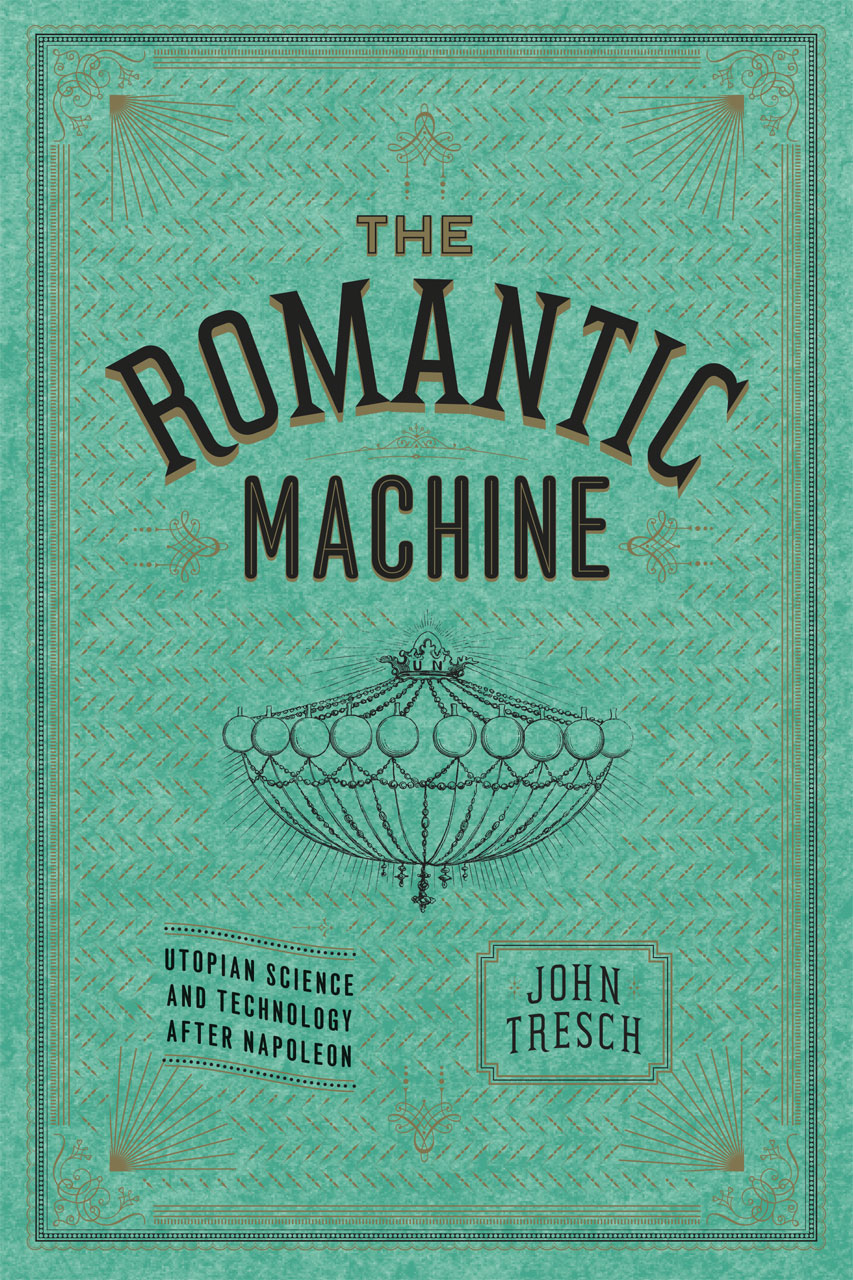
John Tresch's 'The Romantic Machine'

John Tresch's The Romantic Machine: Utopian Science and Technology After Napoleon is a beautifully constructed and unfailingly impressive work that takes its reader on a journey through Parisian scientific and intellectual life in the early to mid nineteenth century. Published in hardback a couple of years ago but only just out in paperback, it won the History of Science's Pfizer Award—and deservedly so.

Tresch's work fits into an historiographical movement that attempts to complicate the distinctions between rationalism and romanticism. Particularly, it problematises this opposition's straightforward mapping on to oppositions between mechanism and organism, science and art. Romantics prior to 1851, he makes clear, were just as enthusiastic about technological and scientific progress as the rationalists. They had their own preferred technologies, which related to their own epistemological and ontological developments in a profound way.
To quote the publisher's summary:
"Focusing on a set of celebrated technologies, including steam engines, electromagnetic and geophysical instruments, early photography, and mass-scale printing, Tresch looks at how new conceptions of energy, instrumentality, and association fueled such diverse developments as fantastic literature, popular astronomy, grand opera, positivism, utopian socialism, and the Revolution of 1848. He shows that those who attempted to fuse organicism and mechanism in various ways, including Alexander von Humboldt and Auguste Comte, charted a road not taken that resonates today."
I also highly recommend Tresch's recent essay (pdf available) Cosmologies Materialized: History of Science and History of Ideas, which argues for the need to bring together histories of science and intellectual histories, something that his Romantic Machine does with aplomb.

I've enjoyed reading Tresch's book tremendously and it's had quite an effect on my own interests and plans. It made me realise that I want to delve into the history of science, particularly that of the nineteenth century, in a much more serious way. It's one of those rare books where I only wish there was more of it!

Tuesday, 5 August 2014

When 'men of science' became 'scientists'

There is a very interesting post by Melinda Baldwin, author of Making Nature: The History of a Scientific Journal (due out in 2015), at the consistently excellent The Conversation blog.

I was well aware that 'science' in its modern meaning is of relatively recent provenance and that most of those early moderns we anachronistically call 'scientists' were known amongst themselves as 'natural philosophers'; however, I was unaware of how recently it was that 'scientist' became accepted as a professional title, at least in Britain.

In 1894 the word 'scientist' was considered positively vulgar with 'man of letters' being the preferred term. Until 1924 Nature had a policy of forbidding the use of 'scientist.' Even after Nature removed this policy many refused to adopt the term.
[In the 1920s] The eminent naturalist E. Ray Lankester protested that any “Barney Bunkum” might be able to lay claim to such a vague title. “I think we must be content to be anatomists, zoologists, geologists, electricians, engineers, mathematicians, naturalists”, he argued. “‘Scientist’ has acquired – perhaps unjustly – the significance of a charlatan’s device”.
[...] 
In the end, Gregory [the journal's editor] decided that Nature would not forbid authors from using “scientist”, but that the journal’s staff would continue to avoid the word. Gregory argued that “scientist” was “too comprehensive in its meaning … the fact is that, in these days of specialised scientific investigation, no one presumes to be ‘a cultivator of science in general’”. 
Nature was far from alone in its stance. As Gregory observed, the Royal Society of London, the British Association for the Advancement of Science, the Royal Institution and the Cambridge University Press all rejected “scientist” as of 1924. It was not until after the World War II that [the physicist Norman] Campbell would truly get his wish for “scientist” to become the accepted British term for a person who pursued scientific research.
It's interesting that detractors of 'scientist' feared that such a generic term would lack the requisite respect and authority. Today many philosophers of science argue against the monolithic designation 'Science' and for a more pluralistic 'the sciences.' Perhaps we should regret that Norman Campbell got his way in the end! If only scientists [sic] were "content to be anatomists, zoologists, geologists, electricians, engineers, mathematicians, naturalists".