Showing posts with label james lovelock. Show all posts

Sunday, 8 February 2015

Clive Hamilton and Jacques Grinevald: 'Was the Anthropocene anticipated?'—Explorations of historical geo-ontology

In what is, in my humble opinion, one of the most important contributions on the subject yet, Clive Hamilton and Jacques Grinevald ask: 'Was the Anthropocene anticipated?' [paywalled; if anyone wants a copy and doesn't have access, drop me an email]. That is, does the notion that human beings can and have had transformative, geology-scale effects on the Earth itself have precedents within the history of thought?

Various commentators have recently drawn links between thinkers as diverse in time and predilection as Pierre Teilhard de Chardin, Vladimir Vernadsky, George Perkins Marsh, and the Comte de Buffon (to name but a few), suggesting that these figures articulated arguments regarding the effects of human action on the Earth that are directly comparable to present concepts.

Hamilton and Grinevald argue in no uncertain terms that to equate any of these authors with the Anthropocene is deeply anachronistic. None of these authors had anything approaching the same conception of what the Earth is as we do today. They were operating, in other words, with completely different geo-ontologies. Their statements should, therefore, be read in their historical contexts.
"[S]ince the last decades of the 19th century natural science’s understanding of the global environment has undergone a profound transformation, a scientific revolution not yet fully recognized. Although human impact on Earth was a well-known theme within naturalistic and geological thinking from the time of the Western industrial revolution, there was no foreshadowing of the Anthropocene in its contemporary sense. Stoppani’s ‘anthropozoic era’ and a number of variations – Renevier’s ‘Période Anthropique’ (1873), Joseph LeConte’s (1877) and Charles Schuchert’s (1918) ‘psychozoic era’, James Dwight Dana’s ‘Era of Mind – Age of Man’, Teilhard’s noösphere – described the impact of human action on ‘the face of the Earth’ rather than on the planet Earth as an evolving complex system. The concept of the Earth system – including the anthropogenic alteration of the great biospheric or biogeochemical cycles – was another century in the making." (p.6)
For Hamilton and Grinevald, we must recognise the deep novelty of the Anthropocene and refuse any undue backdating of either its concept or its referent. The historiographical and geopolitical point of their argument is to unbendingly refute the 'early Anthropocene' thesis.

Alongside John Tresch's work, which I wrote about yesterday, this short but extremely informative essay has convinced me that the project of reconceiving geopolitics as a concept requires a far more historically informed and anachronism-sensitive approach than has prevailed so far. This kind of historical geo-ontology is something that I'm hoping to develop in the near future. 

'Gaia: Global Circus,' London, 14th February

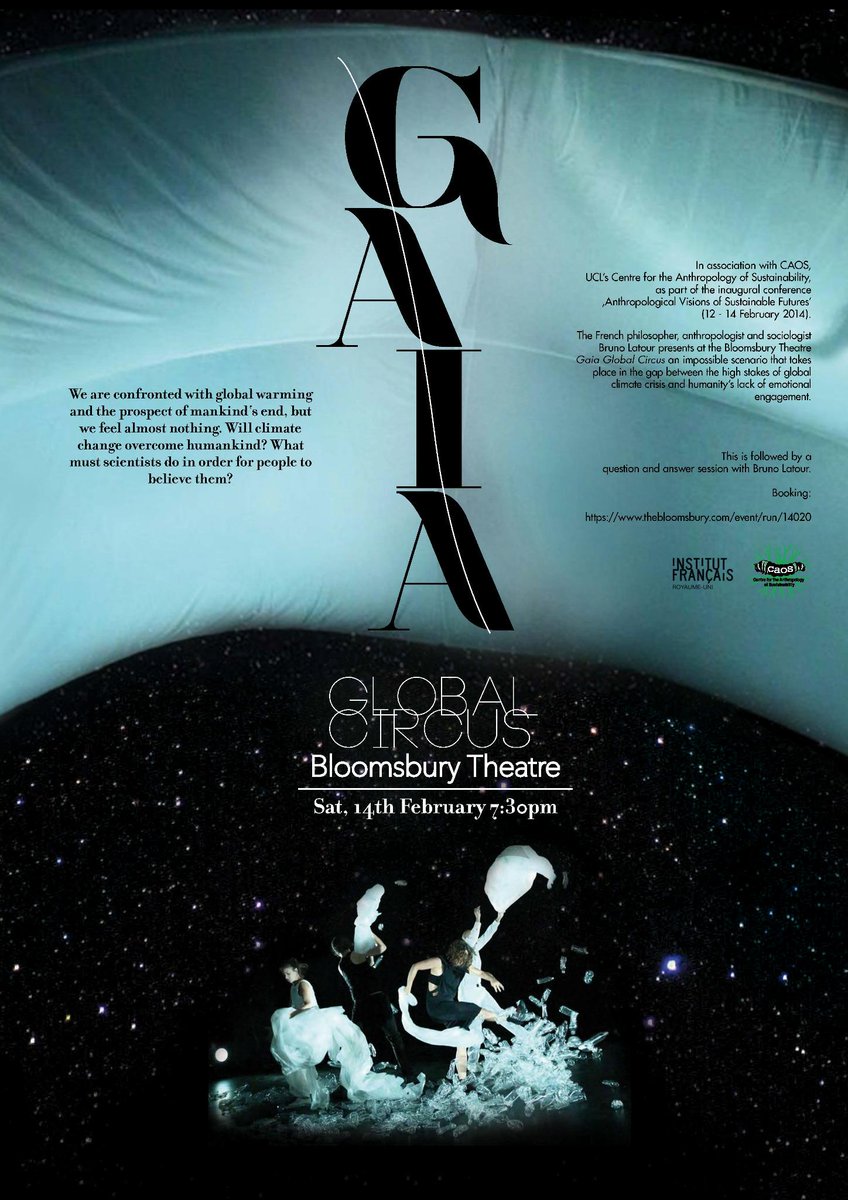
Next weekend at UCL's Bloomsbury Theatre, 'Gaia: Global Circus,' a play by Pierre Daubigny and organised by Bruno Latour, will have its first UK performance. There are still a few tickets left. It should be an interesting experience!


It'll also give me a chance to go and see the exhibition on James Lovelock at the Science Museum, which is on until April.


That particular feature brought to you in association with Shell, Siemens, Bank of America and other presumably generous benefactors.

Tuesday, 3 February 2015

Hot off the press: 'Back Down to Earth: Reassembling Latour's Anthropocenic Geopolitics'

After much preamble on this blog over the past few years, my first journal article has just been published online (it will appear in print at a later date as part of a special issue).

Abstract:
The principal intuition of this article is that Bruno Latour’s explicitly or implicitly ‘geopolitical’ works – strewn as they are across many years and innumerable texts – have not yet been coherently assembled in such a way that their critical interrogation relative to contemporary debates in political geography can gainfully proceed. Such a reassembly must consider ‘earlier,’ ‘later’ and whatever other Latours. Although ‘politics’ per se has, in his more recent works, become just one ‘mode of existence’ among others, every aspect of Latour’s thought has political ramifications. Consequently, his works must be read ‘anthropologically’ – that is to say, in cognisance of the interimplicatedness of every typological strand of ‘the social’ taken altogether. In short, this article attempts not only to read Latour’s works more interconnectedly than have other readers, but, furthermore, to read Latour’s ‘geopolitical’ writings in a more joined-up fashion than he has himself written them. To this end, it (1) introduces the major elements of Latour’s political philosophy, highlighting the importance of geopolitical issues and concepts from his early works onwards; (2) précises his 15 ‘modes of existence,’ laying out the philosophical resources that will be subsequently rewoven; (3) examines six key allies with whom he rearticulates first geo (James Lovelock, Peter Sloterdijk) and politics (Walter Lippmann, John Dewey) separately and then geopolitics (Michel Serres, Carl Schmitt) itself; and, finally, (4) details his Anthropocenic geopolitics conceptually by speculatively intertwining the above with his recent Gifford Lectures. The reassembly attempted – or, rather, initiated – herein is, therefore, neither disinterested nor definitive. It is a working through of the possibilities internal to a specific, albeit sprawling, bundle of texts. It presents a reading both constructive and ‘charitable’ – not in order to obviate critical interrogations but in the hope of provoking a more incisive debate concerning Latour’s works in relation to political geography.
If anyone without institutional access wants a copy, this link allows 50 downloads free of charge. (If those with institutional access could download from the normal page, that would be appreciated.) If and when that route is exhausted, just drop me an email (see top right between 'Subscribe' and 'Archive') and I'd be happy to oblige.

Saturday, 22 November 2014

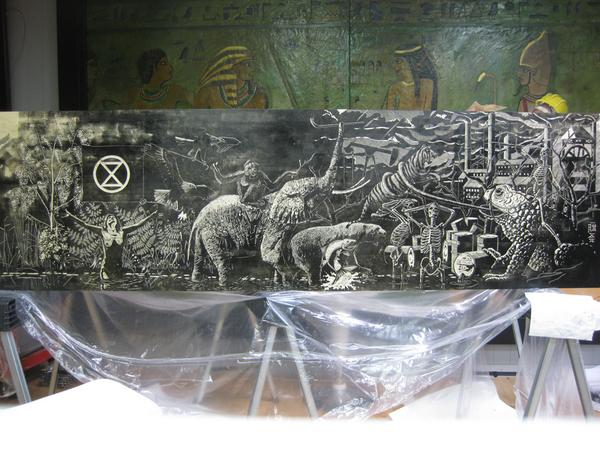
Gaia in woodcut—the artwork of Gordon Liddle

Some arresting images!

See more here. This is what the artist has to say about his work:
I have used Gaia as a metaphor for this print and a series of paintings (underway). She is shown in the print raising her arms below the symbol for the Sixth Extinction, borne by the two eagles. The Sixth Extinction (Holocene Extinction) is being triggered by humans by our treatment of the environment, recently accelerated to about 140,000 species per year. Huge population growth, resource depletion, deforestation, ocean trawling, dumping and industrialisation leading to climate change have exacerbated this event. Gaia stands within a paradise, mother nature, the earth in all its splendour, whilst on the other side are the humans with their processes of destruction: too many to place in a single woodcut, hence the series. The creatures (I’ve shown a few) are leaving Gaia and bound to extinction, ensnared by pollution and destruction. The remnants of humanity wail in despair at the spectacle, unable to stop their own demise. The science is overwhelming now, either we act or we perish. There is no planet B to escape if we destroy life here. My picture is a warning, a lament, my contribution to the debate on the future of humanity and our relationship with Gaia.
I would quibble the mother nature bit—indeed, the personification of Nature as Woman.

Saturday, 4 October 2014

Be careful who you dance with; or, The dangers of modernist post-naturalism; or, The discordant choreographies of the Anthropocene

For some commentators, the advent of the Anthropocene as a geohistorically timely concept has been a cause for celebration in at least one respect: it has thumped the final nail into the coffin of 'Nature' qua absolute, immutable outside. This post argues at possibly interminable length what can also be stated simply and with pith:

Those dancing on the grave of Nature should be careful who they dance with.

Because there are those for whom Nature's demise signals the coming of nothing less than a new White Man's Burden—this time it is the burden of Humans tending a prostrate, pathetic, infantilised and mostly lower-case nature. As though perturbation implied control.

Take this from Erle Ellis, an environmental scientist writing in Wired magazine in 2009:
You are living on a used planet. 
If this bothers you, get over it. We now live in the Anthropocene ― a geological epoch in which Earth’s atmosphere, lithosphere and biosphere are shaped primarily by human forces. 
Yes, nature is still around ― back-seat driving, annoying us with natural disasters from time to time, and everywhere present in the background ― but definitely in no position to take the wheel. That’s our job now. Don’t blame nature for global warming, sea level rise, invasive species, mass extinctions, crop failures and poverty. That’s our thing.
Or these excerpts from Ellis' article in New Scientist magazine in 2011:
[…] it's high time that we – and I do mean all of us – take stock of the new Earth we have created. 
Earth’s biodiversity, biogeochemistry and evolution are now profoundly reshaped by us – and are therefore in our hands. 
It is no longer Mother Nature who will care for us, but us who must care for her. 
[…] can we create a good Anthropocene? In the distant future will we be able to look back with pride? […] We most certainly can […] In the Anthropocene we are the creators, engineers and permanent global stewards of a sustainable human nature.
Or these snippets from Mark Lynas, a British journalist and consultant to the President of Mauritius; for Lynas human beings are now nothing less than The God Species (2011):
On a planetary scale, humans now assert unchallenged dominion over all living things. 
[…] playing God (in the sense of being intelligent designers) at a planetary level is essential if creation is not to be irreparably damaged or even destroyed by humans unwittingly deploying our newfound powers in disastrous ways. At this late stage, false humility is a more urgent danger than hubris. The truth of the Anthropocene is that the Earth is far out of balance, and we must help it regain the stability it needs to function as a self-regulating, highly dynamic, and complex system. It cannot do so alone. 
[…] the first responsibility of a conquering army is always to govern. 
In reality we can build our way out of climate change […] 
[…] simply knowing what we are doing means that none of our actions in the future that affect the climate can be called unwitting. Our hands are on the thermostat whether we like it or not, so sooner or later we are going to have to face up to the need to make a decision about what temperature we want our planet to be at over the longer term. 
Finally, this introductory remark from Emma Marris' book Rambunctious Garden (2011):
We are already running the whole Earth, whether we admit it or not. To run it consciously and effectively, we must admit our role and even embrace it. We must temper our romantic notion of untrammelled wilderness and find room next to it for the more nuanced notion of a global, half-wild rambunctious garden, tended by us. (p.2)
It is not at all difficult to hear the unabashed reclamation of the modernist telos in these claims, as well-intentioned and agreeable as each of the above authors may otherwise be. This is a problem. We are not, in the above, so very far away from the high modernist idealism of Pierre Teilhard de Chardin in his book Building the Earth [Construire La Terre] (1958):
[…] mankind is not an accidental phenomenon occurring by chance on one of the smallest stars in the sky. Mankind represents the culmination of the whole movement of matter and life, so far as it is within the range of our experience. 
[…] real unity, to the extent to which all the world is finally at one in recognising that the function of man is to build and direct the whole of the Earth.

In us the evolution of the World towards the spirit becomes conscious. 
Intellectually, the progress of science is proceeding to construct a synthesis of the laws of Matter and Life, which, fundamentally, is nothing else but a collective act of perception; the World seen in the same coherent perspective by the whole of Mankind. The future of the Earth is in our hands. How shall we decide?
Nor is it so different from the thoughts of the Russian geochemist and philosopher Vladimir Vernadsky, writing just after the Second World War:
If man understands [that the strength of mankind is derived from its brain] an immense future is open before him in the geological history of the biosphere. […] we may face the future with confidence. It is in our hands. 
We are entering this new spontaneous process at a terrible time, at the end of a destructive world war. But the important thing for us is the fact that the ideals of our democracy correspond to a spontaneous geological process, to natural laws – the noösphere. So we can look at the future with confidence.
The neo-noöspheric pretensions of the modernist Anthropocene celebrators are widely evidenced. If the above references are a little obscure then take this from Daniel Dennett's book Freedom Evolves (2003):
We are outnumbered on this planet [by other species] but though we are in the minority, our capacity for long-distance knowledge gives us powers that dwarf the powers of all the rest of the life on the planet. Now, for the first time in its billions of years of history, our planet is protected by far-seeing sentinels, able to anticipate danger from the distant future–a comet on a collision course, or global warming–and devise schemes for doing something about it. The planet has finally grown its own nervous system: us.
The final sentence of that paragraph is taken as the epigraph to James Lovelock's most recent book A Rough Ride to the Future (2014), a book that I've written about on this blog previously.

Evidently, dancing on the grave of Nature qua absolute, immutable outside in no way necessitates the abandonment of modernist onto-imperialism, nor human exceptionalism, nor anything of the sort.

Now, don't get me wrong, it's not that I'm not dancing too, it's just that I'm finding myself more and more wary of those that I'm dancing with.

No one has made more of a cause célèbre of the Anthropocene than Bruno Latour; he has literally monumentalised it. This short essay written for The Breakthrough Institute (2011) chimes fully and loudly with the above:
France, for its part, has never believed in the notion of a pristine Nature that has so confused the "defense of the environment" in other countries. What we call a "national park" is a rural ecosystem complete with post offices, well-tended roads, highly subsidized cows, and handsome villages. 
Those who wish to protect natural ecosystems learn, to their stupefaction, that they have to work harder and harder—that is, to intervene even more, at always greater levels of detail, with ever more subtle care—to keep them "natural enough" for Nature-intoxicated tourists to remain happy. 
Like France's parks, all of Nature needs our constant care, our undivided attention, our costly instruments, our hundreds of thousands of scientists, our huge institutions, our careful funding. But though we have Nature, and we have nurture, we don't know what it would mean for Nature itself to be nurtured.
Nigel Clark has criticised Latour's work for hewing too close to an excessive constructivism in his book Inhuman Nature. However, the obvious resonances of this extract with the foregoing should not be taken altogether out of context; particularly, Latour's more recent work supplements his constructivism. The crucial importance of Gaia for Latour (and, in fairness, for Lovelock) is precisely that she is utterly beyond our ken and unquestionably outside of our control, even if she is essentially immanent to our atmo-chemically effluent perturbations. It is Gaia that wreaks revenge, not us; we are little more than 'tics on her mane.' There is no possibility of mastery here.

This is the crucial difference: It is not enough to simply celebrate the end of 'Nature'—one must also recognise that its successor, Gaia, is more not less fearsome.

There's a saying, supposedly Inuit, that appears on motivational posters and in books of popular quotations: When you're walking on thin ice you might as well dance. Are we dancing because we are fully cognisant that the ice might crack at any moment or because we are so very excited see such a great and glorious future laid out before us? Nothing could be more crucial than this difference.

Are these the last days of Rome or the first?—Our entire Anthropocene choreography pivots on this crucial geopolitical distinction. Entirely different terrestrial ensembles will result from the following through of these distinct plans of movement. They are worlds apart.

It's a ghoulish thought, dancing on the fragilely interred. Might we yet plunge into Nature's icy grave? Might we follow the path of Nature after all; that is, out of existence? I, for one, am disinclined to link arms with anyone who fails to see this as all too real of a possibility.

Thursday, 25 September 2014

Silent Running at the Eden Project / Sci-fi in the Anthropocene

As one of several plates that I'm currently spinning, I'm writing (or, rather, at the moment planning) an article on the 1972 science-fiction film Silent Running.


In a nutshell, the article is about space in the Anthropocene, analysing this film in the context of sci-fi film more widely in order to understand how our collectively imagined attitudes to nature, ecology, space and outer-space have changed, are changing and need to change further.

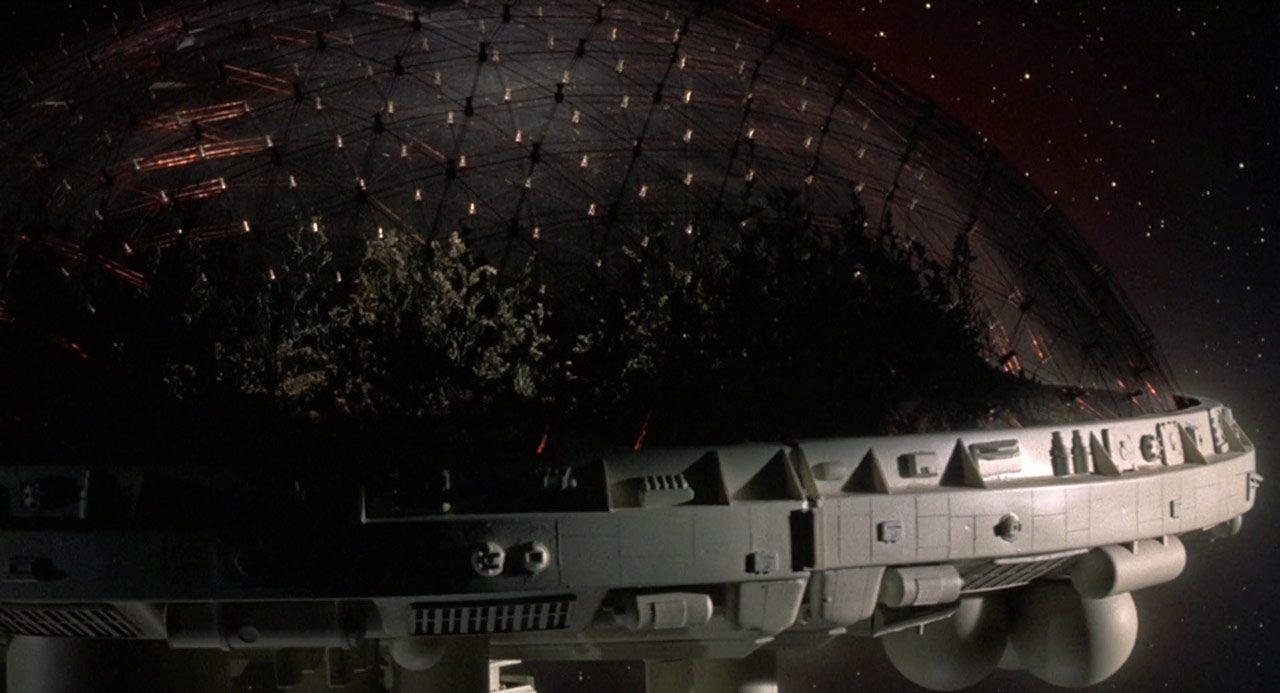
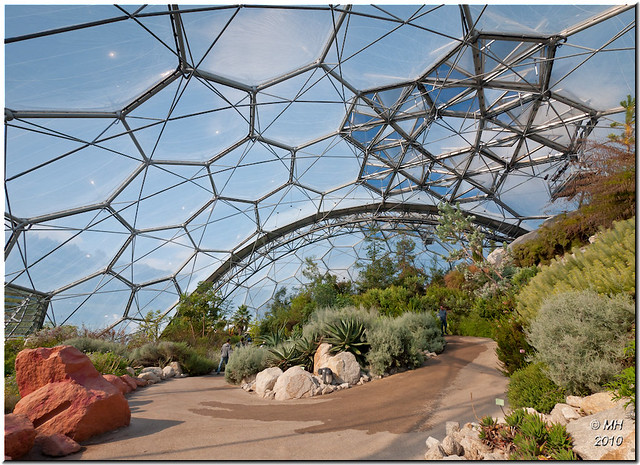
Fortuitously, as part of its 'Days of Fear and Wonder' series, the BFI (British Film Institute) is putting the film on at the Eden Project in Cornwall – a tourist attraction I grew up just a few miles from.

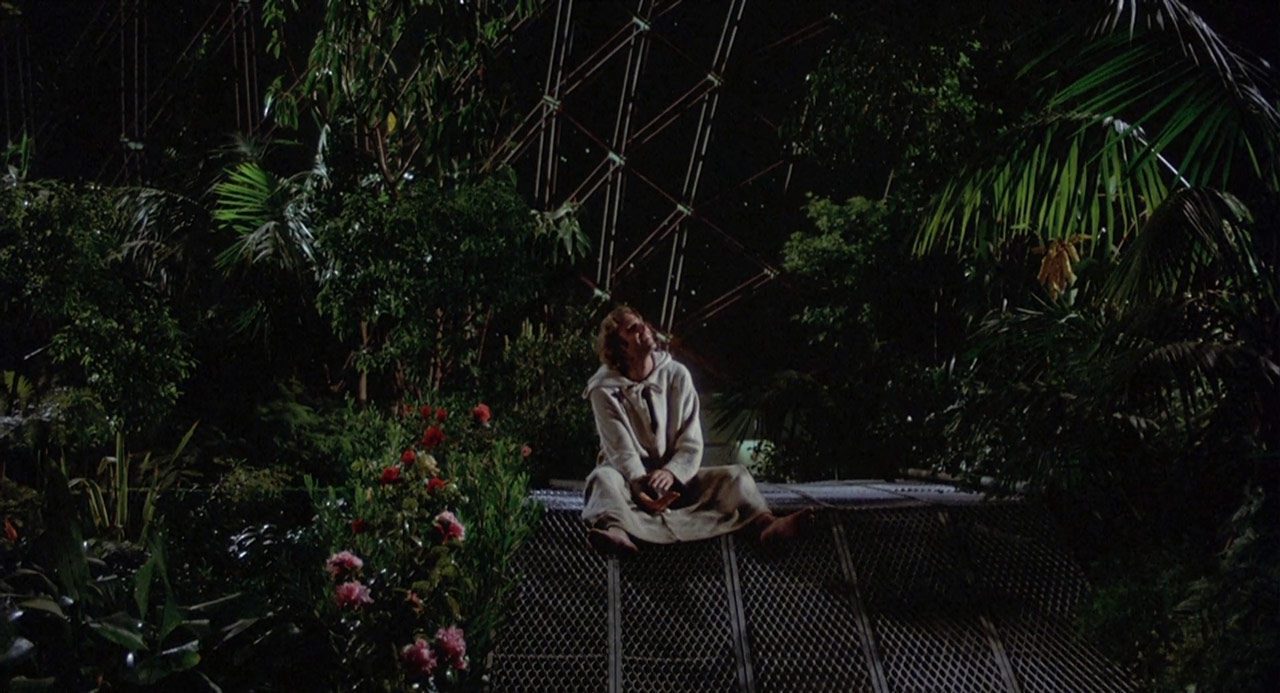
Silent Running's geodesic biodomes inspired the domes at Eden, as one can plainly see:


I am very much looking forward to it!

Incidentally, the last time I went to Eden was to see Sigur Rós perform there last year, which was an experience bordering on transcendent.


The most ethereal, other-worldly music in the most surreal, other-worldly setting. I've seen Sigur Rós perform nearly a dozen times and this was the most perfect mise-en-scène for them.

There's certainly something about these spaces that is musically inspiring. Adrian Utley of Portishead and Will Gregory of Goldfrapp have composed pieces to be played in the Mediterranean biome before the screening of the film.


(Sadly the film will not be shown in the biomes themselves but rather in the visitor centre that overlooks the site.)

Another slightly eccentric rock band, 65daysofstatic, re-scored Silent Running and have performed their version live a number of times (never gotten to see that though, unfortunately):


(By the by, if you've not seen the film before I'd recommend watching the original before the 65daysofstatic version, as brilliant as their score is.)

The film critic Mark Kermode, who has a BFI-curated book on Silent Running coming out soon, is also going to introduce the picture.

All in all, I'm pretty excited! It's provoking lots of thoughts for me with regard to my research. I've started reading semiotics for this project and it's very challenging to think about how I can conceptualise the 'intertext' of the film, so broad and 'beyond-textual' as it all is.

The film's director, Douglas Trumbull, rose to prominence for being one of the foremost special effects wizards on Kubrick's 2001: A Space Odyssey. Off the back of that success he was given $1m by Universal Studios, as a directorial debutant, to make whatever film he wanted. He describes Silent Running as the 'human' reaction to 2001 – it's a film all about emotion, relation and affect; where 2001 is cold and impersonal, Silent Running is warm and intensely personal.

It is often dismissed as an out-of-date, hippy-era melange of preachy nature-worship – and there is that element to it, for sure (see the painfully kitsch Joan Baez song 'Rejoice in the Sun' that was written for the soundtrack, for example); however, its beating heart is the incredible lead performance by Bruce Dern.

(Griemas & Fontanille's The Semiotics of Passion: From States of Affairs to States of Feelings is interesting in this regard, though I don't yet know enough semiotics to really understand it properly. It's an intimidatingly technical discipline.)

It's both the outdated ontology of nature implicit within the film's political aesthetics and the intense, emotional core of the story that I'm interested in. These things together are what make this such an interesting film.

Beyond the narrow 'intertext,' there's also the tourist-ecological relation in the fact that these domes, or derivatives of them, were materialised on a grand scale in an abandoned quarry in a sleepy, quiet and rather impoverished part of Cornwall. And, of course, these are not the only such domes in the world.

Then there's the author-biographical fact that I grew up close to where these domes are and know the area. This, I think, affects how I experience the space of the domes and, consequently, perhaps the film. It will be an interesting phenomenological experience.

There's also a 'making of' documentary that reveals much about how the film was produced and the motivations and mindsets of the performers. Crucial, I think, is that there are no women in this film whatsoever besides a little girl whose picture on the wall is gestured to rhetorically by the main character at one point (and at a pivotal moment in the film, I might add). In this documentary we see that, as one might expect of the time, women are pretty much nowhere to be seen on the production side of things. I find this interesting because of the lead character who blends a sometimes ferocious masculinity with a sensitivity that might have been quite strikingly effeminate in context. Dern recounts jogging around the naval base at which the filming was taking place and being left in no doubt that the world wasn't ready for a long-haired hippy running about the place. The only women in the 'making of' are seemingly either organisational or ornamental; in the film itself there's almost no trace of women-kind whatsoever. And yet the lead character is far from being a straightforward 'man's man,' although he is far from being 'unmanly.' Does he project a progressive masculinity or simply a man's idea of what progressive masculinity would look like? The latter, I think; however, it's interesting either way, especially given the ecological context of the film.


Finally, the spaceship on which the film is set is named the Valley Forge, after the aircraft carrier on which it was filmed, which in turn was named after an important site in the American Revolution:
Valley Forge in Pennsylvania was the site of the military camp of the American Continental Army over the winter of 1777–1778 during the American Revolutionary War. It is approximately 20 miles northwest of Philadelphia. Starvation, disease, and exposure killed nearly 2,500 American soldiers by the end of February 1778.
Ecology and terror are baked into the film's very pretext.

I think it'll be impossible to weave all these threads together into a neat and perfect plait. However, there's certainly plenty to be working with. Here's the abstract as it's been proposed:
This paper examines ontologies of nature and their cognate concepts of space as they are represented in popular culture, particularly in science fiction. It does this through a close, contextualised and intertextualised reading of Douglas Trumbull’s 1972 film Silent Running. It proceeds in two parts. First, the ontologies of space and nature that are implicit within SR’s ecological mise-en-scène are examined alongside Bruno Latour’s rendering of James Lovelock’s concept of Gaia. This is used to theorise the ‘counter-Copernican revolution’ whereby our futural spatial imaginaries are turned around and transformed – as the protagonist in Christopher Nolan’s Interstellar (2014) puts it: “We used to look up at the sky and wonder at our place in the stars, now we just look down and worry about our place in the dirt.” The second section detects deeper and more sophisticated space-creative processes in the manner by which SR’s protagonist, Freeman Lowell, fabricates a life for himself alone aboard the damaged, drifting, dome-clad spaceship in which he is ensconced. This inner-space construction is analysed in terms of Peter Sloterdijk’s ‘microspherology.’ This paper therefore relates to a number of issues in contemporary spatial and cultural theory: the effect of the Anthropocene and the ‘irruption of Gaia’ upon our cosmic spatial imaginaries; affective, postphenomenological theories of the construction of space and their ecological politics; and, finally, the relationship between Latour and Sloterdijk, two major theorists of space whose work has not yet been compared in adequate detail. In short, this paper examines what happens to spatial, terrestrial, imaginative, immunological existence when it is realised that, as Latour (2013) puts it, “we are imprisoned in [the Earth’s] tiny local atmosphere” – when space ceases to be ‘the final frontier.’ 

Tuesday, 23 September 2014

Latour on Tyrell and Gaia

I previously wrote about Toby Tyrell's book On Gaia and Clive Hamilton's references to it at the AIME colloquium. Bruno Latour himself has recently written/spoken about this book at an event in Rio. Suffice to say, his reading of Tyrell's book is scathing. However, there is far more to the text than just the critique. He fleshes out his post-Darwinian reading of Lovelock's work quite a bit and makes very clear the fundamental inscrutability and plurality of Gaia as he understands the concept.
Lovelock describes a planet that is alive because his prose is alive, meaning that any time you add an entity, even if it's a gas, a rock, a worm or a mat of micro-organisms, it vibrates with all the historical specificity of the other agencies intertwined in it. (18)

Tuesday, 26 August 2014

More on Lovelock, technical evolution and the climate apocalypse

I've just re-read through James Lovelock's A Rough Ride to the Future (2014) for a paper I'm presenting this week. In a previous post I mentioned how he had reversed some of his earlier apocalypticism with regard to Gaia and global warming. While it's true that he's now presenting himself as an 'optimist' (169) and damping down the apocalyptic predictions of a human population curtailed to a few hundred million, there are some extremely troubling undertones that remain amidst the hyper-futurist techno-babble.
We have to ask ourselves the painful question: are we seeking the survival of the largest number of humans, regardless of their condition, or seeking the survival of as many as we can keep in an acceptable condition? (110) 
[…] in reality we are not thinking of saving Gaia, we are thinking of saving the Earth for us, or for our nation. […] If I am right to think that our species is evolving maybe to become part of a planetary intelligence, then our most important task for Gaia, as well as for ourselves, is to ensure that enough of is survive to sustain our role as the first species to sense, think about and act to oppose adverse environmental change. […] We are not yet clever nor determined enough to serve in this way, but we could still be the progenitors of those that can. (111)

Perhaps a similar suspension of democracy [as in WWII] will be needed when climate and other changes become as serious and as deadly as a major war. (120)

[Urbanisation might be] a powerful, benign force leading us to a future existence in city super-organisms. (123) 
My hope is that we survive and evolve further to the point where we are as much a part of our living planet as our brains are of us. (131)

[We have] to trust in Gaia to regulate the Earth as she has done since life began, and retreat to the best cities that we can design and build with the objective of saving as many of us as we can […]. (156)

The system cannot sustain the present level of human population for very much longer. (169)
It's clear that, whatever he claims, Lovelock remains a population pessimist. It's also clear that when he asks, rhetorically, 'are we seeking the survival of the largest number of humans, regardless of their condition, or seeking the survival of as many as we can keep in an acceptable condition?' he is erring on the side of urban air-con for the few rather than subsistence for the many.

His 'optimism' is of the techno-utopian variety. The wretched of the Earth remain wretched and voiceless, albeit perhaps with a little more hope for the future thanks to the evolution-accelerating brilliance of inventors (such as James Lovelock).

His pessimistic predictions are never issued with anything like a sense of endorsement or approval; it would be utterly unfair to suggest that. However, he makes them with such an air of blithe disinterest and detachment that he is basically acquiescent to this future. Add to this the extreme superorganic naturalism that he forces upon human political organisation and he is only ever a stone's throw from endorsing the future he foretells. He endorses it teleologically if not morally.

'Resistance is futile in the face of Gaia's evolution'—that is the persisting subtext.

Friday, 8 August 2014

Clive Hamilton and Toby Tyrell on Gaia

Clive Hamilton made two wonderful contributions to the final AIME colloquia/diplomatic summits held the week before last. Both have now been published on his website. First, Gaia Does Not Negotiate; second, When Earth Juts Through.

The latter begins:
With the arrival of the Anthropocene we must now be suspicious of all ideas developed in the last 10,000 years. That includes James Lovelock’s notion of Gaia which, it turns out, is a child of the Holocene. In his recent book, On Gaia, Toby Tyrell shows that since Lovelock put his idea into the world some 30 years ago our understanding of the Earth system has changed dramatically. 
As Earth scientists have found means of taking a more fine-grained view of Earth history, especially through the analysis of ice-cores, the trajectory of Earth appears much more wild and unpredictable. There is no built-in stabiliser; life does not bring the planet back into equilibrium. Gaia is based on old science.
(I love that first line!) Now, I haven't read Tyrell's book but I think one point needs to be made: while Earth system science has moved on in the past thirty years so has Lovelock's take on Gaia. It is true that the original hypothesis posited the Earth as a homeostatic system but that notion of homeostasis has long since been abandoned. 'Gaia' has evolved. Lovelock now well understands that there is no equilibrium as such, only an indefinitely large range of quasi-stable states within a complex system; strange attractors and so on. This is not the same thing as 'homeostasis.' The possibility of a sudden and massive system state shift in response to a relatively minor degree of perturbation is precisely the point of his more recent works. That is why Gaia is 'vengeful.'

Here is how Lovelock differentiates the hypothesis and the theory in the glossary to Revenge of Gaia (p.208):
Gaia Hypothesis
James Lovelock and Lynn Margulis postulated in the early 1970s that life on Earth actively keeps the surface conditions always favourable for whatever is the contemporary ensemble of organisms. When introduced it was contrary to the conventional wisdom that life adapted to planetary conditions as it and they evolved in their separate ways. We now know that both the hypothesis as originally stated and the conventional wisdom were wrong. The hypothesis evolved into what is now Gaia Theory and the conventional wisdom into Earth System Science.
Gaia Theory
A view of the Earth that sees it as a self-regulating system made up from the totality of organisms, the surface rocks, the ocean and the atmosphere tightly coupled as an evolving system. The theory sees this system as having a goal—the regulation of surface conditions so as always to be as favourable as possible for contemporary life. It is based on observations and theoretical models; it is fruitful and has made ten successful predictions.
The hypothesis is not the theory and while I am in no position to scientifically defend either this is worth noting.

While, as I say, I've not read Tyrell's book, this interview on his publisher's website makes for interesting reading. Tyrell makes the case, albeit briefly, that Gaia is simply anthropocentric wishful thinking and should be rejected as a scientific idea:
Q: If the Gaia hypothesis is not the reason, then why did the Earth remain habitable for such an enormously long interval of time? 
A: This may relate partly to the weak Anthropic Principle, whereby we logically cannot observe any facts that preclude our own existence. So however infrequent it may be in the universe for a planet to remain continuously habitable over billions of years, we happen to be on just such a planet. According to this way of thinking, Earth may just have been lucky, with no sentient observers having evolved on other planets which were not so lucky, i.e. where conditions became sterile at some point. Another possible explanation for extended habitability in the absence of Gaia is a predominantly inorganic thermostat, such as has been suggested for silicate weathering.
This is a provocative and contestable claim. However, his concluding remarks are if anything more revealing than his central thesis:
Q: Are there any implications for the current era of global change? 
A: Yes, it is suggested that belief in the Gaia hypothesis can lead to excessive complacency about the robustness and resilience of the natural system. Gaia emphasizes stabilising feedbacks and protective mechanisms that keep the environment in check. If Gaia is rejected, however, we are left with a less comforting view of the natural system. Without Gaia it is easier to appreciate that the natural system contains lines of weakness and other susceptibilities. One such line of weakness that has already been demonstrated is the ozone layer depletion by CFC’s. I have argued in the book that there is no over-riding Gaia to protect our planet’s life support system. Maintaining the Earth’s environment is up to us [emphasis added].
Who is the Modern here? I don't think that it's Lovelock... To suggest that Gaia is a 'comforting' theory is to be a few decades out of date. Yes, the original might have encouraged worshipful idleness and Nature-absorbed complacency but that is not at all the image of Gaia that is now presented to us. In Gaia Does Not Negotiate Hamilton quotes Latour who is in turn ventriloquising Gaia:
I am not your Mother, nor your protector. … So figure out the enigma of my presence.
The motherly vision of Gaia as homeostatic über-regulator is surely a holocenic fable that has long passed its sell-by-date. However, while, as I've mentioned recently, Lovelock is a tricky ally to enrol I'm not sure that Tyrell is a better option.

Without Gaia what planetary imagery are we left with? 'Spaceship Earth'? Again?...

Thursday, 7 August 2014

Lovelock, Singapore and Techno-Superorganicism

James Lovelock's most recent book, A Rough Ride to the Future (2014), backtracks from his previous apocalypticism and, to some degree, from his repeated suggestion that the human global population needs to be reduced to a few hundred million in order to ensure the survival of the species. In this latest work he instead argues that what is needed is a massive and rapid increase in urbanisation and technological development. It is only, he argues, in densely populated mega-cities that humans can keep a low enough ecological profile per capita not to throw Gaia into a wholly hostile state. That is the claim.

Interestingly, the model he holds up for these futuristic urban utopias/dystopias is Singapore -- a city-state often credited as exemplary by futurists in large part due to its success in marrying economic and consumer freedoms with political and social authoritarianism. As a model for authoritarian capitalism in a hot, wet and massively urbanised environment it surely has few rivals.

The epigraph to A Rough Ride comes from Daniel Dennett:
The planet has finally grown its own nervous system: us.
Lovelock thus redoubles his penchant for superorganismic metaphors to describe human society. We are and must become more like ant colonies, he argues. It is only with such technically efficient social organisation that we can hope to survive. Fortunately, we undertake this improbable task endowed with certain gifts. Humans are exceptional Gaians inasmuch as we are the only species able to wire her neurons, to become her mind. We thus have not only the capacity but the duty to undergo this intensive self-systematisation -- 'for Gaia!'

Which brings me to a very interesting (if somewhat toothless) article (accompanied with some beautiful animations) in Foreign Policy today; the headline:
The Social Laboratory: Singapore is testing whether mass surveillance and big data can not only protect national security, but actually engineer a more harmonious society.
I won't repeat its arguments here but it deserves reading -- both in its own right and in light of the above.

With regards to Lovelock the phrase 'Curate's Egg' springs to mind. He is troublesome; but perhaps that is what makes him so important. His potentially genocidal predictions with regard to human population reduction have been heavily criticised but less attention has been given, so far, to his latest thoughts. It is frankly impressive that at 95 years of age Lovelock has flip-flopped from apocalyptic catastrophism to what is basically a qualified capitalist techno-utopianism. But then again, how far apart are these visions?

It would seem a wise bet that our future lies somewhere between the two Lovelocks: between mass eco-death and mass techno-urbanism; perhaps both together.

Sunday, 8 June 2014

'What is space?'

I'll be presenting a paper at the 'What is space?' workshop being held at Warwick in a couple of weeks (17/06/2014). As the programme demonstrates, it's a positively eclectic interdisciplinary event. I'm going to be exploring the title 'Latour, Lovelock and Sloterdijk on being imprisoned in the World.' Looking forward to it!