Sunday, 13 July 2014

'Diplomacy does not exist'—diplomats are servants of the diplomatic frame

From Costas Constantinou's On the Way to Diplomacy:
[…] diplomatic representation functions through simulation, for simulation is traditionally also the art of diplomacy. Simulation is an art, a technique that involves a secret and a challenge. The secret is that diplomacy does not exist. The challenge is to make diplomacy appear. In diplomatic representation, consequently, there is an ironic and fatal alliance, an inaugural quid pro quo between all the subjects involved […] The reality of these diplomatic representations is, therefore, self-referential. It is based on metaphysical rationality that produces its own closure. It involves the capacity to produce a metaphysical picture, to paint articulations, and to frame presences and absences. (p.21)
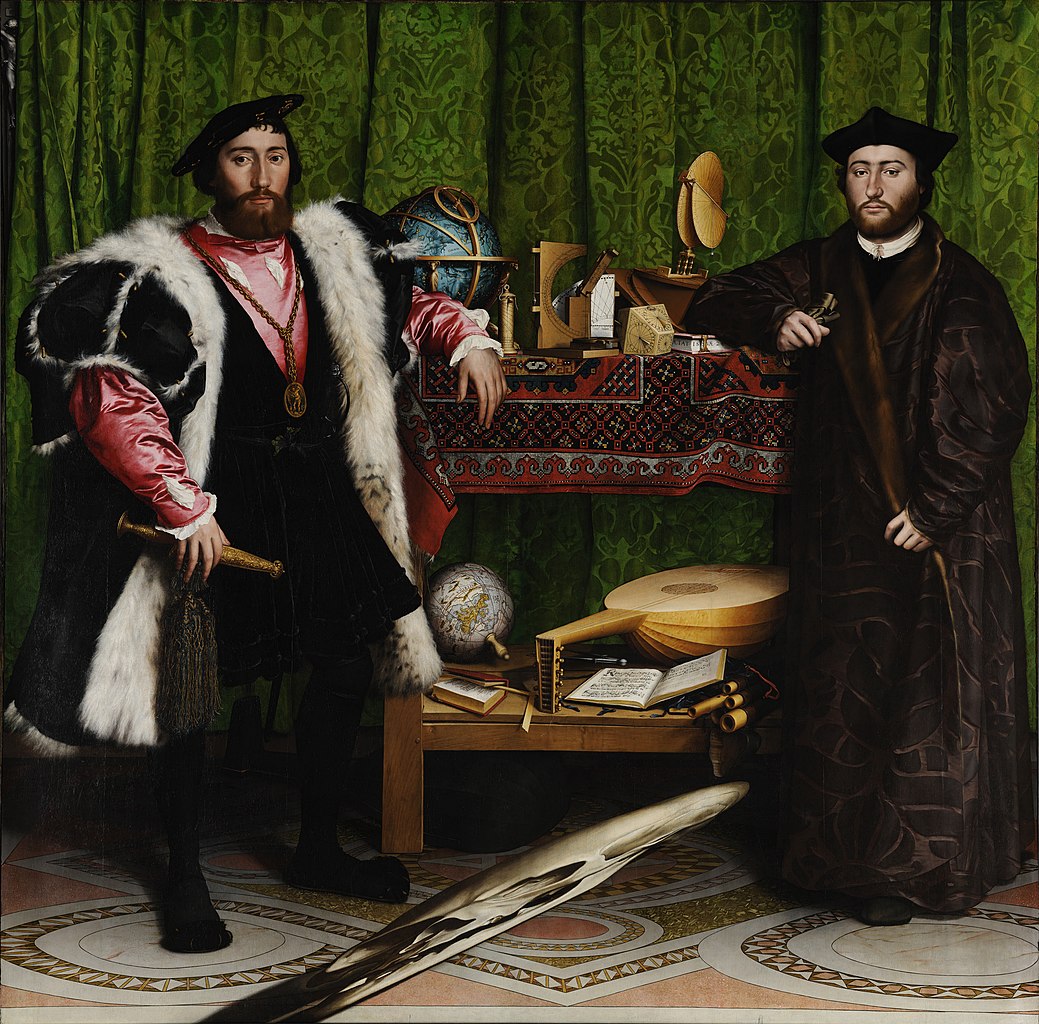
Modern ambassadors are trained to make present the unrepresentable and to see what cannot be seen. They are trained to get the picture and to get into the picture. That is why the ambassadors are enframed, worked in a similar way to those of "The Ambassadors [see below]." (p.22)
Ambassadors are part of and responsible for the diplomatic frame-up—the very construction and animation of the diplomatic world they live in. In and through their confident diplomatic representations, ambassadors normalize the frame-up as the framework. Working within this so-called normal framework they are claimed by their representations and so enter into a power relationship, a relationship of discursive and historical servitude. (Note that the word ambassador stems from the Latin word ambactus, meaning servant.) (p.22)
The primary role of this incredible service is to make credible representations. For diplomatic representation always involves an act of faith (in the picture). It needs to be accredited. Just as ambassadors are required to present their credentials before they can represent, diplomatic representation also needs to be credited itself with establishing a sovereign presence. (p.22)

Sloterdijk on the non-existence of 'Religions'

From You Must Change Your Life:
European Enlightenment—a crisis of form? An experiment on a slippery slope, at any rate, and from a global perspective an anomaly. Sociologists of religion put it quite bluntly: people keep believing everywhere else, but in our society we have glorified disillusionment. Indeed, why should Europeans be the only ones on a metaphysical diet when the rest of the world continues to dine unperturbed at the richly decked tables of illusion? 
[...] a return to religion is as impossible as a return of religion—for the simple reason that no 'religion' or 'religions' exist, only misunderstood spiritual regimens, whether these are practised in collectives—usually church, ordo, umma, sangha—or in customized forms—through interaction with the 'personal God' with whom the citizens of modernity are privately insured. Thus the tiresome distinction between 'true religion' and superstition loses its meaning. There are only regimens that are more and less capable and worthy of propagation. The false dichotomy of believers and unbelievers becomes obsolete and is replaced by the distinction between the practising and the untrained, or those who train differently. (p.3)
In contrast to Latour's translative theology, Sloterdijk's concentration on "regimens that are more and less capable and worthy of propagation" refocuses attention entirely away from the past. Religious truth conditions become entirely presentist: is this regimen worthy or not? It doesn't matter, in and of itself, how many years hermeneuts have agonised over this or that crumb of biblical dogma. There is no prejudice against the nouveau riche of religiosity. If these stratified ponderings upon ponderings going back millennia have generated a rich, beautiful, jumbled jungle of immuno-psychic possibilities then great! However, that is merely the means to the end of the successful religious dispositif, not the end itself.

Religion, in this iteration, becomes fully relativistic and thus fully secularisable and is, therefore, a better diplomatic proposition (from my godless point of view) that the one Latour proposes as [rel].

Friday, 4 July 2014

Diplomas, diplomacy and theory – the folding and unfolding of objects

The diplo- in ‘diplo-macy’ derives from “the ancient Greek verb diploun (to double), and from the Greek noun diploma”[1]; “diplo = folded in two + suffix ma = object” [2; see also]. According to Costas Constantinou, ‘diplomas’ were documents “written on parchment and … papyrus [...] handed over to heralds [and] carried as evidence of their status and authority.” The word diploma later “came to mean a letter of recommendation,” a passport or “an order enabling a traveller to use the public post” [3].

It was only towards the end of the seventeenth century that 'diplomacy' began to attain the meaning we attribute to it today. In 1693, Gottfried Leibniz published his Codex Juris Gentium Diplomaticus, a collection of treaties and official documents which attributed “to the adjective diplomatic the meaning of something related to international relations” [4]. Other European powers followed suit in commissioning large archiving activities such as this; the diploma thus became organised and was a vital resource for statecraft.

However, it wasn't until 1796 that we find 'diplomacy' in its modern form in the writings of Edmund Burke who spoke of the ‘diplomatic body,’ and used “‘diplomacy’ to mean skill … in the conduct of international intercourse and negotiations” [5]. In seventeenth-century Italy, diplomatic agents had become known as “orators” and in most of Europe “ambassadors were still legati” [6].

While the basic elements of the practice of diplomacy may therefore be as old as human being, the word and concept are of quite recent genesis. It's informative to mention at this point the origin of 'theory':
… the Greek practice theôria [is] the etymological precursor to the English word theory. In George Rawlinson's translation of Herodotus, theôria is rendered only as "to see the world," yet theôros has multiple meanings, including a spectator, a state delegate to a festival in another city, and someone who travels to consult an oracle. Theôria is itself a compound of different etymological possibilities: the first half of the word suggests both vision (thea, meaning sight/spectacle) and God (theos), while -oros connotes "one who sees." Unsurprisingly, then, theôrein is the verb meaning "to observe" and is connected to sightseeing and religious emissaries. This etymology posits a link among theôria, travel, direct experience, and vision, but it is in Herodotus's Histories that such practices are tied specifically to the achievement of knowledge: in one of the earliest known uses of the word theôria in the ancient world, Herodotus describes Solon the Lawgiver's journey from Athens for (among other reasons) the sake of theôria and explicitly links theory and wisdom (sophia) to travel across vast terrain (1.30.2). Herodotus reiterates the association among theory, travel, and knowledge when he describes Anacharsis the Scythian (4.76.2) as one who "had traversed much of the world on a theôria and throughout this had given evidence of his great wisdom." [7]
The practical precursor of diplomacy might have been theory (Constantinou makes this point extensively). We could call the 'diplomacy' articulated by Isabelle Stengers and Bruno Latour, therefore, a fittingly theoretical diplomacy. Wisdom, travel, religion and interpolitical relations are all tied up in this web of connections. However, diplomacy, as Stengers and Latour deploy the concept, is rather different to its historical precursors.

The diplomat was once the bearer of the diploma, the emissary that the folded document confirmed. The issues which motivated his journey were borne otherwise; the purpose of the diploma was to authenticate the authority of the received utterances [the science dedicated to the authentication of official documents: 'diplomatics']. It was crucial to the mission but was not its cause.

The folded object remains central to 'cosmopolitical' diplomacy but takes on a different role to one of mere passport. The diploma now does not simply authenticate the diplomat's right to speak but forms precisely the foundation of the entire endeavour.

If the heart of diplomacy remains the diplo-ma – the folded object/document, the duplex entity – then what does this make the diplomat? The diplomat is not the folder of objects (its sovereign – its public – is that which has folded the object and dispatched the envoy). The diplomat is the unfolder of objects that cannot be unfolded by one party. It is as though the causal issues were a giant bed-sheet impossible to fold or unfold by one person alone. The cosmopolitical diplomat is a burdened traveller in search of unfolding that can only come with the meeting of an other.

The diplomat is the one who arrives bearing the folded object but, unlike a mere herald, messenger or legati, is greeted, is subject to elaborate ceremonial attachment to the receiving community and who becomes resident so as to work through the matters at hand – the matters present-at-hand, we might say (the essence of the diploma qua passport was its very unproblematic, indubitable readiness-to-hand).

The duplex character of the diplomatic matter indicates its issue-hood, its status as a matter of concern, of contestation, of disagreement, dissensus, discord. Diplomacy always begins in duplicity; if successful it ends not in unity but in settlement.

The diplomat of this procedure is a transformed character, a theôros – a philosopher, indeed!

------------

[1] Costas Constantinou, On the Way to Diplomacy, p.77.
[2] José Calvet de Magalhães, The Pure Concept of Diplomacy, p.58.
[3] Constantinou, On the Way to Diplomacy, p.77.
[4] Magalhães, The Pure Concept of Diplomacy, p.58.
[5] Ernest Mason Satow, A Guide to Diplomatic Practice, p.3.
[6] Garrett Mattingly, Renaissance Diplomacy, p.130.
[7] Roxanne L. Euben, Journeys to the Other Shore: Muslim and Western Travelers in Search of Knowledge, p.21.

Monday, 30 June 2014

"Resetting Modernity" in Paris

I've just received a flurry of information for the forthcoming 'diplomatic summit' to be held as the conclusion of Bruno Latour's AIME project. It describes the event as (and I paraphrase rather than offering my own mangled translation of the French!) attempting to reflexively redefine the Moderns so that we might present ourselves to Gaia once more under the slogan (and this is given in English) "Reset Modernity." I couldn't help but be reminded of this:


'Designing out crime,' panopticism, etc. etc.

An interesting article today in the Guardian on 'designing out crime' by modifications made to the built environment through planning and design processes:
“You want the rooms most regularly inhabited to be in view of any potential criminals,” says Craig. “It’s what we call ‘natural surveillance’: we like ‘active frontages’ to overlook communal areas so that people are seen and can be seen. The more windows overlooking the street and public spaces, the better.” Enforcing clear boundaries is also important, making distinctions between public and private space with fences and hedges.
[...] 
The crime figures for the area suggest good design has indeed deterred criminals: between 2011 and 2014, just five burglaries were reported in Greenheys, compared with 76 in the surrounding square kilometre. “The fact the estate looks nice helps a lot,” reckons Craig. “If it looks grim, people behave in an accordingly grim way. I think this development shows that compliance with our recommendations doesn’t stifle innovative design. It’s a challenge to planners and architects, sure, but if it’s done right, there’s still scope for imagination.”
There's no doubt that bad urban design (and what mid-twentieth-century architecture in Britain wasn't abominable?) substantially contributes to a poor quality of life – including suffering crime; however, the problem with this is, of course, that it poses a technical fix to essentially political problems. Still, it's an interesting case of the sociology of translation in action.

There's another article from last week about these same practices in Scandinavia. I don't know much about criminology but it'd be interesting to see how this fits in with Scandinavia's generally more progressive approach to crime and punishment. Is it possible to mobilise technical solutions to such problems without this effectively tarmacing over their political causes?

Wednesday, 25 June 2014

On habits and habitats

There's another great write up on the AIME Group blog. This is my favourite bit from chapter 10 on 'Learning to Respect Appearances':
Without habit, we would never have dealings with essences, but always with discontinuities. The world would be unbearable. It is as if habit produced what stays in place on the basis of what does not stay in place. As if it managed to extract Parmenides’s world on the basis of Heraclitus’s. We can say of habit that in effect it makes the world habitable, that is, susceptible to an ethos, to an ethology. (268)
Without habits we cannot become habitated, we cannot have habitats (Latin habitare "to live, dwell," frequentative of habere "to have, to hold, possess"). Habits are therefore things to be celebrated, with the proviso that there are good and bad habits, habits that forget being-as-other and those that retain a connection with it.

[hab] answers a problem that I've found with Latour's philosophy from the beginning: if everything at every moment is in a perpetual state of perishing and becoming something else (and if this process is essentially discontinuous at each moment) then isn't our everyday experience an illusion? Apparently not; we mostly experience through habit for the most part. If the world seems to flow together smoothly and continuously then this is because, when habitated, this is exactly how it is.

This links nicely with Latour's reading of Sloterdijk's spherology. If spheres seem too smooth and continuous to be incorporated into the ontology of networks then we need only consider that such habitats benefit from regimes of habit. We cannot live in broken, bitty, fractured networks; we can only live in envelopes, blankets and containers that permit implicitation—that allow elements of our environment to be taken for granted (even if they are not God- or Nature-given). Habit permits the connection of these two ontologies: the network and the sphere.

Sunday, 22 June 2014

More on Clive Hamilton on optimism

Reading the pieces mentioned in my last post reminded me that I've had Clive Hamilton's Earthmasters on my bookshelf for a few weeks now. Finally getting around to read it this weekend I've found it to be an outstanding introduction to the issue of geoengineering. I'm about half way through and just getting into the discussion of how these technologies intersect with geopolitics. Anyway, I particularly enjoyed this section on the follies of optimism as an end in itself:
Some people derive a peculiar sort of pleasure in describing themselves as an 'optimist.' It's a kind of one-upmanship used to shut down those arguing that the evidence shows the future is not rosy. 'Whatever you might say, I am an optimist,' they declare, implying that their interlocutor is somehow not bold enough to take on the challenge. It's not so much passive aggression as sunny aggression firmly rooted in the moral superiority of cheerfulness [...] (104-105)

Friday, 20 June 2014

Clive Hamilton on the 'new environmentalists' and the 'good Anthropocene'; the rough edges of political aesthetics

An important article by Clive Hamilton on the 'new environmentalists' and the so-called 'good Anthropocene':
[...] almost as soon as the idea of the Anthropocene took hold, people began revising its meaning and distorting its implications. A new breed of ecopragmatists welcomed the new epoch as an opportunity. They gathered around the Breakthrough Institute, a “neogreen” think tank founded by Michael Shellenberger and Ted Nordhaus, the authors of a controversial 2004 paper, “The Death of Environmentalism.” They do not deny global warming; instead they skate over the top of it, insisting that whatever limits and tipping points the Earth system might throw up, human technology and ingenuity will transcend them. 
As carbon dioxide concentrations pass 400 ppm for the first time in a million years, and scientists warn of a United States baking in furnace-like summers by the 2070s, Shellenberger and Nordhaus write that by the end of the century “nearly all of us will be prosperous enough to live healthy, free, and creative lives.” The answer, they say, is not to change course but to more tightly “embrace human power, technology, and the larger process of modernization.” 
The argument absolves us all of the need to change our ways, which is music to the ears of political conservatives. The Anthropocene is system-compatible.
[...] 
In the words of the most vocal eco-pragmatist, the environmental scientist Erle Ellis, “We will be proud of the planet we create.” Ellis speaks of “the good Anthropocene,” a golden era in which we relinquish nostalgic attachments to a nature untouched by humans and embrace the new epoch as “ripe with human-directed opportunity.”
By the final quoted paragraph in particular I am reminded of Nigel Clark's thesis in Inhuman Nature (and other writings) where he holds constructivism (particularly of the Latourian variety) as being effectively complicit with the over-statement of human agency in the face of overwhelmingly inhuman forces. I don't agree with parts of his analysis; however, the above clearly demonstrates his wider and more important point: that we must reckon with our finitude -- and fast.

In another article on the same themes posted only a few days ago Hamilton writes:
In the end, grasping at delusions like “the good Anthropocene” is a failure of courage, courage to face the facts. The power of positive thinking can’t turn malignant tumours into benign growths, and it can’t turn planetary overreach into endless lifestyle improvements. Declaring oneself to be an optimist is often used as a means of gaining the moral upper hand: “Things may look bad but, O ye of little faith, be bold and cheerful like me.”
There is a point at which optimism starts to become pathological; I think this the point where it is taken to be an end in itself. In a society with a fully-developed pathology one can win an argument simply by being optimistic; one can, with a snide chuckle, merely brush off inconvenient questions simply because they are uncomfortable. One's cognitive comfort (and that of the well-heeled choir to which one preaches) comes first and prevails over and above all dissuasive shrieks and cries. Those who suffer must not only suffer but also do so quietly.

I must say that excessive optimism is not a condition not something that we Brits are overburdened with in general.


However, that does not mean that we are not similarly insensitive. Most of us would sooner starve half the world than give up our cars or our South African asparagus (though we would never admit this, least of all to ourselves).

I don't suppose that any of the 'eco-pragmatists' would agree with a word of what I am polemically attributing to them; however, this really does seem to be the unavoidable conclusion of their line of thinking -- how else will they sustain their fantasy if not by exporting disconfirmatory externalities into the bodies and atmospheres of others?

The incapacity to cognise discomforting information as anything other than a falsehood (false because it is discomforting) leads inexorably to chronic insensitivity.

If we're not afraid then we really haven't been paying attention.

Political aesthetics must have rough edges.

Political aesthetics, realpolitik and the composition of the common world

Michael L. Thomas has a really useful summary of Latour's diplomatic political philosophy and, in particular, the importance of aesthetics to this vision of politics (thanks to dmf for pointing to this).
An Inquiry into Modes of Existence, the most recent publication of Bruno Latour, represents an exciting new philosophical project in so far as it raises an audacious question in a novel methodological light: “How do we compose a common world?” On its surface, this question calls forth images of universality of human beings, a “kumbaya” society organized through a shared vision and lack of conflict. The question changes in the hands of Latour, however, insofar as it is not a question of normativity, but of what I term political aesthetics. In deploying this term, I mean to diverge from its usage in Benjamin and others concerned with the relationship between art and the state, and, instead, towards the sense in which the construction of a common world involves determining principles of the articulation and communication of forms of experience. These principles are not decided in advance but generated through making the construction of reality in the present more explicit, thus providing pathways to forge connection between modes of experience (existence) and generating a ground to negotiate reality in the present.
I don't know if Michael has looked at Latour's Gifford Lectures from last year but there he goes into much more detail on his political aesthetics. John Dewey's The Public and its Problems is key here. The fundamental point for Dewey is that:
the consequences of conjoint action take on a new value when they are observed. (24)
There is therefore a political imperative to render constituents sensible to both the consequences of their own actions and to the issues that affect them and their interests. Indeed, if this doesn't happen then there is no politics. In this vein Latour argues that we must:
[...] agree to hear in the word aesthetic its old meaning of being able to ‘perceive’ and to be ‘concerned,’ that is, a capacity to render oneself sensitive, a capacity that precedes any distinction between the instruments of science, of art and of politics. (97)
[...] we have to weave ourselves, to cocoon ourselves within a great many loops so that progressively, thread after thread, the knowledge of where we reside and on what we depend for our atmospheric condition can gain greater relevance and feel more urgent. This slow operation of being wrapped in successive looping strips is what it means to be ‘of this Earth.’ And it has nothing to do with being human-in-nature or human-on-a-globe. It is rather a slow and painful progressive merging of cognitive, emotional and aesthetic virtues because of the ways the loops are rendered more and more visible through instruments and art forms of all sorts. Through each loop we becomes more sensitive and more responsive to the fragile envelopes we inhabit. (95)
In these lectures Latour goes beyond the human-focused diplomatic politics of AIME and opens up onto a world where every living being is sensitive to the world around and which subtly adjusts its environment to suit its own needs during the course of its own evolution (as per the Gaia theory that Latour has made his leitmotif in the last decade or so). In this new political scenography our fragile Sloterdijkian atmospheres and envelopes are what is at stake; science is the most powerful tool we have in explicitating our immunological conditions:
Science is the new aesthetics able to render us sensible to where we are standing. (130)
However, science cannot replace politics. A scientised politics is as worthless as a politicised science. These practical institutions cannot be separated but not should they be conflated. Science cannot decide, only politics can. As Michael rightly notes, this is not a 'kumbaya' political philosophy. Political aesthetics is necessarily conjoined to a kind of political realism extended to non-humans. In AIME Latour writes:
Yes, there are beings that do not deserve to exist. Yes, some constructions are badly made. Yes, we have to judge and decide. (142)
In 2005 Latour argued for 'dingpolitik' as opposed to realpolitik; however, there is a strong strand of political realism that runs from his earliest works right up to the present.

The way in which Latour melds the self-consciously post-colonial, post-secularist peace-making political practice of 'diplomacy' with this thorny, decisionist, Schmittean ethos is the key to understanding his political philosophy. They are very much part of the same project, although how successfully they are combined is an open question.

Monday, 16 June 2014

World Cup Comedy

For anyone who watched the 2010 World Cup final and recalls Mark van Bommel's unique take on the beautiful game:


The funniest thing I've heard in ages.

Also very funny and an absolutely brilliant summary of the whole sorry state of affairs that is FIFA:

Tuesday, 10 June 2014

Actor-Network Theory in theory and in practice

Perhaps in theory actor-network theory neglects human reflexivity; in practice, however, ANT accounts are full of fully reflexive humans all reflexively reflecting in their own ways. Mol's The Body Multiple is a paragon of self-awareness and empathy. Latour's Aramis is replete with engineers agonising over engineering, politicians opportunistically politicking, etc. In Gomart and Hennion's A Sociology of Attachment, even drug addicts aren't reducible to their vice; their vice, instead, provokes instances of subjectivation.
[G&H] reveal a subtle interweaving between being abandoned to an external power and the virtuosity of practices, of manual, and of social skills. The user passes between active and passive. That is, between 'I am manipulated' (because I agree to it) and 'I manipulate' (an object which is stronger than myself). (p.243)
There are no more 'network dopes' than there are 'cultural' ones.

And so on and so on.

Nowhere are human beings reduced to being mere 'mouth pieces' of networks; however, the mere fact that humans have reflexive self-awareness isn't allowed to be the be all and end all, the thing that separates humans from other things so fundamentally that they have to be dealt with in separate chapters or with distinct conceptual vocabularies.

Where does that craving for a kind of ontological cordon – a prophylactic for humanness, an agency-shield – come from? It can only come from the fear of automata, the belief in beings that are pure clockwork and simply reproduce their constitutive causes without alteration. ANT dismisses this as a possibility and so the lack of human agency is never really an issue, at least not a priori.

Certainly people are repressed but always in particular times, in particular places and always by particular networks. If something or someone is without agency (and for a human this must mean that they are incapable of understanding what it is that they are doing) then this is something remarkable that must be explained, it isn't something that justifies letting nature bifurcate all over again.

If you are convinced that human beings are engulfed in totalitarian social structures that threaten to drown them in determination then it makes sense to worry endlessly about reflexivity and to make it the alpha and omega of your sociology. If, however, you grant everything agency (of whatever sort and of whatever strength and intensity) as a matter of course and then proceed to understand the meshing of these infinitely variegated agencies in concrete situations then this never becomes a problem since the presence or absence of any kind of freedom is always explained by concrete forces deployed in the case at hand.

In short, actor-network theorists routinely deal with human reflexivity, they just don't make a big song and dance about it.

The above tenets are, of course, entirely questionable and open to criticism; however, unless ANT is criticised for what it does rather than what its humanist critics like to think that it does we'll never get anywhere with anything.

ANT deserves to be critiqued – but it deserves to be critiqued well.

Sunday, 8 June 2014

'What is space?'

I'll be presenting a paper at the 'What is space?' workshop being held at Warwick in a couple of weeks (17/06/2014). As the programme demonstrates, it's a positively eclectic interdisciplinary event. I'm going to be exploring the title 'Latour, Lovelock and Sloterdijk on being imprisoned in the World.' Looking forward to it!


Edward Casey on place and plants

A tree stands in its own place. Its life is sedentary. It is a life in one place, a life without anxiety. Not only is a tree in its place; it actively contributes to its place, filling it up with its own organic substance. It knows no menacing void, even though to move from its own place is to risk the death of the organism. (Getting Back Into Place, xii)
The movement-capability and hence the spatiality of plants is indeed different to that of locomotory animals. Plants are where they are; they move but only by themselves growing; they migrate but only reproductively, across generations.

This is significant. But if what Latour, Sloterdijk and Lovelock all say of the Earth—that it is the only planet we have and that space migration is, most likely, for fools (or those with a death-wish); that we are trapped within this planet's atmosphere—then aren't we as stuck in our planetary place as plants are in their soil (at least those of them that put down roots)? Even more so since it would take many generations to travel to the nearest habitable planet (wherever that is) even at lightspeed.

This ties into the question of 'soil'; humans are rooted to their 'soil' if not to their soil. Indeed, isn't human from humus (earth)? In this way the difference that is meant to found a fundamental difference in being between animals and plants is really just an illusion of scale—we are even more rooted to our 'soil' (let's say humus instead of 'soil') than plants are to their soil. Territory in the sense that Latour uses the term—to designate all those attachments without which a being could not be and that could fail it at any moment—is as applicable to plants as it is to animals, human or otherwise. Every existent has a territory, an umwelt, a humus. Some existents have the capacity to nurture their natures; plants as well as animals do this—all life does it, according to Lovelock's theory.

The serene emplacedness of plants impresses Casey, a partisan for place. Perhaps, then, we do have to recognise our plant-ness; our common vegetal-spatiality. Plants have accepted their place while we try to convince ourselves that we are placeless, infinitely mobile; that we have no air-conditioning requirements, that we can breathe without spacesuits. We are fools, no doubt.

However, I think with this settlement must also come a rejection of some of the exclusivity granted to plants. They cannot do violence, according to the Hegelian theory—but don't they sever, crush, choke, smother and destroy, like other beings? If we are even more trapped and emplaced (albeit against our apparent will) than they are then how can we attain the self-negation that they cannot? Isn't it the self-negation itself that is illusory? It is only on a short scale that these differences appear and cannot sustain differences in kind, at least not in the respects aforementioned.

Saturday, 7 June 2014

Liberal science denial and other tomfoolery

I don't know if this video will stay online for long but it's a really interesting segment from The Daily Show last week:


It's interesting for at least two reasons: First, it ably (and funnily) demonstrates that cynical attitudes towards science are by no means particular to the right (as is often prejudicially assumed, certainly here in the UK). Second, the show's own attitudes towards science are themselves very problematic. For them it basically boils down to 'yeah, but it's a fact so you're an idiot.' Perhaps true but not helpful. What makes a fact a fact? Is it the fact that scientific knowledge is debated in public, peer reviewed (usually well), and is the product of centuries of rigorous and progressive experiment, confirmation, refutation and invention? Perhaps that is in the subtext but barely. The only real message to this is 'yeah, but it's science.' Of course, having said that, the segment also demonstrates that some people simply aren't interested in evidence, whatever ontology it's dressed up in. However, these discussions always seem to happen at a kind of second-order level where two incompatible notions of truth just bash their heads against each other without ever really engaging with each other or even understanding that there is anything to be engaged with. And it can't be otherwise if science-defenders genuinely don't understand what makes science objective other than 'it's science, durr'...

John Oliver said more or less the same thing recently 'you don't need people's opinion on a fact.' Although he produced a slightly more sophisticated (and equally hilarious) take on it when he constructed a 'statistically representative' debate over climate science. The obvious absurdity doesn't detract from the performative effect: that it isn't a 'two sided' debate, as the rest of the media continue to insist that it is; it's a many sided debate with one alliance of viewpoints utterly overwhelming the other. And that's the key point: an alliance of close-knit viewpoints, not just the singular, thunderous voice of Science being spoken univocally in the language of Facts.

William Connolly on Latour's Gifford Lectures; Pluralist conflux

William E. Connolly has posted an interesting piece on Latour's Gifford Lectures on his blog.

Well, I say it's on Latour's Gifford Lectures—for the most part Connolly takes these lectures as a jumping off point for a reflection on his own micropolitical interests; stuff that'll be familiar to anyone who's read his most recent work, particularly The Fragility of Things.

I think that he thoroughly misinterprets Latour's use of the word 'secular.' Connolly takes this to be referring to the 'new secularists' and their role as a political group. I see no evidence of that whatsoever. When Latour says that Gaia is 'secular' he means it, as I understand him, by contrast to Nature, which is an insufficiently 'secularised theological concept' (to use the phrase of Schmitt); it is because Nature presupposes transcendence and Gaia immanence that Gaia is secular—literally 'worldly.' Connolly is reading too much into that, I feel; although, it would be interesting to think how the new secularists would receive such ideas (not well, I'd imagine!).

Connolly also understands Latour as making a distinction between lab scientists and theoretical scientists—I must have missed that but I recall no such distinction being made, nor such a divide having any real importance. Latour waxes lyrical about the 'Earthbound scientists' but seemingly all manners of scientific praxis are included under this umbrella. The key point is that both lab and theoretical sciences must be irreduced, that is escorted back inside their networks; he has this to say about Stephen Hawking, for instance:
It is hard to point out a more situated knowledge than this one: from this very local place on Free School Lane, in the hands of a great scientist, electrons are supposed to have spread successfully to populate all chemical bonding and all computers! But in the next minute, the same physicists will have no qualms about admiring how Steven Hawkings’ mind roams through the whole cosmos in intimate dialog with the Creator, wishfully ignoring that Hawking’s mind benefits not only from a brain but also from a ‘corporate body’ described by Hélène Mialet in her book Hawking incorporated, as composed of a vast network of computers, chairs, instruments, nurses, helpers and synthesizers that are necessary for the step by step flow of his equations. With such a bifocal view of science, it is hard to reconcile the view from nowhere with the highly localised classrooms, office spaces, laboratory benches, computer centres, meeting rooms, expeditionary treks and field stations, where scientists have to locate themselves when they begin to really talk about their findings or to really write their papers. (86)
If anything Latour refuses the distinction between theoretical and lab sciences—both are fully instrumented, incarnated endeavours and that's the important thing about them. The Earthbound need theorists and lab scientists, both—and who embodies that fusion better than Dr Lovelock?

Connolly writes in conclusion:
I am glad Bruno Latour gave these lectures. They focus attention on the severity of the planetary issue and the denials and evasions attached to it. I am also moved by the spirituality that infuses them.
Latour's theology is about as heterodox as one is likely to find anywhere. He refutes the possibility of any kind of fundamental transcendence; God is only what is assembled in the reverential networks of his followers; religious practice transfers no information, only the transformations of love and tradition. Latour's theology jars with most religious theory at least as much if not more so than his thinking jars with most theories of science. However, in these Lectures he also insists upon the translatability of different deities; taking up Jan Assmann's work on mono/polytheism to suggest that we must conceive of Nature, Gaia or OWWAAB (Out of Which We Are All Born) as secular divinities that are at least potentially comparable, translatable with the divinities of others (as were the divinities of the pre-monotheistic world), thus facilitating a geo- or cosmo-politics that removes (or at least de-emphasises) one unnecessary and, frankly, stupid point of confrontation: whether or not there's a God.

This very much plays into Connolly's project of conceiving of political alliances being built across ostensive cultural and religious divides; heterogeneous assemblages that cultivate a certain political vibrancy in anticipation of Events that will draw them together and produce a General Strike, or some-such. (I have my doubts about Connolly's working-through of this point but there's something to it.)

It might be a stretch to call Latour a 'spiritual' philosopher because his theology is so very anti-transcendence (even more so perhaps than Connolly, self-described 'immanent materialist'!). I don't think many of his fellow Catholics would consider him spiritual on the basis of his thinking. His recent book (recently published in English, anyway) on religion—Rejoicing: Or the Torments of Religious Speech—is a paragon of sensitivity and counterintuition but it is really questionable to what extent it is religious in the sense most people understand that (i.e. as spirituality). Just what is the point of a totally immanent God? Latour's theology is religious in the sense that Michel Serres describes religion as rooted in religiens, which is the opposites of negligens—i.e. 'religion is the opposite of negligence' (as he defines it in The Natural Contract). That is an extremely fecund point; I am converted inasmuch as this: 'Whoever has no religion should not be called atheist or unbeliever, but negligent.' To act religiously is an essential part of life, god or no god.

The real meeting point of Connolly and Latour is, however, pluralism—a pluralism that is political, not just metaphysical. It is this meeting point that presents the challenge; it is here that Latour's whole project of 'diplomacy' (taking up Stengers' term) comes into play. It'd be interesting to read a more sustained engagement by Connolly on this matter. There are clear, strong and (dare I said it?) vibrant parallels between these philosophies but also serious differences. Connolly, for me, leans too heavily on the notions of self-organisation. His reading of Hayek in Fragility is nowhere near critical enough either of Hayek's politics nor of the notion of self-organisation itself.

The problem with self-organisation (and I think this is a critique that needs to be impressed upon many, many... let's say post-Deleuzians who take up self-organisation as their ontological aesthetic of choice) is not the organisation aspect, it's the self—what is the self doing the organising? Gaia is, of course, a self-organising system but her 'self' is something that Latour takes some time discussing. She is not a 'super-organism' and not a final cause but rather the product of all the individual organisms, each of whom are their own final cause, their own providence, their own telos, each of whom follow their own interests but, in doing so, produce an effect, an agency in excess of themselves, an effective being that has maintained atmospheric and chemical conditions conducive to life (whatever that has meant in any given era) for billions of years.

For Hayek, of course, the importance of self-organisation is that it validates extreme market-based individualism (although Hayekian neoliberals are well aware of the need for a coercive state to force people to obey their own true selves...). The 'self' here is that of homo economicus, however contrived and enforced his existence may be. A methodological maxim: never speak of self-organisation without speaking also of a self.

Ramble ends.

Geopolitics and varieties of soil

In Latour's recent Gifford Lectures he attempts to redefine geopolitics as the politics of the Earth itself, the central premiss of this being that we must learn to understand the 'soil' to which we are attached and then to find ways of defending that soil. He does not, of course, mean 'soil' literally or straight-forwardly; certainly not reactionarily:
To insist on the soil is to be reactionary in the old way—appealing to ‘Blut und Boden.’ Reactionaries of all hues and colours have always insisted on how criminal it was to attempt to leave the ancient land, to abandon the old soil, to forget the limits of the old nomos, to be emancipated and cosmopolitan. (108)
Although Latour channels Carl Schmitt extensively he does not want to go back to that horrendous, reactionary geopolitics of yore.
[...] there might be another meaning to being attached to the old soil, this time to the Earth. (108)
Our 'soil' is everything that we need to survive; it's also the air that we breathe and the climate that we perturb. However, the actual soil itself is also part of our 'soil.' George Monbiot points to how certain farming methods are literally washing Britain into the sea and how the land-owner lobby in the UK has utterly captured its own regulatory apparatus, making matters worse and more stupid by the day.
The people who got this directive ditched claim to love their country. But they’ve ensured that it will continue to run down the rivers and into the sea. You want to get Britain out of Europe? Well how about ensuring that our soils stop ending up on the coastlines of France and Holland and Germany?
This is an interesting confluence of political imagery and an extremely apt issue for considering a post-Natural politics that is resolutely not post-national.

We have certainly come a long way since the days of General Haushofer (from The Geopolitics Reader, p.33):
While the theoretical foundations of Geopolitik were laid only in recent times, its practical application—the instinctive sense for geopolitical possibilities, the realization of its deep influence on political development—is as old as history itself. Geopolitical vision inspired daring leaders who guided their people along novel never-before-travelled roads. Powerful new states emerged because their creators, with the sensitivity of the true statesman, understood the geopolitical demands of the hour. Without such insight, violence and arbitrariness would have charted the course of history. Nothing with lasting value could have been created. All structures of state which might have been erected would sooner or later have crumbled into dust and oblivion before the eternal forces of soil and climate.
To be sure, the powerful will of a great and strong man may tear masses and nations away from soil-bound existence into roads other than nature had provided for them. But such actions are short-lived. In the end every people will sink back into its accustomed ways; its lasting earthbound traits will eventually win out.
Neither the soil nor the climate can be taken for granted; much less can their immutability found the dark dreams of imperial domination—that very dream of imperial supremacy, oriented towards 'nature,' has shattered its own illusion. It is indeed time for a new politics of the soil—but also of the air and the sea and ecosystems and so on. A geopolitics finally worthy of the name—of both sides of the name, geo and politics.

Haushofer committed suicide with his wife in 1946; supposedly he died under a tree, clutching the very Bavarian soil that he so cherished. At the end of the film Gravity, the protagonist clutches the sludgy earth she has landed on between her exhausted, trembling fingers. There are whole galaxies between these two relations to the soil—the departure and the return.

Latour's geopolitics is overly naive in the sense that it doesn't engage with historical (or disciplinary) geopolitics in any way; he simply appropriates the phrase and moves on. This isn't good enough. However, I think that his project is an important one. The soil, in the literal sense, is both the cherished basis of the worst kinds of geopolitics from the past and is, evidently, not something that even a powerful state can simply rely on at present. It is a case that this 'new' geopolitics must somehow pass.

Philosophy-wise I'm quite interested in how Peter Sloterdijk's work can be brought into this debate. Latour dedicated his Gifford Lectures to Sloterdijk and his ideas abound throughout the series. While very different thinkers in some ways their work meshes remarkably well.

Weaponising climate change; the American political system

I have my reservations about Ezra Klein but this is a splendid paragraph:
If you were going to weaponize an issue to take advantage of the weak points in the American political system — to highlight all the blind spots, dysfunctions, and irrationalities — you would create climate change. And then you would stand back and watch the world burn.

NB RE PB: a partial retraction

A note with regard to my previous post on plant being, etc.: Michael Marder corrected my misunderstandings on a few points. I added a comment to this effect at the bottom of the post in question.

Friday, 6 June 2014

Another nail in the coffin of the Holocene


From Science:
Plastic may be with us a lot longer than we thought. In addition to clogging up landfills and becoming trapped in Arctic ice, some of it is turning into stone. Scientists say a new type of rock cobbled together from plastic, volcanic rock, beach sand, seashells, and corals has begun forming on the shores of Hawaii.

Luce Irigaray and Michael Marder on 'Meeting through the Vegetal World'

I had the distinct pleasure of attending an extremely interesting event last night, a joint lecture between Luce Irigaray and Michael Marder on the subject of 'plant-being,' 'plant thought,' 'the vegetal world' (as you prefer). They are working to produce a kind of eco-phenomenology of plants. Here's the blurb from last night's talk:
Climate change, resource-related conflict, pressures on food supplies, and the contamination of air and water continue to intensify, despite efforts to put environmental concerns on the political agenda. How can a more collaborative relationship with other living beings, including plants and animals, help ensure a sustainable future? Join two of the world’s leading philosophers for a public lecture on one of the most pressing problems of our age: how to develop a relational ethics through the natural world.
They were both charming and involving; both extremely prolific too (see Marder's website for his list of publications, all downloadable; Irigaray is famous enough that she needs no bibliographing, I'm sure).

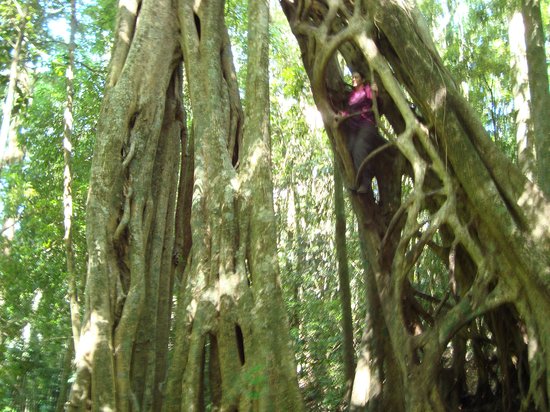
During the Q&A at the end I commented that the picture of the plant world that Marder sketched out (Irigaray's contribution was less programmatic and more reflexive) seemed awfully pacific and genteel. There were lots of trees, grasses and shrubs of various sorts but none of the more ugly and violent kinds of plants. The venus fly trap of course springs to mind but also the nightmarish ophiocordyceps unilateralis – a fungus (okay, not technically a plant) that infects ants, takes over their bodies, compels them to move somewhere warm and humid before the ant dies and a stalk sprouts out of its head which releases more spores. Or, less grotesquely but still rather violently, the so-called 'strangler figs' that wrap themselves around trees, climbing towards the light, eventually crushing their hosts and leaving hollow plaits of ivy as the trunks rot away.


For that matter there was also (and this didn't occur to me to ask until this morning) a rather excessive emphasis on rooted plants such that we might find in a park or garden. Algae, by far the most important kind of photosynthesiser there ever was or ever will be, wasn't mentioned (or if it was I missed it).

I was very conscious in mentioning all of this (although I may have been unsuccessful in warding off this impression) that I wasn't trying to assert a masculine view of nature as blood and thunder, vicious competition – green in thorn and barb, we might say – over a feminised one of it as serene coexistence; however, I did get the impression that it is only a small fraction of the vegetal world that this philosophy is prepared to consider. For me, a philosophy of nature can't just pick and choose the nice bits (to do this is to treat science as a content provider rather than a constituent producer).

This is from a recent article published by both in the Guardian:
The plant world shows us in silence what faithfulness to life consists of. It also helps us to a new beginning, urging us to care for our breath, not only at a vital but also at a spiritual level. We must, in turn, care for it, opposing any sort of pollution that destroys both our world and that of plants. The interdependence to which we must pay the closest attention is that which exists between ourselves and the vegetal world. Often described as "the lungs of the planet", the woods that cover the earth offer us the gift of breathable air by releasing oxygen. But their capacity to renew the air polluted by industry has long reached its limit. If we lack the air necessary for a healthy life (or, indeed, for any kind of life), it is because we have filled it with chemicals and undercut the ability of plants to regenerate it. As we know, rapid deforestation combined with the massive burning of fossil fuels, which are largely the remnants of past plants, is an explosive recipe for an irreversible disaster.
It's all a bit too kumbaya for me, if I'm honest. I don't recall them using the word 'harmony' but it's altogether too much implied. Where's the danger? Where's the non-human agency? It is all about scolding humans for their nasty exploitations with no recognition of the fact that things themselves might strike back...

The more important point I was trying to make by reference to the ugly side of plants was that perhaps in order to revere the non-human world we also need to fear it. Irigaray said that she didn't understand my comment (translation was an issue and I was quite nervous as I tried to articulate myself so it may not be her fault!) but she did say that to fear plants is to fear life itself. For her that is clearly a terrible, horrible thing. But I can't accept that. Yoda had it wrong: 'fear leads to anger, anger leads to hate...'. Fear is an important part of human existence. We can fear well and fear badly. We should fear the right things.

I didn't think that my comments would be received well and they weren't especially (although Marder was very gracious and accepted that it went to the heart of the matter). There's no place for fear, for violence or for that kind of negativity in these sorts of philosophies of nature. They are pick-and-mixes of the pluriverse that simply ignore the nastier sides of things. (Although, I must add another caveat and say that someone told me last night that Marder's book mentions poisonous plants; I will have to read it before I can really make any really bold claims in this regard.)

Marder doesn't believe that plants are capable of 'violence.' His reason for this is Hegelian: plants are, he says, incapable of self-negation. Now, I'm not altogether sure what that means (doubtless my fault) but my impression is that plants cannot do otherwise; immobile, they simply are (being immobile, he added, they cannot be territorial – something else I don't agree with). Devoid of animalistic intentionality they provide us with a model for being ourselves, otherwise, without the exploitative relation with other things that is brought on (this was also made clear in the Q&A) not by capitalism as such but by the specific relation towards logos inaugurated by the Greeks (capitalism being simply the latest product of this mode of thought).

Marder insisted that he didn't want to give a pacific picture of the plant world – it isn't that plants don't do damage to other things but that this isn't violence per se. Plants can be neither pacific nor violent, they just are. I don't think that this is a very good definition of violence. Moreover, I am of the Darwinian opinion that intentionality precedes awareness; all life is intentional because all life is goal-oriented, even if the only goal is survival and procreation.

When a fly trap dissolves an insect alive it isn't 'aware' of that insect in the way that an entity with a central nervous system is, of course, but I'm not sure why that matters. What difference does it make that the plant cannot uproot and move off, or retreat from a conflict with its tail between its legs? The plant destroys the insect, making it a means to its own ends. In this way, although it seems like Marder goes far too far in talking about 'plant thought' and so on, I think he doesn't go nearly far enough.

Plants in this phenomenological ontology of Irigaray-Marder aren't fully agential in the Latourian sense. Consequently they lack the capacity to demand our reverence; they cannot stoke fear in us; they cannot endanger us; they cannot unnerve us; and, consequently, they are entirely dependent upon our good will towards them. The vector of our moral obligation towards our green others always begins with the active, cognising human; the plants, however essential to our oxygen-hungry being they are acknowledged to be, cannot make demands on us, cannot really perturb us because they simply are – and their simple unindividuated thereness is what, for these authors, makes 'plant thinking' a model (or at least a partial model) for our own modes of thought.

I think it's quite the contrary: we need to be threatened by the non-human world again. People revere in large part that which they fear (when I said that at the lecture someone towards the front audibly snorted with derision – I feel I was not amongst like-minded people!). People used to fear nature – many still do who live in less homogenised, emaciated ecosystems than ours in the towns and cities (and the biochemically annihilated farmlands) of the Western world. That fear is proper, it's necessary. It's all very well insisting that we must recognise our extreme indebtedness to our plants others, etc, etc. but by itself this is still idealism. Humans neither revere nor respect just out of the kindness of their hearts nor through the workings of their rationality. Nothing is a simple as that.

This event was very thought provoking and I'm sticking my neck out since I've only read a tiny bit of the oeuvres of either of these extremely impressive intellectuals. However, this is not a naturphilosophie that I think I can get on board with. It actually, despite many explicit and very assertive insistences to the contrary, reproduces the modernist attitude towards non-human things because it makes humans the root of every vector of moral evaluation. Plants are there and they do stuff but they are at our mercy; they are prostrate before us; we are to be scoldingly reproached for our exploitation but human supremacy is to be presupposed and baked into the settlement. This isn't a break with whatever modes of thought the Greeks loaded on us; it's more of the same, differently nuanced.

I prefer what Latour calls an ethos of 'Optimism': all entities evaluate means and ends; it is as impossible to make the whole world a means for us, as per the modernist dream of progress (because immutable, eternal Nature doesn't exist and that attitude therefore leads to environmental catastrophe); however, it is equally impossible to make all the world our ends (we have to eat, breathe, etc.). The moral imperative is, first, to introduce a moment of hesitation in action where we are uncertain of how means and ends are distributed; second, it is to perpetually renew the search for the Optimum, for the best distribution of means and ends for a collective. This philosophy necessary requires political decision (in the literal sense of de-scission, cutting off). This is cosmopolitics (or geopolitics, if you prefer). It has nothing to do with harmony but rather spheres of influence; exploitation isn't a dirty word, we just have to know our limits and the limits of the world around us.

This brings me to Gaia (largely a vegetal entity though emphatically one not in a 'vegetal state'!), the whole point of which is that she is fiercely dangerous to us. She is a danger in the proper etymological sense (from Old French dangier 'power, power to harm, mastery, authority, control'). She is 'sovereign,' according to Latour.

Marder has a paper on Carl Schmitt ('The Elemental Regimes of Carl Schmitt') that I'm looking forward to reading. I'll conclude this over-long ramble with a quote from Latour discussing Schmitt. I think it's pertinent:
The great virtue of dangerous and reactionary thinkers like Schmitt is to force us to make a choice much starker than that of so many wishy-washy ecologists still swayed by unremitting hope. Schmitt’s choice is terribly clear: either you agree to tell foes from friends, and then you engage in politics, sharply defining the borderlines of real enough wars — ‘wars about what the world is made of’ —; or you shy away from waging wars and having enemies, but then you do away with politics [...] (105).
From living plant-like to living dangerously – there's a world of difference between these programmes.

[Update (07/06/14):

I received an email from Michael Marder which politely informed me that I'd gotten the wrong end of the stick about a couple of things!:
1. I never said that plants are immobile. Their being-in-place precludes locomotion, but not other kinds of movement, as I discuss everywhere in my writings. (In fact, even a certain long-distance locomotion is possible for plant seeds and pollen, as I always note.) 
2. Plant-Thinking is in large part dedicated to an exploration of the plant's intentionality. You will notice this as soon as you open the book, but especially if you reach Ch. 5 on The Wisdom of Plants.
On the first point, I meant 'immobile' in the sense of locomotion; in the sense that animals are not immobile but plants are—that is a fair point of clarification.

Second, I do need to read more of his books. The tagline of this blog 'In which I form strong opinions about things I don't know enough about' was never more appropriate!

This is a very interesting naturphilosophie and I encourage others to take it up. Hopefully one day I can give it the critique it deserves—i.e. an informed one!]