Showing posts with label john tresch. Show all posts

Saturday, 4 April 2015

Scientific iterations of 'Anthropocene' and modal incommensurability

Terence Blake writes (by way of introduction to a broader blog critique of Latour's AIME project):
The term “Anthropocene” is a scientific denomination, and so belongs to the mode of scientific knowledge, or “REF” in Latour’s terminology.
I don't think that's fair. 'Anthropocene' is a multi-modal term if ever there was one. This is an interesting video that pertains to that point:


John Tresch in conversation with Jan Zalasiewicz. The latter is very insistent upon the necessity of sticking to a strictly scientific (and, more specifically, geological) vocabulary within the context of his debates with other geologists. There is a very precise mode of discourse that cannot be seen to be influenced by political or moral concerns in any way. For the geologist, it all ultimately comes back to the stratigraphic record itself. That is king. However, Zalasiewicz at no point attempts to push away or close down political or moral iterations of 'Anthropocene.' Indeed, he seems to have many sympathies with these readings.

The distinction of modalities here is an institutional necessity but it does not follow that 'Anthropocene' begins and ends with science.

Terence's broader point concerns something he's taken issue with before: the apparent incommensurability of the modes of existence. When writing my recent article on the subject, I thought long and hard about how to describe the relationship of Latour's modes to one another. I settled on the term 'interimplicatedness'—ugly but precise. The context: "[Latour's] works must be read ‘anthropologically’ – that is to say, in cognisance of the interimplicatedness of every typological strand of ‘the social’ taken altogether [that is, all of the modes]."

'Interdependent' would be too strong, 'interrelated' too bland. Implication seems to me to be the correct choice. To transform one mode is to transform the others. They are not vacuum sealed. However, the question does persist with regards to their purity.

If a mode is akin to a particular kind of rhythm, vibration or tone and if the 'crossing' of modes can result in harmonics and disharmonics then are we to expect a pure harmony (a perfect sine wave) when we overlay modal events of the same kind? Or is there a necessary degree of modulation (a resonant disharmony) between any two existents, even at a strictly ontological level? The latter seems a more palatable. There is, therefore, a question of plurality within modes of existence as well as between them.

To put it another way, if we overlay two existential waveforms on one another and if we then discover subtle disharmonics in evidence, this indicates the historicity of these abstract categories. To paraphrase Nietzsche, only that which has no history can be identified. This intra-modal plurality was not the concern of the Inquiry; nevertheless, it is something that seems to follow from the principal concepts upon which the project was constructed.

Friday, 13 March 2015

"I wish you to know that I am a river about 350 miles long; I have not many tributaries, nor much timber, but I am full of fish."

I recently finished reading a fascinating book by Laura Dassow Walls, The Passage to Cosmos: Alexander von Humboldt and the Shaping of America. It is essentially a biography but pays particular attention to Humboldt's travels through the (mostly South) Americas and his influence on (mostly North) American literature. It issues an impassioned plea for a revival of interest in Humboldt's proto-ecology, his worldly cosmopolitanism and his synthetic, romantic naturalism. I would take issue with most of that but there's no doubt that he's a fascinating character, one whom I intend to learn more about.

For a differently focused but equally enthusiastic take on the man, see John Tresch's glorious essay Even the Tools Will Be Free: Humboldt’s Romantic Technologies (this is reproduced in Tresch's equally excellent book The Romantic Machine).

The titular quotation ("I wish you to know...") comes from one of Humboldt's letters, written upon receiving news that a Nevadan river had been named after him (in addition to hundreds of towns and countless streets all over the US).

I think the thing that fascinates me about Humboldt, even as I admit greater wariness than the above-mentioned authors, is his project. He was a man with a plan: the production of a cosmic synthesis; a singular poetic-scientific vision of the entire universe that would bring readers to understand their interconnectedness, interdependence and shared fate. He was hardly the first to attempt an encyclopaedic synthesis of all knowledge but few have approached it with such poetic gusto.

All of that is completely at odds with where we are now. It is no longer possible (perhaps it was no longer possible even by the end of the nineteenth century—although Élisée Reclus continued Humboldt's project in his own way into the twentieth) to conceive of the synthesis of nature and humanity as a progressive project (at least not without considerable naivety, even stupidity). We know all too well what Humboldt's legacy really was in practical terms: he facilitated, whatever his noble intentions, the colonisation and capitalisation of the very territories, strata and ecosystems that he mapped and surveyed with such superhuman vigour. His pioneering (in every sense) techniques were quickly adopted by state and corporate agents and his quasi-utopian hope for the nascent United States was soon shown to have been misplaced.

He perhaps did more than any other individual (although from another point of view 'Humboldt' himself was a collective of many agents, human and machinic—see Tresch on this point) to join up, to interconnect, to (in a sense) socialise the Americas. He thought, ever so naively, that this would bring peace, progress, harmony. We can no longer be so sheltered. And yet there is something so very appealing in his energy and character. Walls frequently notes that Humboldt rarely writes about himself (he is always intensely focused on the world he is frenziedly vascularising) and yet the charisma simply leaps off the page, even reading his works second hand.

We can no longer be as naive as Humboldt. His mapping, surveying, ethnographing, vascularising, cosmosynthesising project we now understand was, at best, a double-edged sword. His faith in modernisation can only be something of the past. But the interest of him I think is this: he was born just early enough that he could still in all good faith believe in modernisation as a progressive project without having to wear blinkers of such a scale that we can simply dismiss him out of hand as wilfully ignoring the consequences of his actions. He was a moderniser that it is possible to sympathise with even if we cannot identify with his problems as such.

If he had been born any later, his project, his grand synthesis would have been all but unthinkable. Indeed, he struggled against the growing disciplinisation of the sciences even as his gargantuan specimen-gathering exercises necessitated ever greater specialisation (indeed, his brother Wilhelm is remembered for presiding over the reconstruction of the German academic and educational system, as well as being one of the foremost linguists of the era).

He was perhaps the last major figure who could elude the later nineteenth century's obsession with disciplinisation. He exuded an intellectual freedom that had been crushed by 1900 and was perhaps mortally wounded even by 1851. Now that every field of the humanities and social sciences seems (at last) to be deeply concerned with inter- trans- post- or multi-disciplinarity (take your pick), it might be time to reconsider Humboldt in more detail.

I don't share the belief that his romantic, cosmosynthetic naturalism is the answer to our problems today. Nevertheless, better understanding this extraordinary and crucially liminal figure might allow us to better understand our present predicaments, both geo-political and academic-disciplinary, in more sophisticated terms. From this tumbling, darting, indefatigable blur of such prodigious vivacity it seems utterly implausible that there is nothing more to be learned.

Saturday, 7 February 2015

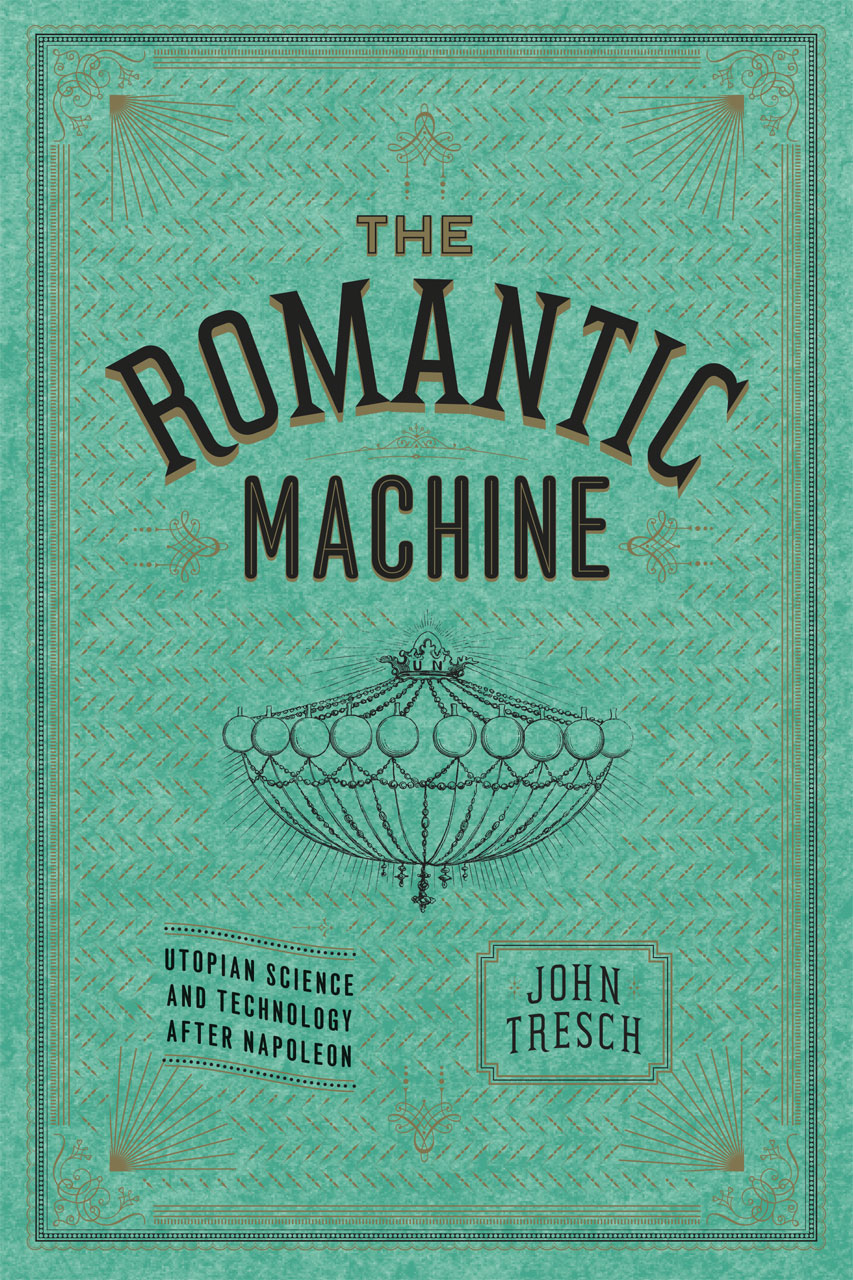
John Tresch's 'The Romantic Machine'

John Tresch's The Romantic Machine: Utopian Science and Technology After Napoleon is a beautifully constructed and unfailingly impressive work that takes its reader on a journey through Parisian scientific and intellectual life in the early to mid nineteenth century. Published in hardback a couple of years ago but only just out in paperback, it won the History of Science's Pfizer Award—and deservedly so.

Tresch's work fits into an historiographical movement that attempts to complicate the distinctions between rationalism and romanticism. Particularly, it problematises this opposition's straightforward mapping on to oppositions between mechanism and organism, science and art. Romantics prior to 1851, he makes clear, were just as enthusiastic about technological and scientific progress as the rationalists. They had their own preferred technologies, which related to their own epistemological and ontological developments in a profound way.
To quote the publisher's summary:
"Focusing on a set of celebrated technologies, including steam engines, electromagnetic and geophysical instruments, early photography, and mass-scale printing, Tresch looks at how new conceptions of energy, instrumentality, and association fueled such diverse developments as fantastic literature, popular astronomy, grand opera, positivism, utopian socialism, and the Revolution of 1848. He shows that those who attempted to fuse organicism and mechanism in various ways, including Alexander von Humboldt and Auguste Comte, charted a road not taken that resonates today."
I also highly recommend Tresch's recent essay (pdf available) Cosmologies Materialized: History of Science and History of Ideas, which argues for the need to bring together histories of science and intellectual histories, something that his Romantic Machine does with aplomb.

I've enjoyed reading Tresch's book tremendously and it's had quite an effect on my own interests and plans. It made me realise that I want to delve into the history of science, particularly that of the nineteenth century, in a much more serious way. It's one of those rare books where I only wish there was more of it!