Showing posts with label alexander von humboldt. Show all posts

Monday, 31 October 2016

Bruno Latour on geo-logy in a neo-Humboldtian university

In her book The Passage to Cosmos: Alexander von Humboldt and the Shaping of America, Laura Dassow Walls writes:
"By asserting that nature is independent of humans in a difference that is profoundly generative, [Alexander] Humboldt is trying to bridge the impasse reached by Kant, who had deepened the Cartesian dualism of mind and nature into an unbridgeable abyss by arguing that the nonhuman or “noumenal” world could never be reached or conceived. We could see only its phenomenal shadow, the mask, what little was open to the human senses. As Margarita Bowen details, Humboldt bridged this Kantian impasse by showing how humans developed their concepts over time, in a historical process by which they “are generated, tested and incorporated into the sphere of ideas.” Through this historical process, ideas forged in the crucible of physical nature made the world of thought part of the process of nature. As Bowen observes, Humboldt sees the very gulf between mind and nature “as the locus of the sciences.”"
In an endnote to this passage, she adds:
"I would argue that in this respect Humboldt’s philosophy anticipates that of the French sociologist of science Bruno Latour. A Latourian analysis of Humboldtian science would be a very productive project."
Walls is surely not the first to find affinity between Humboldt, whose leitmotif was Alles ist Wechselwirkung [everything is interrelated], and Latour, the famous thinker of networks.

In a recent talk at Cornell, Latour himself has reflected on the contemporary relevance of Humboldt with regard to the challenges of Anthropocene affairs, particularly regarding the question of how to organise training and knowledge production in a world where words like "world," "nature" and "earth" have been challenged on the most fundamental level. This connection presumably derives from the suggestion of Cornell's Aaron Sachs, whose book The Humboldt Current: Nineteenth-Century Exploration and the Roots of American Environmentalism establishes Humboldt as something of a 'founding father' of North American environmental thinking.
This is a felicitous happenstance for this blog (as long-term readers will probably have noticed). I'm currently writing what began as a chapter (and is ending up as six chapters) on Humboldt's work. It is not my intention to directly compare his thinking with that of Latour; however, there is an important connection.

My thesis, such as it currently exists (13 months into my PhD), asks a very simple and very complicated question: What is the history of the concept of environment? The basic philosophical idea that runs through the whole project derives from a paper by Latour and Michel Callon from 1992, Don't Throw the Baby Out With the Bath School! – specifically, "the distribution of agencies." In short, I understand the evolution of the concept "environment" (and its various equivalents, cognates and associates) in terms of variations in the distribution of agency between domains (particularly "society" and "nature").

In writing this I am attempting to engage with a whole range of questions and debates. However, one book in particular that stands out is The Shock of the Anthropocene by Christophe Bonneuil and Jean-Baptiste Fressoz. This is, as I have written previously, not just another Anthropocene book. It is an excellent piece of work and covers much the same sort of territory that I am attempting to examine; however, it has some serious limitations. First of all, I'm not convinced that the critique it makes of the works of Latour and Ulrich Beck stand up. What they call "environmental reflexivity" seems to somewhat misrepresent what these two authors were saying.

However, the important point for my project is that while they do a very good job of demonstrating that capacities for sophisticated modes of thought and action concerning "environment" are nothing new, they do little or nothing to establish what, in statistical language, we can call the incidence or, simply, the relative importance of environmental concepts, practices and concerns within their particular historical epoch. They seem to me to be operating within an epistemological conception of historiography (à la Bachelard through Foucault) that primarily concerns itself with establishing what is "thinkable" and "unthinkable" in any historical period. That is to say, an historiography for which incidence is largely irrelevant.

This is why I am interested in Humboldt – and why my initial single chapter has ballooned to six. I am attempting to set the aspects of his work that can, anachronistically, be termed "environmental" or "ecological" within a fuller account of his life, works and networks. By doing so, I will be able to show the relative importance (or otherwise) of these aspects for Humboldt and, by a more tentative implication, for his historical epoch.

Needless to say, this has been quite a challenge! Not only are Humboldt's own works voluminous in the extreme but the figure of this "great man" has been claimed and re-claimed so many times that the layers of interpretation form strata that are themselves formidable. My agenda is not really to criticise the spectacular plume of recent writings that have reclaimed Humboldt once again for the ecological age we seem to be in. However, I cannot help but be struck by how different my approach and the reading that results is from most if not all of these writings.

Humboldt is, undoubtedly, quite a likeable chap. However, Humboldtography has a definite tendency towards sanitisation, sometimes turning over into outright hagiography. My objection to this is not so much that one should not attempt to reclaim aspects of the past for the present. Rather, it is, I think, that the version of Humboldt that results from this purification is substantially more boring than the "warts and all" version that results from a more thorough and less tendentious reading. Quite often, the specifics of Humboldt's work simply disappear by his being interpreted through more contemporary modes of thought.

This is, I think, what happens in the passage from Walls quoted above. It is deeply misrepresentative in a whole number of ways. Primarily, presenting Humboldt as somehow overcoming Kant (even in intention) is quite implausible. He constructed his magnum opus Cosmos (written in the final years of his life and never finished) on explicitly Kantian lines, strictly dividing the objective and subjective elements into separate works. Yes, he was attempting to reconcile the opposition – but so was everyone else (including Kant). Nothing could have been further from his mind than the project we inherit from Whitehead (circa 1919) of overcoming the bifurcation of nature.

Once again, I have no problem with creative readings of past thinkers. However, there is a risk in this: making the past an extension of the present and thereby erasing the possibility of encountering historical difference.

And so, I think there is much to recommend revisiting the Humboldtian project (evidently!). Latour is careful to distinguish Alexander from his brother Wilhelm, who was a statesman, linguist and political theorist. However, I would argue that this separation should not be undertaken too hastily. It was Wilhelm who founded the University of Berlin (later Humboldt University) and was principally involved with educational reform (Alexander worked, before his South American journey from 1799 to 1804, reforming mining and industrial practices). True, Wilhelm was known as the "humanist" in a disciplinary sense – they were both humanists in the philosophical sense. However, Alexander explicitly joins the two projects in Cosmos, extensively quoting his brother's works (and, after Wilhelm's death, editing and publishing his most important works).

I would also, on the basis of the above, have to question Latour's statement that:
"What I propose to do, then, is to introduce a division between nature and the natural sciences, on the one hand, and phusis and the earthly sciences on the other. A fully geo-centric move, if you wish, provided that you take geo not as a globe but as a critical zone. It is not as speculative as one might think, since there are lots of good technical reasons to utilize such a partition. Witness Timothy Lenton’s version of the same divide in his book: “For many Earth system scientists, the planet Earth is really comprised of two systems -the surface Earth system that supports life, and the great bulk of the inner Earth underneath. It is the thin layer of a system at the surface of the Earth -and its remarkable properties- that is the subject of my work” 
This is something that Humboldt would have understood easily."
Humboldt was nothing if not an open-minded empiricist and, so, would undoubtedly have been delighted to encounter the geo-logy of today. He did as much as anyone in his era, both intellectually and infrastructurally, to enable the contemporary earth sciences. However, it is, I think, important to remember that his "climate" was nothing like ours – nor was his "earth." Moreover, his geopolitics (to use another anachronistic term) was a very, very long way from what is needed today. If there was ever a more enthusiastic advocate of modernisation than Alexander von Humboldt, I have never encountered them.

In short, if we are to learn from the likes of Humboldt we must not get hung up on those aspects that echo with reassuring familiarity. We must, instead, be attentive to the differences – encounter that historical difference. Doubtless, we share some of Humboldt's problems but we should not, as his hagiographers all too often do, suppose that we have much "common ground" with him or his epoch.

Monday, 6 June 2016

PhD diary #8: 06/06/2016

Alexander von Humboldt's Cosmos – a book more often cited than read (aren't they all?). Over the past couple of weeks I've managed to plough through all 1100 pages of the three volumes (to be precise, the English translation, of which the first two volumes were published in 1848 and the third, posthumously and incomplete, in 1859).

The scientist (and 25th Prime Minister of France) François Arago once remarked,
"Humboldt, you really don't know how to write a book. You write endlessly, but what comes out of it is not a book, but a portrait without a frame."
He was not wrong. To read Humboldt's work is to face down a deluge of information, poured out as if uncontrollably. The several hundred pages of the first volume roll on and on without so much as a section break.

Astronomical illustration from the atlas accompanying the German version of Kosmos

Nevertheless, while Humboldt's science was already somewhat eccentric by 1850 and although his politics were, at best, naive, his is an impressive bundle of intellectual energy to spend some time with.

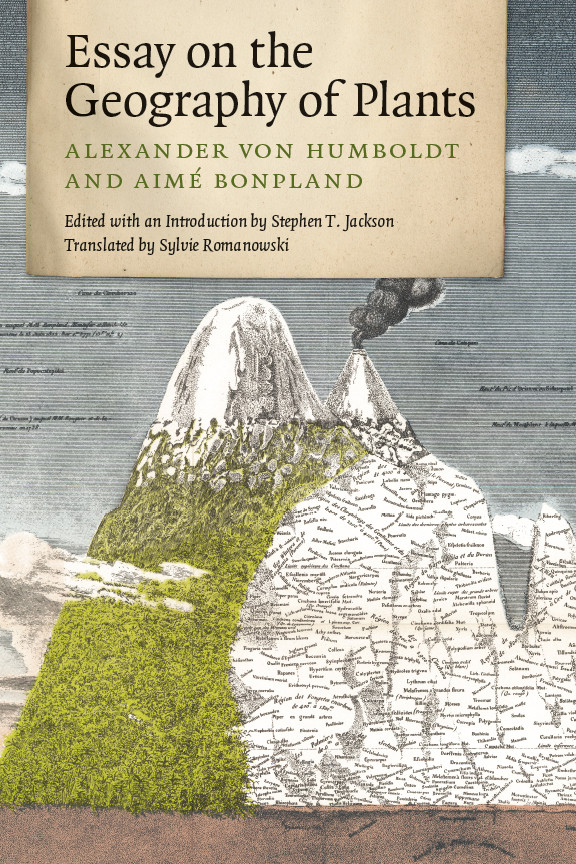
Next up is his Essay on the Geography of Plants from 1807. This was the first major publication following his famous voyage from 1899 to 1804 (and, as such, although it was written by Humboldt, it is co-credited to his travelling partner, the botanist Aimé Bonpland).


It's interesting to look at this early text after Cosmos, which was the magnum opus supposed to cap off his career. There are substantial continuities between the two; indeed, much of the grand, synthetic vision of a universal cosmography was apparent to Humboldt by the early 1790s. Nevertheless, some of the (from a contemporary point of view) stranger geological ideas are more pronounced in the earlier work.

Humboldt went to his grave just a few months before Darwin's The Origin of Species was published and he never quite accepted (due to, in his view, insufficient evidence) the extent of earthly deep time necessary to make sense of the thesis of natural selection. His was an old earth but not to the extent that ours is, post-Darwin. On the question of whether the Earth had a history (in the sense of experiencing many eras of gradual or sudden transformation or remaining more or less in its current processual state from the beginning), in 1807 at least, the burden of proof was very much on the historicists. Likewise, his journey dissuaded him from the Neptunism of his former teacher Abraham Gottlob Werner but he was tentative in abandoning its hypotheses.

I have the next four weeks or so to continue delving into Humboldt's works (and still other works on them). There is no hope whatsoever for any kind of completism; however, that should not be necessary. I am essentially interested in Humboldt as a figure who, in a sense, typifies the naturalism of one era while, at the same time, setting up another. The kind of "cosmic geopolitics" that emerge in his final major work is, I think, a very interesting way into the history of ideas and transformations that my thesis chapters 2 to 6 will explore.

Friday, 13 March 2015

"I wish you to know that I am a river about 350 miles long; I have not many tributaries, nor much timber, but I am full of fish."

I recently finished reading a fascinating book by Laura Dassow Walls, The Passage to Cosmos: Alexander von Humboldt and the Shaping of America. It is essentially a biography but pays particular attention to Humboldt's travels through the (mostly South) Americas and his influence on (mostly North) American literature. It issues an impassioned plea for a revival of interest in Humboldt's proto-ecology, his worldly cosmopolitanism and his synthetic, romantic naturalism. I would take issue with most of that but there's no doubt that he's a fascinating character, one whom I intend to learn more about.

For a differently focused but equally enthusiastic take on the man, see John Tresch's glorious essay Even the Tools Will Be Free: Humboldt’s Romantic Technologies (this is reproduced in Tresch's equally excellent book The Romantic Machine).

The titular quotation ("I wish you to know...") comes from one of Humboldt's letters, written upon receiving news that a Nevadan river had been named after him (in addition to hundreds of towns and countless streets all over the US).

I think the thing that fascinates me about Humboldt, even as I admit greater wariness than the above-mentioned authors, is his project. He was a man with a plan: the production of a cosmic synthesis; a singular poetic-scientific vision of the entire universe that would bring readers to understand their interconnectedness, interdependence and shared fate. He was hardly the first to attempt an encyclopaedic synthesis of all knowledge but few have approached it with such poetic gusto.

All of that is completely at odds with where we are now. It is no longer possible (perhaps it was no longer possible even by the end of the nineteenth century—although Élisée Reclus continued Humboldt's project in his own way into the twentieth) to conceive of the synthesis of nature and humanity as a progressive project (at least not without considerable naivety, even stupidity). We know all too well what Humboldt's legacy really was in practical terms: he facilitated, whatever his noble intentions, the colonisation and capitalisation of the very territories, strata and ecosystems that he mapped and surveyed with such superhuman vigour. His pioneering (in every sense) techniques were quickly adopted by state and corporate agents and his quasi-utopian hope for the nascent United States was soon shown to have been misplaced.

He perhaps did more than any other individual (although from another point of view 'Humboldt' himself was a collective of many agents, human and machinic—see Tresch on this point) to join up, to interconnect, to (in a sense) socialise the Americas. He thought, ever so naively, that this would bring peace, progress, harmony. We can no longer be so sheltered. And yet there is something so very appealing in his energy and character. Walls frequently notes that Humboldt rarely writes about himself (he is always intensely focused on the world he is frenziedly vascularising) and yet the charisma simply leaps off the page, even reading his works second hand.

We can no longer be as naive as Humboldt. His mapping, surveying, ethnographing, vascularising, cosmosynthesising project we now understand was, at best, a double-edged sword. His faith in modernisation can only be something of the past. But the interest of him I think is this: he was born just early enough that he could still in all good faith believe in modernisation as a progressive project without having to wear blinkers of such a scale that we can simply dismiss him out of hand as wilfully ignoring the consequences of his actions. He was a moderniser that it is possible to sympathise with even if we cannot identify with his problems as such.

If he had been born any later, his project, his grand synthesis would have been all but unthinkable. Indeed, he struggled against the growing disciplinisation of the sciences even as his gargantuan specimen-gathering exercises necessitated ever greater specialisation (indeed, his brother Wilhelm is remembered for presiding over the reconstruction of the German academic and educational system, as well as being one of the foremost linguists of the era).

He was perhaps the last major figure who could elude the later nineteenth century's obsession with disciplinisation. He exuded an intellectual freedom that had been crushed by 1900 and was perhaps mortally wounded even by 1851. Now that every field of the humanities and social sciences seems (at last) to be deeply concerned with inter- trans- post- or multi-disciplinarity (take your pick), it might be time to reconsider Humboldt in more detail.

I don't share the belief that his romantic, cosmosynthetic naturalism is the answer to our problems today. Nevertheless, better understanding this extraordinary and crucially liminal figure might allow us to better understand our present predicaments, both geo-political and academic-disciplinary, in more sophisticated terms. From this tumbling, darting, indefatigable blur of such prodigious vivacity it seems utterly implausible that there is nothing more to be learned.

Saturday, 7 February 2015

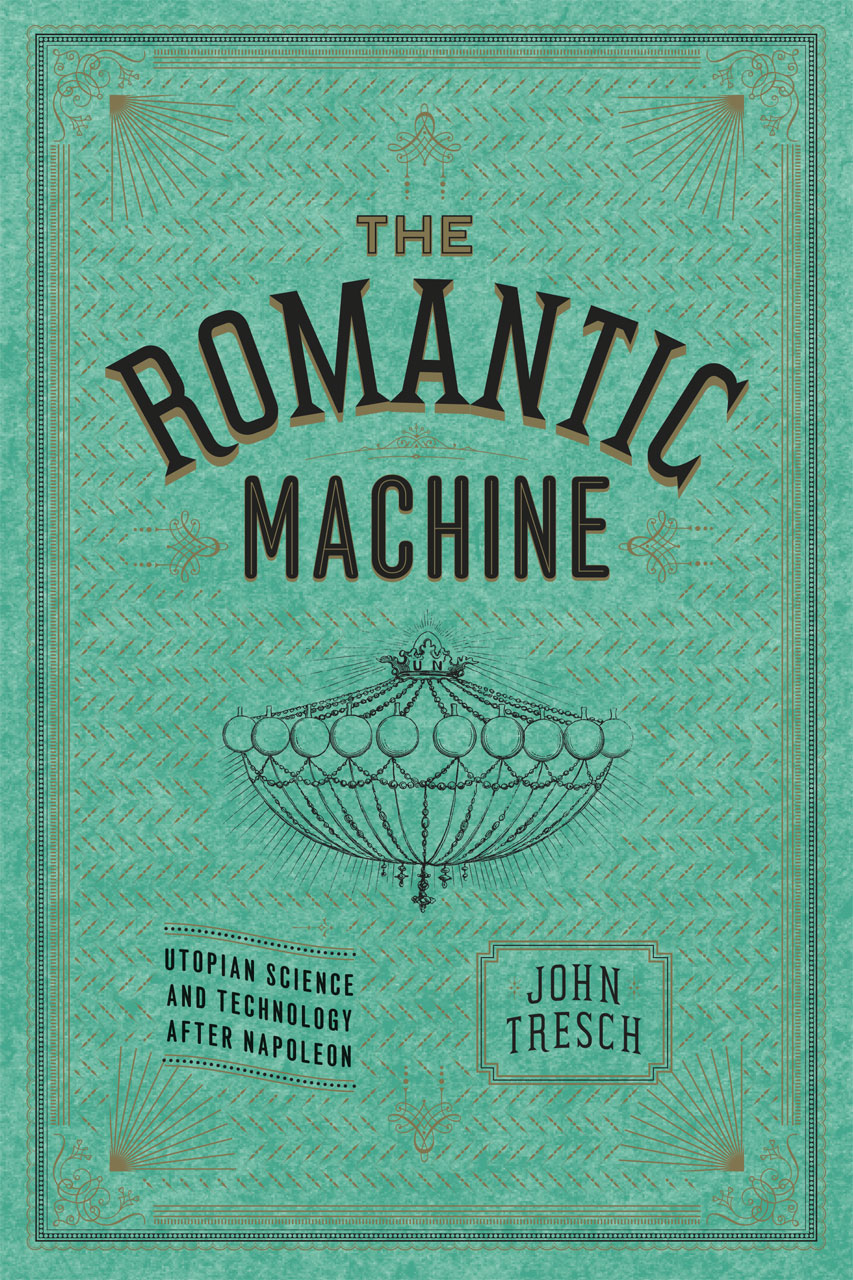
John Tresch's 'The Romantic Machine'

John Tresch's The Romantic Machine: Utopian Science and Technology After Napoleon is a beautifully constructed and unfailingly impressive work that takes its reader on a journey through Parisian scientific and intellectual life in the early to mid nineteenth century. Published in hardback a couple of years ago but only just out in paperback, it won the History of Science's Pfizer Award—and deservedly so.

Tresch's work fits into an historiographical movement that attempts to complicate the distinctions between rationalism and romanticism. Particularly, it problematises this opposition's straightforward mapping on to oppositions between mechanism and organism, science and art. Romantics prior to 1851, he makes clear, were just as enthusiastic about technological and scientific progress as the rationalists. They had their own preferred technologies, which related to their own epistemological and ontological developments in a profound way.
To quote the publisher's summary:
"Focusing on a set of celebrated technologies, including steam engines, electromagnetic and geophysical instruments, early photography, and mass-scale printing, Tresch looks at how new conceptions of energy, instrumentality, and association fueled such diverse developments as fantastic literature, popular astronomy, grand opera, positivism, utopian socialism, and the Revolution of 1848. He shows that those who attempted to fuse organicism and mechanism in various ways, including Alexander von Humboldt and Auguste Comte, charted a road not taken that resonates today."
I also highly recommend Tresch's recent essay (pdf available) Cosmologies Materialized: History of Science and History of Ideas, which argues for the need to bring together histories of science and intellectual histories, something that his Romantic Machine does with aplomb.

I've enjoyed reading Tresch's book tremendously and it's had quite an effect on my own interests and plans. It made me realise that I want to delve into the history of science, particularly that of the nineteenth century, in a much more serious way. It's one of those rare books where I only wish there was more of it!

Wednesday, 4 February 2015

Should 'system' be part of our ontological inheritance?

In response to my last post, Tim Howles writes:
Cf. the question put to BL in his recent interview on 'AIME as system': "The site has been open for two years in French, one in English, and I still don’t see new modes coming in. Isn’t the 'system' here coming to paralyse the inquiry?"
System or 'quasi-system' (a term that I've applied to AIME elsewhere)?

What is the 'quasi' doing for 'object' and 'subject'? Literally speaking, they are 'as if' objects and subjects. More specifically, it renders them not a kind of object or entity, or at least not any entity with an enduring identity, but a point in a trajectory; it implies that the quasi-X is always a becoming-X and always a becoming-with-others. It is a relativisation of subject and object not to each other (à la dialectic) but to a wider pluriverse of existential modalities.

In terms of AIME, it is obvious enough as to why we'd want to keep notions of objectivity and subjectivity as part of our 'inheritance' (albeit deeply modified). The question is really one that I posed right at the end of my article: what are we to inherit and how? What is it in the notion of 'system' that is valuable, despite all the problems with that term?

I think it could be related to the notion of cosmos. Unlike high modernists like Alexander von Humboldt (whose biography I've been reading recently -- but that's an aside), the Latourian cosmos is not at all a pure, perfect state of harmonious nature. It's more Messiaen than Mozart. Harmony, yes, but amidst discord of all sorts. No kosmos without kakosmos -- we'd do well to remember that there is no guarantee of enjoying a cosmos whatsoever; cosmoi are composed.

If a quasi-systematising is an organising, a settling, a becoming-cosmos, then the important question concerns how that systematising is happening. And isn't that what the diplomacy is all about? Progressively composing the common cosmos in the absence of a pre-given sovereign?

Certainly, we shouldn't hold becoming-cosmic or becoming-system to be necessarily superior to whatever the contrary would be -- no composition without decomposition. What a quasi-system permits is an organised conversation about our cherished abstractions. Its realisation is necessarily a stuttering and pragmatic one. However, I think that there is definitely a case for 'system' to be part of what we inherit from the moderns.

I'm trying to think up a joke about Quasimodo but I haven't quite gotten there yet.
quasimodo: "Low Sunday," 1706, Quasimodo Sunday, from Latin quasi modo, first words of introit for the first Sunday after Easter: quasi modo geniti infantes "as newborn babes" (1 Pet. ii:2). The hunchback in Victor Hugo's novel was supposed to have been abandoned as an infant at Notre Dame on this day, hence his name. For first element, see quasi; for second see mode.