Showing posts with label cosmopolitics. Show all posts

Tuesday, 11 July 2017

Microblog mesoblog: On the cosmopolitics of the Anthropocene

It's easy to get carried away on Twitter. That's more or less its purpose. I sometimes wonder what the point of writing long threads of multiple tweets is. Why not just write it properly, in continuous prose?! However, occasionally I too indulge the medium's raison d'être.

I was re-reading a piece that I commented on before: Scientists still don’t understand the Anthropocene – and they’re going about it the wrong way by Mark Maslin and Erle Ellis.

(Full disclosure – and no surprises: I am also a white, male and Western, although not much of a scientist.)


I should add that the Anthropocene as a scientific problem necessarily concerns more than geologists in the strict, disciplinary sense. Earth sciences are a far broader church today than they were in the past. Nevertheless, I think the point stands.


They argue, in short, that:
"Defining a human epoch is so important it should not be rushed. It should be treated by scholars from all disciplines with the seriousness it deserves."
I could not disagree. However, there is a risk of politically overburdening earth scientists when, in fairness, human and social sciences are not necessarily in a position to be overconfident in their own cosmopolitical acuity.

Reminding ourselves of the Greek epokhe would therefore seem to be a necessary waypoint in this conversation.

Friday, 13 March 2015

"I wish you to know that I am a river about 350 miles long; I have not many tributaries, nor much timber, but I am full of fish."

I recently finished reading a fascinating book by Laura Dassow Walls, The Passage to Cosmos: Alexander von Humboldt and the Shaping of America. It is essentially a biography but pays particular attention to Humboldt's travels through the (mostly South) Americas and his influence on (mostly North) American literature. It issues an impassioned plea for a revival of interest in Humboldt's proto-ecology, his worldly cosmopolitanism and his synthetic, romantic naturalism. I would take issue with most of that but there's no doubt that he's a fascinating character, one whom I intend to learn more about.

For a differently focused but equally enthusiastic take on the man, see John Tresch's glorious essay Even the Tools Will Be Free: Humboldt’s Romantic Technologies (this is reproduced in Tresch's equally excellent book The Romantic Machine).

The titular quotation ("I wish you to know...") comes from one of Humboldt's letters, written upon receiving news that a Nevadan river had been named after him (in addition to hundreds of towns and countless streets all over the US).

I think the thing that fascinates me about Humboldt, even as I admit greater wariness than the above-mentioned authors, is his project. He was a man with a plan: the production of a cosmic synthesis; a singular poetic-scientific vision of the entire universe that would bring readers to understand their interconnectedness, interdependence and shared fate. He was hardly the first to attempt an encyclopaedic synthesis of all knowledge but few have approached it with such poetic gusto.

All of that is completely at odds with where we are now. It is no longer possible (perhaps it was no longer possible even by the end of the nineteenth century—although Élisée Reclus continued Humboldt's project in his own way into the twentieth) to conceive of the synthesis of nature and humanity as a progressive project (at least not without considerable naivety, even stupidity). We know all too well what Humboldt's legacy really was in practical terms: he facilitated, whatever his noble intentions, the colonisation and capitalisation of the very territories, strata and ecosystems that he mapped and surveyed with such superhuman vigour. His pioneering (in every sense) techniques were quickly adopted by state and corporate agents and his quasi-utopian hope for the nascent United States was soon shown to have been misplaced.

He perhaps did more than any other individual (although from another point of view 'Humboldt' himself was a collective of many agents, human and machinic—see Tresch on this point) to join up, to interconnect, to (in a sense) socialise the Americas. He thought, ever so naively, that this would bring peace, progress, harmony. We can no longer be so sheltered. And yet there is something so very appealing in his energy and character. Walls frequently notes that Humboldt rarely writes about himself (he is always intensely focused on the world he is frenziedly vascularising) and yet the charisma simply leaps off the page, even reading his works second hand.

We can no longer be as naive as Humboldt. His mapping, surveying, ethnographing, vascularising, cosmosynthesising project we now understand was, at best, a double-edged sword. His faith in modernisation can only be something of the past. But the interest of him I think is this: he was born just early enough that he could still in all good faith believe in modernisation as a progressive project without having to wear blinkers of such a scale that we can simply dismiss him out of hand as wilfully ignoring the consequences of his actions. He was a moderniser that it is possible to sympathise with even if we cannot identify with his problems as such.

If he had been born any later, his project, his grand synthesis would have been all but unthinkable. Indeed, he struggled against the growing disciplinisation of the sciences even as his gargantuan specimen-gathering exercises necessitated ever greater specialisation (indeed, his brother Wilhelm is remembered for presiding over the reconstruction of the German academic and educational system, as well as being one of the foremost linguists of the era).

He was perhaps the last major figure who could elude the later nineteenth century's obsession with disciplinisation. He exuded an intellectual freedom that had been crushed by 1900 and was perhaps mortally wounded even by 1851. Now that every field of the humanities and social sciences seems (at last) to be deeply concerned with inter- trans- post- or multi-disciplinarity (take your pick), it might be time to reconsider Humboldt in more detail.

I don't share the belief that his romantic, cosmosynthetic naturalism is the answer to our problems today. Nevertheless, better understanding this extraordinary and crucially liminal figure might allow us to better understand our present predicaments, both geo-political and academic-disciplinary, in more sophisticated terms. From this tumbling, darting, indefatigable blur of such prodigious vivacity it seems utterly implausible that there is nothing more to be learned.

Thursday, 5 February 2015

Diplomacy and cosmopolitics

In response to my last post, dmf writes:
see I thought diplomacy was about the negotiating workable (extra-military) relations between competing interests. more William James than Kant...
It certainly is much more James than Kant. I didn't mean to suggest that the goal is synthesis as such. That would be unanimity rather than plurality and is emphatically not the goal of diplomacy as either Stengers or Latour articulate it.

[What follows is a thinking-out-loud. Consider yourselves warned.]

There are and must be indefinitely multiple cosmoi. And diplomacy is the "technology of belonging," to use Stengers' words, that renders these cosmoi "contrasting rather than contradictory." It turns either/or into and/and, as she puts it.

This becoming-coexistent requires an openness of all parties to change. It is a political technology and by no means the only one.

When you share an atmosphere, in the Sloterdijkian sense of the word, then you share a kosmos/kakosmos. A progressive composition of a common world means a collective air-conditioning of that atmosphere. And this requires the same diplomatic openness. The same detachment in a very precise sense: not disinterest or any kind of neutered neutrality but detachment from a fixed, permanent, absolutised self that could only ever dominate, be adopted, be enforced, be destroyed or be 'tolerated.' A diplomat's detachment is a unique and extreme case. But that doesn't mean that the rest of us can go around living out our inner perfections.

Is diplomacy just the negotiation between cosmoi or is it also the name of the political technology at work in conditioning and composing the cosmoi from within?

Well, mereologically speaking, once the notion of cosmos is radically pluralised, we are constantly within, between and butting up against the cosmoi of others. We are in a world of foam, in Sloterdijk's imagery. And yet when we find ourselves 'in the same boat' as another—whether that other is a hungry tiger or not—veritably it is not a matter as simple as maintaining border relations (although that is unavoidably part of it). When we share an infrastructure that is toxifying the very air that we breathe then we surely have no option but to negotiate the terms of our coexistence in a rather more intimate sense.

And when this 'air' is conceptual then the ground of the negotiation is a philosophical one. Calculemus!

So, the AIME project, as I understand it, was about attempting to negotiate the composition of a shared atmosphere: a conceptual, philosophical atmosphere. In its participatory stages it was about collectively writing the design specifications that would construct the problem to which the philosopher(s) will respond.

Not everyone or everything is inside this particular 'hothouse.' There are many other abodes. And yet 'the Western philosophical tradition' is not a meaningless designation. Too simple, certainly, but it passably signifies the shared atmosphere in question; an atmosphere that undoubtedly has its toxicities and yet that we cannot simply forego breathing all of a sudden—we cannot simply step out into the void. Hence 'inheritance' and the inevitable problems of translating between generations.

If we suppose that diplomacy pertains to the inter-cosmic and cosmopolitics to the intra-cosmic then that would be an elegant enough distinction. However, as far as I can see, the difference is not one of polarity but of intensity. The pressure of coexistence is relative to the pressure of the atmosphere and the pressure increases relative to the toxicity experienced by the occupants who format the existential space itself—pressure is a function of the tension experienced by those who collectively constitute the tensegretic milieu. And even hostile parties share a space formatted by that very non-indifference.

So, while there are undoubtedly other political technologies besides the diplomatic metamorphosing of contradictions into contrasts and while there are vastly more kinds of atmospheres than the merely conceptual and while diplomacy as a concept obviously suggests a concern with the interrelation of existential spaces that have some sort of mutual exteriority, the capacities, the requirements, the technical competencies required of the diplomat are only an extreme case of what is required of a negotiated coexistence in general. The 'true self' abhors coexistence.

So, pace Kant, it is not synthesis that any kind of diplomacy is working for. There is no 'perpetual peace,' only perpetually negotiated settlements. There are no shortcuts. But, equally, this is not an atomising gesture. It does not function to fracture the foam into ever smaller bubbles. Co-occupancy is not a choice and toxicity is not a mere metaphor.

The goal is not synthesis and yet if we are co-occupant then we will soon realise it. Plurality does not mean disentanglement. And so becoming-cosmic through a quasi-system, as I have described it, does not presuppose a will to synthesis—only the recognition that this is one possible tool for the negotiation of a co-occupancy that we cannot easily opt out of, nor need we.

Those of us who read and talk philosophy—or simply those of us who speak a European language—are part of a hothouse that we cannot close like a book. It is something that we share and something that we are, something that is part of us.

We speak of becoming-coexistent not becoming-unified. And yet negotiating the shape of the space we occupy necessarily means negotiating the very shape of who we are—and the 'we' is not an idle one because we are something together, 'we are in this together.' Such a statement can never be exempted from scepticism or even refusal but nor can we pretend that we are all mutually exterior and that we don't have collective projects or that we can become-cosmic without some sort of convergence—even if, and here we can inherit a modern classic, every action has an equal and opposite reaction. That is, even if convergence contains its contrary within itself, it is still a necessary motion. Convergence is still something that is built, is still something that can be built better.

Why is cosmopolitics not cosmopolitan? Cosmopolitanism, in its perpetually pacific end state, would have no need of diplomacy since all borders would be dissolved. In a cosmopolitical world—'cosmopolitics' being the recognition that there is only cosmos with politics and only politics with a cosmos, not that these are one and the same but that they are in a state of tension—there would be only varying intensities of the demand for diplomatic detachment that would be adjusted according to relative degrees of estrangement, conflict and pressure. Unity would never be the goal but nor would isolation be anything but a death sentence. Collective writing projects would be commonplace, not because we were striving for a hive-mind but because we would be capable of saying 'that is my writing' even when the words did not conform to 'my true beliefs.' We would recognise our ecstasy, our being outside ourselves. We would recognise ourselves in collective composites, in trace-lattices without a trace of purity.

Our borders would not disappear but their fortification would become ever less urgent.

[P.S. just saw Ex Machina and it left me feeling very philosophical.]

Wednesday, 4 February 2015

Should 'system' be part of our ontological inheritance?

In response to my last post, Tim Howles writes:
Cf. the question put to BL in his recent interview on 'AIME as system': "The site has been open for two years in French, one in English, and I still don’t see new modes coming in. Isn’t the 'system' here coming to paralyse the inquiry?"
System or 'quasi-system' (a term that I've applied to AIME elsewhere)?

What is the 'quasi' doing for 'object' and 'subject'? Literally speaking, they are 'as if' objects and subjects. More specifically, it renders them not a kind of object or entity, or at least not any entity with an enduring identity, but a point in a trajectory; it implies that the quasi-X is always a becoming-X and always a becoming-with-others. It is a relativisation of subject and object not to each other (à la dialectic) but to a wider pluriverse of existential modalities.

In terms of AIME, it is obvious enough as to why we'd want to keep notions of objectivity and subjectivity as part of our 'inheritance' (albeit deeply modified). The question is really one that I posed right at the end of my article: what are we to inherit and how? What is it in the notion of 'system' that is valuable, despite all the problems with that term?

I think it could be related to the notion of cosmos. Unlike high modernists like Alexander von Humboldt (whose biography I've been reading recently -- but that's an aside), the Latourian cosmos is not at all a pure, perfect state of harmonious nature. It's more Messiaen than Mozart. Harmony, yes, but amidst discord of all sorts. No kosmos without kakosmos -- we'd do well to remember that there is no guarantee of enjoying a cosmos whatsoever; cosmoi are composed.

If a quasi-systematising is an organising, a settling, a becoming-cosmos, then the important question concerns how that systematising is happening. And isn't that what the diplomacy is all about? Progressively composing the common cosmos in the absence of a pre-given sovereign?

Certainly, we shouldn't hold becoming-cosmic or becoming-system to be necessarily superior to whatever the contrary would be -- no composition without decomposition. What a quasi-system permits is an organised conversation about our cherished abstractions. Its realisation is necessarily a stuttering and pragmatic one. However, I think that there is definitely a case for 'system' to be part of what we inherit from the moderns.

I'm trying to think up a joke about Quasimodo but I haven't quite gotten there yet.
quasimodo: "Low Sunday," 1706, Quasimodo Sunday, from Latin quasi modo, first words of introit for the first Sunday after Easter: quasi modo geniti infantes "as newborn babes" (1 Pet. ii:2). The hunchback in Victor Hugo's novel was supposed to have been abandoned as an infant at Notre Dame on this day, hence his name. For first element, see quasi; for second see mode.

Wednesday, 13 August 2014

What is the contrary of 'cosmos'? What, then, is 'cosmopolitics'?

Isabelle Stengers' cosmopolitics is one of those concepts that is oft-cited but rarely examined in any detail. I won't try to explicate it on the basis of Stengers' texts here (though that needs to be done); I'll just ask a simple question: what is the contrary of 'cosmos'? How we answer this question will determine what we take cosmopolitics to be.

It seems to me that many readers take the cosmos in cosmopolitics to be basically equivalent to the everyday meaning of that word; they take it to mean cosmos in the sense of Carl Sagan's Cosmos -- that is, as, more or less, a synonym for the universe. The only possible contrary to 'cosmos' in this sense would be 'non-existence, nothingness.'

Taken this way, cosmopolitics must either mean that politics is a transcendent metaphysical model for existence (i.e. Graham Harman's reading of Bruno Latour's Irreductions); or, cosmopolitics must mean that the entirety of existence must now be subsumed within political contestation (taking the old cliché 'everything is political' to ever more absurd heights). Neither of these interpretations are, in my opinion, especially useful (or even comprehensible).

It'd be helpful to think of 'cosmos' in broader terms. Here's what the etymology dictionary has to say about 'cosmos':
c.1200 (but not popular until 1848, as a translation of Humboldt's Kosmos), from Latinized form of Greek kosmos "order, good order, orderly arrangement," a word with several main senses rooted in those notions: The verb kosmein meant generally "to dispose, prepare," but especially "to order and arrange (troops for battle), to set (an army) in array;" also "to establish (a government or regime);" "to deck, adorn, equip, dress" (especially of women). Thus kosmos had an important secondary sense of "ornaments of a woman's dress, decoration" (compare kosmokomes "dressing the hair") as well as "the universe, the world." 
Pythagoras is said to have been the first to apply this word to "the universe," perhaps originally meaning "the starry firmament," but later it was extended to the whole physical world, including the earth. For specific reference to "the world of people," the classical phrase was he oikoumene (ge) "the inhabited (earth)." Septuagint uses both kosmos and oikoumene. Kosmos also was used in Christian religious writing with a sense of "worldly life, this world (as opposed to the afterlife)," but the more frequent word for this was aion, literally "lifetime, age."
For the Stoics, kosmos meant that existence was divinely ordered; it meant that, to ape Leibniz, we lived in the best and most rational of all possible worlds and for this we owed thanks to God or Nature in all their divinity. It is related to this sense of kosmos as a divinely ordered existence that we get cosmos as simply a synonym for astronomical existence generally (perhaps beginning with Pythagoras). However, the etymology of the term is demonstrably more complex and interesting than that.

So, we should take note that when Latour uses 'cosmopolitics' in Pandora's Hope, Politics of Nature and later texts he opposes it not to non-existence but to 'kakosmos' (kakos in many contemporary European languages meaning shit and in the Ancient Greek meaning bad or evil). Cosmos is, in this usage, not just a straightforward synonym for existence; it is, like for the Stoics and the other Greeks described in the quotation above, a word meaning a specific kind of ordering, a good, beautiful, agreeable ordering. In this usage there may well be no cosmos! The mere fact that there is existence proves nothing.

Cosmopolitics, in this sense, therefore means not that politics is a transcendent metaphysical principle such that all existence is political in and of itself, nor that the entirety of the cosmos must be brought within previously human-exceptional politics (whatever that would mean). Cosmopolitics is instead the recognition that since both God and Nature are dead then there is only one possible route towards a cosmos and away from a kakosmos: through politics, with all the messiness, compromise and frustration that this word entails.

It is not that the universe is always already political in itself, as though politics were some kind of transcendent metaphysical condition. It is precisely the opposite of that: there is no transcendent metaphysical condition, that's why there must be cosmopolitics.

Sunday, 13 July 2014

Diplomacy as theory; theory as diplomacy—excerpts from Constantinou's On the Way to Diplomacy

Further to my last post, which provided some excerpts from Costas Constantinou's On the Way to Diplomacy on the subject of diplomacy itself, here are some more, this time concentrating on the etymology of 'theory' and its relation to diplomatic and metaphysical practice.
This word theoria was used in ancient Greek to designate, among other things, an old type of embassy, the solemn or sacred embassy sent to attend religious festivals and games, discharge the divine obligations of the polis, and consult the oracle. This particular ancient meaning has been lost in the modern, Anglicized use of the term theoria, as is the case with the modern Greek term. (p.52-53) 
Firstly, theoria is derived from the words theos (god) and orao (to see). It had the meaning ‘to see god’ and particularly referred to this aspect of eyeing god in the shrine. Orao also relates, however, to the word hora (time, hour), and so theoria can be understood as the moment of god or the moment devoted to god. The sight and time of the theoria invoked therefore a specific truth-making process. (p.53)

Later, in the biblical tradition, theoria was given a special theological significance, for it was specifically used to describe the view of Jesus at the cross, that is, bearing witness to the moment of sacrifice. But the root word theo in Ancient Greek also meant—depending on the emphasis—to run and to look. […] From this root theo- (run), theoria acquired the meaning of a journey, of traveling abroad to see the world. This meaning is especially important, for it refers to the first known use of the word theoria by Herodotus. It was employed to designate the journey of Solon, the lawgiver of Athens, to Egypt and other ‘far away’ places. The importance of the timing of Solon’s journey points to the significance of hora, the reaching of a certain moment in one’s private or political lifetime for going on a theoria. (p.54)

[There is also a link with theatre,] the theatron itself being the place where theoria was practiced. (p.54)

The sacred ambassadors [sent to religious events and oracles] were called theors or theoroi and were specially chosen. (p.55)

Theoria then was an embassy to god or truth (tied to divine sanction and authority), and theors were ambassadors, peripatetic ‘theorists,’ charged with the discovery of what was right or true. In theoria, therefore, one can view embassy as theory and theory as embassy. (p.55)

[…] theory at its Platonic conception was the mirror image of the very diplomatic process it [i.e. diplomatic theory] now seeks to explain. (p.56)

In Phaedo, Plato employed theoria to describe the solemn embassy sent to the Delian oracle ‘in honour of the god’ Apollo and to commemorate Theseus’s journey to Crete. In The Republic, there are instances where Plato’s theoria can be understood more generally as participation in any kind of festival or campaign. In Crito, theoria is used as a journey, and in the Laws, in addition to voyage, as view and careful observation. In another instance, it has a more specific meaning when it refers exclusively to the Dionysian celebrations. Finally, Plato employs the word theoria to denote the contemplation of the divine, and in his most common usage as speculation and philosophical reasoning. (p.56)

[…] in order to see reality, the philosopher is required to ascend out of the cave. Plato thus describes the return of the philosopher to the cave as a theoria. The return of the philosopher signifies the conclusion of a contemplative journey, a journey that equips the philosopher with theoretical knowledge subsequently communicated for the benefit and education of the people. Theoria constitutes, therefore, the philosophical journey out of the cave of ignorance. But it is important to note that this is not a journey of any kind. It is not simply a theoria, as understood by Herodotus […]. It is a theoria meant for divine contemplations. Just like the sacred embassy, it is sent to contemplate the metaphysical. (p.57)

Platonic philosophical thinking, therefore, appears [at first] to resemble ancient Greek diplomatic practice. (p.58)

[In the Laws, ambassadors and theors have a key pedagogical role. They are to educate the] youth concerning the laws and affairs of the polis. This was a role traditionally reserved for the man of philosophy, but Plato appears also to expect pedagogical responsibility from the man of diplomacy. (p.58)

[This granting of power required strict rules—infringement of which would be punishable by death.] Plato begins by establishing certain conditions under which a citizen could travel abroad. First, nobody under the age of forty would be permitted to do so under any circumstances. Second, nobody would be permitted to go abroad in a private capacity—only in a public one, which involves the sending of heralds, embassies, and theorias […]. The information and knowledge acquired by such theorias is then to be communicated to the citizens of the model polis so to confirm the rightness of its laws or to amend the deficient ones. […] Theoria is therefore charged with the discovery of the good and held responsible for the perfect condition of the polis. Of course, that was precisely the role saved for the philosopher-ruler in The Republic. In the Laws, consequently, the Platonic republic attains its full metaphysical significance. It becomes a political cave. (p.58-9)

It is typical of Platonic irony that Socrates, the nontravelling philosopher, becomes a model of the theoretician. Socrates is a philosopher who contemplates aporia and yet he himself is an aporos (without passage or way), one who has never crossed to the beyond (peras). (p.59-60)

[Eventually, ideas win out over journeys.] Plato demotes and marginalizes the journey out of the cave. Once the light is encountered, once the truth is revealed, once reality is viewed, the quest is passé and the path that led there loses its significance. […] the Platonic idea becomes an idol (eidolon) in the mirror of which theoria is now immediately discharged. (p.60)
So, long story short, the Greeks before and around Plato provided the linguistic and conceptual basis for the kind of theoretical diplomacy that Bruno Latour is now seeking to practice; however, Plato being Plato, this promising beginning was immediately sundered by Transcendence.

From the beginning of the AIME project I've felt that diplomacy was an undertheorised concept. The above (and the previous two posts on the subject [one two]) might provide the possibility of a more thorough conceptuual consideration of diplomacy.

Credit must go, however, to Costas Constantinou whose wonderful little book I've so ruthlessly pillaged here. (It deserves a proper read; these excerpts do it no justice.) I took his class on diplomacy during my final year of undergraduate study at Keele University and it's the one thing I learned at that time theory-wise that really stuck with me.

See also:

Articles

Costas Constantinou's Between Statecraft and Humanism: Diplomacy and Its Forms of Knowledge (pdf)

On Homo-Diplomacy (pdf)

Between Statecraft and Humanism: Diplomacy and Its Forms of Knowledge (pdf)

Constantinou & Der Derian's Sustaining Global Hope: Sovereignty, Power and the Transformation of Diplomacy (pdf)

Books

Noé Cornago's Plural Diplomacies: Normative Predicaments and Functional Imperatives

James Der Derian's On Diplomacy: A Genealogy of Western Estrangement

Iver B. Neumann's At Home with the Diplomats: Inside a European Foreign Ministry

Friday, 4 July 2014

Diplomas, diplomacy and theory – the folding and unfolding of objects

The diplo- in ‘diplo-macy’ derives from “the ancient Greek verb diploun (to double), and from the Greek noun diploma”[1]; “diplo = folded in two + suffix ma = object” [2; see also]. According to Costas Constantinou, ‘diplomas’ were documents “written on parchment and … papyrus [...] handed over to heralds [and] carried as evidence of their status and authority.” The word diploma later “came to mean a letter of recommendation,” a passport or “an order enabling a traveller to use the public post” [3].

It was only towards the end of the seventeenth century that 'diplomacy' began to attain the meaning we attribute to it today. In 1693, Gottfried Leibniz published his Codex Juris Gentium Diplomaticus, a collection of treaties and official documents which attributed “to the adjective diplomatic the meaning of something related to international relations” [4]. Other European powers followed suit in commissioning large archiving activities such as this; the diploma thus became organised and was a vital resource for statecraft.

However, it wasn't until 1796 that we find 'diplomacy' in its modern form in the writings of Edmund Burke who spoke of the ‘diplomatic body,’ and used “‘diplomacy’ to mean skill … in the conduct of international intercourse and negotiations” [5]. In seventeenth-century Italy, diplomatic agents had become known as “orators” and in most of Europe “ambassadors were still legati” [6].

While the basic elements of the practice of diplomacy may therefore be as old as human being, the word and concept are of quite recent genesis. It's informative to mention at this point the origin of 'theory':
… the Greek practice theôria [is] the etymological precursor to the English word theory. In George Rawlinson's translation of Herodotus, theôria is rendered only as "to see the world," yet theôros has multiple meanings, including a spectator, a state delegate to a festival in another city, and someone who travels to consult an oracle. Theôria is itself a compound of different etymological possibilities: the first half of the word suggests both vision (thea, meaning sight/spectacle) and God (theos), while -oros connotes "one who sees." Unsurprisingly, then, theôrein is the verb meaning "to observe" and is connected to sightseeing and religious emissaries. This etymology posits a link among theôria, travel, direct experience, and vision, but it is in Herodotus's Histories that such practices are tied specifically to the achievement of knowledge: in one of the earliest known uses of the word theôria in the ancient world, Herodotus describes Solon the Lawgiver's journey from Athens for (among other reasons) the sake of theôria and explicitly links theory and wisdom (sophia) to travel across vast terrain (1.30.2). Herodotus reiterates the association among theory, travel, and knowledge when he describes Anacharsis the Scythian (4.76.2) as one who "had traversed much of the world on a theôria and throughout this had given evidence of his great wisdom." [7]
The practical precursor of diplomacy might have been theory (Constantinou makes this point extensively). We could call the 'diplomacy' articulated by Isabelle Stengers and Bruno Latour, therefore, a fittingly theoretical diplomacy. Wisdom, travel, religion and interpolitical relations are all tied up in this web of connections. However, diplomacy, as Stengers and Latour deploy the concept, is rather different to its historical precursors.

The diplomat was once the bearer of the diploma, the emissary that the folded document confirmed. The issues which motivated his journey were borne otherwise; the purpose of the diploma was to authenticate the authority of the received utterances [the science dedicated to the authentication of official documents: 'diplomatics']. It was crucial to the mission but was not its cause.

The folded object remains central to 'cosmopolitical' diplomacy but takes on a different role to one of mere passport. The diploma now does not simply authenticate the diplomat's right to speak but forms precisely the foundation of the entire endeavour.

If the heart of diplomacy remains the diplo-ma – the folded object/document, the duplex entity – then what does this make the diplomat? The diplomat is not the folder of objects (its sovereign – its public – is that which has folded the object and dispatched the envoy). The diplomat is the unfolder of objects that cannot be unfolded by one party. It is as though the causal issues were a giant bed-sheet impossible to fold or unfold by one person alone. The cosmopolitical diplomat is a burdened traveller in search of unfolding that can only come with the meeting of an other.

The diplomat is the one who arrives bearing the folded object but, unlike a mere herald, messenger or legati, is greeted, is subject to elaborate ceremonial attachment to the receiving community and who becomes resident so as to work through the matters at hand – the matters present-at-hand, we might say (the essence of the diploma qua passport was its very unproblematic, indubitable readiness-to-hand).

The duplex character of the diplomatic matter indicates its issue-hood, its status as a matter of concern, of contestation, of disagreement, dissensus, discord. Diplomacy always begins in duplicity; if successful it ends not in unity but in settlement.

The diplomat of this procedure is a transformed character, a theôros – a philosopher, indeed!

------------

[1] Costas Constantinou, On the Way to Diplomacy, p.77.
[2] José Calvet de Magalhães, The Pure Concept of Diplomacy, p.58.
[3] Constantinou, On the Way to Diplomacy, p.77.
[4] Magalhães, The Pure Concept of Diplomacy, p.58.
[5] Ernest Mason Satow, A Guide to Diplomatic Practice, p.3.
[6] Garrett Mattingly, Renaissance Diplomacy, p.130.
[7] Roxanne L. Euben, Journeys to the Other Shore: Muslim and Western Travelers in Search of Knowledge, p.21.

Friday, 6 June 2014

Luce Irigaray and Michael Marder on 'Meeting through the Vegetal World'

I had the distinct pleasure of attending an extremely interesting event last night, a joint lecture between Luce Irigaray and Michael Marder on the subject of 'plant-being,' 'plant thought,' 'the vegetal world' (as you prefer). They are working to produce a kind of eco-phenomenology of plants. Here's the blurb from last night's talk:
Climate change, resource-related conflict, pressures on food supplies, and the contamination of air and water continue to intensify, despite efforts to put environmental concerns on the political agenda. How can a more collaborative relationship with other living beings, including plants and animals, help ensure a sustainable future? Join two of the world’s leading philosophers for a public lecture on one of the most pressing problems of our age: how to develop a relational ethics through the natural world.
They were both charming and involving; both extremely prolific too (see Marder's website for his list of publications, all downloadable; Irigaray is famous enough that she needs no bibliographing, I'm sure).

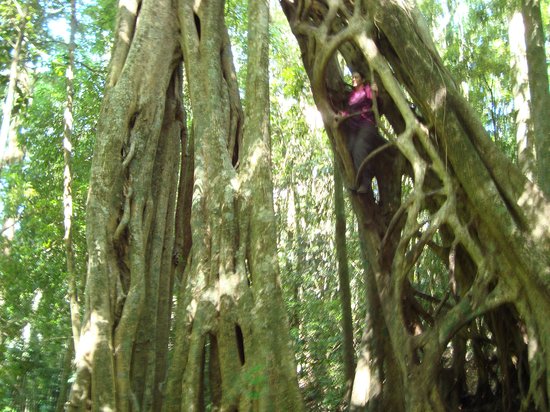
During the Q&A at the end I commented that the picture of the plant world that Marder sketched out (Irigaray's contribution was less programmatic and more reflexive) seemed awfully pacific and genteel. There were lots of trees, grasses and shrubs of various sorts but none of the more ugly and violent kinds of plants. The venus fly trap of course springs to mind but also the nightmarish ophiocordyceps unilateralis – a fungus (okay, not technically a plant) that infects ants, takes over their bodies, compels them to move somewhere warm and humid before the ant dies and a stalk sprouts out of its head which releases more spores. Or, less grotesquely but still rather violently, the so-called 'strangler figs' that wrap themselves around trees, climbing towards the light, eventually crushing their hosts and leaving hollow plaits of ivy as the trunks rot away.


For that matter there was also (and this didn't occur to me to ask until this morning) a rather excessive emphasis on rooted plants such that we might find in a park or garden. Algae, by far the most important kind of photosynthesiser there ever was or ever will be, wasn't mentioned (or if it was I missed it).

I was very conscious in mentioning all of this (although I may have been unsuccessful in warding off this impression) that I wasn't trying to assert a masculine view of nature as blood and thunder, vicious competition – green in thorn and barb, we might say – over a feminised one of it as serene coexistence; however, I did get the impression that it is only a small fraction of the vegetal world that this philosophy is prepared to consider. For me, a philosophy of nature can't just pick and choose the nice bits (to do this is to treat science as a content provider rather than a constituent producer).

This is from a recent article published by both in the Guardian:
The plant world shows us in silence what faithfulness to life consists of. It also helps us to a new beginning, urging us to care for our breath, not only at a vital but also at a spiritual level. We must, in turn, care for it, opposing any sort of pollution that destroys both our world and that of plants. The interdependence to which we must pay the closest attention is that which exists between ourselves and the vegetal world. Often described as "the lungs of the planet", the woods that cover the earth offer us the gift of breathable air by releasing oxygen. But their capacity to renew the air polluted by industry has long reached its limit. If we lack the air necessary for a healthy life (or, indeed, for any kind of life), it is because we have filled it with chemicals and undercut the ability of plants to regenerate it. As we know, rapid deforestation combined with the massive burning of fossil fuels, which are largely the remnants of past plants, is an explosive recipe for an irreversible disaster.
It's all a bit too kumbaya for me, if I'm honest. I don't recall them using the word 'harmony' but it's altogether too much implied. Where's the danger? Where's the non-human agency? It is all about scolding humans for their nasty exploitations with no recognition of the fact that things themselves might strike back...

The more important point I was trying to make by reference to the ugly side of plants was that perhaps in order to revere the non-human world we also need to fear it. Irigaray said that she didn't understand my comment (translation was an issue and I was quite nervous as I tried to articulate myself so it may not be her fault!) but she did say that to fear plants is to fear life itself. For her that is clearly a terrible, horrible thing. But I can't accept that. Yoda had it wrong: 'fear leads to anger, anger leads to hate...'. Fear is an important part of human existence. We can fear well and fear badly. We should fear the right things.

I didn't think that my comments would be received well and they weren't especially (although Marder was very gracious and accepted that it went to the heart of the matter). There's no place for fear, for violence or for that kind of negativity in these sorts of philosophies of nature. They are pick-and-mixes of the pluriverse that simply ignore the nastier sides of things. (Although, I must add another caveat and say that someone told me last night that Marder's book mentions poisonous plants; I will have to read it before I can really make any really bold claims in this regard.)

Marder doesn't believe that plants are capable of 'violence.' His reason for this is Hegelian: plants are, he says, incapable of self-negation. Now, I'm not altogether sure what that means (doubtless my fault) but my impression is that plants cannot do otherwise; immobile, they simply are (being immobile, he added, they cannot be territorial – something else I don't agree with). Devoid of animalistic intentionality they provide us with a model for being ourselves, otherwise, without the exploitative relation with other things that is brought on (this was also made clear in the Q&A) not by capitalism as such but by the specific relation towards logos inaugurated by the Greeks (capitalism being simply the latest product of this mode of thought).

Marder insisted that he didn't want to give a pacific picture of the plant world – it isn't that plants don't do damage to other things but that this isn't violence per se. Plants can be neither pacific nor violent, they just are. I don't think that this is a very good definition of violence. Moreover, I am of the Darwinian opinion that intentionality precedes awareness; all life is intentional because all life is goal-oriented, even if the only goal is survival and procreation.

When a fly trap dissolves an insect alive it isn't 'aware' of that insect in the way that an entity with a central nervous system is, of course, but I'm not sure why that matters. What difference does it make that the plant cannot uproot and move off, or retreat from a conflict with its tail between its legs? The plant destroys the insect, making it a means to its own ends. In this way, although it seems like Marder goes far too far in talking about 'plant thought' and so on, I think he doesn't go nearly far enough.

Plants in this phenomenological ontology of Irigaray-Marder aren't fully agential in the Latourian sense. Consequently they lack the capacity to demand our reverence; they cannot stoke fear in us; they cannot endanger us; they cannot unnerve us; and, consequently, they are entirely dependent upon our good will towards them. The vector of our moral obligation towards our green others always begins with the active, cognising human; the plants, however essential to our oxygen-hungry being they are acknowledged to be, cannot make demands on us, cannot really perturb us because they simply are – and their simple unindividuated thereness is what, for these authors, makes 'plant thinking' a model (or at least a partial model) for our own modes of thought.

I think it's quite the contrary: we need to be threatened by the non-human world again. People revere in large part that which they fear (when I said that at the lecture someone towards the front audibly snorted with derision – I feel I was not amongst like-minded people!). People used to fear nature – many still do who live in less homogenised, emaciated ecosystems than ours in the towns and cities (and the biochemically annihilated farmlands) of the Western world. That fear is proper, it's necessary. It's all very well insisting that we must recognise our extreme indebtedness to our plants others, etc, etc. but by itself this is still idealism. Humans neither revere nor respect just out of the kindness of their hearts nor through the workings of their rationality. Nothing is a simple as that.

This event was very thought provoking and I'm sticking my neck out since I've only read a tiny bit of the oeuvres of either of these extremely impressive intellectuals. However, this is not a naturphilosophie that I think I can get on board with. It actually, despite many explicit and very assertive insistences to the contrary, reproduces the modernist attitude towards non-human things because it makes humans the root of every vector of moral evaluation. Plants are there and they do stuff but they are at our mercy; they are prostrate before us; we are to be scoldingly reproached for our exploitation but human supremacy is to be presupposed and baked into the settlement. This isn't a break with whatever modes of thought the Greeks loaded on us; it's more of the same, differently nuanced.

I prefer what Latour calls an ethos of 'Optimism': all entities evaluate means and ends; it is as impossible to make the whole world a means for us, as per the modernist dream of progress (because immutable, eternal Nature doesn't exist and that attitude therefore leads to environmental catastrophe); however, it is equally impossible to make all the world our ends (we have to eat, breathe, etc.). The moral imperative is, first, to introduce a moment of hesitation in action where we are uncertain of how means and ends are distributed; second, it is to perpetually renew the search for the Optimum, for the best distribution of means and ends for a collective. This philosophy necessary requires political decision (in the literal sense of de-scission, cutting off). This is cosmopolitics (or geopolitics, if you prefer). It has nothing to do with harmony but rather spheres of influence; exploitation isn't a dirty word, we just have to know our limits and the limits of the world around us.

This brings me to Gaia (largely a vegetal entity though emphatically one not in a 'vegetal state'!), the whole point of which is that she is fiercely dangerous to us. She is a danger in the proper etymological sense (from Old French dangier 'power, power to harm, mastery, authority, control'). She is 'sovereign,' according to Latour.

Marder has a paper on Carl Schmitt ('The Elemental Regimes of Carl Schmitt') that I'm looking forward to reading. I'll conclude this over-long ramble with a quote from Latour discussing Schmitt. I think it's pertinent:
The great virtue of dangerous and reactionary thinkers like Schmitt is to force us to make a choice much starker than that of so many wishy-washy ecologists still swayed by unremitting hope. Schmitt’s choice is terribly clear: either you agree to tell foes from friends, and then you engage in politics, sharply defining the borderlines of real enough wars — ‘wars about what the world is made of’ —; or you shy away from waging wars and having enemies, but then you do away with politics [...] (105).
From living plant-like to living dangerously – there's a world of difference between these programmes.

[Update (07/06/14):

I received an email from Michael Marder which politely informed me that I'd gotten the wrong end of the stick about a couple of things!:
1. I never said that plants are immobile. Their being-in-place precludes locomotion, but not other kinds of movement, as I discuss everywhere in my writings. (In fact, even a certain long-distance locomotion is possible for plant seeds and pollen, as I always note.) 
2. Plant-Thinking is in large part dedicated to an exploration of the plant's intentionality. You will notice this as soon as you open the book, but especially if you reach Ch. 5 on The Wisdom of Plants.
On the first point, I meant 'immobile' in the sense of locomotion; in the sense that animals are not immobile but plants are—that is a fair point of clarification.

Second, I do need to read more of his books. The tagline of this blog 'In which I form strong opinions about things I don't know enough about' was never more appropriate!

This is a very interesting naturphilosophie and I encourage others to take it up. Hopefully one day I can give it the critique it deserves—i.e. an informed one!]

Friday, 24 January 2014

Cosmopolitics and blasphemy

Levi has a reply to my musing on cosmopolitics, itself a reply to his thoughts on pluralism and realism.

One thing I didn't mention in my previous post (though I think I hinted at it) is that I am ambivalent about this diplomacy/cosmopolitics pluralist thing.  I'm probably more in favour than against on balance but I wrote that post more as a proposition than a thoroughgoing endorsement.  I share some of Levi's reservations and criticisms and have others besides.  Having said that, however, really I don't agree that it's idealism (if it's idealism where are the ideas? what's an idealism that accepts stars, bacteria and rocks as real?).  In fact I think some of the criticisms Levi gives bear little relation to what I wrote (I'm not offended or picking a fight or anything, just saying it as I see it!).
I get the feeling that realism that dares to say that a particular world-picture is mistaken is seen as somehow being intolerant or totalitarian or oppressive.
I get where Levi's coming from with that.  It's definitely something that Latour insinuates often enough but that's not how my preferred interpretation of his argument goes.

The cosmopolitician doesn't deny the possibility or occasional necessity of a 'war footing,' so to speak (I actually don't like this martial terminology but I'll stick with it for now).  If we look at Latour's reading of Carl Schmitt (key to his political writings since Politics of Nature) then it is the omnipresent possibility of 'war' that makes the political friend/enemy decision necessary and renders politics possible in the first place.  'War' is always a possibility and so this is not a lovey-dovey, liberal, 'aw shucks can't we all just get along' kind of pluralism.  It simply asks the questions: Can we get along or not?  Need we come to rhetorical or critical blows over this or can we just let it be?  What forces are at play?  What battles must we fight?  It forces decisions to be made rather than simply being in a perpetual battle with everyone around you by default.

As I understand it Latour and Stengers are not arguing for a wishy-washy pluralism but an agonistic pluralism à la Chantal Mouffe - a political philosophy explicitly based upon a deep critique of the very conflict-averse liberalism that Levi is suggesting cosmopolitics reproduces.  A pluralism that accepts the inevitability of conflict, which requires a friend/enemy decision to be made and that strives for an adversarial rather than antagonistic relationship (but accepts the possibility of either).  So, the claim that cosmopolitics would deny the possibility of justifiably agonistic or antagonistic debate is simply untrue, at least in my understanding.
In arguing that everything is a social construction, the pluralist undermines the possibility of public deliberation about truth.
This is also, in my opinion, simply false.  The claim seems to rest on a couple of premises: first, that all the cosmopolitics/instauration stuff is just a fancy new vocabulary for the same old social construction (debatable); second, that any meaningful concept of truth requires transcendence - either things are real or not, existent or non-existent, a social construction or a real reality and we must decide, definitively, on which category all things belong to or our mouths are somehow sewn shut or our words have no purpose.

And this strikes me as really odd.  I can't see how Levi's philosophy can allow for unmediated access to reality à la the view-from-nowhere - to be candid: it can't.  And yet such hard-boiled realism seems, to me, to necessitate such a thing.  So, if he can't hold that then he can only demand transcendent truth as a regulative ideal, something to strive for but which is by definition unachievable - in short as a practice.  And if he's conceded that then he's conceded the inevitability of mediation and, therefore, the inescapability of 'social construction.'  (I don't want to do the lame Kantian/correlationist 'gotcha' thing, even if I were capable of such, but I can't see a way around this.)  I don't deny (nor, I'm sure, would Stengers or Latour) that bifurcated reasoning can be very productive (indeed, one could valuably argue that it is a 'noble lie' that is necessary for some forms of discourse, especially scientific, despite being strictly impossible) but to separate the socially, practically constructed from the non-socially constructed (if we must persist in using these terms) in a fundamental, transcendent way requires unmediated access to something that transcends the practices that bear the enquiry, doesn't it?  Otherwise we simply have constructivism with added self-denial.  (I presume Levi would refer to critical realism on this point but I don't think their arguments work, personally.  In short: ontological realism and epistemological relativism can only be rounded off by judgemental rationalism given an essentialist view of the human subject.)
In disagreeing with an-other do we not, in fact, recognize their dignity as subject by attributing to them the capacity to both decide their own being and act according to reasons?  Isn’t there a sort of denigration of otherness in pluralism insofar as it thinks of people as mere products of their cultural horizon or world-picture?
Yes and no.  There's definitely something to this and under some circumstances I'd agree entirely.  I think that Latour and Stengers overgeneralise and fail to cast their ideas with anything like adequate clarity.  Quite often a friendly debate ending in 'agree to disagree' is perfectly adequate.  But then that's hardly a political discussion.  Where's the conflict?  Where's the friend/enemy declaration?  Having a friendly debate with a Bishop over dinner and drinks is an easy case, all too easy - roughly equal power relations (if anything the philosophy prof. holds a lower social status!), a social setting explicitly open to such debate and (I would presume to guess) many shared values besides the theological disagreements.  For an agonistic pluralist there's no politics here, just a bit of fun.

But debates over deities and idols aren't always conducted on such cosy, well-fed, egalitarian grounds.  Sometimes there's real conflict, real ant/agonism.  The much more difficult (and interesting) cases are ones where power relations are unequal.  The phrase Latour always comes back to is 'the modernising front.'  Stengers talks about capitalism and the way it destroys practices (including those of science).  I think they overstate their case, in a way.  Not every political situation is conquistadors facing off against Amazonians or colonialists lecturing natives (as important as these cases are).  Latour and Stengers sometimes act as though these were all the cases that mattered and clearly they're not.

So, sometimes, in some situations if one were to apply the 'I'll grant your deity an ontology for the sake of peace' thing it would be just a load of over-intellectualised hot air - yes, I'd grant that.  But then sometimes it's not.  And how can one make the distinction if one is committed to perpetual critique of the perceived irrationalities of others?  Cosmopolitics allows the distinction - brutish, dualist realism doesn't.

I don't think I've got any way of wrapping all this up in a neat little bow - I'm still unsure of all this myself.  Clearly this is an ongoing debate both between and within ourselves.  I'll conclude by saying that although the tension between pluralism and realism isn't zero-sum clearly a choice needs to be made.  The gruff, gravel-voiced realism that mutters under its breath about 'bloody idealists' and 'religious loons' is compatible with a pluralism of 'it's a free country - if you wanna believe in fairies, be my guest' but little else.  Maybe that kind of arrangement is the right one - I have some sympathies in that direction, I'll admit - but I don't think it's obviously right.  Not at all.

In my last post I linked to a stand-up routine on 'political correctness' by a British comedian called Stewart Lee.  He is probably best known internationally for co-writing Jerry Springer: The Opera (if you've not seen it do!).  It was a massive critical and popular success.  It was due to be aired on the BBC when an evangelical organisation orchestrated a campaign to stop it being broadcast, to close the show down and to prosecute the writers for blasphemy.  They objected to the portrayal of Jesus during a fantasy sequence (actually internal to Jerry Springer's twisted imagination).  There were also threats of violence and so on as you'd expect.  It was broadcast and no prosecutions were made, in part because the government didn't pass a blasphemy law that it was debating at the time.  (In the US you suffer from far greater evangelism but also enjoy far greater freedom of speech, which is in no way formally enshrined in law in this country.)   The evangelicals did succeed in preventing the show from touring provincial theatres, however, and so they ensured that the creators made little or no money from several years of work.

After the dust had settled Lee got back on the standup circuit he had given up pre-Springer.  He wrote a routine called Stewart Lee, '90s Comedian, which concluded the most intensely, scatalogically blasphemous story one could possibly imagine.  It has to be seen to be understood - he did it in such a way that the story seems real, almost moving.  It was, in short, a giant 'fuck you' to those who had hounded him and stressed him to the point of illness.  But, and this part has to be seen to be believed, he did all this with a sensitivity and intelligence that made a mockery of the blunt-headed stupidity of his haters.  He wasn't attacking Christianity as such, despite the monumental blasphemousness of his routine.  It was a squarely, forcefully, artfully directed blow straight onto the collective chin of those who had wronged him - directed at them in particular.

This was an 'act of war,' no doubt.  But it wasn't total war.  It wasn't perpetrated in the name of any absolute, it was strategic.  This is Carl Schmitt's realpolitik critique of liberalism: it leads to worse wars because they are wars fought in pursuit of absolutes rather than limited objectives.  Wars fought for 'freedom' or 'to end all wars' are, ultimately, wars of extermination.  I don't like building a political philosophy on the basis of war-talk (and basing it on Schmitt is, shall we say, problematic) but in this case it makes a point.  As soon as your introduce absolutes into the equation the ground shifts.

I realise that this is an inadequate explication of the point but it is all my brain seems capable of at present!  I suppose all I really mean is this: have friendly debates over dinner, sure; say 'fuck you' to evangelicals who want to impress their fundamentalisms on you, of course; but hold out the possibility that peaceable relations are also possible besides simply saying 'I think you're an idiot but each to their own.'  The value of the diplomatic attitude, I think, is that it broadens the range of attitudes possible towards others and it permits this at an ontological level.  It closes off nothing - it's openness that's the point.

Saturday, 14 December 2013

BBC rewilding documentary 'Predators In Your Backyard'

A beautifully made and politically rather mind-blowing look at the practice of 'rewilding.'  Specifically, this documentary looks at the reintroduction of large predators such as wolves, panthers and bears into ecosystems that were damaged by the eradication of these species in the 19th/20th centuries.

Unfortunately the audio gets a bit out of sync with the pictures but only marginally.  It's still worth watching.  It really is cosmopolitics in action.  The yearning for a Nature that could be mastered and possessed is still in evidence but its absurdity becomes plain.

Also, there's some Mogwai on the soundtrack, which is always nice.