Showing posts with label isabelle stengers. Show all posts

Monday, 2 April 2018

Tarde’s 'Fragment d’histoire future' and the modal coordination of history and fiction – Reflections on 'Imagining the History of the Future'

Last week, I had the great fortune of attending the Imagining the History of the Future conference, part of the Unsettling Scientific Stories project (based at the universities of York, Newcastle and Aberystwyth). It was a really fantastic three days that introduced me to some fascinating people and has left me with a lot to think about.

For my part, I presented a paper – an exerpt from my thesis – on 'Gabriel Tarde’s Fragment d’histoire future and the milieu-fantôme.' This title is slightly modified from what I originally proposed (and from what appears in the programme). However, the original abstract still gets the gist of it:
Gabriel Tarde (1843-1904) was a magistrate, criminologist, sociologist and philosopher. Around the turn of the century, he engaged in a series of polemical exchanges with Émile Durkheim (1858-1917) concerning the remit and purpose of sociology. He also wrote a science fiction novel: Fragment d’histoire future (1896), published in English as Underground Man (1905) with a preface by H.G. Wells. The setting is apocalyptic: The sun has gone out and humanity – or rather a lone inventive pocket of it – has burrowed into the earth’s crust, chasing its enduring inner heat. All other life is extinguished. Written from the perspective of a future historian, Tarde uses this subterranean scenario to conduct a thought experiment that tests out his sociological theories concerning imitation, creativity and 'great men.' Although war and strife are suffered early on, this new civilisation comes to enjoy a golden age, free from the hardships of its surface-dwelling ancestors. Diseases are few; air is “the purest that man has ever breathed”; food is plentifully acquired from the frozen oceans above; the new troglodytes wear “coats of asbestos spangled with mica.” The Malthusian tendencies of population are the only serious problem, held in check by strict controls on marriage. Read in relation to Tarde’s other works, particularly Monadologie et sociologie (1893), Fragment d’histoire future provides an alternative means of approaching the development of the social sciences, their relation to race, class and gender, as well as the not so much ecological as sociological futurology of an eccentric but important fin de siècle thinker.
More precisely, I am interested this book for several reasons: First, in explaining the premises of the story, the narrator describes a "social milieu" entirely separated from the "natural milieu" that was destroyed with the cataclysm. It is this "purification," as he calls it, that constitutes Tarde's thought experiment; that is, he asks what would happen to social relations when all other conditions of life are removed.

Second, this sociological system – or, rather, ontology – involved an open criticism of Durkheim's rather more superorganismic conception. Whereas Tarde understood sociology along the lines of networks of creative imitations, Durkheim thought of society as a totality of collective representations impinging upon and transcending individual agents. Third, just two years later, this led Tarde to ridicule Durkheim et al.'s use of the concept of "milieu" as a kind of explanatory panacea for all phenomena. Durkheim's "milieu-fantôme," as Tarde called it, was therefore to be repudiated, although Tarde continued to use a somewhat different conception of milieu. 

Fourth, Tarde's book can be taken as a kind of witness to its situation – that is, to the time and place to which it accommodated itself. As well as the apocalyptic science-fiction premise, Tarde's technological anticipations give us a strong sense of the common sense of his time, as does his apparent endorsement (however eccentric) of a kind of artistic eugenics (where only the most creative are permitted to reproduce). Moreover, Tarde's development of a social ontology based on ideas of epidemic contagion (he was by no means the only to propound such an ontology but was unusual as regards the extent of his defence of it) creates interesting parallels not only with other sociologists and criminologists but also with post-Pasteurian transformations in bacteriology.

Tarde, then, links together a great many things. Indeed, a rather wide-ranging world can be reconstructed in terms of the networks and milieus that relate to his choices and dispositions – an elite, metropolitan world but nevertheless a significant one for my purposes.

The presentation was, I think, well-received and there were a number of great questions that tested my thinking and gave me ideas as to how to take this further. However, one question in particular, from Hanna-Riikka Roine, has stayed with me (I paraphrase): What was Tarde trying to do with this shift from legal and academic to fictional-speculative writing? What was the purpose or motivation of this segue of genres?

This is not something that I've looked into in detail yet; however, my immediate response was that Tarde was, at this time, involved in a polemical relationship with his intellectual competitors and wished to propagate his ideas to a wider audience. I am quite sure that this is the case; however, it is also a rather unsatisfactory answer and I hope to develop a better one.

The conference closed with a roundtable where participants were invited to submit questions ahead of time. I asked:

In the discussion itself, in response to a comment by Sarah Dillon on the subject of evidence in relation to historiography, I expanded on these questions a little. In my thesis work I've found a comment from Michael Oakeshott's 1933 book Experience and its Modes to be particularly useful – specifically, that a historian is someone who is obliged to interpret the past in terms of the evidence of that past. In other words, an historian qua historian bears an obligation to evidence.

This leads to a criterion of distinction (or a differentia as Oakeshott calls it in more formal philosophical terms) that differentiates historical from other modes of experience. A fictionist qua fictionist may or may not incorporate historical fact into her text; however, a fiction qua fiction cannot be faulted for its choices in this regard. Rather, the obligations incumbent upon a fiction are to the immersive or transformative effects it may have on its audience – a quite different condition of relevance.

(My thinking on this point is related to both Étienne Souriau and, more recently, Bruno Latour who have described fiction as a 'mode of existence,' as well as to Isabelle Stengers' philosophy of science; however, I will leave their particular propositions for another day.)

To cut a long histoire short, it is in relation to this distinction between history and fiction that my thinking as regards historiography (and, indeed, my practice thereof) is being developed. However, while history and fiction are therefore understood as fundamentally distinct in modal or categorical terms, they are also practically and technically highly interrelated. In the abstract, they share a great many textual and rhetorical techniques and, in the concrete, it may be difficult in certain liminal cases to tell them apart.

So, the basic point that I was (and am) trying to make is that historians, even if they do not write fiction, already venture onto at least some of the same terrain. Likewise, fictionists often have more interesting things to say about the writing of history (or just writing in general) than do professional historiographers (I think this is no coincidence). And so what is needed, I believe, is a more precise understanding of the modal differentiae that both distinguish these practices and, at the same time, allow them to be intellectually and, perhaps, politically coordinated.

I am making this argument here in perhaps more cohesive terms than I managed 'off the cuff.' Indeed, articulating these ideas was quite a challenge, given the diversity of the audience. During the three days, I talked to at least one non-academic sci-fi author, a curator, and academics from half a dozen recognised disciplines and many more subfields and disciplinary interstices.

In response to my mini-monologue, Maxine Gee (a screenwriter and PhD candidate at York) made the completely fair point that many academics are already authors of fiction (sci-fi and otherwise). Amanda Rees added that writing fiction is not at all easy. Mat Paskins commented that while the exploration of the intricate overlaps between history and fiction is all well and good, historians must recognise a fundamental moral obligation to relating the past as it happened, both for the sake of the victims of historical events (such as, to take only the most obvious and oft-cited example, victims of the Holocaust) and also for present-day survivors (such as those gay men for whom the very possibility of a collective future was, at the height of the AIDS epidemic, very much in doubt). Then, towards the end of the session, Kanta Dihal commented that there are many more voices producing (science-)fiction than are usually taken notice of in academic discourse – a lack of diversity being something for which this conference itself could, indeed, be faulted. And, so, rather than writing more fiction, perhaps academics should instead undertake to read more widely.

I would not substantively disagree with any of the above remarks (as I have remembered and reconstructed them). Indeed, they really expand on, in different ways, what I was trying to articulate.

However, I would just add that I think there remain unexplored possibilities at the modal and practical meeting point of fiction and history that I want to explore further. I do not mean to suggest that academics (as a homogenous group) can or should all start writing fiction. Some already do; many would not want to; most would not be much good at it. Nevertheless, I think it is notable that the likes of Tarde's Fragment can still, today, be understood as being a rather eccentric and exceptional expressive and discursive choice.

Writing fiction well is indeed a formidable task, as is any other kind of artistic creation. However, while counterfactuals are a common enough pedagogical (and, to a lesser extent, historiographical) tool, the active coordination of historical and fictional modes of experience (or of existence) remains at the margins. This is not, moreover, to deny the vibrancy of the margins; however, it is to call attention to what may be lost by accepting marginalisation as a given.

As to why the practices of historical and fictional writing are thus, for the most part, estranged, the reasons are fairly obvious: In more or less all of the social sciences (where I am located) and perhaps most of the humanities, scholarship is institutionally rewarded in a manner not only strictly demarcated from the artistic but is, to some extent, defined in opposition to it. This arrangement is tied to political expectations as to what constitutes useful knowledge and how funding regimes, accordingly, are to be distributed. For most academics, writing fiction could only be a pastime; it could not be a serious part of that for which they are employed.

None of this is either surprising or insightful but it remains, I think, relevant.

My thesis asks: What is the history of the concept of environment? I am interested in how this expression, along with its precursors such as milieu and climate, came to be a part of the everyday conceptual landscape. However, I am also interested in answering a second question: What does this history mean for the problems of the present?

Fictions, such as that of Tarde, are a crucial resource for reconstructing this history – that is, for answering the first question. However, could they not also be a starting point for approaching the second?

To be sure, I would not like to align myself with Tarde in any substantive sense. And yet at least some of his problems remain problems that concern us today. Thus, I take his work as presenting a problem of inheritance: What worlds will we make from the always conflicted and often deeply corrupted traces and evidences that we have, with great degrees of preservational prejudice, inherited?

My paper and this post only tease out the outer fringes of this question. However, this conference has given me many more routes to now explore.

Wednesday, 21 February 2018

The situation of reclamation – a review of: "Another Science is Possible: A Manifesto for Slow Science" by Isabelle Stengers

A review that I wrote of Isabelle Stengers' recently translated Another Science is Possible: A Manifesto for Slow Science has just gone up at the Society & Space open site. Very nice it looks, too.

The great thing about the S&S platform is that it allows for more extensive engagements with the works in question than is allowed by the usual print journal book review. Accordingly, I do not just summarise Stengers' text but try to clarify its major claims and then extend them in new directions.

I begin from a prominent, if rather poor, review that the book received in the Times Higher Education in December. I then try to explicate the most crucial proposals that Stengers makes and conclude by suggesting what a 'slow' geography might look like, thinking about possible connections with 'accelerationism,' the works of the late Ursula Le Guin and, then, the Situationist International.

In short, this is probably Stengers' most condensed and accessible account of her philosophy of science to date, as well as being an important addition to her thought in its own right. I would recommend it.

Tuesday, 14 February 2017

Isabelle Stengers on becoming a philosopher with Deleuze and Whitehead

Further to my last post on why I wouldn't feel comfortable calling myself a philosopher, Isabelle Stengers' recent essay in Roland Faber and Andrew Goffey's The Allure of Things is very interesting. She writes:
"I learned that I would become a philosopher when reading Deleuze and I experienced that philosophy is worth existing only if it accepts the risk of existing in the teeth of other practices, producing its own demanding concerns without needing to weaken theirs." (p.195)
That is more or less exactly my frustration with so many excessively pious and all-encompassing readings of 'geophilosophy.' She adds:
"If I learned what it feels to become a philosopher with Deleuze, it is with Whitehead that I learned what it means to answer this challenge by practicing philosophy as an openly speculative adventure."(p.196)
I must admit that I continue to feel un-carried away by Deleuze. The aspects of his thought I find compelling are those I find in either Stengers or Latour after him or James or Whitehead before (and with less intellectual indigestion). It may well be my failing.

Friday, 3 February 2017

Away from 'theory as overlay'; or: On not being a philosopher

I make no claim to be a philosopher, although I philosophise (and maybe that is enough – need one philosophise well?). This reluctance perhaps derives from being Anglophone and thus born of a deeply anti-intellectual culture for which more or less the only legitimate meaning of 'philosopher' is as shorthand for a particular subsection of the academic profession (and not one given much respect).

However, the more philosophical reason for this reluctance is that I find myself ever more an empiricist. I am interested in ideas only if they do not lead away from experience but allow it to be extended or amplified in various ways. This is, I suspect, why I have always found a liking for pragmatism, actor-network theory, and so on.

Above all, I am sceptical – no, that is too polite: I cannot abide – the use of theory as overlay. That is, the situation where an abstract vocabulary becomes so sophisticatedly all-consuming that it does not enable surprising connections but rather precludes them – a universe unto itself. This is Whitehead’s "thought within a groove" – the stuff of the professional.

For example, I find myself unable to share the fascination of so many philosophically-inclined geographers* with the geophilosophy of Deleuze and Guattari. It seems to me that their conceptual vocabulary of territories and strata is, if anything, the least useful aspect of their continually transforming, runaway stagecoach of a philosophical project (I mean this as a compliment) for thinking about matters of earth, experience and politics.

By taking practically all of the conventional terms available to actors engaging in geographical/geological practices and making them into unconventional technical terms, there is no longer any easy way of relating the web of abstractions to said practices as such actors themselves describe them.

There is a decoupling at this moment that carves out 'philosophy' as an autonomous space. I cannot abide that space. In this much, I am not a philosopher.

This is not to suggest that words should not be made and remade in abstraction from convention – they should. However, as counterintuitive as it may be, it seems to me that a creative conceptual universe made from the lexicon of geography might be less useful for geography than a conceptual universe made from something else.

This would not be such a problem if the likes of D&G were read more creatively and less, for want of a better word, 'professionally.' There is a remarkable lack of creativity – indeed, often outright piety – in the parsing of these thoughts as though they were to be a system adequate to an object.

Theory as overlay is incapable of astringency, as Isabelle Stengers describes that term:
"[…] the function of scientific thought has less to do with its ‘truth’ than with its astringent effects, the way it stops thought from just turning in self-satisfying circles."
Self-satisfaction is a vice of the intellect.


____________
*I'm not a geographer either but let's save that for another day.

Thursday, 8 December 2016

Alfred North Whitehead and the Logician's Nose

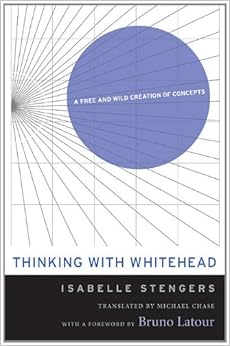
In his foreword to Isabelle Stengers’ Thinking With Whitehead, Bruno Latour writes:
“It could be one of those little games journalists play on television talk shows about books: “Who was the greatest philosopher of the twentieth century whose name begins with W?” Most learned people in America would answer “Wittgenstein.” Sorry. The right answer is “Whitehead” – another philosopher whose name begins with W to be sure, but one who is vastly more daring, and also, unfortunately, much less studied.”
Last week, here in Aber InterPol, we had a two-part reading group on A.N. Whitehead’s works. Being partial instigator, I got to choose the readings:
Session 1 – Whitehead’s Problem: The Bifurcation of Nature
The Concept of Nature, chapters I (“Nature and Thought”), II (“Theories of the Bifurcation of Nature”) and VIII (“Summary”). In these lectures (given 1919), Whitehead sets out his “problematique” for the first time, concentrating primarily on the philosophy of physics – something that is taken up and expanded in his later works. His argument here is crucial to many contemporary thinkers, such as Haraway, Barad, Latour and so on. 
Session 2 – Philosophy between Science, Art and Nature
Science and the Modern World chapters IV (“The Eighteenth Century”), V (“The Romantic Reaction”) and XIII (“Requisites for Social Progress”). In these lectures (given 1925), Whitehead fleshes out his problem historically, ranging much more widely than before. The fourth and fifth chapters are particularly interesting because they set out a distinction between natural philosophy and nature poetry, respectively, with Whitehead, as philosopher, taking both equally seriously.
We had been hoping to arrange something like this for a while; however, the occasion was provided by the annual visit of (Visiting Professor) Patrick Thaddeus Jackson from American University – noted Wittgensteinian (and Weberian, for that matter).

Besides myself, we had Milja Kurki, whose work on ‘relational cosmology’ gave us some really important parallels between Whitehead’s century-old works and contemporary physical thinking. Also, representatives of Lacanian psychoanalysis, Eliasian process sociology, and more.

Whitehead’s works are really important for my research at the moment, particularly regarding the place of ‘environment’ within his ‘philosophy of organism,’ and so it was extremely useful to get such a wide range of reactions. Having spent quite some time reading and absorbing Stengers’ reading of (or rather with) Whitehead, I am given to picking up particularly on his pragmatist tendencies. For example, from Science and the Modern World:
“You cannot think without abstractions; accordingly, it is of the utmost importance to be vigilant in critically revising your modes of abstraction. It is here that philosophy finds its niche as essential to the healthy progress of society. It is the critic of abstractions.” (p.59)
Patrick, on the other hand, was most struck by the ‘totalising’ ethic of endeavouring to combine all elements of experience and of scientific fact into a complete conceptual scheme, a theory of everything.

This impression derived particularly from recognition of Whitehead’s intellectual milieu. This being a few years before Gödel's incompleteness theorems were published (1931); a place and time where a ‘theory of everything’ was an objective that hardly needed explanation. Indeed, in our first reading, The Concept of Nature, Whitehead pointedly evades what he calls ‘metaphysics’ but sets out, quite straightforwardly, to construct a concept of nature that will enable the unification of the sciences. And, of course, we can hardly ignore that Whitehead was the mathematician who, with Bertrand Russell, attempted to do nothing less than provide a new foundation for mathematics in their Principia Mathematica (explicitly echoing Isaac Newton in the process).

Reading Whitehead's prose can seem, as Patrick put it, as though it's translated “from the original math.” We can see the ‘totalising’ aspect encapsulated very well on the very first page of Process and Reality (1927), where Whitehead describes “Speculative Philosophy” as:
“the endeavour to frame a coherent, logical, necessary system of general ideas in terms of which every element of our experience can be interpreted.” (p.3)
Of course, much hinges on what is understood by “our experience” but we can see the point.

My first reaction to this was that Whitehead’s project may have been totalising in this sense but it was not dogmatic. In other words, we should consider precisely what way it was totalising (partial, preliminary, fleeting – i.e. pragmatic). In Stengers’ words (taken by Latour as an epigraph): “Every synthesis begins ‘anew’ and has to be taken up from the start as if for the first time.” In Whitehead's own words: “The many become one, and are increased by one” (1927, p.21).

However, this all got me to thinking further about what I take from Whitehead, creatively rather than historically per se. My interest is not so much in ‘totalisation’ in the sense of insisting that conceptual schemes should necessarily involve consistent abstractions from “every element of our experience.” I am interested in avoiding arbitrary and premature delineations of intellectual boundaries – something for which Whitehead is evidently excellent.

However, I think the more interesting point concerns the profound obligation imposed by the requirement of logical consistency. The interesting aspect of logic, in this regard, is not so much the promise of cohesion into a permanent, solid, unshakeable whole. Rather, it is the unavoidable recognition of the fact that altering one part of the spider's web ripples through every other element. Change your concept of relation and this affects your understanding of life, knowledge, politics, dreams.

If Whitehead’s milieu compels us to interpret him as searching for the totality of the infinite, I am in a sense interested in the totality of the indefinite – stretching far beyond any given instance or expression, constantly rippling back, surprising and forcing reassessment of what could previously taken as totality. In other words, when we refuse to keep process cosmology out of the process of thought. When we give up trying to think the thought that would allow us to stop thinking.

In this sense, you need the logician’s nose to follow the flows. The genius of the tradition of rationalism that Whitehead embodies lies not so much in permanence but in its capacity for dealing with impermanence.

Thinking the thought that would allow us to stop thinking – was this Whitehead's objective? Maybe. But he provides plenty of possibilities for those seeking to kick the habit. Not trying to bring thought to an end but refusing to give up on the means yet developed for dealing with the exigencies of the indefinite.

Sunday, 1 May 2016

PhD diary #7: 01/05/2016 – On stupidity

Among the questions commonly asked of PhD candidates concerning their research, there are two that I think are closely related: the "so what?" question and the "what are your normative commitments?" question. The first asks for some justification, by unspecified criteria, as to the project's general worth and validity. The second might be attempting to elicit some sort of political or tribal affiliation – as is an academic's wont; or, it might be asking largely the same thing as the first question but slightly more specifically: what are the political or moral commitments that make this a worthy, valid project to be undertaking?

With a project as broad, abstract, philosophical and, therefore, as "academic" as the one that I am working on, these questions can be tricky – not least because these are the sorts of questions that keep PhD students up at night, quite apart from any summary, collegial interrogation! Particularly, working in the field of International Relations, there is often an implicit sense that the intellectual validity of your work is directly proportional to the directness with which it is concerned with grotesque amounts of horrendous violence and death – actual or possible.

Of course, I have many normative and political commitments, some of which might even be relevant to this specific instance. Likewise, there are many ways in which I think that I could respond to the "so what?" question with regard to this or that nugget of academic debate. However, the stronger answer that I am inclined to give, even if this might be seen to indulge in a certain intellectualism, is to say: what I am against, what I am resisting, what I am seeking to undo, displace or contradict is, most fundamentally, stupidity.

Now, of course, that is the kind of word that requires immediate qualification.

In Isabelle Stengers' recent (or, rather, recently translated) book In Catastrophic Times (2015, Andrew Goffey trans. [Au temps des catastrophes, 2009]), she describes stupidity [bêtise] as follows:
"Stupidity does not here refer to stupor, to paralysis, or to impotence. Stupidity is active, it feeds on its effects, on the manner in which it dismembers a concrete situation, in which it destroys the capacity for thinking and imagining of those who envisaged ways of doing things differently, leaving them stunned, a stupid and nasty argument may well leave you stunned with the mute perplexity of a “he may be right but all the same,” or enraged, which confirms it in turn: you see, with these kinds of people, there’s always violence."
The concept has a particular meaning in the context of her overall argument, which particularly concerns how to deal with (or not) the "guardians" that take it upon themselves to govern us. My meaning is slightly different, although perhaps adjacent.

For my purposes, stupidity is not so much inadequacy of understanding or inability to respond intelligently to a problem as an inability to recognise such inadequacy as inadequacy and, therefore, a wilful, active inability to recognise this thing as a "problem" at all.

It is in this sense a second order inability. The proper response to stupidity is neither problematisation as an end in itself nor an attempt to fix or solve the problem once and for all. Rather, it is to attempt to respond better, by some metric relevant to the immediate situation. General metrics can only lead to further and deeper stupidity.

A failure to think where thinking is necessary. (Of course, everything rests on this "necessary.")

In whichever way you cut it, there is a great deal of stupidity with regard to how we think (or do not think) about issues of environment and geopolitics, today. Both the purposes and the commitments of the project therefore derive from a determination to, in however minor a fashion, ease the pressures imposed by the stupidity of the moment.

Friday, 20 November 2015

The epistemological rupture and other stories

Catching up with the Eagles of Death Metal back catalogue. Seems only right.

Just finished reading Ursula Le Guin's City of Illusions. Deeply affecting.

These are inchoate, distracted, fragmented, tired thoughts (aren't they all?).

I am presently characterising my research project as an 'historical ontology' but this presents me with a problem – how far can or should I attempt to dissociate this term from its origins in the works of Michel Foucault and Ian Hacking?

Pointedly, what if the famous 'epistemological rupture' were a myth (more pointedly still: a bad one)? Or, more specifically, what if many of the problems currently encountered in thought were the result of assuming history to be a succession of more or less wiped-clean slates? Ruptures and revolutions? What if these events, not doubted per se, were susceptible to overly enthusiastic identification?

As Isabelle Stengers puts it in her book on Alfred North Whitehead, most encapsulatingly: "critical consciousness admits so many things without criticising them." And do not revolutions leave so very much in place?

I am thinking of much writing on 'resilience,' particularly the more scathing kind. So often the critics buy wholly into the propaganda of those they are criticising – that this is a wholly new way of thinking; a brand new set of techniques clearing away all that came before it, destined to take over, to sweep over and cover the planet like a blanket.

No more safety net or security cordon, just bounce-back-ability – the knocking opportunity found in the dull, distant thuds of an other's tragedy. There is certainly truth to this image. Neoliberalism and all that. The vultures do swarm.

But still there are nets, cordons, walls everywhere (a favourite world-making device of Le Guin, as it happens; particularly in The Dispossessed, chronologically the first in the Hainish cycle of books, which City of Illusions follows, a few thousand Terran years later). Walls growing like long, flat bamboo, cutting right through the land – but selectively, oh so precisely. Bringing a whole new meaning to 'land-locked.' There's security for some. It is the means of delivery and the extent of the coverage that is really in question.

And while walls are certainly enrollable into techniques of resilience, they surely echo and issue from a far older place. So why the blanket, as if such all-covering ruptures had actually occurred?

What does the built landscape of our collective abstractions look like if not a succession of semi-blank slates, temporarily stable states, rebuilt upon like neat, compressed strata? What is the proper image of such historicity. What forensis for this landscape?

Our thoughts, our categories, our abstractions – an ancient conurbation, continuously inhabited. No edifice persists without maintenance, without struts and strappings, without repetition but, for all that, we should not confuse the ages, conflate the epochs, prematurely compress the sprawling, soaring pulses of life, love, ceramic and aggregate. The architecture of our abstractions is less pristine palace, clean lines and geometric domes, than a reclaimed, hard-won, be-decked and bedraggled; ancient edifices built over, reused, repurposed – repetition, yes, but persistence nevertheless.

Some of every thought is the newest of the new and it surely cannot be otherwise. But some patterns aren't easily shrugged off. It is easier to hear them than to resist them…

The problem of history. It is not a storage crate to be picked through at leisure. It is not a layer cake that needs re-separating.

Perhaps 'historical metaphysics' would be a better term. An historical metaphysics born of speculative pragmatism. I need only show that neither of these phrases are contradictions in terms but, in fact, elements of a necessary tensegrity.

Back to the music. Damn, that's a riff.

Saturday, 7 November 2015

Matter, a concrete generality

Is it possible to sum up Alfred North Whitehead's metaphysics in a sentence? No. But here's a sentence anyway:

There are no concrete generalities.

For philosophical materialism, matter is a concrete generality. It is, quite simply, what is. In Whitehead's thought, there are only concrete particularities. That is, 'actual occasions.' But isn't actual occasion just then another way of saying 'matter'? I think not. To say that reality is constituted by actual occasions is to say absolutely nothing about what those occasions are like. Neither hot nor cold, wet nor dry, material nor immaterial. That's really rather the point of them. Contrast this to 'matter,' which is said to have all kinds of properties. For some it is dead, lifeless, inert. For others, it is active, lively, vibrant. These are variations on the same theme: matter as a concrete generality. On the contrary, actual occasions demand specificity – it is built into their very definition that nothing much can be said about them in general. Matter, then, appears as an abstraction. And there's nothing wrong with abstractions. As Whitehead affirms, one cannot so much as think without abstractions. However, we have to be careful as these things can get out of hand fast. 'Actual occasion' can then be understood as the minimal concept that permits wide-ranging abstract thought while safeguarding against the poison of concrete generality – i.e. against something fundamental, general and capable of being meaningfully described.

I'm going to be reading a lot more Whitehead in the near future, so we shall see whether this understanding is still standing in a little while. At the moment, this is basically an abridged version of my understanding of Isabelle Stengers' understanding of Whitehead.

Sunday, 31 May 2015

William James on the conciliation of religion and science; also, mathematics and pragmatism

I'm presently reading William James' Varieties of Religious Experience. Like much of James' writing, some of it can be rather pedestrian and ponderous but then certain sections jump out like great glowing epiphanies. I like this section from the end of lecture 5 on "The religion of healthy-mindedness" in particular:
The experiences which we have been studying during this hour (and a great many other kinds of religious experiences are like them) plainly show the universe to be a more many-sided affair than any sect, even the scientific sect, allows for. What, in the end, are all our verifications but experiences that agree with more or less isolated systems of ideas (conceptual systems) that our minds have framed? But why in the name of common sense need we assume that only one such system of ideas can be true? The obvious outcome of our total experience is that the world can be handled according to many systems of ideas, and is so handled by different men, and will each time give some characteristic kind of profit, for which he cares, to the handler, while at the same time some other kind of profit has to be omitted or postponed. Science gives to all of us telegraphy, electric lighting, and diagnosis, and succeeds in preventing and curing a certain amount of disease. Religion in the shape of mind-cure gives to some of us serenity, moral poise, and happiness, and prevents certain forms of disease as well as science does, or even better in a certain class of persons. Evidently, then, the science and the religion are both of them genuine keys for unlocking the world’s treasure-house to him who can use either of them practically. Just as evidently neither is exhaustive or exclusive of the other’s simultaneous use. And why, after all, may not the world be so complex as to consist of many interpenetrating spheres of reality, which we can thus approach in alternation by using different conceptions and assuming different attitudes, just as mathematicians handle the same numerical and spatial facts by geometry, by analytical geometry, by algebra, by the calculus, or by quaternions, and each time come out right? On this view religion and science, each verified in its own way from hour to hour and from life to life, would be co-eternal. (99-100)
This brief note on mathematics reminds me of Isabelle Stengers' regular insistence on the importance of the fact that A. N. Whitehead was a mathematician. Far from granting transcendent access-authority to a higher realm of ideas, in this understanding mathematics heightens only one's capacity for perspective-shifting—that is, for pragmatism.

Saturday, 23 May 2015

Reassembling geopolitics—a brief synopsis of my long-term project

For the past 8 or 9 months, I've been plotting and planning the long-term research project that, one way or another, I will pursue for the next several years. (In fact, this plan has been more or less complete since January but I'm just getting around to sharing it now.)

It takes Bruno Latour's work on geopolitics as its starting point but also departs from it in various ways. My recently published article Back down to Earth: reassembling Latour's Anthropocenic geopolitics is essentially a (very) long preface to this larger work.

The project is divided into six parts, each of which are substantially independent but also follow on from each other:

1. Earth and Cosmos
2. Geopolitics and Environment
3. Spherology and Fortification
4. Diplomacy and Territory
5. Possibilism and Possession
6. Geohistory and Geodesy

The first two parts suppose that if we are to reimagine what geopolitics might mean 'in the Anthropocene' or 'facing Gaia,' etc. then we really need to understand what some key terms mean (and have meant) in a broader historical context: Earth, first and foremost, but also the inherited Latin and Greek parallels of that Germanic term, terra and geo. Following on from Peter Sloterdijk's grand conceptual histories, Earth also has to be understood in its historical geo-ontological relation with cosmos. Geopolitics, as I've written in Back down to Earth, was coined in 1899; however, it has to be related to the much longer history of geography and then, in turn, to the entangled histories of words such as environment, climate, milieu, and so on. By the end of these first two parts/chapters, the various conceptual-historical issues surrounding 'geopolitics in the Anthropocene' should be well understood and a thorough reconstruction should therefore be possible.

The middle two parts focus on different sorts of techniques and technologies and how these produce differing configurations of exclusion and belonging. Techniques of fortification—walls, fences, barricades, etc.—carve up space and cement geopolitical arrangements. We are used to understanding such constructions along borders and on strategic high grounds as being geopolitical but increasingly it is not only humans that must be kept in/out: flood defences, dykes, geoengineering projects—these are all geopolitical forms of fortification in the new sense that I would like to articulate. Diplomacy, meanwhile, is not a technique of exclusion but a 'technology of belonging,' as Isabelle Stengers puts it. How differing forms of territory are negotiated (or not) is crucial to understanding the possibility of new forms of coexistence given mounting Anthropocenic pressures.

The final two parts investigate the role of the sciences in this nascent geopolitics in more detail, particularly focusing on problems of calculation, possibility and deep time in relation to matters of land, dispossession and resistance. Possibilism is a term taken from the historian Lucien Febvre. He opposed it to the alleged environmental determinism of the previous generation of geographers from Germany, such as Friedrich Ratzel. Linking to abovementioned investigations, I also want to think about compossibility in the sense of Leibniz and the concept of compossibilism as a diplomatic form of thought about possibilities of coexistence. Possession I take to mean both possession of and possession by—I want to relate geopolitics particularly and inextricably to matters of expropriation but also to mass movements and political passions. Geohistory I mean both in the sense of Fernand Braudel's geographical histories and of Martin Rudwick's history of the geological sciences. Related to the latter, geodesy is a somewhat archaic term meaning the science of measuring the shape of the Earth. However, etymologically the '-desy' also suggests division, which relates back to matters of apportionment, appropriation and nomos, in the sense of Carl Schmitt.

There is an enormous amount of work to be done on all of the above; however, I've already made a start on some of it.

My work-in-progress paper Varieties of diplomatic experience (with particular attention to the problem of territory), presented at a workshop in Windsor this week, investigates the conceptual side of the diplomacy/territory conundrum. I intend to do more empirical work on these issues, taking Richard White's The Middle Ground: Indians, Empires, and Republics in the Great Lakes Region, 1650–1815 as a starting point; however, working out some of the conceptual problems is a first step.

On possibilism and determinism, I've arranged a roundtable conference session at RGS-IBG in Exeter later this year: Determinism, environment and geopolitics: an interdisciplinary conversation. I'm hoping to assemble a variety of geographers and environmental scientists to talk through these issues from different perspectives and to form, however modestly, a research agenda on these topics that are so crucial for political geographers and earth-concerned thinkers of all sorts.

As the project develops over the coming months/years it'll be interesting to see how it changes relative to this initial envisagement!

Sunday, 26 April 2015

The dialogue of Beelzebub and the Hermit—Leibniz, The Philosopher's Confession

Further to a previous post, and particularly Tim Howles' comment thereon, I thought I'd post an extract from Leibniz's 'The Philosopher's Confession,' which Isabelle Stengers references in her Penser Avec Whitehead (although it isn't mentioned in the English translation).

It is a dialogue on God's justness. The interlocutors are 'The Theologian as Catechist [i.e. instructor]' and 'The Philosopher as Catechumen [i.e. instructed].'

We may join them in the closing stages of their discussion, as our principal interest vis-à-vis Stengers' remark concerns a 'dialogue within a dialogue' that occurs soon after:
Philosopher: [...] No one who does not know God can love him properly, but such a person can hate him nevertheless. Therefore, he who hates God, hates nature, hates things, hates the world: he who wants these things to be different wants God to be different. He who dies malcontent dies a hater of God and now, as if pushed to the edge of an abyss, he follows the path on which he began, external things no more calling him back. With the access to the senses closed off he nourishes his soul, which has withdrawn into itself, with the hatred of things already began, and with that misery and loathing, indignation, jealousy and displeasure, which increase more and more. When reunited with the body, and when the senses have returned, he continually finds new material for contempt, disapproval and anger, and is so much more tormented the less he is able to change and endure the torrent of things displeasing to him. However, in a certain way the pain turns into pleasure and the wretched are glad to find something by which they are tormented. Just as with humans too, the unhappy, while envying the happy, seek at the same time to wear them down, with no other outcome than that they become indignant, as they think the inept are the masters of things, and their pain, more unimpeded and more unchecked, is turned into a kind of harmony, i.e. an appearance of reason. For in the case of the jealous, indignant and malcontent of this kind, pleasure is mixed with pain in a remarkable way, for just as they are pleased and delighted by their belief in their own wisdom, so they suffer so much more furious pain because they lack the power they think is due to them, or rather is in others they deem unworthy. Here you have the explanation of those extraordinary paradoxes, that no one is damned unless he wills it, but also that no one remains damned unless damned by himself. The damned are never absolutely damned, always damnable. They are damned by stubbornness and a perverse appetite, by an aversion to God, so that nothing gladdens them more than to have something by which they may feel pain; they seek nothing more than to discover a reason for them to get angry. This is the highest degree of madness of reason - it is voluntary, irredeemable, desperate and eternal! The damned, therefore, even if they wanted to, can never make use of those complaints which we ascribed to them earlier, and so cannot accuse nature, the universal harmony and God as being the authors of their own misery. 
Theologian: Immortal God! How you have brought about endoxa from your paradoxes. I realize that the Holy Fathers were not averse to this kind of explanation. And the pious ancients summed up the innate character of the damned very much like this in a simple but wise fable. Some hermit, in the depths of contemplation as if intoxicated, begins to be pained in earnest on account of there being so many creatures coming to ruin. Therefore he approaches God with his prayers, and shows the sincerity of his own longing - 'Oh father,' he says, 'can you watch the destruction of so many healthy children? Ah, receive into your grace those wretched demons, which drag so many souls with them into the abyss.' To him who cried out like this, the almighty calmly replies, with an expression which brightens the sky and quietens the storm: 'I see, my son, the simplicity of your heart, and I forgive the exuberance of your emotions, and in my case there is indeed no obstacle. Let those who seek forgiveness come to me.' The hermit then says, in adoration: 'You are blessed, oh Father of all mercy, oh inexhaustible source of grace. And now I go with your permission in order to meet he who is wretched to himself and others - he who so far is ignorant of the happiness of this day.' He departs to meet the prince of devils, not an infrequent visitor for him, and immediately upon making his way in, says: 'Oh you are fortunate! Oh fortunate this day, on which the way of salvation is opened to you, which almost from the beginning of the world has been closed! Come now, and complain about the cruelty of God, in whose presence the supplication of a miserable hermit on behalf of rebels of so many centuries has been effective.' The prince of devils, like the indignant and like those speaking menacingly, replies 'And who has appointed you as our agent? Who has persuaded you to so foolish a pity? Understand, foolish one, that we need neither you as mediator nor God's pardon.'
The Theologian then proceeds to recount this intra-dialogue:
Hermit: Oh the stubbornness! Oh the blindness! Stop, I beseech you, and allow me to discuss this with you.
Beelzebub: Evidently you will tell me.
Hermit: But how trifling is the loss of a few moments you spend listening to a little man who is desirous of the best for all?
Beelzebub: So what do you want?
Hermit: You should know that I have pleaded with God concerning your salvation.
Beelzebub: You? With God? Oh disgrace of heaven, oh infamy of the world, oh humiliation of the universe! And this is he who rules things, this is he who so demands the angels tremble before an authority which has prostituted itself before these worms of the earth? I am bursting with anger and rage.
Hermit: Ah, refrain from these curses as we are on the verge of reconciliation.
Beelzebub: I am beside myself.
Hermit: You will return to yourself when you have learned with how much fatherly tenderness the lap of God hopes for the return of a son.
Beelzebub: And is it possible that he who has exasperated us through so many injustices wants reconciliation? He who has so often harmed has recovered his senses? He who considers himself all-knowing has recognized his error, he who considers himself all-powerful humbles himself? Eh, and what is the price, do you think, for agreeing to the peace?
Hermit: A single supplication will extinguish the angers, will bury the hatreds, and will make the memory of earlier events submerge as if in the depths of the sea.
Beelzebub: Go and announce that by this condition I am prepared for friendship.
Hermit: Seriously?
Beelzebub: Not a doubt.
Hermit: You are not making fun?
Beelzebub: Only go, and enable the matter to be accomplished.
Hermit: Oh happy me! Oh cheerful day! Men freed, God blessed! 
God: What news do you bring with so much dancing?
Hermit: The matter is settled, oh Father! Now the kingdom and the power, and the salvation, and the strength, and the honour, and the glory are of our God and his son Christ, because he who accused us every day, and who bellowed by night and by day for our death, has turned.
God: What? You have also added the condition of begging mercy?
Hermit: He has approved it.
God: See that you should not be deceived.
Hermit: I go in order to bring him so that he will keep his promise.
God: But listen, you: let us work out in advance the form of words.
Hermit: I shall follow them.
God: Therefore give notice to whoever may want to be accepted in grace that they will have to commit to the use of these words before my throne: 'I confess with my mouth and acknowledge with my heart that my wickedness has been the cause of my misery and that it would have been made eternal if your ineffable pity had not dispelled my stupidity. Now that I, with a subdued mind, have understood the distinction between light and darkness, I would rather suffer everything to the end than return to the condition where I repeated the offence to him, which the nature of things can consider nothing so vile.'
Hermit: I have it. And now I shall go, or rather I shall fly. 
Beelzebub: Can it be that you are winged?
Hermit: The emotion has made me so fast. Here is the form of words of the supplication.
Beelzebub: I shall read it if it pleases you. But when will the condition be fulfilled?
Hermit: Whenever you want.
Beelzebub: As if the delay is on account of me.
Hermit: Come then. Let us go to the throne of God.
Beelzebub: What? Are you quite sane? Do I go to him, or him to me?
Hermit: Do not mock with regard to a matter so great.
Beelzebub: He who is going to beg for pardon will go.
Hermit: Let's go then.
Beelzebub: You are mad.
Hermit: Are you not the one who has to beg for pardon?
Beelzebub: Is this what you have promised?
Hermit: Who would think differently, even if he were dreaming?
Beelzebub: Is it not I who am offended? Shall I become suppliant to that tyrant? Oh excellent mediator! Oh plague of man! Oh model of a colluding advocate!
Hermit: Ah, what are you doing?
Beelzebub: Poison enters the limbs, and already rages the anger Through the whole body: crime is heaped upon crime. Thus we are purified. The only victim for the frenzied Is the sacrifice of his enemy. It is pleasing that he be scattered in the winds And mangled alive, drawn into a thousand pieces, Persecuted with as many marks of my own pain, The trumpet itself summoning those to be resurrected To withdraw the flesh.
Hermit: God, turn to my assistance.
Beelzebub: Gaping jaws of pale Avernus, and you lakes of Taenarum...
Hermit: He has vanished, I breathe again. That wretched creature left behind testimony of where he would go in his last words. Oh despair! Oh enemy of God, of the universe, of himself! The cursed should go to him, and have their deliberate insanity. But to you praise, honour, glory, oh my God, who have condescended to reveal your pity and also your justice so splendidly to your servant; you have removed all those temptations of doubts which were trying to make out that you are either unjust or powerless. Now my soul is at peace, and basks with unexhausted delights in the light of your beauty.

Thus spoke our hermit, and I with him.
 To quote Tim's previous comment:
This is not Milton's Satan. It's a much more cowardly, dastardly, niggardly refusal of truth: the perfect analogy, as Stengers points out, for the destructive/ deconstructive/ denunciatory reaction that she doesn't want from the reader of this book.
The crucial thing here is mediation (this is why I think that the figure of the diplomat must be kept in mind throughout Stengers' writings, even when she doesn't mention it explicitly).

The Hermit is the mediator here who is abused and betrayed by Beelzebub. God, as the previous discussion between the Theological and the Philosopher indicates, is conceived of as a substance of pure harmony. To make peace with God is thus to find peace; to reject God is to wallow in an inwardly and outwardly destructive circle of loathing and contempt.

However, I am inclined to hold at least a moment's thought for Beelzebub's position here. Is his objection not that he is being summoned to kneel before a Father? He is being granted a divine invitation to peace and harmony—an invitation that his loathing and self-importance cannot allow him to accept. However, it is an offer issued from a position that is discernibly monarchical.

Indeed, Stengers says something similar on this same dialogue towards the end of her Cosmopolitics II:
"When Leibniz attempted to consider the question of damnation and introduced Beelzebub's refusal to 'ask forgiveness,' which God had decreed to be the condition for his salvation, he also showed, perhaps in spite of himself, the extent to which apparent generosity, whenever it is one-sided, can exacerbate the rage of the one it was supposed to benefit. The cosmopolitical calculus will always remain exposed to rage, to Beelzebub's despair [...]." (415)
She goes on:
"Beelzebub's venomous rage is the rage liable to invade the victims of crimes to whom the risky commitment of the calculemus is proffered." (415)
The calculemus ('let us calculate') in Stengers' reading refers to the construction of a temporary common measure, a 'middle ground' between estranged parties for the purposes of conciliation. It takes two to conciliate; we may infer that the condescension of a benign deity is insufficient to this end.

I think it's also important that Stengers notes that Leibniz might be making this case "perhaps in spite of himself." Her reading of Leibniz posits him as a 'minor key' thinker, in the sense of Deleuze and Guattari. Leibniz is notoriously impossible to pin down—a multiplicity if ever there was one. However, the minoritarian, diplomatic reading is, I think, really fruitful, even if it has to be constructed to some degree 'in spite of' certain facets of the man himself.

Sunday, 19 April 2015

"My readers have now been warned"—halfway through Stengers' Thinking With Whitehead

At the end of chapter 16 of her book on the work of Alfred North Whitehead (just slightly over halfway through the text), Isabelle Stengers writes:
"My readers have now been warned. If they are fascinated by the heroic grandeur of refusal, and despise compromises; if they deplore the fact that the radical demands of every new position are recuperated by what was supposed to be subverted; if 'to deconstruct' is a goal in itself for them, and scandalizing self-righteous people is a testimony to truth; if they oppose the pure to the impure, the authentic to the artificial; if they cannot understand how the most 'unplatonic' of philosophers situated himself as a 'footnote' to the text of Plato ... let them close this book. Never will they see celebrated in it the power of a truth that is verified by the destruction of false pretenders. They will therefore find in it only disappointments and reasons for contempt." (Thinking With Whitehead, p.275-6)
And slightly different in French:
"Le lecteur est maintenant prévenu. Si, comme le Belzébuth mis en scène par Leibniz dans Confessio philosophi, dont la rage se déchaîne à l'offre de salut, il est fasciné par la pureté du refus et méprise les compromis, s'il déplore que les exigences radicales de toute position nouvelle se monnaient progressivement en contrastes enrichissant ce qu'il s'agissait de subvertir, s'il ne peut comprendre que le plus « non platonicien » des philosophes se soit situé lui-même comme « note en bas de page » au texte de Platon... qu'il referme ce livre. Jamais il n'y verra célébré le pouvoir d'une vérité qui se vérifie par la destruction de faux prétendants. Il n'y trouvera donc que déceptions et raisons de mépris." (Penser Avec Whitehead, p.310)
This is my third attempt to read this book and it's the first time that I am sure that I will reach the end. It is not that it is a 'difficult' book as such. Stengers, in her own inimitable way, writes with extraordinary precision. However, being something of an autodidact with respect to philosophy, I wasn't quite ready for such a dense and demanding text in the past.

It is a work that requires a very particular routine of reading. It cannot be read casually, put down and picked up a week or two later (not usefully, anyhow). At over 500 pages it is not something that can be read in one sitting, or several sittings, either. (There is no quick way through such a text—the whole point is that the reader slows down.) It requires, for me at least, extreme attention and focus. It's not something that I am able to read except when at my most clear headed, and then for a few hours at a time. Unfortunately, there aren't many windows like that in my week (I hope that soon this will change). I, out of necessity, do most of my own reading and research in the evenings—not a time of day conducive to this kind of endeavour.

Nevertheless, I am gradually working my way through the book—one immersion at a time—and it is most certainly worth the effort. It's the kind of book that, after having read it, I will never be able to read any other book in the same way again. It neither condescends to its reader nor indulges in unnecessary dissimulation. It attempts to be clear but, at the same time, transformative. This time around, I am finding that it succeeds in both respects. Again, I find that the best words for it are: precise but, at the same time, extraordinarily dense. It is the most exquisitely constructed thicket.

There is far, far too much in this book to even begin to summarise or select. However, I find the above quotation(s) to be a perfect signal of its tone and intentions. This dissuasion addressed directly to the reader is at the same time reassuring—I am assured that none of the things described appeal to me (and their sirenic allure is further muted with each and every passing page).

Thursday, 16 April 2015

"The varieties of diplomatic experience (with special attention to the problem of territory)"—for workshop on "Bruno Latour and Environmental Governance"

I'm very excited to be taking part in a workshop next month titled "Bruno Latour and Environmental Governance."
Since the 1980s Bruno Latour has attempted to supplant the prevailing image of science by proposing a pragmatic and anthropological perspective. [...] The two-day workshop takes as its starting point the idea the Latour's work can be used to explain and understand the workings of environmental governance, using the IPCC as a prime example.
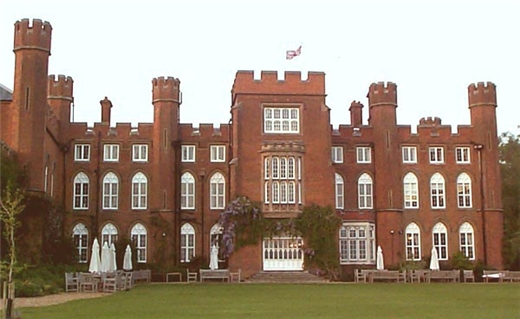
It's being organised and funded by UCL Department of Science, Technology, Engineering and Public Policy and PBL Netherlands Environmental Assessment Agency and will be held at Cumberland Lodge, Windsor (just outside London)—an impressive venue!


My paper will be titled, wordily, "The varieties of diplomatic experience (with special attention to the problem of territory)." I hope to:

(a) Introduce the history of diplomacy as a word and practice, particularly drawing on the existing literature on the subject in the field of International Relations.
(b) Articulate diplomacy as a philosophical concept, particularly as it is developed in the work of Isabelle Stengers (see for example).
(c) Relate the preceding to the concept (and problem) of territory, particularly comparing its modern, state-centric iteration (as traced most notably by Stuart Elden) to the speculative, topological conception articulated by Bruno Latour in his most recent works (see here for an overview).

The crucial link between (b) and (c) is Gottfried Wilhelm Leibniz—he is the prized witness of Stengers' philosophical diplomacy and is credited by Elden as articulating the modern conception of territory for the first time. Understanding his creative conception of territory as a diplomatic act itself allows Latour's reconception to be framed as a diplomatic act also—and thus related to the geo-ontological upheavals that institutions like the IPCC are grappling with in their own ways.

My overall argument is that 'high-level' diplomacy, such as is practised at the IPCC, can only succeed if diplomacy is occurring at all levels and everywhere. Geogovernance (being the focus of the workshop) cannot be taken in abstraction from geopolitics (taking the latter term more or less as Latour articulates it).

I attended a really excellent conference session on anthropology and diplomacy in Exeter this week. Their focus was, as you might expect, 'everyday' diplomacy outside the corridors and constrictions of formalised, state diplomacy (although not ignoring the unavoidable connections and collisions between tentacular state institutions and mediative practices everywhere).

I want to bring these threads together—the historical, the philosophical, the anthropological—and to use this convergence to nudge the concept of geopolitics towards an integration of state and non-state apparatuses.

It's very much a work in progress, and will remain so for a while; however, it should be published, with a bit of luck, in a special issue of Science & Technology Studies next year.

Thursday, 26 March 2015

Styles of writing, modes of thought and logic versus poetics

By way of response to my previous post on the seminar that she organised, Penny Newell writes (with terrific kindness!):
It's great to read the write-up on your blog Philip, and, having browsed the press release for the Reset Modernity! exhibition, I really see how it all links in to the anomalies series. I feel compelled to say something. One thing I really love about your blog is your ability to say that you simply do not know, or that you might know, at some point, but perhaps not everything, just yet. I actually think this in itself is how I think modernity should be 'reset'. It blows syllogistic logic out of the water, allowing you to speak meaningfully, truthfully, rigorously, with an quality of erudition that I think is truly important, in ways that allow your reader to slow down; allows your ideas to resist the finitude of conclusive statements. Put simply: I can't extract what you say from how you are saying it. Maybe you don't intend this, but it's there (and it's actually, in my opinion, really in keeping with the Stengers piece you sent to me - not that I am calling you out as an 'idiot'... merely that I feel you resist the 'and so' of writing). 
Bit of a tangent, but just yesterday I was reading a piece by Constantino Marmo, referenced in Eco's work on metaphor, entitled, 'Suspicio: A Key Word to the Significance of Aristotle’s Rhetoric in Thirteenth-Century Scholasticism'. It sparked an interest in me as Marmo posits the 13th c. (esp. Albert the Great / Aquinas) as a (mini-)paradigm shift toward subtended various modes of thinking within logic, such that Aristotelian rhetoric and poetics became subsumed within the rationalis scientia; opening the way to reading poetics as and through a methodological modus sciendi. This is fascinating! (though I need to explore in more depth just how much I can make the following claim...) as it seems to me that part of the task of resetting modernity should be to reclaim rhetoric and poetics from logic; or at least to position them alongside it. My open question is: if we do so, what happens? What happens to the task of criticism within the field of poetics, if we consciously, just-so-slightly, nudge logic to one side? Does it reveal that works such as the Poetics are somehow subordinate to the Organon? Does it show that we're trying to be too logical in our readings of those works? What does it say about a whole field of Arts and Humanities, which owes so much of its thinking to thinking substantial things, drawing substantial conclusions, about poetics and rhetoric? I feel (or at least, I try in my work to practice the possibility that), if we shift the positionality of the Poetics, away from logic, it becomes a document that we can just write through, away from the rationalising project of modernity, towards, well, not much ... perhaps just away from an 'and so'. Perhaps just towards a 'perhaps'.
I hadn’t thought about it in that way but I suppose that I do work with a degree of ‘idiocy’ (in the technical sense!). I feel utterly unimpressed by modes of thought that always have a pre-fabricated answer for everything. ‘Well,’ they say with a half-stifled yawn, ‘this is, of course, just a case of [xyz].’ Such boredom infects and infests everything it touches (it’s the boredom of someone who’s already had every idea they’ll ever have...). The most important thing I ever learned was how to be productively and creatively perplexed (rather than merely bored) by things that I didn’t understand. It took me a long time to figure that out. I feel like I’ve been making up for lost time ever since.

Self-certainty is good for defending hilltops; exploring forests is another thing altogether. How this translates into a writing style is tricky. I do give a lot of thought to the relation between style, mood, rhythm, structure and argument. And I do find them to be inseparable. Of course, this is not a new insight. However, acceptance of the mere fact of performativity tells us nothing with regard to how that performance should be carried out. And that is something that doesn’t get thought through enough. (Most academic and intellectual ‘styles’ are just copies of copies of copies.)

Regarding poetics and logic, that all does sound very interesting! I suppose if we want to think about ‘resetting’ some dualistic aspect of modernity then we would have to begin by acknowledging or finding the value of both sides of the equation. We might want to save poetics from the stolid strictures of logic. Okay, but if we are to flood this particular valley we need to adequately re-house both villages. If the modernist settlement makes logic an enemy of poetics then we should have some sympathy for the logicians too! They also have no choice but to act as though logic is exhaustively defined by the abstract, the austere, the ‘whether-you-like-it-or-not.’ To quote one Freeman Lowell, “now, what kind of life is that?”

However, it is not a question of adopting a 'neutral' position. A diplomat will never attempt to arbitrate a dispute as though it could be resolved by technicality. A diplomat is necessarily ‘biased’ (or, better, committed) to one side or the other. However, a diplomat will also sometimes say to their side ‘now hold on, they won’t accept that; no, no, that won’t fly.’ Even militants can be diplomats if they are able to slow down momentarily in this manner. So, to militate for poetics against logic is fine and understandable (goodness knows we are all tired of having our poetic daisies stomped on by jackbooted yawn-stiflers!) but the situation, to my mind, becomes truly interesting (in every sense of that word) when we take on the agency re-distributions necessary to do justice to both sides. It becomes interesting when we start to say ‘now, hang on….’

And, in that respect, I think an historical approach is really crucial. A kind of diplomatic history in the sense of a history of disputes becomes extremely fecund when we are able to recognise ourselves as inheritors of these disputes. We may not share the problems that these disputers were grappling with but we have often inherited their solutions.

So, in other words, we should ask not only what could poetics be if it was not browbeaten by logic but also what could logic be if it was not burdened with having to browbeat poetics? A far harder question, I admit!

Thursday, 5 February 2015

Diplomacy and cosmopolitics

In response to my last post, dmf writes:
see I thought diplomacy was about the negotiating workable (extra-military) relations between competing interests. more William James than Kant...
It certainly is much more James than Kant. I didn't mean to suggest that the goal is synthesis as such. That would be unanimity rather than plurality and is emphatically not the goal of diplomacy as either Stengers or Latour articulate it.

[What follows is a thinking-out-loud. Consider yourselves warned.]

There are and must be indefinitely multiple cosmoi. And diplomacy is the "technology of belonging," to use Stengers' words, that renders these cosmoi "contrasting rather than contradictory." It turns either/or into and/and, as she puts it.

This becoming-coexistent requires an openness of all parties to change. It is a political technology and by no means the only one.

When you share an atmosphere, in the Sloterdijkian sense of the word, then you share a kosmos/kakosmos. A progressive composition of a common world means a collective air-conditioning of that atmosphere. And this requires the same diplomatic openness. The same detachment in a very precise sense: not disinterest or any kind of neutered neutrality but detachment from a fixed, permanent, absolutised self that could only ever dominate, be adopted, be enforced, be destroyed or be 'tolerated.' A diplomat's detachment is a unique and extreme case. But that doesn't mean that the rest of us can go around living out our inner perfections.

Is diplomacy just the negotiation between cosmoi or is it also the name of the political technology at work in conditioning and composing the cosmoi from within?

Well, mereologically speaking, once the notion of cosmos is radically pluralised, we are constantly within, between and butting up against the cosmoi of others. We are in a world of foam, in Sloterdijk's imagery. And yet when we find ourselves 'in the same boat' as another—whether that other is a hungry tiger or not—veritably it is not a matter as simple as maintaining border relations (although that is unavoidably part of it). When we share an infrastructure that is toxifying the very air that we breathe then we surely have no option but to negotiate the terms of our coexistence in a rather more intimate sense.

And when this 'air' is conceptual then the ground of the negotiation is a philosophical one. Calculemus!

So, the AIME project, as I understand it, was about attempting to negotiate the composition of a shared atmosphere: a conceptual, philosophical atmosphere. In its participatory stages it was about collectively writing the design specifications that would construct the problem to which the philosopher(s) will respond.

Not everyone or everything is inside this particular 'hothouse.' There are many other abodes. And yet 'the Western philosophical tradition' is not a meaningless designation. Too simple, certainly, but it passably signifies the shared atmosphere in question; an atmosphere that undoubtedly has its toxicities and yet that we cannot simply forego breathing all of a sudden—we cannot simply step out into the void. Hence 'inheritance' and the inevitable problems of translating between generations.

If we suppose that diplomacy pertains to the inter-cosmic and cosmopolitics to the intra-cosmic then that would be an elegant enough distinction. However, as far as I can see, the difference is not one of polarity but of intensity. The pressure of coexistence is relative to the pressure of the atmosphere and the pressure increases relative to the toxicity experienced by the occupants who format the existential space itself—pressure is a function of the tension experienced by those who collectively constitute the tensegretic milieu. And even hostile parties share a space formatted by that very non-indifference.

So, while there are undoubtedly other political technologies besides the diplomatic metamorphosing of contradictions into contrasts and while there are vastly more kinds of atmospheres than the merely conceptual and while diplomacy as a concept obviously suggests a concern with the interrelation of existential spaces that have some sort of mutual exteriority, the capacities, the requirements, the technical competencies required of the diplomat are only an extreme case of what is required of a negotiated coexistence in general. The 'true self' abhors coexistence.

So, pace Kant, it is not synthesis that any kind of diplomacy is working for. There is no 'perpetual peace,' only perpetually negotiated settlements. There are no shortcuts. But, equally, this is not an atomising gesture. It does not function to fracture the foam into ever smaller bubbles. Co-occupancy is not a choice and toxicity is not a mere metaphor.

The goal is not synthesis and yet if we are co-occupant then we will soon realise it. Plurality does not mean disentanglement. And so becoming-cosmic through a quasi-system, as I have described it, does not presuppose a will to synthesis—only the recognition that this is one possible tool for the negotiation of a co-occupancy that we cannot easily opt out of, nor need we.

Those of us who read and talk philosophy—or simply those of us who speak a European language—are part of a hothouse that we cannot close like a book. It is something that we share and something that we are, something that is part of us.

We speak of becoming-coexistent not becoming-unified. And yet negotiating the shape of the space we occupy necessarily means negotiating the very shape of who we are—and the 'we' is not an idle one because we are something together, 'we are in this together.' Such a statement can never be exempted from scepticism or even refusal but nor can we pretend that we are all mutually exterior and that we don't have collective projects or that we can become-cosmic without some sort of convergence—even if, and here we can inherit a modern classic, every action has an equal and opposite reaction. That is, even if convergence contains its contrary within itself, it is still a necessary motion. Convergence is still something that is built, is still something that can be built better.

Why is cosmopolitics not cosmopolitan? Cosmopolitanism, in its perpetually pacific end state, would have no need of diplomacy since all borders would be dissolved. In a cosmopolitical world—'cosmopolitics' being the recognition that there is only cosmos with politics and only politics with a cosmos, not that these are one and the same but that they are in a state of tension—there would be only varying intensities of the demand for diplomatic detachment that would be adjusted according to relative degrees of estrangement, conflict and pressure. Unity would never be the goal but nor would isolation be anything but a death sentence. Collective writing projects would be commonplace, not because we were striving for a hive-mind but because we would be capable of saying 'that is my writing' even when the words did not conform to 'my true beliefs.' We would recognise our ecstasy, our being outside ourselves. We would recognise ourselves in collective composites, in trace-lattices without a trace of purity.

Our borders would not disappear but their fortification would become ever less urgent.

[P.S. just saw Ex Machina and it left me feeling very philosophical.]

Wednesday, 31 December 2014

The last book I'll read this year: Peter Sloterdijk's 'Globes'

I haven't kept a list of the books I've read this year but I know what will be the last I'll read (as I've just finished reading it): the second volume of Peter Sloterdijk's Spheres trilogy, Globes.

At 1,019 pages it is a veritable breeze-block of book. However, while somewhat time-consuming, it is lucidly written and so full of illustrations that the 1000+ page count is in fact somewhat illusory. Moreover, much of the final chapter has previously appeared in another book: In the World Interior of Capital (sections 1-10 and 13-30 of Interior appear in Globes).

While meandering and ponderous in places, the journey is well worth enduring. It is a quite monumental achievement, the purpose of which one only really begins to glimpse towards the end of volume 2.

The book is obviously unsummarisable and so I won't bother. However, I'll be looking forward to the third instalment, whenever Wieland Hoban gets round to finishing that translation (he does a very good job, by the way). I have a copy of the third volume in French but am only planning on reading snippets of it in that format. With my language skills, reading the whole thing would take me up to this time next year!

Next up, if my brain can handle it (it's sore), is Isabelle Stengers' Thinking With Whitehead. I've made two attempts at this book in the past and failed to make it more than half way through. It isn't the kind of book one can read a bit here, a bit there. It demands sustained periods of close attention, which I've struggled to find the time/energy/wherewithal for. I perhaps wasn't ready for it in the past but I'm feeling confident this time around!

Wednesday, 3 December 2014

Reflections on An Inquiry into Modes of Existence as an experiment in the digital humanities

In the last week of July this year, I had the good fortune of attending the concluding workshops of Bruno Latour's An Inquiry into Modes of Existence project. I've written several posts on and deriving from this in the past; however, I've not really reflected on the event itself as an experiment ‒ which is what it was; an experiment in the digital humanities. (See also this by Consuelo Vasquez.)

We were to play a 'Serious Game' ‒ that is, to test, trial and interrogate the 'Report' (i.e. the AIME book) produced by Latour as his 'Anthropology of the Moderns.' However, we were not at liberty to simply set about 'critiquing.' The attendees were divided into several roundtables that worked independently on politics, religion, economy, nature and diplomacy, respectively. Each table was to, first of all, review and synthesise the many contributions submitted to the project website. By the end of the week, we had to collectively write a 'Specbook' containing our indispensable values and requirements that would inform, first, the public seminar to be held the following week in which the chargés d'affaires (Barbara Cassin, Eduardo Viveiros de Castro, Annemarie Mol, Dipesh Chakrabarty, Deborah Danowski, Peter Weibel, Simon Schaffer, Clive Hamilton) would, each in their own way, begin to edge towards 'facing Gaia'; and, secondly, the eventual rewriting of the Report. At the end of each day, there was a plenary session where the groups came together and debated their findings.

At this point I should mention my own struggles ‒ travails, as we say in English... ‒ with having only the most rudimentary grasp of the French language. The roundtable on politics was held primarily in English (and this is were I spent the first part of the week); however, the plenary sessions were almost entirely in French (and with perfect justification since I was the only non-French speaker in attendance!). Although I was greatly aided by the interpretations of Cormac O'Keefe and Stephen Muecke, the most immediate consequences of this linguistic disjuncture were that (a) my head hurt a lot and (b) whenever I opened my mouth I ran the very serious risk of making a fool of myself, having only understood about 10% of what was going on. (Sure enough, that happened. However, I more or less got through the week in one piece!)

But back to the point. The thing that strikes me most about the way all this worked, retrospectively, is the very partial realisation of the 'game' aspect. Certainly, this was never going to be a run-of-the-mill academic workshop since we were playing a 'Serious Game' under quite unconventional conditions. However, it was not quite a 'role playing game' (something like a Model United Nations) either since there was no clearly defined narrative nor prescribed characters. As 'gamers' we were surely playing characters ‒ but those characters were, seemingly, ourselves.

The whole format of the event was consequently approached from an array (perhaps, at times, a disarray) of perspectives. At times it seemed as though every participant had their own idea of what was going on (though this may have been an impression imposed by my aforementioned linguistic marginality). This was liberating inasmuch as it permitted the event to evolve ‒ diverging, converging and improvising ‒ as it progressed. However, this freedom was by no means uncurtailed. The plenary session effectively acted as a 'sovereign voice' that stamped down on this or that, approving or denying certain lines of conjecture.

In other words, it was never completely clear what the rules were but it was occasionally made very clear what they were not. This is how the experiment was able to hang so loosely without falling apart altogether. (Schmitt, and so on...)

These occasionally crossed purposes, and the practical misalignments that resulted, came to a head particularly in the discussions of diplomacy (a roundtable that I participated in towards the end of the week). Every table was under instruction to 'deflate' its subject matter, and to do so both simultaneously and symmetrically. A deflated politics without a correspondingly humilous economy would be neoliberal; a deflated religion without its matching politics would be a cold and aggressive secularism, and so on. The diplomacy table interpreted its remit as covering both anthropology and philosophy. It then, and this was certainly the overwhelming judgement, inflated these institutions to a degree earning the label 'Kantian.' This really didn't go down well. The balloon burst.

Upon reflection, I think that the whole experiment may have worked better if it had been more of a 'role playing game' and, in that sense, more intensively fictionalised. Some attendees (myself included) were, at times, labouring under the misapprehension that we (the attendees) were ourselves 'diplomats.' It seems to me now that we should have thought of ourselves as, at most, attachés. We were doing nothing more than preparing briefing papers based upon our own, partial, naive perspectives (plus the electronic augmentations afforded by the contribution-collecting website), towards a negotiation that would be decidedly 'above our pay-grade.' The 'middle ground' was indeed the issue but it was not we who would go there.

Nevertheless, it was enormously refreshing and exciting to participate in an intellectual exercise that broke the usual conference/workshop format where various researchers assemble, read their pre-written papers, eat, drink and then fly back to wherever it is they came from. If this experiment seeds more creativity in the manners and modes by which ideas get debated and texts get drafted then it will have been a success for that alone.

However, on that point, a final difficulty sticks in my mind in particular: the difficulty of speaking under a condition of the suspension of 'true belief.' In other words, in order to participate in a game one does not act solely on the basis of one's own sense of self but, rather, upon the instructions received, the roles given or taken up. One must speak from a subject position that is not 'oneself' but is already the result of the displacement that necessarily occurs in anticipation of negotiation.

This happened, I think, only fleetingly and inconsistently. The participant to have adopted such a pose most explicitly was the chargé d'affaires Simon Schaffer,   who made a point of embodying a diplomatic persona and thus not 'saying what he really thinks.' While there were many personae flying about the place, I'm not convinced that the specific form of detachment necessary for the diplomatic game was widely achieved ‒ at least not as widely as it could have been. Indeed, some clung to their 'true beliefs' with a passion.

To be 'detached' with regard to any firm, pre-given ground but not, for that reason, 'disinterested' ‒ such discursive techniques are still to a large extent awaiting if not their invention then certainly their adoption.

And this brings me back to my previous remarks: the experiment only partially broke free of the conventions and standards of existing academic discursive formats. At times the 'game' relapsed into something much more closely resembling a conventional 'conference' or 'workshop' than, I think, was intended. The gravitational pull of engrained habits remained too strong and the deterritorialisation effected by the territorialising motions of the 'rules of the game' was too weak precisely because the rules themselves were too weakly specified. Truly leaving the orbit of arbitrary convention would, however counter-intuitively, have required a stronger and more arbitrary imposition of a counter-convention for the purposes of the game. Stronger, more challenging rules, roles and narratives would have meant a greater pull towards dissociating 'true belief' from speech-action and would, therefore, have established a more diplomatic event, a more thoroughly and impressively prepared 'middle ground.'

That said, I count myself very fortunate to have played a part in this experience ‒ perplexed, furrow-faced, pain-brained onlooker though I so often was!

Sunday, 2 November 2014

Pluralism—neither idealism nor realism but, above all, not absolutism

If philosophical absolutism can be defined as the expectation that a philosophical schema can (and should) be capable of incorporating any thing of any kind, anywhere at any time into its tenets, postulates and axioms with no remainder then we will notice that many philosophies termed ‘realist’ and ‘idealist’ have much in common.

A pluralist philosophy not only expects to encounter entities that baffle, dissemble and defy but welcomes such virtuous incomprehension—but then, of course, so may an inquisitive, curious and expansionist absolutism. What distinguishes pluralism is that it does not attempt to explain, subsume or incorporate as such; instead, it attempts to facilitate the terms of the encounter, to work through the situation as a specific event, to think through the middle, penser par le milieu.

Many ‘realisms’ would be better termed 'absolutisms'; and it would be well noted that they are not so dissimilar to their declared others. Pluralism does not mean idealism; on the contrary, it has no necessary affiliation to either side of that conflict. Pluralism needn’t grant ‘ideas,’ ‘mind,’ ‘language,’ ‘discourse’ or ‘consciousness’ any particular privilege. Indeed, it’s difficult to see how a properly pluralist philosophy ever could.

Pluralism must be realistic with regard to itself. All its realism must derive from—no, be subsequent to—this first demand (note: not first principle).

Realisms tend to operate with an implicit and more or less denied self-denial that I have characterised with the phrase ‘of course, I might be wrong.’ Few philosophers are such megalomaniacs as to think that they have finally—'at last!'—uncovered the real secret key to the hidden order of things. However, an all too thin concept of ‘speculation’ permits the argumentatively tentative (although often rhetorically bombastic) suggestion that this or that particular bundle of words and pages may, finally, have pinned down the butterfly, uncovered the thought that would allow us to stop thinking.

Pluralism operates, as I have written previously, with a much ‘thicker’ and more demanding notion of speculation. Philosophical action, not unlike action in general, results from existential demands. Its speculative character must be understood in relation to these demands. Thought untethered from a real problem is simply practice in the sense of 'today I practiced my guitar.' If a real, pressing, urgent problem is not present then one must be simulated. Nothing can be said against this but it is plainly an example practice qua preparation.

If philosophical thought—action—has a virtue (and I don't take the 'if' lightly) it is realised 'on stage,' as it were; in the midst, in the melee, in the milieu.

Pluralism can be distinguished from other comparable terms by the fact that it never takes 'reality' as its problem. The realist qua absolutist seems to say 'anything less than reality as a whole, without remainder, is not worth my time.' There is a political consequence that does not 'follow from' such philosophical pomposity but closely neighbours it: any ignorance, any foolishness, any deception relative to the Real that is the one and only real, perennial Problem is a matter of concern that must have Truth spoken to its power, to its plainly illegitimate Being. Pluralism, on the contrary, can choose its battles neither arbitrarily nor dogmatically. Not every disagreement on the register of knowledge must become public, political. In fact, many disagreements simply do not matter. That 'not mattering' is the new route to the good life. To live well is to live with, well enough—to 'I can live with that.'

This is perhaps the fault, then, of materialism, as generally conceived: it cannot ever reach the truly immaterial, that which simply does not matter. If everything, everywhere is of a common base and follows common laws and if avowed acknowledgement of all that is ontologically subtensive is a matter of public order then any divergence from reality, no matter how trivial, becomes a matter of public concern. On the contrary, if differences must do more than merely diverge in order to become a problem, and if 'reality' as such simply cannot ever become meaningfully 'problematic,' then coexistence becomes remarkably more thinkable.

The question then really becomes: is 'coexistence' that which we are working for? For many the answer to this is 'no' (they have other agendas) and that is the terrain on which arguments should proceed since this is what truly divides; this is terrain worthy of a friend/enemy declaration; endless feuds over relations and substances and so on are not at all as deserving—these are examples of philosophy for its own ends.

To the pluralists, problems; to the absolutists, perennials. This chasm runs far deeper than idealism versus realism, and is many times more urgent an area for exploration.