Showing posts with label critique. Show all posts

Monday, 5 October 2015

Reflections on EISA 2015—Day 4

As the EISA 2015 conference ebbed towards its conclusion, I am happy to say that the level of interest did not.

Saturday commenced, for me, with a session on ‘Securing the Atmospheric: On Shifting, Melting, Rising and Geo-Engineered Boundaries,’ chaired by Lukas Pauer of RMIT University.

The first presentation was my old friend Marijn Nieuwenhuis from whom I have heard about half a dozen papers in the last eighteen months, including one earlier in the week. (Once I’ve finished scribbling these posts I have to get on with an essay that I’m due to write for a collection Marijn is putting together—tick-tock, tick-tock…) He spoke about the need for re-engaging elemental concepts, particularly reconnecting with a geopolitics of the air before moving on to the subject of law, particularly the principle from property law: Cuius est solum, eius est usque ad coelum et ad inferos (whoever's is the soil, it is theirs all the way to Heaven and all the way to hell) Paralleling the work of his Warwick colleague Stuart Elden, he talked about “territory’s volumetric cone” and the inherent absurdity in geometric-legal partitions of space that are constantly undone by the forceful dynamics of the pluri-elemental Earth.

I must admit that the conceptual vocabulary of elements leaves me a little cold, although I am gradually warming to it. I find it difficult to extract the classical elements from a sense of purity and essence. If all we encounter is mixture and if air is unthinkable without combustion, oxidation, photosynthesis (to name but a few processes), then what sense does it make to speak of ‘the elements’ in this older sense? I think there is a strong case for looking at how these concepts are embedded in our (European) languages and seeing how this structures our thought. I am sceptical as to whether it makes sense to appropriate them positively as useful concepts in their own right. That said, the use to which Marijn is putting these concepts is an interesting one. I am just left wondering whether elementalism is, on the whole, a plausible avenue for creative thought (but I may be alone in this).

The second paper came from Elizabeth Reed Yarina, ‘Post-Island Futures: Mobility and Territory for Tuvalu’s Sinking Atolls.’ This was certainly the most visually impressive presentation that I’ve seen in a long time, as you might expect from an architecture student at MIT (see this paper of hers for another example).

Finally, Janelle Knox-Hayes presented the work of her collaborator Alyssa Maraj Grahame on ‘Resources of Recovery: Connecting Crisis and Arctic Economic Governance’—a fascinating tour through the recent political economy of Iceland in all its multi-faceted complexity, touching on the incredibly fast recovery from its recent financial and political crises, its heated (if you’ll pardon…) national debates over its geothermal engineering projects and its tendencies towards protectionism against building an export economy.

For the last two sessions of the conference, I joined the section organised by Delf Rothe and David Chandler. The penultimate of these: ‘Environmental Terror: Complex climate change, disasters and resilience.’

First up was Harshavardhan Bhat, another architect who talked about ‘Open hegemony: In anticipation of forgetting architecture.’ This was followed by three German scholars whose papers chimed together, as I heard them, rather well.

Maximilian Mayer in ‘Reducing the complexity of climate change? A comparison of diverging co-productions of planetary order’ spoke about the epistemic technologies—infrastructural and conceptual—that render climatic complexity an actionable object of knowledge. He also mentioned the various political contestations and contradictions surrounding such technologies, particularly around Green politics in Germany; for example, environmental activists resisting the construction of wind turbines for the sake of birds. Delf Rothe in ‘Seeing like a satellite: Of plants, carbon and other securitizing actors’ (great title) spoke about the emergence of these same sorts of technologies from Cold War geopolitics before moving on to discuss planetary emergency, the commercialisation of remote sensing and more besides. Finally, Stefanie Wodrig in ‘Science and emotions as a response to complexity: First evidence from anti-fracking protests in Northern Germany,’ talked about fearful reactions against technologies such as fracking and how these emotions enter into matters of scientific knowledge, the production of expertise and, ultimately, governance.

One crucial thread that was, for me, connecting at least the final three presentations and perhaps all of them was the question of modernisation, something that has been back on the agenda recently. What was in Europe in the 1990s called ecological modernisation theory has been given a brash, slick new makeover for the US market in the form of ecomodernism (on this connection see for example). The principal target of the ecomodernists has been the traditional, allegedly techno-sceptic wing of environmentalism. Against this, the ecomods advise ramping up technological innovation, lassoing capitalism via intelligent state regulation and getting out of the ecological and demographical crises by producing enough wealth that family sizes dwindle and production is concentrated onto industrially intensified portions of the earth. More technology, more capitalism—less environmentalism. Regardless of the pitfalls of this thinking, an echo of this resonated in these papers, even if negatively: the question of modernisation, its varieties and its alternatives.

The simplistic critique often levelled at Greens that lumps anyone who doubts the power of technology to liberate humanity from any- and everything into the same category as anarcho-primitivists is silly. But it is not always without some evidential basis. Very well, so wind turbines will harm birds—but then where, what, when, how? There is no technology without downsides—there must be decision, a cutting off, a cutting out.

I cannot resist quoting Alfred North Whitehead at this point:
“In a museum the crystals are kept under glass cases; in zoological gardens the animals are fed. Having regard to the universality of reactions with environment, the distinction is not quite absolute. It cannot, however, be ignored. The crystals are not agencies requiring the destruction of elaborate societies derived from the environment; a living society is such an agency. The societies which it destroys are its food. This food is destroyed by dissolving it into somewhat simpler social elements. It has been robbed of something. Thus, all societies require interplay with their environment; and in the case of living societies this interplay takes the form of robbery. The living society may, or may not, be a higher type of organism than the food which it disintegrates. But whether or no it be for the general good, life is robbery. It is at this point that with life morals become acute. The robber requires justification.”
And this all got me to thinking about Germany in particular. There is no country in Europe that has based its economy so heavily on engineering and technology—and few in the world (even a scandal of the magnitude of that consuming Volkswagen is unlikely to shake this). Certainly from a British perspective, where finance capitalism has been politically dominant for decades now, this is particularly striking. Likewise, there can be few countries in the world who are so manifestly proud—this is how it is projected abroad at least—of their economic productivity. This work ethic self-righteousness plays a large part in setting the political agenda for the whole of Europe, as was demonstrated so starkly during the the ‘negotiations’ with Greece this summer. The German Ordoliberal ideal of balanced budgets and fiscal austerity rests upon the material basis of a technologically sophisticated, export-based economy, something that is not easily replicated.
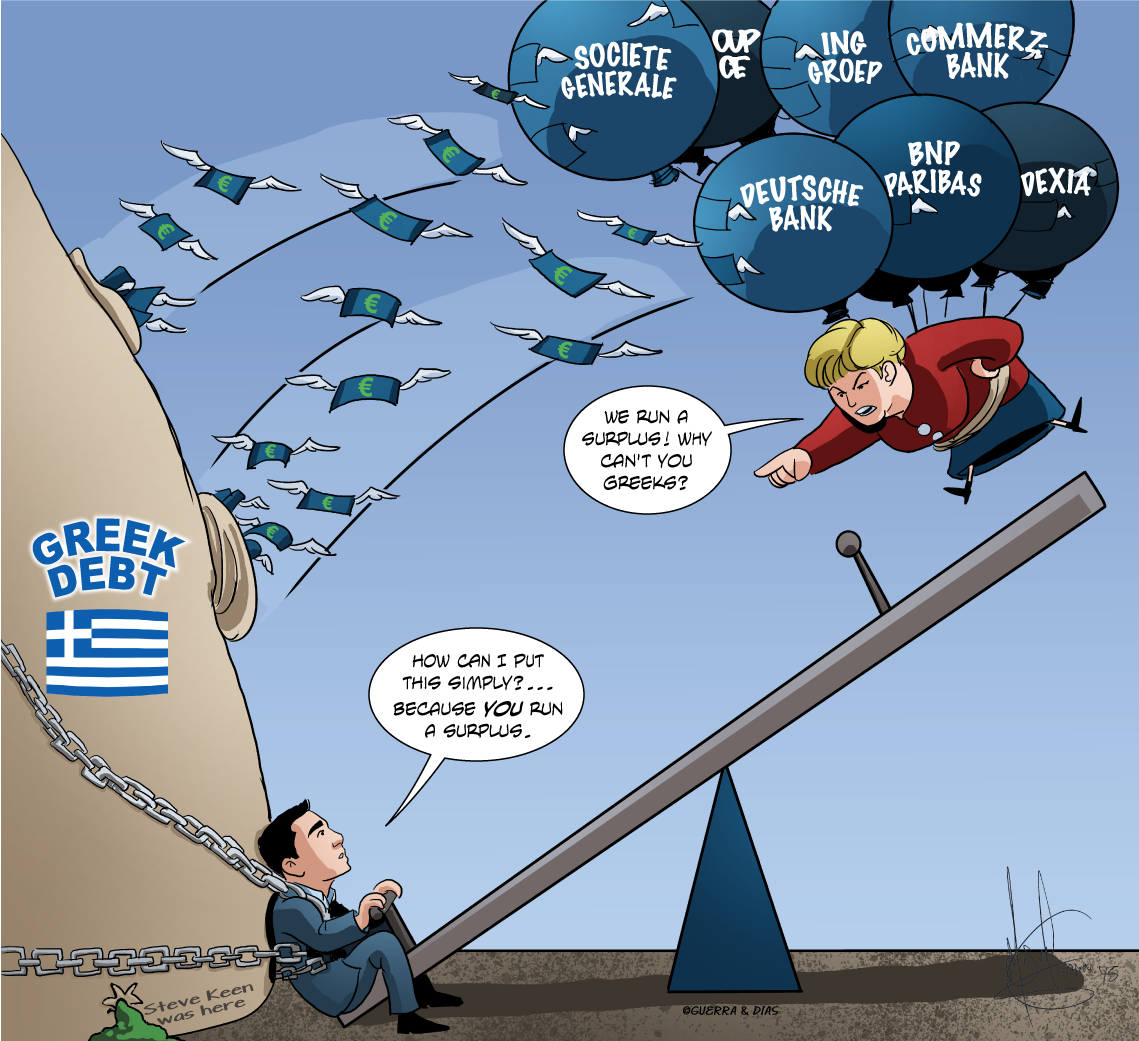

And yet the general consensus is that the German attitude towards technology is, and has perhaps always been, markedly sceptical (although see this for another view). Germans are understood to be among the most hostile in the world with regard to nuclear power, fracking, geoengineering and so on. The roots of this undoubtedly run deep—the whole early-to-mid-twentieth-century thing springs to mind (Heidegger!)—but the entire history of romanticism long before that, also.

I should add that I know very little about political economy and even less about German political discourse. My impressions are very much made from afar. However, the point I am trying to make is this: Germany seems to embody in a particularly pronounced form a contradiction broadly evident right across the Euro-American world (and perhaps beyond), a contradiction that the likes of the ecomods capitalise on. I have little sympathy with their politics—their strategy is consistent: demonise those to their left, build bridges to those to their right—but they are asking some of the necessary questions.

So, having said all of that, the last (but by no means least) panel of the EISA 2015 conference that I attended followed right on from this one and was chaired by Delf Rothe. ‘Critique in an Age of Complexity’: this is how my conference was concluded.

The four papers presented were: ‘Resisting Resilience?’ by Chris Zebrowski; ‘Warring in the Mind: Ideology, Truth and the Neuromarketing of Hope’ by Claes Richard Wrangel; ‘Assemblages and the Positives of the New Materialism’ by Jonathan Joseph and Robert Carter (only the former of whom was present); ‘Complexity and “critical government”: Kantian legacies, critical disjunctures’ by Regan Burles.

Chris, drawing on his recent book The Value of Resilience: Securing life in the twenty-first century, talked about hybridity as immanent critique and how resilience depreciates the non-adaptive. Claes, drawing on a broader research project on hope, discussed the neuroscientific conception of the mind as an adaptive system and how this, quite peculiarly, leads to new forms of politically questionable subjectivism. Jonathan levelled a scornful critique at ‘new materialism,’ particularly taking exception to the alleged levelling of human and non-human agencies in the ‘flat ontology’ of actor-network theory. He mentioned that the concept of assemblage might have some value as a tool for diagnosing neoliberalism but that was about the best that could be said of it from his critical realist point of view. Finally, Regan drew more from the Kantian legacy. To be honest, by this point my brain was fried and I can’t really remember what he said—but it was good!

On the new materialism point, Delf, as discussant, commented that perhaps Jonathan and Robert would be better off aiming their critique at one particular author rather than the group as a whole since this term ‘new materialism’ masks a lot of important differences (a point that I have made previously). From my point of view, Jonathan’s critique was nothing new and mostly relied upon only half thought through reductiones ad absurdum—however, having not read the full paper perhaps I should hold my tongue/fingers.

The question that stuck in my mind at the end of this session was the relative obscurity of ‘critique’ as a term that is constantly used within academic discourse but is used in a variety of different ways. From the strict Kantian sense of interrogating transcendental conditions of possibility to the more deconstructionist sense of ‘problematising’ and ‘destabilising,’ there are clear commonalities and shades and degrees in-between but critique remains, to my mind, a concept that is used almost invariably without any qualification and clarification and, perhaps it’s just me, but I am often left wondering what precisely it is supposed to mean—not that it is meaningless but that it is rather fetishised. I did raise this question in the final Q&A but was left none the wiser.

And so concludeth the conference.

Sunday, 19 April 2015

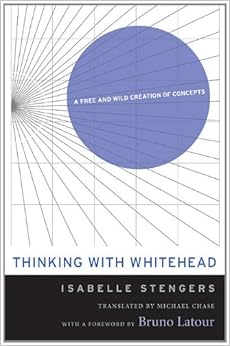
"My readers have now been warned"—halfway through Stengers' Thinking With Whitehead

At the end of chapter 16 of her book on the work of Alfred North Whitehead (just slightly over halfway through the text), Isabelle Stengers writes:
"My readers have now been warned. If they are fascinated by the heroic grandeur of refusal, and despise compromises; if they deplore the fact that the radical demands of every new position are recuperated by what was supposed to be subverted; if 'to deconstruct' is a goal in itself for them, and scandalizing self-righteous people is a testimony to truth; if they oppose the pure to the impure, the authentic to the artificial; if they cannot understand how the most 'unplatonic' of philosophers situated himself as a 'footnote' to the text of Plato ... let them close this book. Never will they see celebrated in it the power of a truth that is verified by the destruction of false pretenders. They will therefore find in it only disappointments and reasons for contempt." (Thinking With Whitehead, p.275-6)
And slightly different in French:
"Le lecteur est maintenant prévenu. Si, comme le Belzébuth mis en scène par Leibniz dans Confessio philosophi, dont la rage se déchaĆ®ne à l'offre de salut, il est fasciné par la pureté du refus et méprise les compromis, s'il déplore que les exigences radicales de toute position nouvelle se monnaient progressivement en contrastes enrichissant ce qu'il s'agissait de subvertir, s'il ne peut comprendre que le plus « non platonicien » des philosophes se soit situé lui-même comme « note en bas de page » au texte de Platon... qu'il referme ce livre. Jamais il n'y verra célébré le pouvoir d'une vérité qui se vérifie par la destruction de faux prétendants. Il n'y trouvera donc que déceptions et raisons de mépris." (Penser Avec Whitehead, p.310)
This is my third attempt to read this book and it's the first time that I am sure that I will reach the end. It is not that it is a 'difficult' book as such. Stengers, in her own inimitable way, writes with extraordinary precision. However, being something of an autodidact with respect to philosophy, I wasn't quite ready for such a dense and demanding text in the past.

It is a work that requires a very particular routine of reading. It cannot be read casually, put down and picked up a week or two later (not usefully, anyhow). At over 500 pages it is not something that can be read in one sitting, or several sittings, either. (There is no quick way through such a text—the whole point is that the reader slows down.) It requires, for me at least, extreme attention and focus. It's not something that I am able to read except when at my most clear headed, and then for a few hours at a time. Unfortunately, there aren't many windows like that in my week (I hope that soon this will change). I, out of necessity, do most of my own reading and research in the evenings—not a time of day conducive to this kind of endeavour.

Nevertheless, I am gradually working my way through the book—one immersion at a time—and it is most certainly worth the effort. It's the kind of book that, after having read it, I will never be able to read any other book in the same way again. It neither condescends to its reader nor indulges in unnecessary dissimulation. It attempts to be clear but, at the same time, transformative. This time around, I am finding that it succeeds in both respects. Again, I find that the best words for it are: precise but, at the same time, extraordinarily dense. It is the most exquisitely constructed thicket.

There is far, far too much in this book to even begin to summarise or select. However, I find the above quotation(s) to be a perfect signal of its tone and intentions. This dissuasion addressed directly to the reader is at the same time reassuring—I am assured that none of the things described appeal to me (and their sirenic allure is further muted with each and every passing page).

Friday, 27 February 2015

Four theses on (and for) criticism

If the intention of a criticism is not to construct then call it what it is: a denunciation. That would save us all a lot of time.

I would not denounce denunciation – sometimes there are things worthy. However, it is not an act that should be taken lightly. Nor should it be confused with criticism, which is an opening, not a closing.

To denounce is to decide (or to claim to). It is to cut off, to load up the proverbial iceberg and push it out to sea.

If 'constructive criticism' were a pleonasm then critique might be less deserving of its critics (not to mention its denunciators).

Monday, 7 November 2011

Poststructuralism and the Agoraphobia of 'Thinking Space'

A "post-structuralist discourse" apparently "expands the agenda of social theory, posing questions that other discourses must refuse to ask" (Richard Ashley, Living on Borderlines). It 'opens up thinking space' (Jim George, International Relations and the Search for Thinking Space).

But poststructuralism itself is utterly incapable of asking a whole swathe of questions because of its own dogmatic ontological assumptions; its thinking space is suffocating. In fact, whatever ground it opens up is micrified by that which it forecloses; for example: the assumption that objects are reducible to the discursive conditions of their emergence eliminates the possibility of understanding what it even means to be 'critical.'

Take science (an excellent but not fundamentally privileged example):

Scientists are always engaged in criticism but they don’t criticise everything at once (‘perpetual critique’), nor could they, nor would they ever want to. This would disallow instrumentation or black boxing. No debate could ever end. Scientists don’t engage in perpetual critique because they believe that their subject matter is capable of objecting – of showing itself to differ from established knowledges.

This doesn’t mean that scientific objects can object on their own but many scientific discoveries have been made in the course of otherwise routine experiments that went awry, felix culpa; when one was looking for one thing but found another.

Simply: knowledge can become critical (i.e. unstable) without the instigating (which is not to say intentional, although it's similar) intervention of a (human) critic. Without the labour of scientists most scientific objects have no means of eliciting this surprise, it is true. But that doesn’t mean that making critical is dependent upon critique.

Making critical, in such cases, may only occur during scientific practice but that practice needn’t be critical per se; it is often or perhaps even usually routine, directed towards another end entirely.

And isn’t this how everyone saw the end of the Cold War? As an event that objected to IR theory itself? (Poststructuralists included.) Certainly it wasn’t self-interpreting but it demanded interpretation by social scientists (and everyone else for that matter). It is in no way reducible to interpretation or the sum of all human interpretations. If it was it could never demand interpretation.

(Does this mean that the demand transcends interpretation? I'd say not, it can be ignored, missed - nothing necessitates its being taken as a provocation and so its conditions of emergence remain pivotal but none of that makes its demand reducible to its interpretations. This is realism.)

Beware modesty dressed up as radicalism.

Beware radicalism generally when it runs from the typing fingers of middle-aged academics.

Poststructuralists are truly agoraphobic (and this is a nice little academic play on words). They are afraid of the outdoors, of things (at least in their work - in the rest of life they enjoy all the luxuries). Moreover, for all the talk of radical democracy and opening up debate they foreclose almost all of it by having such a limited and such a dogmatic ontology. They cannot ever genuinely stand in the agora and speak. They are doubly afraid of the outdoors and of things. Of things qua objects and things qua places of politics. They can barely stifle their grins and snorts when people talk passionately about their belief in the reality of things. This is my own ethnographic observation!

The 'thinking spaces' are not wide open spaces, they are closets.

Sunday, 17 October 2010

Comment on: "What Would Flat Ontological Criticism Look Like?"


This question has occupied my mind a fair bit. I think the best place to start is most definitely Latour's critique of critique. (This has been present in his work since at least 'We Have Never Been Modern' but has been most fully expounded in his essay 'Why has critique run out of steam?')

For Latour all critique, whether in the lineage of Kant through Marx to the Frankfurt School and today's poststructuralists or in the tradition of denunciation in the name of Science, results from the same ontological assumption: ontological un-flatness (what is the opposite of a flat ontology?). This is because critique is equated directly with denunciation and to denounce one needs an unreal overlaying the really real to peel back or tear away or unveil (postmodernists still follow this path even though they no longer believe in a real underneath the fabric - it's veil all the way down!). A flat ontology, for Latour, must therefore forego critique.

He makes a powerful point with regard to some elements of what has passed for critique to date. There is a widespread sense among (usually self declared) 'critical scholars' in the social sciences that not only is critique good but that it is the only valid occupation for a true scholar. All other forms of scholarship are seen as being somehow repressive. This is taken to an extreme by deconstructionists who insist that anyone enforcing their interpretation on anything is committing 'symbolic violence' or somesuch. To this extent, critique is a self-marginalising discourse. By this I mean that 'critical' thinkers are bound to ONLY criticise and they can only define themselves in opposition to a fabled 'uncritical' or 'essentialising' Other. For this reason they can never possibly succeed, which is a canny move as it means they never have to stop publishing and we never have to stop reading their work!

Latour makes mincemeat of these cliches but he goes too far. In fact I would say that he himself is too critical of critique - he ends up mirroring the very people he seeks to destroy. He has not one good word to say about critique and has no interest in asking what of it should be saved.

It's disappointing because Latour is at his very best when he takes something he disagrees with, takes it apart, translates it into his terms, puts it back together in the context of his overall system and makes you wonder how you ever thought otherwise. That is the way to proceed with the somewhat sullied word 'critique,' I feel.

etymonline.com informs me that 'critique' comes from the Greek kritikos "able to make judgments," from krinein "to separate, decide". The word thus carries connotations of separation and deciding; separation and judgement. Might we say that critique consists in separation and judgment? Judgement by separation? Separation by judgement? Aren't we all critically minded? If we weren't able to separate and to judge we wouldn't be able to get very far in life. If we accept something along these lines then there can be no more pure, exceptional form of critique only known by a chosen few (notice how in this way critique production has mirrored truth production). If this is so then we have to distinguish between different forms of critique and separate the good from the bad (itself a critical act, as I would describe it). This would require no foundation (contra Habermas), it would proceed by a process of critical deambulation, if you like. This would be a better definition (if a broad one) because we wouldn't have 'critical' thinkers opposed to 'uncritical' thinkers and the self-perpetuating dance this necessarily creates.

(Also this is more or less what a music or movie critic does - breaks cultural objects down, analyses the pieces, relates them historically and contextually and judges them (or at least that is the ideal).)

Moreover, this definition wouldn't allow for the assumption that everyone is engaged in a competition to be more critical than everyone else. This is really what critique as a self-marginalising discourse must do - its a perpetual arms race, a race to the bottom that isn't there. No matter how critical you are I must always try to be more critical because that is all there is to do. If we try to do anything else we're committing 'violence' and so must surely commit hara-kari forthwith. As with all practices premised on fundamental bifurcations of reality, it just can't work.

Yet critique is far too valuable an activity to throw to the dogs of excess and stupidity. For all the negligence of those who take critique too far - and far away from where they should - they're not all completely mad - there really are those who would deny critique all licence as a scholarly activity. And these people are the real enemy.

Latour often goes on about how Science Studies was the only field that could foment the breakthrough of transcending bifurcated nature - in other words, refusing sociological idealism without trudging back to the same old realism; of forming a new realism. Science Studies, so he says, was uniquely placed at the midpoint of the 'two cultures' and he and others were thus able to realise how both sides had it all wrong. Well, I think something similar could be said for my field, International Relations, on this subject of critique. If eradication of critique is at all possible or desirable in Science Studies it certainly is not in IR, the field that deals with war, genocide, espionage and all forms of tyranny as a matter of routine. One would have to be an utter sociopath to engage seriously with these issues and not have some sort of 'will to critique' (although, having said that, there are plenty who would attempt to do so in the name of 'political Science', but that's another story).

So, I'm not sure what a flat ontological criticism would look like. First we'd have to figure out just what 'criticism' has meant in other traditions - it doesn't seem to be any one thing. I've been meaning to read Foucault's 'What Is Critique?' for a bit as well as Judith Butler's commentary on it. That might be as good a place as any to start.

Sunday, 21 March 2010

On Latour's Reflections on Critique

Denunciations of ‘fact’ may fall into the same trap as their opponents – they regard a ‘critique’ of a ‘fact’ as a significant event. Both sides seem unable to see facts as something produced rather than in/adequated, though the critical camp stray closer to this terrain.

Bruno Latour points out that a physics paper that would, if widely read, revolutionise its field will have no effect if, as is the fate of most scientific papers, it remains entirely unread. It contains, then, no truth that transcends its particular emplotment in space, time and matter; if read it might be hailed as the new Truth, but unread, devoid of any and all alliances it can be no such thing. Does not the drive to critique fall into this same trap? To submit an ‘essentialism’ to critique is seen, in some quarters, as an inherently valuable event. ‘Take that substance metaphysics!’ But if this critique has no effect – if no one reads it – what critique (as a kind of event rather than a theme or genre of literature) has actually occurred? Does a largely unread critique have more, less or the same existence as a largely unread fact? If being is an effect of language and language alone can the relative expediency of an unread critique or fact over a read one be ascertained?

Plainly, to switch from a demand for adequation to a demand for inadequation is insufficient. Hitherto ‘critical scholars’ have just ‘critiqued’ the world; the point is to change it (I thought we all knew this by now).