Showing posts with label philosophy of science. Show all posts

Tuesday, 20 October 2015

"My enemy is arrows. I want to get rid of arrows" – Bruno Latour on maps, earth and International Relations

One of the first academic conferences I went to was that of the Millennium journal of International Relations in 2012. The theme was 'Materialism and World Politics' and IR, always late to any bandwagon, was doing its best to catch up. One striking pattern that was immediately evident was the proliferation of references to a certain Bruno Latour in many papers and presentations, particularly amongst students and early career academics. Up to that point, his name was almost completely unknown amongst IR scholars – surely one of the last provinces of the social sciences and humanities to remain so unperturbed.

Three years on and Latour was Millennium's headline act, delivering the keynote lecture. This was filmed and will presumably be made available online in the next few days. Consequently, I will not try to summarise it but will just offer some thoughts.

The lecture began with a visual comparison of Hobbes' famous frontispiece with a recent front cover from Nature.


Both are monstrous but in totally different ways. The Anthropocenic human juts out randomly, stupidly, headlessly. The Hobbesian sovereign is all measure, calculation and looming menace. This speaks to the real difference between them: Hobbes was proposing a solution to the problem of political order that had so drastically broken down in his time; Nature, on the contrary, is representing the problem of the Anthropocene, a problem of order – indeed, political order – without any apparent solution in sight. The problem of Nature's image, then, is precisely the disappearance of Nature as an organising principle of geopolitics in the fullest sense of that term.

This is one thing that I was trying to get at when I recently wrote at a fair bit of length about Latour's conception of geopolitics and, particularly, his reading of Gaia. The key feature of Gaia, taking James Lovelock's iteration somewhat creatively, is that it is not any sort of personal deity because it doesn't care one bit about the fate of any individual or species but, at the same time, Gaia is not Nature because it is not indifferent or external to human action – it reacts, it is perturbed, it is responsive. To quote myself:
"However, responsiveness is not responsibility. Gaia can summon no Leviathan; there is a Great Society but no Great Community [à la Dewey]. Of course, it is not that Gaia ‘lacks’ the appurtenances of a formalised polity per se – it is only we Earthbound that such a supplement impels; it is, rather, that Gaia, our past and our present, will only be our future – we will only have a future – if such an assembly is realised."
The image I had in mind at this time was precisely Hobbes' most famous image and the cohesiveness and unity of that ugly apparition looming over the English countryside. Nothing could be less true of the geopolitical predicament that Latour is addressing. There is no Global State – nor will there be. The things formerly known as natural do not bring unity; total knowledge of the Earth's surface in no way allowed it to be mastered (some of its occupants, perhaps, but this paramilitary victory was plainly overestimated); its complex spatiality greatly exceeds merely topographical imagings; the things formerly known as natural, in fact, disturb, destabilise and destroy the comforts of order and regulation, they do not and will never again give it a secure foundation. This realisation, to parrot Naomi Klein, changes everything.

Oliver Kessler mentioned in the closing panel of the conference that he wished that Latour had used the modified version of this image from Shapin & Schaffer's Leviathan and the Air-Pump.
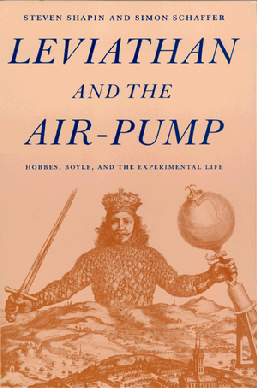

That would have been an interesting connection but the point that Latour was making concerned political unity rather than the relation between science and politics per se. In any case, Latour's attempt to imagine a representative geopolitics of this Gaian situation was precisely the overarching theme of his lecture.

Representation in every sense of that word – political, scientific, artistic. And representation not in the vague, vain liberal sense of 'letting everyone have their say.' It was very clearly representation as a precondition of action. In other words, it was a question of collective will and adherence; of achieving the political infrastructures by which a collective could act – and a collective that is constituted by far more than just humans and their (delegated or imposed) spokespeople. A form of action that requires the alignment of actors of all kinds (and here the humanists leave the room…).

To self-indulgently quote myself again (because I can't think of a better way of putting it than this sentence that I spent months writing and re-writing):
"Gaia is not just the scene of politics, nor a violent interjection to it, but a dramatic, swirling convolution of world-convening relations – a collective constituted by all the constituents that she collects."
This is why Gaia is at the centre of Latour's geopolitics. It is not a unity. It is not a single, homogeneous, centred actor. It is not a totality and it is not nature. It has no one name. It is not something everywhere the same. It is impersonal but not indifferent. It is violent but not malevolent. It has intentionality but no teleology.
"There is only one Gaia but Gaia is not One."
It is, above all (and in more than one sense of that phrase), a sovereign. Here we see that, however 'flat' Latour's philosophy may or may not have been in the past, his 'Gaia-politics' presupposes an emphatic verticality; a power, a transcendence that vastly exceeds human actions but does not transcend them in the sense of being in any way exterior.

This must unground every sense of earth, terrain, territory on which International Relations, knowingly or unknowingly, has based its object.

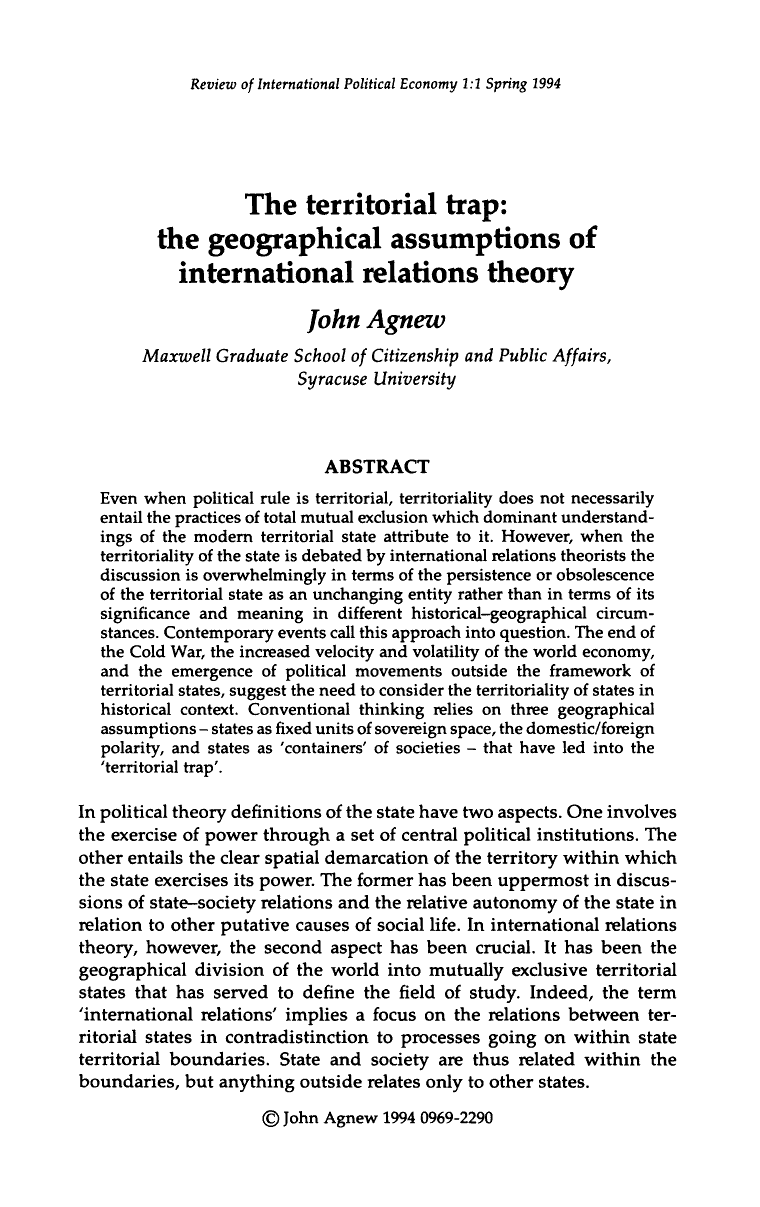
But here we should pause. Geopolitics is not IR. To re-hash John Agnew's famous article The Territorial Trap, IR has been consistently ignorant of the space, the materiality, the environments that its institutions presupposed.

Political geography was born as a discipline in the imperial struggles of the late nineteenth-century. Its reactionary extremes directed and enthusiastically served those ends – knowledge of the earth, its environments and climates was to found the efficient, ruthless administration of empire. This is, quite unambiguously, the root of 'geopolitics' (the word itself was coined, as 'Geopolitik,' in 1899).

Some would say that IR was born as a discipline in 1919 (at my home institution in Aberystwyth, from which I type these words); however, it only really got going as a disciplinary space and movement in the 1950s with sponsorship from the Rockefeller Foundation, among others. At this time, 'geopolitics' had all but disappeared from conversations in polite society as it had become had it become almost synonymous with Nazi expansionism via Karl Haushofer's association with the regime (a somewhat more complicated relationship than was recognised at the time but nevertheless).

Geopolitical ideas were soon revived by the likes of Henry Kissinger who reconstructed them for the new era of empires that the so-called Cold War brought about but human geography as an academic discipline on the whole lost its connection with international or global politics. IR, meanwhile, soaked as it was in the behavioural sciences and the realpolitik of its various émigrés, had little interest in the complexities of the ways that the world gets composed. The planet was, by this point, known rather well (or so they thought) and explanatory power was to be sought primarily in understanding the behavioural characteristics of human beings and their institutions. Their agenda was, variously, to secure peace and to overcome the non-liberal remnants of 'History,' in the Hegel/Fukuyama sense of the word.

This aside has a point, which I will now get to: 'environment' in IR has always been a special interest, a subfield, something to do with whales; 'earth' has been either an anachronism or an irrelevance; 'space' has been what you put satellites in.

Is there any discipline less prepared for what is coming than IR? I can hardly believe that there is. And yet, does this mean that IR must be brought to an end? Perhaps not.

Latour's lecture concluded with an overview of the 'Make It Work!' event – essentially a Latourised model UN – that was held in Paris this summer. The main point made by this event was that oceans, icecaps, forests, etc. – all these also require political representation, alongside corporations, NGOs and states.

And states. It is so very easy to denounce and demean this mode of geopolitical organisation, born out of the historical milieu that is encapsulated by Hobbes' towering phantasm. But let's be honest, the 'Westphalian state system is redundant' critique practically writes itself at this point, doesn't it?

"The old (but still useful) world of States" – this was on one of Latour's slides.

And this brings me to the Q&A session that followed the lecture. Two of the questioners made more or less the same point: Okay, so having non-state representatives representing beings other than humans is good but are we to believe that states do such a wonderful job of representing people? Verily, if (critical) IR scholars have achieved anything over these years it has been to demonstrate the vicious iniquities of state-based political complacency!

I was reminded at this point of the Olympics where stateless athletes are permitted to compete under an independent banner.


Of course, all of this raises questions of power. How does anything come to be represented politically? By demanding that it be so. In other words, through struggle. Or, to put it in more Latourian terms, how is a 'middle ground' ever formed from which diplomacy can begin? According to Richard White, this too is about power. All sides must be capable of compelling their other to meet on the middle ground rather than imposing a settlement from without.

But returning to my thread, if we are to extend representative politics to more than humans is this not a perfect time to reconsider how we represent human beings too? And is not a discipline such as IR not well placed to consider such a task? Well, perhaps. But not on its own. IR's ignorance of space and geography is well known but its connections with anthropology are not much better. The very concept of representation, for instance, was also born around the time of Hobbes – it is no more universal than 'Nature.'

Here it might be opportune to cast our minds back to Patrick Thaddeus Jackson's keynote at the Millennium conference last year:
"The way I understand it, the term ‘international’ picks out those aspects of anything that involves cross-boundary encounters with difference. The international aspect of a military manoeuver or a financial transaction does not simply begin at the moment that a formal territorial border is crossed, but as soon as the existence of some other—the alien, the foreigner, the stranger—is taken into account in the operation. Representations of otherness, which shape and structure what we come to regard as legitimate or acceptable or appropriate action towards or in reaction to those others, are the common thread connecting all of our myriad substantive concerns, and the ‘return’ of culture and identity to the scholarly agenda is better thought of as a clarification of what we were all already interested in in the first place."
This, to my mind, is a large step in the right direction but isn't quite there yet because it continues to pretend that other academic disciplines haven't been doing this for years and years in their own ways (and doing a very good job of it). It's still sectarian. What about anthropology, for instance? Cynthia Enloe was also present at this year's Millennium conference and was a perfect reminder of the importance of that connection to IR historically. But the larger part of these disciplines remain entirely estranged.

Plainly, there is a need for a complete re-evaluation of what the purpose of IR in this new world is. Reconsidering its relations to not only geography and Earth system science, etc. but also to anthropology and other forms of knowledge production besides. A comparative and interstitial sociology of social science.

Is there an appetite for such self-criticism within this most cloistered and jurisdictionally jealous of academic disciplines? Some, perhaps not enough. But it is a conversation worth having and a task worth attempting – and one that Latour's work will help us to initiate, even if he by no means has all the answers.

But perhaps I should end with the quote that titles this post. 'What's so wrong with arrows?', I hear you ask. Well, Latour tells us, you draw an arrow on a map when you need to account for something that the map itself (base map plus territorial outlines) says shouldn't be there – migration, movement, pollution, mess. In other words, if you need to draw an arrow it's because your map is inadequate to its representational task because it assumes a flat, stable base upon which everything else is projected rather than trying to capture the territorial complexes in motion and in their own complexity; that is to say, in the process of their ongoing assembly.

This is a difficult point to grasp without a thorough transformation of conceptual vocabularies. For example, this is how Latour describes 'territory':
"A territory is everything that you need to survive and that may suddenly fail you. […] Of course the territory does not resemble the nicely coloured geographical maps of our classrooms. It is not made of nation states – the only actors that Schmitt was ready to consider –but of interlocking, conflicting, entangled, contradictory networks that no harmony, no system, no ‘third party,’ no overall Providence may unify in advance. Ecological conflicts do not bear on the nationalistic Lebensraum of the past but they do deal with ‘space’ and‘life.’ The territory of an agent is the series of other agents that are necessary for it to survive on the long run, its Umwelt, its protective envelope."
To quote myself again, in attempting to think through this conception:
"[…] an economy does not distribute goods circulating across a given territory, it formats the territories themselves; globalisation has nothing to do with ‘levels’ or ‘scales’ but rather concerns intensifications and extensions of entangled dependencies; a Collective does not have a territory but rather as many territories as it has constituents; and geopolitics is not a matter of bickering over bounded surfaces but, rather, publicly contesting these polydimensional spaces."
What political agency such a kind of spatial formatting could have is questionable. However, it asks questions that are plainly unanswerable without a great degree of conversation between researchers and technicians with a range of different skills and disciplinary experiences – scientists, artists, theorists, ethnographers, programmers, organisers, and so on. It requires institutions such as Latour's own Medialab, for instance. (For all the talk of post-disciplinarity, let's not pretend that we can do away with institutions.)

That is an exciting prospect but not one that IR is well-prepared for. Nevertheless, I think we can most certainly all count ourselves as 'perturbed' – whether this way or that – by now. If nothing else, Latour is laying down a challenge that tremors right across the disciplinary landscape. To what extent it will uproot IR's usual comforts and homilies remains to be seen but it will be interesting to find out.

Sunday, 16 March 2014

Science as content provider/constituent producer

What's the difference between 'constructivism' à la Latour, Stengers, Whitehead and 'realism' à la Bryant, DeLanda, Morton, etc.?  Specifically, what's the difference with respect to their uses of scientific knowledge?

The 'realists' take science to be a content provider – that is, science provides and certifies a more or less stable list of entities with which the philosopher can justifiably populate the world as they see fit.

The 'constructivists' also want to populate the world with a wide range of entities and to grant these beings their autonomy, their powers, their dignity.  However, they (a) are not prepared to grant science the right of unilateral list-writing, (b) they emphasise the instability of the list (as a necessary precondition of science itself as much as anything else) and (c) they insist, above all, on making science a constituent producer – that is, the fact of scientific production as an ongoing process must be factored in to any substantial discussion of scientific facts, including their mobilisation in world-population exercises.

It is not that scientific facts are reducible to their construction or instauration (that is, this is not relativism in the vulgar sense) but rather that discussing scientific facts severed from their subtending networks results in a dogmatism that precludes politics and a simplicity that does no justice to science.  In other words, populating the cosmos is a shared interest but opinions differ on how it is to be done.

There's far more to this dispute than this one, only partially explicated difference, of course, but this is a key part of it, I think.  For one side 'realism' means that any discussion of scientific facts implies an understanding of scientific processes and that this implication must be made explicit in the discussion; for the other side 'realism' means that one can and should ignore this implication and sever, at least in rhetoric, the facts from their networks.  It's the difference between a realism that thinks it misleading or even meaningless to discuss scientific objects in abstraction from the processes that stabilise them as knowable and hence articulable entities and a realism that thinks it the quintessence of realism to do just this.

Tuesday, 29 January 2013

The Cancer of 'Values'; Or, you can't hang your 'values' on a peg

Another interesting post at Duck of Minerva, this time on science and 'values' in human rights scholarship:
Questions of personal biases and valid science permeate all facets of science; of course, we as social scientists face these questions all the time in our research.  Do personal biases get in the way of our science?  Is there any way around our personal biases?

I’m a firm believer that the process of science allows us to eliminate many of the potential biases that we carry around with us. ...
My somewhat Latourian take on this issue would be this: Of course science allows people to get around their personal biases; that's the whole point of science as a formal, social, discursive, argumentative, agonistic, critical, collective process.  Without this science has nothing.  However, scientists can only 'get around' their own biases by making their experiments and reasoning public and having others reproduce their experiments and reasoning.

But let's define 'bias' broadly.  Is assay result X the product of a hitherto undiscovered protein or a contaminated batch of enzymes?  Contamination is a 'bias' to the experiment in that it is an unwanted variable intruding upon the artificially purified experimental design.  The scientist can take many steps to check, doublecheck and crosscheck their results but ultimately the only thing that will establish result X as a fact rather than an artifact is the experiment's successful reproduction by other scientists in other labs around the world.  An individual scientist's personal preferences on the outcome of an experiment may prove to be an extraneous variable intruding upon the experimental design, that is to be determined.  However, the way they overcome this is not by being 'value neutral' in their own minds as such, it is by designing their experiment as best they can and then submitting the whole process to critical peer review, which may or may not validate their claims.

No individual scientist can or should ever be 'value neutral' -- if they didn't care about the outcome of the experiment why would they bother doing it?  The only 'neutrality' science can have emerges in its sociality, in its practices of argumentation -- in being validated by numerous different values.  It isn't about 'checking your biases at the door' so much a not letting them intrude into your experimental design.  'Values' are not an item of clothing that you can arbitrarily hang up on a clothes peg -- that's a very poor metaphor, albeit a common one.  Being 'scientific' is better described, I think as an ongoing process of drafting, redrafting and self-critique prior to the social critique of peer review.  If your conclusions are based on nothing more than your own wishes and wants then your arguments will be undone as easily as pointing out a batch of contaminated enzymes.  If the argument draws upon no more support than empty rhetoric then it'll be quickly exposed as hot air.  A strong argument requires more evidential and rational support than a statement of desires.  Scientists needn't transcend their values, they need only produce an argument that is stronger than the values that inspired it.

Human rights research has precious little in common with molecular biology and it can never follow the same scientific practices or adhere to the same standards (nor should it want to) but it can follow a similar process: produce arguments that are stronger than the values they are inspired by; produce arguments that can be validated by a wide range of value orientations.

So, no, a cancer researcher needn't have any specific value orientation in the sense of being 'pro-' or 'anti-' cancer (though one would hope that it is not the former!) but nor can or should any researcher be 'value neutral' -- our values get us out of bed in the morning.  Wanting to produce objective knowledge about cancer: that's a value in and of itself.

Wednesday, 23 January 2013

David Campbell on 'the retreat from reality' / The need for political epistemology

David Campbell has very nice, thought provoking piece on the right-wing disregard for science and evidence generally, particularly in the cases of climate change and gun violence.  He concludes with the following:
Of course, there is – especially for those of us with post-structuralist philosophical commitments – no easily discernible, singular, uncontested reality. There are no facts beyond dispute or arguments immune from contestation. No group has privileged access to the truth. Reality has to be narrated and narratives are inherently constructed. But some stories have more support than others, and the “concordance of evidence” favours some positions over others. When anyone flies in the face of such evidence it’s time to get angry and insist that we won’t stand for such BS.
I have a few comments as I think this raises a whole load of really interesting questions:

While it's true that a nuanced, epistemologically relativist social theory of knowledge does not preclude the kind of hearty, thorough evidentialism that we so desperately need -- no part of scepticism or constructivism necessitates cynicism or nihilism -- I don't see much in the poststructuralist canon (as I understand it) that provides the theoretical resources for such a discussion.  The very notion of evidential 'support' is not a positive concept that I've encountered in poststructuralist writing.  Indeed, the very notion implies the kind of epistemological commitments that such writings go out of their way to avoid.  That isn't to say that poststructuralist writings do not deploy evidence; of course they do, your own work included.  But the theory with which this evidence is articulated tends to be stuck in a critical, narrowly relativist register of admitting that its own account is one theory among many and that it is just 'keeping the discussion going' in Rortyean fashion.  Consequently, such accounts generally claim no greater epistemic authority than being one legitimate voice within the discussion.

In my view, saying that "some stories have more support than others, and the 'concordance of evidence' favours some positions over others" goes beyond merely 'keeping the conversation going' -- it takes us into the realm of epistemology proper and a step or two outside the comfort zone of any acknowledged 'poststructuralist' theory that I've ever read.  This argument does not, of course, invalidate anything but, if it is correct, it imparts a theoretical burden -- it demands that we acknowledge the inadequacy of what we had previously relied upon and endeavour to go beyond it.

Essentially what you seem to be calling for is what Latour (who isn't generally understood to be a 'poststructuralist', although his thought is certainly related) calls 'political epistemology.'  All epistemology, for Latour, is political because epistemology isn't just about how or why we believe what we do -- it's not a neutral theory about the basic mechanics of knowledge; rather, it's about what we should believe and how we can make others believe what we think is right (in every sense of the word).  The most obvious kind of political epistemology is the 'demarcation criteria' of scientistic philosophers of science -- of what gets to count as science (and thus be valid) and what doesn't (and what is consequently invalid).  But it runs far deeper than that.

As I see it, you can't have 'evidentialism' without a discussion of what does and (importantly) does not count as evidence and this requires active endorsement of particular standards -- a political epistemology or 'political metrology,' if you will.  It requires the progressive institution of a collective epistemological reality.  This reality is inevitably contested -- indeed, scepticism and contestation are its very conditions of possibility -- but it must also be built up, endorsed, promoted, reinforced, rationalised, validated -- not just cut down, scrutinised, picked apart and deconstructed.  It must be active -- in that it creates, circulates and promotes new ideas and instruments -- and not just reactive -- in the sense of picking up on existing discourses and subjecting them to scrutiny.  And this brings us to perhaps the biggest challenge for poststructuralism: the need to interrogate the purposes and the limitations of 'critique' and 'critical theory' in general -- of the need for something besides and beyond (or in addition to) these practices.

Latour's new book, coming out in English soon, on 'modes of existence' talks about the need to rediscover trust in institutions, such as science.  That is basically the issue: evidentialism requires a kind of epistemic institutionalism, a collective epistemological project based not just on scepticism but also on trust, on belief.  This institution needn't be 'scientific' but it needs to be definite and exclusive.  It needn't dispense with 'anything goes' as such but it needs to recognise that such epistemic anarchism is but an initial step, logically prior to a more formal sorting process that includes and excludes, legitimating some knowledge claims and delegitimating others.  It can no longer be enough to just 'keep the conversation going' by adding one more voice to the mix.  That plays straight into the hands of the climate denialists and the gun fetishists, etc. who relish, embelish, exaggerate and exploit epistemic division and uncertainty so as to extract political advantages.  Unvarnished epistemological relativism -- in the sense of rendering all knowledge claims formally equal -- is incapable of issuing the necessary clarion call for 'evidence' because what evidence is requires a definite idea of what it is not, which implies an exclusionary distinction.

So, perhaps it's time to reconsider those fusty old epistemology-obsessed modernists who undoubtedly gave us the wrong answers but were nevertheless asking the right questions...  They were wrong in arguing that epistemological validity -- i.e. 'Truth' -- was singular, universal and transcendent but they were right in understanding the political need for socially validating some knowledge claims over others.  They were wrong in making the validation criteria -- 'Reason, Science,' etc. -- abstract and accessible only to the elites but they were right in understanding that such epistemological criteria are politically indispensible.

We live in an age of 'cynical reason,' as Sloterdijk put it; or, in Latour's words, we live in an age where critique has been 'miniaturised' -- that is, perfected, instrumentalised and woven into the fabric of everyday life such that we scarcely even notice it.  The tools and techniques that were constructed for the struggle against power have been internalised by the powerful and turned against resistance itself, hitting it square in its very conditions of possibility.  For both these guys this political fact indicates the inadequacy of poststructuralist theory, as received.  I tend to agree.

I know that David has been over similar ground in his arguments in print with Colin Wight et al.  As I recall he argued then that epistemic validation should be found in ethics rather than epistemology, strictly speaking.  I'll shut up now since this is already more essay than comment, but I think it suffices to say that I don't think that 'ethics' alone does the job.  The concept of political epistemology seems to me to be a more fruitful avenue, precisely because neither half of the phrase is reducible to the other -- it must be both political and epistemology.  If 'evidence' is to have meaningful, positive political force within a poststructuralist understanding of the world, something like Latour's 'institutions' (or perhaps Badiou's 'Truths') are called for.  I see room for them within poststructuralism in general but it is just that -- room, empty space yet to be filled.

Friday, 18 January 2013

A Defence of 'Agency' and Human Specificity


A nice post at Struggle Forever got me thinking.  Some of the below is directly related to it and then I go off into some general wanderings:
If agency is intentionality and efficacy, then structure can be seen as a kind of agency itself rather than merely the opposition to agency or a kind of determinancy.
There's another way of looking at this which is to say that, yes, structure and agency are two different kinds of causal efficacy - so in that they are of the same kind.  Their opposition is only a division within a unity.  But the point is that they still delineate a difference.  Now, I have no particular fondness for the agency/structure opposition.  I think it's a tired abstraction that is actually quite useless.  But nevertheless I'm resistant to this continual immolation of 'agency' in the name of 'flat ontology' or whatever you want to call it.

Establishing a common vocabulary for human and non-human things and holding them to common metaphysical standards instead of having one rule for one and another for the other is a worthy goal.  I fully accept that the difference between humans and rocks is no more ontologically profound than the difference between rocks and clouds and that all things have their own emergent, irreducible and end-oriented but nevertheless speculative, risky telos.  Man is not made in God's image.  We are wholly natural beings, just like everything else.

But still, using the term 'agency' to apply to any and all kinds of causal efficacy does violence to what that word has traditionally meant - and that meaning still means something.  What Latour, Callon et al. did in the early 1980s was to bracket any and all forms of causal efficacy under the title 'agency'.  They did this for analytical reasons, because differences in causal efficacy weren't interesting to them; they did this for polemical reasons, because it pissed people off and got them noticed; and they did it for philosophical reasons, because it allowed them to get away from the bifurcation of nature.  However, there is nothing utterly essential about 'agency' in all of this.  The redefinition of agency was one way that they could do these things but it's perfectly possible to retain their insights and follow their lead without turning all forms of causal efficacy into 'agency'.

And that is what I think we should do: retain a concept of consciousness, retain a concept of intentionality as it pertains to animals with highly complex nervous systems.  I suggest this not because I think that reality is made up of humans on the one hand and things on the other but because talking about a pluriverse still requires the ability to distinguish between things and to attend to very important things in their specificity.  Just because the difference between humans and other things is one difference among many, not a primordial ontological transcendence, doesn't mean that we can slash and burn all the vocabulary we have for talking about the particularities of human existence - and there are such things.  While I agree that we do need to transform our conceptual vocabularies in order to avoid bifurcating nature we still need our conceptual vocabularies to be able to make meaningful distinctions between different sorts of things and to discuss the particularities of those things - humans included.  More and more I'm convinced that 'agency' is too fundamental a concept to give away.  We can retain the insights of Latour et al. without trashing the concepts that they do.  We can trash other concepts by over-generalising them, but agency is too important.

The thing that people forget about 'agency' is that Latour, etc. were originally taking on the ideologies of science, which were flawed because they granted scientists far too *much* agency.  There was no real danger that scientists would forget that they had agency, intentionality and all these things just because a few French academics wrote some books bracketing that concept out of the equation.  However, since ANT, etc. is no longer confined to science we have to be careful because the political arena, in particular, is utterly unlike the scientific one.  In politics human agency is *not* assured.  People are *not* universally acknowledged to be capable of intentional political action.  In fact, half of political struggle is just convincing people that another world is possible, that they don't have to just go along with things as they are.

We need to be aware that agency in politics has a very different status compared to agency in science and we shouldn't assume that what worked well in the latter is necessarily right for the former.  What was good for sociologists of science in Paris thirty years ago isn't necessarily good for us now.

This is in no way a defence of dualism.  We can retain ontological pluralism, flat ontology and so on without eliminating the specificities of human existence.  That is the proper task, in my view.  There is nothing especially profound in wondering whether or not non-human things have agency or intentionality.  You're really just expanding these terms to encompass more and more kinds of causal efficacy - abstracting the abstraction.  A thoroughly dualist, scientific realist biologist could wander through the woods and wonder much the same as you in terms of the evolution of all the things in there without transforming 'agency' or 'intentionality' in the way that you have (following Latour, etc.).

Such transformation isn't necessary and, in my view, it isn't even desirable.  Not any more.  Other conceptual vocabularies are possible.

Sunday, 9 September 2012

Philosophy or Science? Yes, please!

In the Guardian today, a conversation between philosopher Julian Baggini and physicist Lawrence Krauss.  The former asks the latter:
So tell me, how far do you think science can and should offer answers to the questions that are still considered the domain of philosophy?
The language of 'territory' and 'mission creep' has it exactly wrong. It's a 'God of the gaps' argument for philosophy that goes like this: Before 'science,' philosophy was the method used to answer the various questions of existence. As science has progressed it has provided convincing explanations of various aspects of existence and as it has done so it has made philosophy superfluous in those areas.

Or, in short: philosophy recedes as science advances -- their's is a zero sum game.

Rubbish. Science and philosophy are, first and foremost, methods. You can investigate anything or ask any question either scientifically or philosophically. They do not and cannot have separate 'territories' -- that isn't the difference between them. The difference is the methods they use, the standards they adhere to and, consequently, the conclusions they arrive at.

Science beats the heck out of philosophy in many, many respects. In terms of instrumental value there is clearly no comparison to be made. However, instrumentalism is not the only criterion for assessing value -- to believe that this is the case is an extremely impoverished world-view.

Moreover, historically, science developed out of philosophy. Philosophy provided the cognitive preconditions for scientific thought -- and, in my opinion, it still does in many respects.

Scientific practice has philosophical presuppositions. To say that we can or should do away with formal philosophical thought doesn't make those presuppositions go away it just means that we lose the capacity to interrogate them and we are thereby condemned to unthinking dogmatism with respect to them.

If science and philosophy are not engaged in a zero sum game, if they are not competing over territory like horny, rutting stags, then we, instead, need to look more broadly at their relative values with respect to specific problems and questions. For instance, morality. It is dead wrong to say that science 'cannot' answer questions of morality. Scientists can and they have!

Since most of us are taught basic science from a young age and since it permeates through all our culture and media and so on, science informs every aspect of our moralities just as it informs every aspect of our worldviews (whether we know or like it or not).

The pertinent question is not whether science can answer moral questions but whether scientific answers to moral questions are ever going to be sufficient. I think that they most certainly will not be. They have a place in the conversation but, nevertheless, moral judgements require more than explanations of why we make moral judgements.

Anyway, it's an interesting piece, although I'd have preferred reading a conversation between a physicist and a philosopher who doesn't suffer from such an acute case of physics envy. Saying 'science doesn't know everything yet' is as pathetic a justification for philosophy as it is for religion.

Monday, 7 November 2011

Poststructuralism and the Agoraphobia of 'Thinking Space'

A "post-structuralist discourse" apparently "expands the agenda of social theory, posing questions that other discourses must refuse to ask" (Richard Ashley, Living on Borderlines). It 'opens up thinking space' (Jim George, International Relations and the Search for Thinking Space).

But poststructuralism itself is utterly incapable of asking a whole swathe of questions because of its own dogmatic ontological assumptions; its thinking space is suffocating. In fact, whatever ground it opens up is micrified by that which it forecloses; for example: the assumption that objects are reducible to the discursive conditions of their emergence eliminates the possibility of understanding what it even means to be 'critical.'

Take science (an excellent but not fundamentally privileged example):

Scientists are always engaged in criticism but they don’t criticise everything at once (‘perpetual critique’), nor could they, nor would they ever want to. This would disallow instrumentation or black boxing. No debate could ever end. Scientists don’t engage in perpetual critique because they believe that their subject matter is capable of objecting – of showing itself to differ from established knowledges.

This doesn’t mean that scientific objects can object on their own but many scientific discoveries have been made in the course of otherwise routine experiments that went awry, felix culpa; when one was looking for one thing but found another.

Simply: knowledge can become critical (i.e. unstable) without the instigating (which is not to say intentional, although it's similar) intervention of a (human) critic. Without the labour of scientists most scientific objects have no means of eliciting this surprise, it is true. But that doesn’t mean that making critical is dependent upon critique.

Making critical, in such cases, may only occur during scientific practice but that practice needn’t be critical per se; it is often or perhaps even usually routine, directed towards another end entirely.

And isn’t this how everyone saw the end of the Cold War? As an event that objected to IR theory itself? (Poststructuralists included.) Certainly it wasn’t self-interpreting but it demanded interpretation by social scientists (and everyone else for that matter). It is in no way reducible to interpretation or the sum of all human interpretations. If it was it could never demand interpretation.

(Does this mean that the demand transcends interpretation? I'd say not, it can be ignored, missed - nothing necessitates its being taken as a provocation and so its conditions of emergence remain pivotal but none of that makes its demand reducible to its interpretations. This is realism.)

Beware modesty dressed up as radicalism.

Beware radicalism generally when it runs from the typing fingers of middle-aged academics.

Poststructuralists are truly agoraphobic (and this is a nice little academic play on words). They are afraid of the outdoors, of things (at least in their work - in the rest of life they enjoy all the luxuries). Moreover, for all the talk of radical democracy and opening up debate they foreclose almost all of it by having such a limited and such a dogmatic ontology. They cannot ever genuinely stand in the agora and speak. They are doubly afraid of the outdoors and of things. Of things qua objects and things qua places of politics. They can barely stifle their grins and snorts when people talk passionately about their belief in the reality of things. This is my own ethnographic observation!

The 'thinking spaces' are not wide open spaces, they are closets.

Friday, 23 September 2011

'If we do not have causality, we are buggered'

Faster than light particles found, claim scientists

Instruments, colleagues and institutions, all in evidence.

Sunday, 21 March 2010

On Latour's Reflections on Critique

Denunciations of ‘fact’ may fall into the same trap as their opponents – they regard a ‘critique’ of a ‘fact’ as a significant event. Both sides seem unable to see facts as something produced rather than in/adequated, though the critical camp stray closer to this terrain.

Bruno Latour points out that a physics paper that would, if widely read, revolutionise its field will have no effect if, as is the fate of most scientific papers, it remains entirely unread. It contains, then, no truth that transcends its particular emplotment in space, time and matter; if read it might be hailed as the new Truth, but unread, devoid of any and all alliances it can be no such thing. Does not the drive to critique fall into this same trap? To submit an ‘essentialism’ to critique is seen, in some quarters, as an inherently valuable event. ‘Take that substance metaphysics!’ But if this critique has no effect – if no one reads it – what critique (as a kind of event rather than a theme or genre of literature) has actually occurred? Does a largely unread critique have more, less or the same existence as a largely unread fact? If being is an effect of language and language alone can the relative expediency of an unread critique or fact over a read one be ascertained?

Plainly, to switch from a demand for adequation to a demand for inadequation is insufficient. Hitherto ‘critical scholars’ have just ‘critiqued’ the world; the point is to change it (I thought we all knew this by now).