Showing posts with label hobbes. Show all posts

Tuesday, 20 October 2015

"My enemy is arrows. I want to get rid of arrows" – Bruno Latour on maps, earth and International Relations

One of the first academic conferences I went to was that of the Millennium journal of International Relations in 2012. The theme was 'Materialism and World Politics' and IR, always late to any bandwagon, was doing its best to catch up. One striking pattern that was immediately evident was the proliferation of references to a certain Bruno Latour in many papers and presentations, particularly amongst students and early career academics. Up to that point, his name was almost completely unknown amongst IR scholars – surely one of the last provinces of the social sciences and humanities to remain so unperturbed.

Three years on and Latour was Millennium's headline act, delivering the keynote lecture. This was filmed and will presumably be made available online in the next few days. Consequently, I will not try to summarise it but will just offer some thoughts.

The lecture began with a visual comparison of Hobbes' famous frontispiece with a recent front cover from Nature.
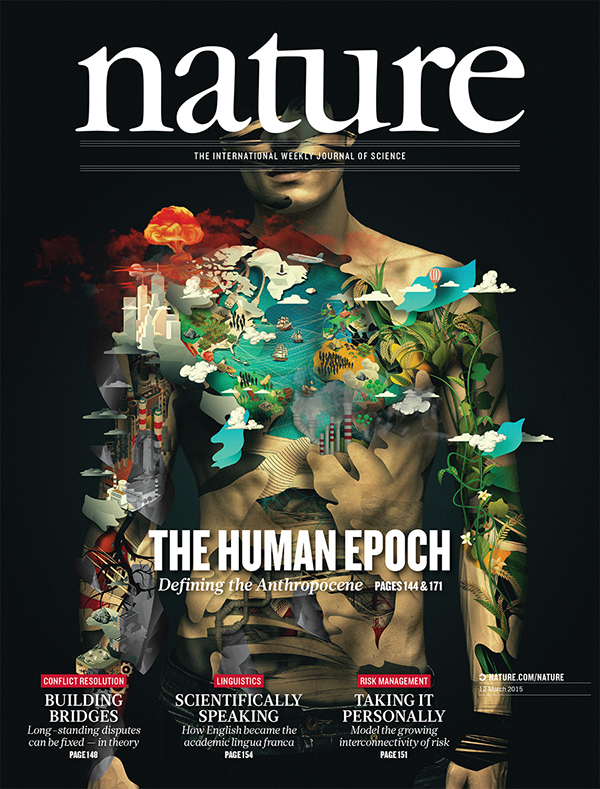

Both are monstrous but in totally different ways. The Anthropocenic human juts out randomly, stupidly, headlessly. The Hobbesian sovereign is all measure, calculation and looming menace. This speaks to the real difference between them: Hobbes was proposing a solution to the problem of political order that had so drastically broken down in his time; Nature, on the contrary, is representing the problem of the Anthropocene, a problem of order – indeed, political order – without any apparent solution in sight. The problem of Nature's image, then, is precisely the disappearance of Nature as an organising principle of geopolitics in the fullest sense of that term.

This is one thing that I was trying to get at when I recently wrote at a fair bit of length about Latour's conception of geopolitics and, particularly, his reading of Gaia. The key feature of Gaia, taking James Lovelock's iteration somewhat creatively, is that it is not any sort of personal deity because it doesn't care one bit about the fate of any individual or species but, at the same time, Gaia is not Nature because it is not indifferent or external to human action – it reacts, it is perturbed, it is responsive. To quote myself:
"However, responsiveness is not responsibility. Gaia can summon no Leviathan; there is a Great Society but no Great Community [à la Dewey]. Of course, it is not that Gaia ‘lacks’ the appurtenances of a formalised polity per se – it is only we Earthbound that such a supplement impels; it is, rather, that Gaia, our past and our present, will only be our future – we will only have a future – if such an assembly is realised."
The image I had in mind at this time was precisely Hobbes' most famous image and the cohesiveness and unity of that ugly apparition looming over the English countryside. Nothing could be less true of the geopolitical predicament that Latour is addressing. There is no Global State – nor will there be. The things formerly known as natural do not bring unity; total knowledge of the Earth's surface in no way allowed it to be mastered (some of its occupants, perhaps, but this paramilitary victory was plainly overestimated); its complex spatiality greatly exceeds merely topographical imagings; the things formerly known as natural, in fact, disturb, destabilise and destroy the comforts of order and regulation, they do not and will never again give it a secure foundation. This realisation, to parrot Naomi Klein, changes everything.

Oliver Kessler mentioned in the closing panel of the conference that he wished that Latour had used the modified version of this image from Shapin & Schaffer's Leviathan and the Air-Pump.
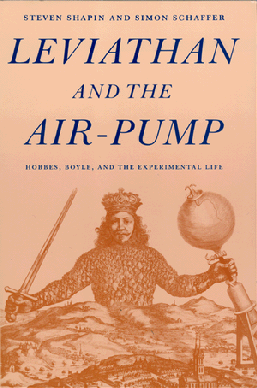

That would have been an interesting connection but the point that Latour was making concerned political unity rather than the relation between science and politics per se. In any case, Latour's attempt to imagine a representative geopolitics of this Gaian situation was precisely the overarching theme of his lecture.

Representation in every sense of that word – political, scientific, artistic. And representation not in the vague, vain liberal sense of 'letting everyone have their say.' It was very clearly representation as a precondition of action. In other words, it was a question of collective will and adherence; of achieving the political infrastructures by which a collective could act – and a collective that is constituted by far more than just humans and their (delegated or imposed) spokespeople. A form of action that requires the alignment of actors of all kinds (and here the humanists leave the room…).

To self-indulgently quote myself again (because I can't think of a better way of putting it than this sentence that I spent months writing and re-writing):
"Gaia is not just the scene of politics, nor a violent interjection to it, but a dramatic, swirling convolution of world-convening relations – a collective constituted by all the constituents that she collects."
This is why Gaia is at the centre of Latour's geopolitics. It is not a unity. It is not a single, homogeneous, centred actor. It is not a totality and it is not nature. It has no one name. It is not something everywhere the same. It is impersonal but not indifferent. It is violent but not malevolent. It has intentionality but no teleology.
"There is only one Gaia but Gaia is not One."
It is, above all (and in more than one sense of that phrase), a sovereign. Here we see that, however 'flat' Latour's philosophy may or may not have been in the past, his 'Gaia-politics' presupposes an emphatic verticality; a power, a transcendence that vastly exceeds human actions but does not transcend them in the sense of being in any way exterior.

This must unground every sense of earth, terrain, territory on which International Relations, knowingly or unknowingly, has based its object.

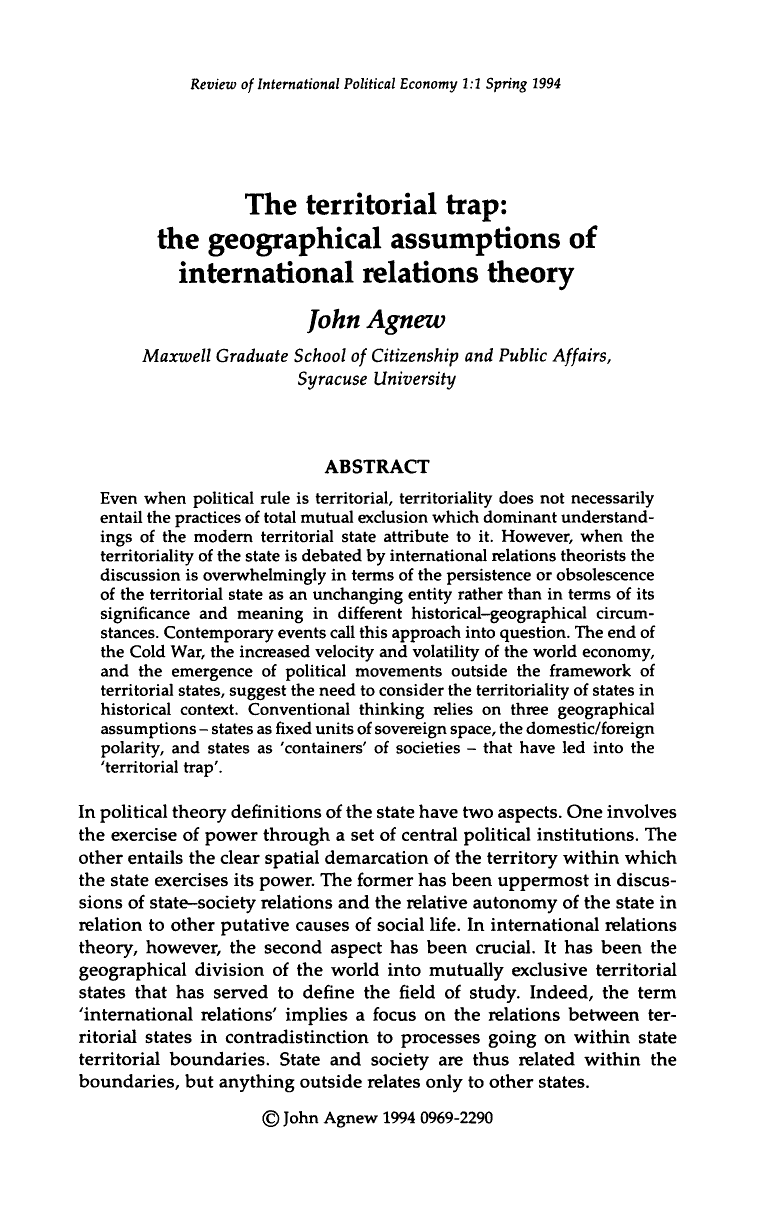
But here we should pause. Geopolitics is not IR. To re-hash John Agnew's famous article The Territorial Trap, IR has been consistently ignorant of the space, the materiality, the environments that its institutions presupposed.

Political geography was born as a discipline in the imperial struggles of the late nineteenth-century. Its reactionary extremes directed and enthusiastically served those ends – knowledge of the earth, its environments and climates was to found the efficient, ruthless administration of empire. This is, quite unambiguously, the root of 'geopolitics' (the word itself was coined, as 'Geopolitik,' in 1899).

Some would say that IR was born as a discipline in 1919 (at my home institution in Aberystwyth, from which I type these words); however, it only really got going as a disciplinary space and movement in the 1950s with sponsorship from the Rockefeller Foundation, among others. At this time, 'geopolitics' had all but disappeared from conversations in polite society as it had become had it become almost synonymous with Nazi expansionism via Karl Haushofer's association with the regime (a somewhat more complicated relationship than was recognised at the time but nevertheless).

Geopolitical ideas were soon revived by the likes of Henry Kissinger who reconstructed them for the new era of empires that the so-called Cold War brought about but human geography as an academic discipline on the whole lost its connection with international or global politics. IR, meanwhile, soaked as it was in the behavioural sciences and the realpolitik of its various émigrés, had little interest in the complexities of the ways that the world gets composed. The planet was, by this point, known rather well (or so they thought) and explanatory power was to be sought primarily in understanding the behavioural characteristics of human beings and their institutions. Their agenda was, variously, to secure peace and to overcome the non-liberal remnants of 'History,' in the Hegel/Fukuyama sense of the word.

This aside has a point, which I will now get to: 'environment' in IR has always been a special interest, a subfield, something to do with whales; 'earth' has been either an anachronism or an irrelevance; 'space' has been what you put satellites in.

Is there any discipline less prepared for what is coming than IR? I can hardly believe that there is. And yet, does this mean that IR must be brought to an end? Perhaps not.

Latour's lecture concluded with an overview of the 'Make It Work!' event – essentially a Latourised model UN – that was held in Paris this summer. The main point made by this event was that oceans, icecaps, forests, etc. – all these also require political representation, alongside corporations, NGOs and states.

And states. It is so very easy to denounce and demean this mode of geopolitical organisation, born out of the historical milieu that is encapsulated by Hobbes' towering phantasm. But let's be honest, the 'Westphalian state system is redundant' critique practically writes itself at this point, doesn't it?

"The old (but still useful) world of States" – this was on one of Latour's slides.

And this brings me to the Q&A session that followed the lecture. Two of the questioners made more or less the same point: Okay, so having non-state representatives representing beings other than humans is good but are we to believe that states do such a wonderful job of representing people? Verily, if (critical) IR scholars have achieved anything over these years it has been to demonstrate the vicious iniquities of state-based political complacency!

I was reminded at this point of the Olympics where stateless athletes are permitted to compete under an independent banner.


Of course, all of this raises questions of power. How does anything come to be represented politically? By demanding that it be so. In other words, through struggle. Or, to put it in more Latourian terms, how is a 'middle ground' ever formed from which diplomacy can begin? According to Richard White, this too is about power. All sides must be capable of compelling their other to meet on the middle ground rather than imposing a settlement from without.

But returning to my thread, if we are to extend representative politics to more than humans is this not a perfect time to reconsider how we represent human beings too? And is not a discipline such as IR not well placed to consider such a task? Well, perhaps. But not on its own. IR's ignorance of space and geography is well known but its connections with anthropology are not much better. The very concept of representation, for instance, was also born around the time of Hobbes – it is no more universal than 'Nature.'

Here it might be opportune to cast our minds back to Patrick Thaddeus Jackson's keynote at the Millennium conference last year:
"The way I understand it, the term ‘international’ picks out those aspects of anything that involves cross-boundary encounters with difference. The international aspect of a military manoeuver or a financial transaction does not simply begin at the moment that a formal territorial border is crossed, but as soon as the existence of some other—the alien, the foreigner, the stranger—is taken into account in the operation. Representations of otherness, which shape and structure what we come to regard as legitimate or acceptable or appropriate action towards or in reaction to those others, are the common thread connecting all of our myriad substantive concerns, and the ‘return’ of culture and identity to the scholarly agenda is better thought of as a clarification of what we were all already interested in in the first place."
This, to my mind, is a large step in the right direction but isn't quite there yet because it continues to pretend that other academic disciplines haven't been doing this for years and years in their own ways (and doing a very good job of it). It's still sectarian. What about anthropology, for instance? Cynthia Enloe was also present at this year's Millennium conference and was a perfect reminder of the importance of that connection to IR historically. But the larger part of these disciplines remain entirely estranged.

Plainly, there is a need for a complete re-evaluation of what the purpose of IR in this new world is. Reconsidering its relations to not only geography and Earth system science, etc. but also to anthropology and other forms of knowledge production besides. A comparative and interstitial sociology of social science.

Is there an appetite for such self-criticism within this most cloistered and jurisdictionally jealous of academic disciplines? Some, perhaps not enough. But it is a conversation worth having and a task worth attempting – and one that Latour's work will help us to initiate, even if he by no means has all the answers.

But perhaps I should end with the quote that titles this post. 'What's so wrong with arrows?', I hear you ask. Well, Latour tells us, you draw an arrow on a map when you need to account for something that the map itself (base map plus territorial outlines) says shouldn't be there – migration, movement, pollution, mess. In other words, if you need to draw an arrow it's because your map is inadequate to its representational task because it assumes a flat, stable base upon which everything else is projected rather than trying to capture the territorial complexes in motion and in their own complexity; that is to say, in the process of their ongoing assembly.

This is a difficult point to grasp without a thorough transformation of conceptual vocabularies. For example, this is how Latour describes 'territory':
"A territory is everything that you need to survive and that may suddenly fail you. […] Of course the territory does not resemble the nicely coloured geographical maps of our classrooms. It is not made of nation states – the only actors that Schmitt was ready to consider –but of interlocking, conflicting, entangled, contradictory networks that no harmony, no system, no ‘third party,’ no overall Providence may unify in advance. Ecological conflicts do not bear on the nationalistic Lebensraum of the past but they do deal with ‘space’ and‘life.’ The territory of an agent is the series of other agents that are necessary for it to survive on the long run, its Umwelt, its protective envelope."
To quote myself again, in attempting to think through this conception:
"[…] an economy does not distribute goods circulating across a given territory, it formats the territories themselves; globalisation has nothing to do with ‘levels’ or ‘scales’ but rather concerns intensifications and extensions of entangled dependencies; a Collective does not have a territory but rather as many territories as it has constituents; and geopolitics is not a matter of bickering over bounded surfaces but, rather, publicly contesting these polydimensional spaces."
What political agency such a kind of spatial formatting could have is questionable. However, it asks questions that are plainly unanswerable without a great degree of conversation between researchers and technicians with a range of different skills and disciplinary experiences – scientists, artists, theorists, ethnographers, programmers, organisers, and so on. It requires institutions such as Latour's own Medialab, for instance. (For all the talk of post-disciplinarity, let's not pretend that we can do away with institutions.)

That is an exciting prospect but not one that IR is well-prepared for. Nevertheless, I think we can most certainly all count ourselves as 'perturbed' – whether this way or that – by now. If nothing else, Latour is laying down a challenge that tremors right across the disciplinary landscape. To what extent it will uproot IR's usual comforts and homilies remains to be seen but it will be interesting to find out.

Wednesday, 18 February 2015

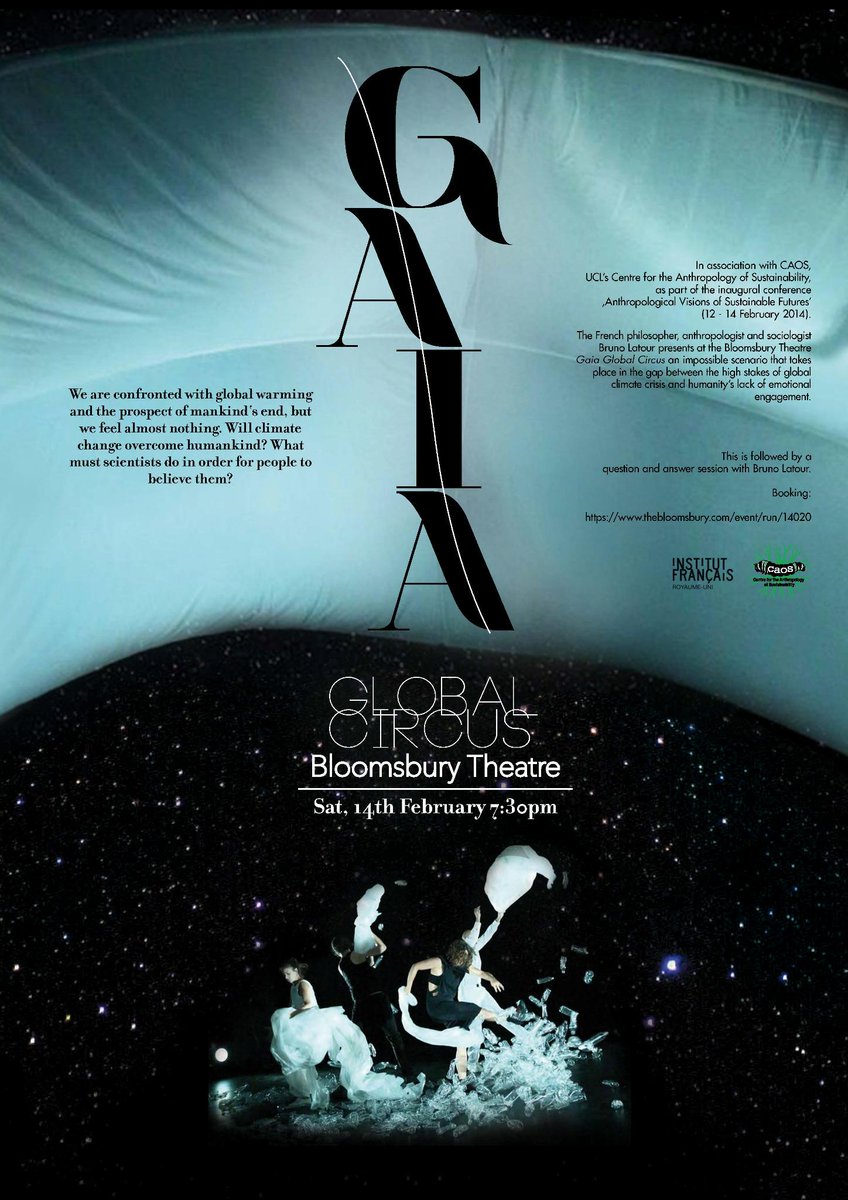
“We scientists are on a warpath” – Gaia: Global Circus

Last Saturday evening, I had the great pleasure of attending the first UK performance (and, indeed, the first in English) of a play written by Pierre Daubigny and organised by Bruno Latour – ‘Gaia: Global Circus.’


It should be noted immediately that I am a total and complete plebeian when it comes to the theatre. Nevertheless, some thoughts:

What is Gaia? I am tempted to quote Hobbes and say a ‘mortal god.’ However, if we think of the famous frontispiece to Hobbes’ book, we find a problem with this allusion.


Hobbes' Leviathan, at least as it is visualised here, suggests something organ-ised in the most profound sense. Gaia, on the contrary, does not have – does not have yet – any sort of apparatus or dispositif (political, legal, religious, scientific) that could broadcast her 'eviction notices,' as I have called them, with anything approaching a singular, booming 'old Testament' kind of a voice. The phenomenology is more that of earth-shaking claps of thunder and blinding bolts of lightning that we are all stumbling around, bumping into each other trying to understand.

Galileo's 'and yet it moves' (apocryphal or not) is a crucial phrase. Oh, he had no idea! Certainly, Gaia has the authority to decide to 'move' as she pleases 'whether we like it or not' – so much more so than Galileo could even have imagined; however, one scientist's self-righteous mutterings does nothing for the problems we face.

It is this not-yet-assembledness that, I think, 'Gaia: Global Circus' explored. I will not attempt to summarise it in detail. It was too inventive and multi-layered to be précised in any useful way. From the very first scene, events constantly folded back on themselves, going one way and then stopping, resetting and approaching their topic from another angle, with an ever shifting array of personae.

The star of the show was perhaps the canvas, the canopia or the ‘sheet with balloons attached to it,’ as one audience member commented, that dominated the stage. It could be manipulated in such a way that it was facing the audience and acting as a projection screen; at other times, it was pulled and tussled so as to convulse and summon up a storm; it lurked above the stage for a time before being pulled down so as to conceal and partition the space; finally, and by way of finale, it floated out over the audience, encapsulating them. This was an impressive technical achievement (although one of the actors did remark at the end on the difficulties they would be in if a balloon burst!), however it was also a poetic one as the device never seemed extraneous to the performance – on the contrary, it was integral.

A few words must be added for the four actors whose performances were remarkable, particularly considering that portions of the play relied heavily on improvisation and that they were doing this outside their first language. Being that funny and that engaging under those conditions deserves applause in itself.

And on that point, humour! A play on something as serious as climate change and environmental destruction could easily lapse into a kind of dour, pious sagacity. This was averted by simply being consistently very funny (as one might well expect from a Bruno Latour production).

The most important point is that the play attempted to enact the stuttering, uncertain beginnings of the representative invocation of a sovereign. We are not yet ready to carve Gaia’s image in brass, all her features clear and distinct. In terms of Gaia’s fictive representation, we remain at a much more impressionistic stage, for political, religious, artistic and scientific reasons. A stage well suited to... the stage!

On this point, a tangent beckons me... It'd also be interesting to investigate, in the style of von Uexküll, how Gaia perceives us. What are we to her? We are not ambulating beings, wandering around, faces wobbling, eyes blinking – we are chemicals and heat; we are a chemical burn, an itch. Perhaps that should be factored into our representations. Gaia is 'ticklish' but only in response to very specific stimuli. Our pleas will not be heard! She should not be imagined as having eyes, ears. Perhaps she should have a nose, a giant and over-sensitive nose. She will be monstrous, in any case. Maybe less a task for a fine artist than a cartoonist. Something out of H.P. Lovecraft.

Gaia can call on no Leviathan; by this I mean that there is no assembly so coherently assembled as to legitimately declare itself the medium of her 'Word' and, therefore, the task of translating her coded, gaseous missives into affective and cognisable messages falls on Earthbound scientists, politicians, religionists, etc.

At perhaps the pivotal moment in the play, one character declares with defiant force: "we scientists are on a warpath!" I’ve been critical of Latour’s use of ‘war’ as a concept previously. As I mentioned in the conclusion to my recent article, there are problems of translation when adapting these ideas for political geography (which is my interest). The matters of concern that must be taken into account there involve ISIS in Iraq, Putin in Ukraine, Obama's drones in Pakistan, the walls and fences being built in Israel, Texas, India, Saudi Arabia's plan to build a fence around their entire territory (!), and so on. Consequently, one must be very careful when talking about 'war' and violence in this context.

And, in light of that, I think 'warpath' is good alternative to 'war.' It indicates an attitude – which is serious, passionate, angry, implacable, forceful, being prepared for violence – but doesn't conflate what we are doing with what we are trying to prevent ('all out' or 'total' war). In Lippmann's Phantom Public he remarks that a war could perhaps be fought for democracy but it couldn't be fought democratically. We are most definitely on the path to war. Those fences on the borders of the EU, those migrants drowning in the Mediterranean, those drones in the sky – these are geogovernance and geostrategy at work (and the Pentagon is not where you'll find the climate deniers...).

However, if we accept that 'politics is war by other means' then we should conclude not that politics and war are one and the same but that politics is not war because it is by other means. In other words, the means matter. To somewhat egocentrically quote myself:
A climate scientist arguing fiercely with a denialist at a public meeting may lack a ‘sovereign’ to whom he can appeal to settle the dispute; however, no matter how much they bellow – no matter even if they brawl – they are not ‘at war’ in a sense that should be so easily literalised. [...] We would do well to remember the difference between heated arguments and charred flesh, even if we are staring at a future that is going up in flames.
So, the sense of 'being on a warpath' modifies this vocabulary notably. It becomes possible to state that we are engaged in a secret war with Gaia but, for the most part, a nervous peace amongst ourselves. There are relations of domination, violence and injustice, of course, but 'total war' is, for now, absent. Those 'on a warpath' must insist that, if we are not very careful, we are headed for worse. Those walls, fences and other fortifications are there for a reason and Gaia will not differentiate between polluters and non-polluters. Nothing proves that the crimes of the last century are unrepeatable.

More could be said, much more (particularly by someone who knew what they were talking about). Nevertheless, the play has achieved what it set out to do, from my perspective at least: to provoke thought.

Tuesday, 18 November 2014

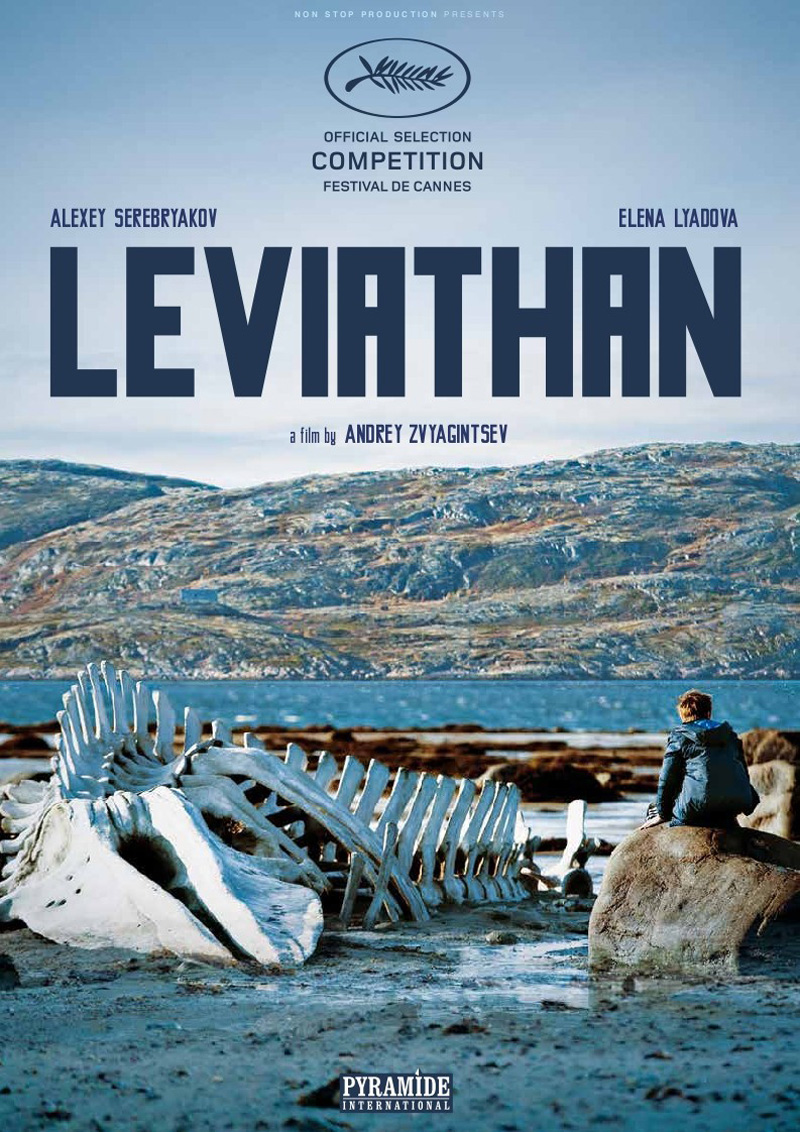
"that Mortall God" — Zvyagintsev's Leviathan; law, structure and the state

"This is the Generation of the great Leviathan, or rather (to speake more reverently) of that Mortall God, to which we owe under the Immortal God, our peace, and defence." — Thomas Hobbes

Although Andrey Zvyagintsev's highly (and justly) celebrated film Leviathan obviously connotes Thomas Hobbes' famous treatise, it should perhaps also be linked with one of Nietzsche's most famous lines, specifically when he called the state "the coldest of all cold monsters". 'Leviathan' gives this film not only its title but its whole sense of world; it is a film about structure, about the crushing, irresistible weight of this great, horrible, monstrous, but also mortal being.

If it can be summed up so simply, the film reflects on the immense, destructive, tragic but also transient force of assembled societal power; a power that seems utterly vast and yet will, in time, crumble like everything else. Churches will become ruins in which teenagers hang out, powerful leaders will become jokes (albeit private ones), whales will wash up and leave only their skeletons on the beaches.
"Canst thou draw out Leviathan with a fishhook?" (Job 41:1)
There is a strong sense of anger but also, overwhelmingly, futility in this film. Non-resistance seems to be the only means of survival for any of these characters (indeed, the Book of Job-speaking priest offers precisely this advice at one point). The protagonists perturb the status quo in the first act but, like a sturdy ship, it rights itself and it is as if that wave had never rolled in. The state's fragility (and here taking 'state' in its broadest sense, including the church, organised crime, and so on), its transience, its mutability is of no comfort to those caught up in its wheels and cogs. It is something that is only even really perceptible on a broader scale of time than that of a human life. It would take the whole 140 years that Job is said to have lived in order to make anything of this mortality. The skeleton on the beach, while deeply symbolic, doesn't suggest any real possibility of resistance. Structural mortality and fatalism come together, without contradiction.

There is far more to this film than I am able to go into here. Despite its bleak themes, it is often very funny and is beautifully shot. Many shots of the decaying ships in the harbour recall the cinema of Tarkovsky so strongly that had they been held for 50 seconds rather than 5 one could have been excused for mistaking parts of Leviathan for his Stalker.

In short, the film is about church, state, Russia past and present. The fact that it was sponsored by the Institute Of Modern Russian Culture is interesting in itself. The film treads an extremely fine and precarious line with regard to the current regime. Overt criticism is more or less avoided but the subtext sounds out like a foghorn. The various portraits of Putin hanging about the place, the Orthodox figures of Jesus staring from every mantlepiece (and dashboard), the scene with the portraits of past Russian leaders, the brief glimpse of the words 'Pussy Riot' on a TV screen. Iconographically the film is incredibly rich and it'd take someone far better qualified than me to do any of it justice. It is a remarkably critical film in many ways although clearly one that has elected to mind its historical moment (one character says precisely this in one of the film's most crucial political scenes — a scene that occurs, tellingly, far out in the wilderness, 100km from the small town in which the film is mostly set).

The one other thing I'd like to mention is the law. One of the most striking scenes in the film is found in a court room where the presiding official reads through the judgement so fast that the words become just a blur, a solid block of somehow insignificant signification, a stream of pronouncement without even the slightest hesitation; she barely even pauses to breathe and when she does it seems almost reluctant. It is a barrage, an avalanche, a volley of legalese. The force of the power on display is its total incontestability. Never mind 'getting in a word edgeways,' there is no gap for any objection whatsoever.

It is also quite amazing how surprised everyone at the police station and courts appear when the hotshot lawyer from Moscow swans in and presents them with legal argument (with the ever so naive belief that this will have some force). It is not only that they do not accept its force, it is that the very notion that they would appears to be the strangest thing in the world. 'What? That is not how things work here,' they seem to be saying. For the most part this is without any particular maliciousness (except for where the principle antagonist is concerned, who is nothing but malevolence, maliciousness and greed). It simply is not the way things are done. It is an alien proposition.

Here we are presented with the institution of law without its process. The hollowed out shell, the great fleshless ribcage of the social in a society corrupted, captured by organised crime of one sort or another. Although this is a film on the most ostensive level about law there is precious little legality within it. All legal utterances fall flat against an edifice that has simply rendered them not unspeakable but inaudible. (And here perhaps it would be interesting to reflect on the preoccupation of structuralism with speech — 'can the subaltern speak?' In the case of the main character, a socially privileged male in some respects but utterly incapable of engaging with bureaucratic formality on its own terms, he clearly cannot speak or act in the language of law. And yet when his incomparably more nuanced, cultured lawyer friend speaks for him in perfect, considered, calm but also forceful and pointed sentences he meets an infrastructure simply incapable of hearing his flawless, metropolitan speech acts.) This is a world in which law has, to all intents and purposes, died; reduced to procedure; reduced to a tool of power, of organisation.

Like so many excellent films, this one has, its excellence notwithstanding, perhaps been a little overhyped. I went into the screening with mildly overinflated expectations. It is not an epic. It is a low budget film with a relatively small cast but, most importantly, big ideas. It is the epitome of what film making should be; however, I certainly didn't find it to be life-changing or anything of the sort. An absolute must watch for anyone interested in political or legal theory, or simply anyone who likes slow moving, beautifully made, slightly dystopian tragedies. Since I tick all of those boxes it is a film that I'll be thinking about for some time to come.