Showing posts with label international relations. Show all posts

Saturday, 21 April 2018

Thinking Through Planet Politics—25 April 2018, Tampere, Finland

I'm very much looking forward to travelling to Tampere in Finland next week for what should be a fascinating workshop on the subject of "planet politics."

For those of you who may not be familiar, Planet Politics: A Manifesto from the End of IR was published two years ago. This workshop continues the conversation that has resulted therefrom.

It is open to whoever may be interested, so if you happen to be in the area next week, just drop Hannes Peltonen an email!

(If the below is a bit fuzzy, click the image for higher resolution.)


My own contribution will involve a somewhat critical analysis of the debate thus far, particularly arguing that if planet politics as a 'thing' is to be more than just another re-branding effort for environmental politics then we need to give much more thought to reconceptualising the planetary as such.

Saturday, 20 January 2018

Enough of ‘new’ diplomacies: reclaiming the diplomatic pluriverse

I’m a little late to this particular party; however, in the middle of last year, a very interesting debate broke out between the blogs of Shaun Riordan, Katharina Hone and others on the subject of ‘new’ diplomacies. Does the proliferation of new ‘kinds’ of (or prefixes for) diplomacy serve an intellectual, analytical purpose or is it just another case of academics hankering after scholarly turf?

As Katharina writes:
“Indeed, those practices we describe as diplomacy are expanding. We are seeing discussions on digital diplomacy, climate diplomacy, health diplomacy, business diplomacy, education diplomacy, and sport diplomacy to name a few. Should we, as scholars and practitioners of diplomacy, be concerned? The worry seems all too real. If everything is diplomacy, then nothing is. An ever-expanding concept eventually becomes meaningless. Does this charge apply to these new diplomacies?”
To be sure, from ‘-isms,’ ‘turns’ and (lately) ‘-cenes’ to ‘x diplomacies,’ the urge to name and rename is a strong one. I myself have named this urge ‘entrepreneurial neologism’ (which is, of course, an example of itself).

But, as regards diplomacy, is this just another semantic snowball fight masquerading as thought or does it serve a purpose? Well, to be honest, I think this is a case of a badly formulated question. We have the starting point all wrong.

If what we are really talking about is the conditions under which different kinds of practice can be legitimately counted as ‘diplomacy’ then we are dealing not at all with an idle academic question but, rather, with an intensely – indeed, existentially – political one.

As Sam Okoth Opondo and others have argued, through the course of what is known, euphemistically, as ‘the expansion of international society’ (i.e. European colonialism), the non-white and non-Western were precluded from being agents of diplomacy until such time as they “were converted into something recognizable, yet inferior to the European standard” [1]. Modes of inter-collective negotiation and conflict resolution that did not conform to the received standard not only could not be accepted as legitimate but could scarcely be accepted as existing. By definition, diplomacy was an institution of the civilised; therefore…

If there is a gap – nay, a gaping abyss – in the research of diplomacy today, it does not concern the role of sports or businesspeople (although these are legitimate and necessary courses of study [2]). Rather, it concerns the historical marginalisation and suppression of forms of diplomatic practice undertaken by and between collectives not recognised as legitimate (i.e. state) actors by colonial and imperial powers.

Practices like the ‘wampum diplomacy’ of the Iroquois have received some coverage in anthropological and, to a lesser extent, diplomatic literatures [3]. However, such studies are few and far between. Within the academy at least, the decolonisation of diplomacy has barely begun.

So, in short: Questioning the varieties of diplomacy is not just an idle intellectual debate. It is a matter of sovereignty and existential recognition. In other words, we are talking about matters of diplomatic ontology – what kinds of beings can be recognised as legitimate parties to diplomatic engagement?

This is an historical matter; however, it is also utterly contemporary. When representatives of the First Nations existing within the territory of Canada meet with state representatives, is this an ‘internal’ negotiation between the government and an interest group like any other? Or, is it a meeting between occupying and occupied polities?

It seems to me that this is the point from which to begin questioning diplomatic plurality, rather than from formalistic schemas or issues of professional propriety. That said, starting from this point does not preclude any of the questions that Shaun, Katharina and others have been asking. It simply makes clear what is at stake.

In anthropology and elsewhere, it has become popular to contrast the ‘universe’ with the ‘pluriverse’ – the latter term recognising that there are indefinitely many more ways of existing in the world, indeed of conceiving and making worlds, than has been admitted by the imperial proclivities of modernist Eurocentrism [4].

The problem with the ‘new’ diplomacies debate is twofold. First, it implies that issues of diplomatic variety are somehow recent, rather than the state-centric understanding of diplomacy itself being historically produced [5]. Second, and as a consequence, this debate thinks too small – fiddling while Rome burns the world.

We must accept nothing less than the reclamation of the diplomatic pluriverse.


References
[1] Opondo, Sam Okoth. "Decolonizing diplomacy: reflections on African estrangement and exclusion." In Sustainable Diplomacies (Palgrave Macmillan UK, 2010): p.110.
[2] E.g. Marsden, Magnus. Trading worlds: Afghan merchants across modern frontiers (Hurst and Company, 2016).
[3] E.g. Andersen, Morten Skumsrud, and Iver B. Neumann. "Practices as models: A methodology with an illustration concerning wampum diplomacy." Millennium 40, no. 3 (2012): pp.457-481. See also: Neumann, Iver B. "Euro-centric diplomacy: Challenging but manageable." European Journal of International Relations 18, no. 2 (2012): 299-321.
[4] Blaser, Mario. "Ontological Conflicts and the Stories of Peoples in Spite of Europe: Toward a Conversation on Political Ontology." Current Anthropology 54, no. 5 (2013): pp.547-568.
[5] Although see the comment and response by Barbara and Katharina. See also: McConnell, Fiona, Terri Moreau, and Jason Dittmer. "Mimicking state diplomacy: The legitimizing strategies of unofficial diplomacies." Geoforum 43, no. 4 (2012): 804-814. Cornago, Noé. Plural diplomacies: Normative predicaments and functional imperatives (Martinus Nijhoff Publishers, 2013).

Wednesday, 29 March 2017

New essay on 'Post-Truth, Complicity and International Politics'

We need to talk about truth. Or, more precisely, “post-truth.” As has been widely reported, shared, liked and ridiculed, this was the Oxford Dictionaries Word of the Year for 2016: “[R]elating to or denoting circumstances in which objective facts are less influential in shaping public opinion than appeals to emotion and personal belief.” Although in use since at least the early 1990s, in the year of Brexit and Trump, post-truth was claimed as a kind of zeitgeist. Cue much pensiveness and gnashing of teeth.
A new essay on 'Post-Truth, Complicity and International Politics' that I wrote in response to recent debates on these issues has published at E-International Relations.

Writing about US politics at present is a bit like trying to nail jelly to a wall. I started writing the piece in the immediate aftermath of the Trump election in November. It was updated in the early part of the year to reflect various changes that had occurred by that point. Consequently, I didn't comment on some more recent contributions mentioned in a previous post.

So, this is really my attempt to make sense of the politics of nonsense that Trumpism embodies. It is, in this sense, an ongoing project; something of a collective work in progress.

I write particularly from my current disciplinary situation in International Politics (or International Relations, delete as appropriate). Nevertheless, this is a discussion that goes well beyond any academic circumstance.

I'm very glad to have it out there (even if I'm currently experiencing the customary apprehensiveness that comes from having one's own thoughts suddenly on public display!).

Monday, 27 February 2017

The prison house of disciplinarity and the poverty of paraphrasism

Working within a discipline is a tricky thing, particularly when your work doesn't fit at all neatly into any discipline in particular. Such are the quandaries of inter- trans- or multi-disciplinary, neatly summarised here:
Intradisciplinary: working within a single discipline.
Crossdisciplinary: viewing one discipline from the perspective of another.
Multidisciplinary: people from different disciplines working together, each drawing on their disciplinary knowledge.
Interdisciplinary: integrating knowledge and methods from different disciplines, using a real synthesis of approaches.
Transdisciplinary: creating a unity of intellectual frameworks beyond the disciplinary perspectives.
My PhD project involves writing a history of the concept of the environment, particularly in the 19th century. One basic methodological principle I have adopted is to work 'semasiologically' – that is, to take a word and explore its possible meanings as opposed to 'onomasiologically,' which takes a concept or thing and explores its possible significations.

Of course, these approaches are not mutually exclusive. However, prioritising the former has an important consequence: it is impossible to limit the study to pre-specified disciplinary domains. For example, while geographical uses of 'environment' are extremely important to the story I'm telling, they cannot be prematurely isolated from the popularisation of 'milieu' as a term in literary theory or linguistics.

Disciplinarily, I am housed within and funded by a department of International Politics, although I also have supervision from geography and the history of science. This is working out to be a very productive arrangement as it combines a substantial degree of intellectual freedom with a continual demand to think more intensively about the political consequences of what I'm working on.

So, clearly my work is inter- or multi-disciplinary, depending on how you look at it. It is also trans-disciplinary inasmuch as I am not just combining different areas of knowledge haphazardly or indifferently but also thinking about things that none of these 'boxes' really encourage (although, institutionally, they may to some extent facilitate).

However, it is perhaps easier to define the kind of disciplinarity that I am working against than what I am working towards. Obviously, nothing about this project is 'intra-disciplinary.' However, it seems to me that strict intra-disciplinarity is becoming more and more rare, at least in the areas that I am familiar with.

The aspect of disciplinarity that I would really see myself as resisting has more to do with the 'cross-disciplinary,' or perhaps a better term would be 'para-disciplinary.' This is something that I find to be particularly prevalent in International Relations, although by no means only there.

In a word, I would call it 'paraphrasism' – that is, the norm that a scholar residing within one discipline, looking to other disciplines for interesting ideas and then essentially paraphrasing these ideas, repackaging them for colleagues in their home discipline, makes not only an acceptable but a highly valued form of intellectual contribution to collective knowledge.

For example, within IR it is possible to be a scholar who works primarily on the philosophy of science. To varying degrees, ideas taken from disciplinary philosophy of science may be adapted to the specificities of IR; however, equally they may remain debated in the abstract among other IR-philosophers. Sometimes such debates do get to the point of going beyond what has been said elsewhere. However, the important point is that paraphrasing and 'bringing in' these ideas is considered to be original intellectual work in itself.

Such para-disciplinary repackagings seem to score highly on assessment metrics and are generally a sound route to professional success. I find this rather disappointing. I hasten to add that I'm not condemning or demeaning this sort of endeavour. It is worthwhile. However, it is also extremely limited.

I try to set myself quite different goals. If I am making use of ideas derived from the philosophy of science, the history of science and anthropology, I want my recombination and rethinking of these ideas to entail original contributions to each of these areas. That is, every significant adoption should entertain the possibility of productively feeding back on whence it came.

I hasten to add once again that this is extremely difficult to achieve and that I do not expect that I am any more capable of this than anyone else. It is difficult to add to any one area of knowledge, never mind several. However, this is rather beside the point. The important thing is to choose your implausible objectives very carefully – to construct one's own intellectual obligations in such a way as to make such a thing possible rather than foreclosed from the start.

I expect that this is not an altogether original thought. However, I don't know of anyone articulating it in quite this way. For example, in Why International Relations has Failed as an Intellectual Project and What to do About it (2001), Barry Buzan and Richard Little argue that the "semipermeable membrane that allows ideas from other disciplines to filter into IR, but seems to block substantial traffic in the other direction" amounts to their discipline's 'failure.' They propose that IR qua coherent, ontologically grounded discipline must have something to 'give back,' balancing the trade deficit with other coherent, ontological grounded disciplines, particularly sociology. That 'something' is the very thing that gives the discipline its 'ground': the concept of 'international systems.' Along very similar lines, in International Relations in the prison of Political Science (2016), Justin Rosenberg proposes that the discipline find its ground in the concept of 'political multiplicity' – it is this disciplinary heartland that will let IR scholars hold their heads high at the table of social sciences.

Personally, I have little interest in such intra- and inter-disciplinary politics. I have the luxury, at present, of ignoring such things. However, at some point, I will have to dress myself in the garb of one house or another. Clearly, my past and present institutional circumstances have effected my reference points for thinking about these things. Disciplinarity is certainly not something that can be shrugged off. It is an ongoing, continual conditioning effect operating via a variety of means, obvious and otherwise. Nor is it necessarily a bad thing – I mean it when I write that my situation in an IR department provokes me to think politically in a way that I would not elsewhere.

There is something of a tightrope to navigate. However, I won't content myself with paraphrasism, even if that would make for an easier life. I just find that altogether too boring.

Friday, 14 October 2016

Exploring the international through film

As part of my teaching this term, I am screening and introducing five films (or collections of films) from around the world that deal with various aspects of international politics. Below are my synopses. Looking forward to it!

1. Apocalypse Now (1979)
Regularly listed as one of the greatest films ever made, Francis Ford Coppola's masterpiece has won plaudits and provoked controversy ever since its release. Set during the Vietnam War in 1969, the film follows Benjamin L. Willard, a Captain instructed to travel up the Nung river and assassinate Walter E. Kurtz, a Special Forces Colonel gone rogue, establishing himself as a demigod somewhere inside neutral Cambodia. Simultaneously realistic and surreal, Coppola once claimed that: "My movie is not a movie. My movie is not about Vietnam. My movie is Vietnam." Having as much to do with the drugs, the lies and the madness of the era as with the war itself, Apocalypse Now will make us ask: Does this film really criticise war or, rather, subtly glorify it? Does it undercut racism or just reproduce existing prejudices? And can we, in the end, separate the cinematic spectacle, the 'entertainment value,' from the politics it plays out?

2. Our Friend the Atom (1957)/The War Game (1965)
Appearing just eight years apart, these two short films show two very different sides of Western nuclear politics in the mid-twentieth century. Our Friend the Atom was produced by Disney to educate the public about nuclear science and extol the virtues of this 'magical' technology for everything from energy and transportation to health. In stark contrast to such bubbly optimism, The War Game depicts the events and aftermath of a Soviet nuclear attack on Britain. It was produced for the BBC but deemed "too horrifying" to broadcast. With recent debates around the renewal of the Trident nuclear weapons system and, in light of global warming, the vices and virtues of nuclear power, these films offer a window onto past attitudes to nuclear politics that will help inform our thinking in the present. These films will make us ask: How are apparently 'elite' issues of strategy and planning connected to public perceptions of legitimacy, security and science? What do these differing understandings of nuclear technology tell us about our collective attitudes towards the future? And is it even possible to have a 'rational' debate around these issues, given how massively emotive they have been for such a long time?

3. Mustang (2015)
Set in a parochial, provincial Turkish village ("1000 miles from Istanbul"), this Franco-Turkish production tells the story of five teenage sisters, rebellious and orphaned, living with their kind but conservative grandmother and brutal, controlling uncle. After one act of youthful disobedience too many, it is decided that the girls are to be married – forcibly, if needs be. As a result, their home is gradually turned into a prisonlike "wife factory" – complete with bars on the windows. However, while the film does not shy away from the horrors possible in a patriarchal society, it is not a film about suffering but, rather, about resistance, love and the exuberance of youth. With a relevance that transcends its particular cultural circumstances, Mustang will make us ask: What are the sorts of violence that young women are particularly vulnerable to and how are these vulnerabilities perpetuated? What sorts of agency do women, of all ages, have to resist these unequal and unjust relationships? And what message might this film have for those of us living, seemingly, much further away than "1000 miles from Istanbul"?

4. World War II short films (1935-1945)
World War II was perhaps the heyday of propaganda films. Huge numbers were produced on all sides, across a wide variety of genres. This session will play a selection of British, American, French, German, Japanese and Soviet short films and cartoons, as well as excerpts from feature films such as the infamous Nazi epic Triumph of the Will (1935). Placing all these audiovisual artefacts side-by-side will demonstrate the differences but also the similarities between the competing schemes of national representation and vilification that were tearing the world apart at this time. While in many ways 'of their era,' we will find in these films certain tropes and techniques that remain in continual use, right up to today. These films will make us ask: How were perceptions of the War produced through film and how did they differ between different nations? What do these differences tell us about our own hyperactive media environments? And what, in the end, is a 'propaganda' film, anyway?

5. Embrace of the Serpent (2016)
Like Coppola's Apocalypse Now, this film also features a journey down a tropical river – a journey taken under desperate circumstances. Théo, a German explorer, seeks the help of an Amazonian shaman, the only man for many miles who can cure his fatal illness. However, this is not another story of a white European disappearing into the frightful foliage of the wild and 'primitive.' Instead, the story is told from the perspective of Karamakate, the shaman. Set against the background of the 'rubber wars' perpetrated by Euro-American invaders seeking to exploit Amazonian rubber trees, Embrace of the Serpent is simultaneously a scathing indictment of colonialism and, in the words of its director, "an attempt to build a bridge between Western and Amazonian storytelling." This film will make us ask: What place is there in our political attention-spans for forms of violence and exploitation apparently at the 'fringes' of civilisation? Are we even able to recognise all the forms of violence that such projects of domination enact? And how, given all of that, can we 'build bridges' between different ways of living and surviving in the world?

Tuesday, 19 April 2016

Latour, sovereignty and the ‘generalised international’

Bruno Latour's keynote from the Millennium conference in London last October has now been published: Onus Orbis Terrarum: About a Possible Shift in the Definition of Sovereignty. Alongside it is an interview conversation between Latour, Mark Salter, William Walters and Iver Neumann: Bruno Latour Encounters International Relations: An Interview.

In the latter, one of the interviewers mentions a point I made (to be cited: still very much a novelty for me!) in my article on Latour's geopolitics, published last year. Specifically, I suggested that his work had shifted in the last 10 or 15 years from a conceptual vocabulary mostly concerned with parliaments and procedures to one perhaps better characterised by the term, borrowed from Jenny Edkins and Maja Zehfuss, the 'generalised international.'

This connection is something that I really just threw in to the article without much explanation. The point that Edkins and Zehfuss were making in their article was that 'the international' is generally understood, in International Relations (as an academic discipline) at least, as a realm of contingency, uncertainty, negotiation and open-endedness. In other words, of anarchy (see also Alex Prichard on this point). This realm is then generally pathologised relative to the 'domestic' arena of order, law, certainty and control. Their appeal, therefore, in 'generalising the international' is to embrace this more anarchic political sensibility not as the illegitimate other of the domestic but as a general condition of a politics 'open to the future.'

The connection to Latour's work is, I think, not completely straightforward or equivalent. However, from at least his War of the Worlds: What about Peace?, published in 2002, Latour has not only tended towards a predominantly 'geopolitical' conceptual vocabulary rather than a 'parliamentary' one, but he has increasingly emphasised the importance of Carl Schmitt's distinction between war and police operations as distinguishing fundamentally different political conditions.

The major difference that I papered over in my passing allusion is that, for Latour, the 'anarchic' political situation is not necessarily the preferable one. A state of war may be 'open to the future' in a way that a police operation is not – recognising this state is the precondition of negotiating a peace that is more than nominal. However, it is more a matter of recognising the state that we are in than it is opting for a political imaginary that is morally preferable in any general sense. And so, I suppose, in the end, we meet with different meanings of 'generalisation.'

Tuesday, 20 October 2015

"My enemy is arrows. I want to get rid of arrows" – Bruno Latour on maps, earth and International Relations

One of the first academic conferences I went to was that of the Millennium journal of International Relations in 2012. The theme was 'Materialism and World Politics' and IR, always late to any bandwagon, was doing its best to catch up. One striking pattern that was immediately evident was the proliferation of references to a certain Bruno Latour in many papers and presentations, particularly amongst students and early career academics. Up to that point, his name was almost completely unknown amongst IR scholars – surely one of the last provinces of the social sciences and humanities to remain so unperturbed.

Three years on and Latour was Millennium's headline act, delivering the keynote lecture. This was filmed and will presumably be made available online in the next few days. Consequently, I will not try to summarise it but will just offer some thoughts.

The lecture began with a visual comparison of Hobbes' famous frontispiece with a recent front cover from Nature.


Both are monstrous but in totally different ways. The Anthropocenic human juts out randomly, stupidly, headlessly. The Hobbesian sovereign is all measure, calculation and looming menace. This speaks to the real difference between them: Hobbes was proposing a solution to the problem of political order that had so drastically broken down in his time; Nature, on the contrary, is representing the problem of the Anthropocene, a problem of order – indeed, political order – without any apparent solution in sight. The problem of Nature's image, then, is precisely the disappearance of Nature as an organising principle of geopolitics in the fullest sense of that term.

This is one thing that I was trying to get at when I recently wrote at a fair bit of length about Latour's conception of geopolitics and, particularly, his reading of Gaia. The key feature of Gaia, taking James Lovelock's iteration somewhat creatively, is that it is not any sort of personal deity because it doesn't care one bit about the fate of any individual or species but, at the same time, Gaia is not Nature because it is not indifferent or external to human action – it reacts, it is perturbed, it is responsive. To quote myself:
"However, responsiveness is not responsibility. Gaia can summon no Leviathan; there is a Great Society but no Great Community [à la Dewey]. Of course, it is not that Gaia ‘lacks’ the appurtenances of a formalised polity per se – it is only we Earthbound that such a supplement impels; it is, rather, that Gaia, our past and our present, will only be our future – we will only have a future – if such an assembly is realised."
The image I had in mind at this time was precisely Hobbes' most famous image and the cohesiveness and unity of that ugly apparition looming over the English countryside. Nothing could be less true of the geopolitical predicament that Latour is addressing. There is no Global State – nor will there be. The things formerly known as natural do not bring unity; total knowledge of the Earth's surface in no way allowed it to be mastered (some of its occupants, perhaps, but this paramilitary victory was plainly overestimated); its complex spatiality greatly exceeds merely topographical imagings; the things formerly known as natural, in fact, disturb, destabilise and destroy the comforts of order and regulation, they do not and will never again give it a secure foundation. This realisation, to parrot Naomi Klein, changes everything.

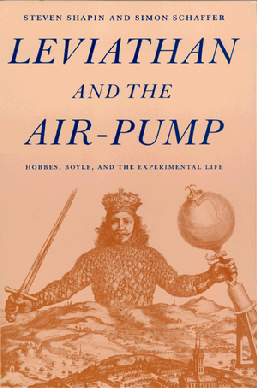
Oliver Kessler mentioned in the closing panel of the conference that he wished that Latour had used the modified version of this image from Shapin & Schaffer's Leviathan and the Air-Pump.


That would have been an interesting connection but the point that Latour was making concerned political unity rather than the relation between science and politics per se. In any case, Latour's attempt to imagine a representative geopolitics of this Gaian situation was precisely the overarching theme of his lecture.

Representation in every sense of that word – political, scientific, artistic. And representation not in the vague, vain liberal sense of 'letting everyone have their say.' It was very clearly representation as a precondition of action. In other words, it was a question of collective will and adherence; of achieving the political infrastructures by which a collective could act – and a collective that is constituted by far more than just humans and their (delegated or imposed) spokespeople. A form of action that requires the alignment of actors of all kinds (and here the humanists leave the room…).

To self-indulgently quote myself again (because I can't think of a better way of putting it than this sentence that I spent months writing and re-writing):
"Gaia is not just the scene of politics, nor a violent interjection to it, but a dramatic, swirling convolution of world-convening relations – a collective constituted by all the constituents that she collects."
This is why Gaia is at the centre of Latour's geopolitics. It is not a unity. It is not a single, homogeneous, centred actor. It is not a totality and it is not nature. It has no one name. It is not something everywhere the same. It is impersonal but not indifferent. It is violent but not malevolent. It has intentionality but no teleology.
"There is only one Gaia but Gaia is not One."
It is, above all (and in more than one sense of that phrase), a sovereign. Here we see that, however 'flat' Latour's philosophy may or may not have been in the past, his 'Gaia-politics' presupposes an emphatic verticality; a power, a transcendence that vastly exceeds human actions but does not transcend them in the sense of being in any way exterior.

This must unground every sense of earth, terrain, territory on which International Relations, knowingly or unknowingly, has based its object.

But here we should pause. Geopolitics is not IR. To re-hash John Agnew's famous article The Territorial Trap, IR has been consistently ignorant of the space, the materiality, the environments that its institutions presupposed.


Political geography was born as a discipline in the imperial struggles of the late nineteenth-century. Its reactionary extremes directed and enthusiastically served those ends – knowledge of the earth, its environments and climates was to found the efficient, ruthless administration of empire. This is, quite unambiguously, the root of 'geopolitics' (the word itself was coined, as 'Geopolitik,' in 1899).

Some would say that IR was born as a discipline in 1919 (at my home institution in Aberystwyth, from which I type these words); however, it only really got going as a disciplinary space and movement in the 1950s with sponsorship from the Rockefeller Foundation, among others. At this time, 'geopolitics' had all but disappeared from conversations in polite society as it had become had it become almost synonymous with Nazi expansionism via Karl Haushofer's association with the regime (a somewhat more complicated relationship than was recognised at the time but nevertheless).

Geopolitical ideas were soon revived by the likes of Henry Kissinger who reconstructed them for the new era of empires that the so-called Cold War brought about but human geography as an academic discipline on the whole lost its connection with international or global politics. IR, meanwhile, soaked as it was in the behavioural sciences and the realpolitik of its various émigrés, had little interest in the complexities of the ways that the world gets composed. The planet was, by this point, known rather well (or so they thought) and explanatory power was to be sought primarily in understanding the behavioural characteristics of human beings and their institutions. Their agenda was, variously, to secure peace and to overcome the non-liberal remnants of 'History,' in the Hegel/Fukuyama sense of the word.

This aside has a point, which I will now get to: 'environment' in IR has always been a special interest, a subfield, something to do with whales; 'earth' has been either an anachronism or an irrelevance; 'space' has been what you put satellites in.

Is there any discipline less prepared for what is coming than IR? I can hardly believe that there is. And yet, does this mean that IR must be brought to an end? Perhaps not.

Latour's lecture concluded with an overview of the 'Make It Work!' event – essentially a Latourised model UN – that was held in Paris this summer. The main point made by this event was that oceans, icecaps, forests, etc. – all these also require political representation, alongside corporations, NGOs and states.

And states. It is so very easy to denounce and demean this mode of geopolitical organisation, born out of the historical milieu that is encapsulated by Hobbes' towering phantasm. But let's be honest, the 'Westphalian state system is redundant' critique practically writes itself at this point, doesn't it?

"The old (but still useful) world of States" – this was on one of Latour's slides.

And this brings me to the Q&A session that followed the lecture. Two of the questioners made more or less the same point: Okay, so having non-state representatives representing beings other than humans is good but are we to believe that states do such a wonderful job of representing people? Verily, if (critical) IR scholars have achieved anything over these years it has been to demonstrate the vicious iniquities of state-based political complacency!

I was reminded at this point of the Olympics where stateless athletes are permitted to compete under an independent banner.


Of course, all of this raises questions of power. How does anything come to be represented politically? By demanding that it be so. In other words, through struggle. Or, to put it in more Latourian terms, how is a 'middle ground' ever formed from which diplomacy can begin? According to Richard White, this too is about power. All sides must be capable of compelling their other to meet on the middle ground rather than imposing a settlement from without.

But returning to my thread, if we are to extend representative politics to more than humans is this not a perfect time to reconsider how we represent human beings too? And is not a discipline such as IR not well placed to consider such a task? Well, perhaps. But not on its own. IR's ignorance of space and geography is well known but its connections with anthropology are not much better. The very concept of representation, for instance, was also born around the time of Hobbes – it is no more universal than 'Nature.'

Here it might be opportune to cast our minds back to Patrick Thaddeus Jackson's keynote at the Millennium conference last year:
"The way I understand it, the term ‘international’ picks out those aspects of anything that involves cross-boundary encounters with difference. The international aspect of a military manoeuver or a financial transaction does not simply begin at the moment that a formal territorial border is crossed, but as soon as the existence of some other—the alien, the foreigner, the stranger—is taken into account in the operation. Representations of otherness, which shape and structure what we come to regard as legitimate or acceptable or appropriate action towards or in reaction to those others, are the common thread connecting all of our myriad substantive concerns, and the ‘return’ of culture and identity to the scholarly agenda is better thought of as a clarification of what we were all already interested in in the first place."
This, to my mind, is a large step in the right direction but isn't quite there yet because it continues to pretend that other academic disciplines haven't been doing this for years and years in their own ways (and doing a very good job of it). It's still sectarian. What about anthropology, for instance? Cynthia Enloe was also present at this year's Millennium conference and was a perfect reminder of the importance of that connection to IR historically. But the larger part of these disciplines remain entirely estranged.

Plainly, there is a need for a complete re-evaluation of what the purpose of IR in this new world is. Reconsidering its relations to not only geography and Earth system science, etc. but also to anthropology and other forms of knowledge production besides. A comparative and interstitial sociology of social science.

Is there an appetite for such self-criticism within this most cloistered and jurisdictionally jealous of academic disciplines? Some, perhaps not enough. But it is a conversation worth having and a task worth attempting – and one that Latour's work will help us to initiate, even if he by no means has all the answers.

But perhaps I should end with the quote that titles this post. 'What's so wrong with arrows?', I hear you ask. Well, Latour tells us, you draw an arrow on a map when you need to account for something that the map itself (base map plus territorial outlines) says shouldn't be there – migration, movement, pollution, mess. In other words, if you need to draw an arrow it's because your map is inadequate to its representational task because it assumes a flat, stable base upon which everything else is projected rather than trying to capture the territorial complexes in motion and in their own complexity; that is to say, in the process of their ongoing assembly.

This is a difficult point to grasp without a thorough transformation of conceptual vocabularies. For example, this is how Latour describes 'territory':
"A territory is everything that you need to survive and that may suddenly fail you. […] Of course the territory does not resemble the nicely coloured geographical maps of our classrooms. It is not made of nation states – the only actors that Schmitt was ready to consider –but of interlocking, conflicting, entangled, contradictory networks that no harmony, no system, no ‘third party,’ no overall Providence may unify in advance. Ecological conflicts do not bear on the nationalistic Lebensraum of the past but they do deal with ‘space’ and‘life.’ The territory of an agent is the series of other agents that are necessary for it to survive on the long run, its Umwelt, its protective envelope."
To quote myself again, in attempting to think through this conception:
"[…] an economy does not distribute goods circulating across a given territory, it formats the territories themselves; globalisation has nothing to do with ‘levels’ or ‘scales’ but rather concerns intensifications and extensions of entangled dependencies; a Collective does not have a territory but rather as many territories as it has constituents; and geopolitics is not a matter of bickering over bounded surfaces but, rather, publicly contesting these polydimensional spaces."
What political agency such a kind of spatial formatting could have is questionable. However, it asks questions that are plainly unanswerable without a great degree of conversation between researchers and technicians with a range of different skills and disciplinary experiences – scientists, artists, theorists, ethnographers, programmers, organisers, and so on. It requires institutions such as Latour's own Medialab, for instance. (For all the talk of post-disciplinarity, let's not pretend that we can do away with institutions.)

That is an exciting prospect but not one that IR is well-prepared for. Nevertheless, I think we can most certainly all count ourselves as 'perturbed' – whether this way or that – by now. If nothing else, Latour is laying down a challenge that tremors right across the disciplinary landscape. To what extent it will uproot IR's usual comforts and homilies remains to be seen but it will be interesting to find out.

Wednesday, 17 June 2015

What is 'International'? A few reflections on Patrick Thaddeus Jackson's 'Must International Studies Be a Science?'

I didn’t go to the Millennium Journal of International Studies' conference at the LSE last year. (I did in 2012 and intend to attend this year.) However, a selection of the papers from the conference have just been published, including the keynote by Patrick Thaddeus Jackson ‘Must International Studies Be a Science?’ (His short answer: no.)

I don't want to go into the whole thing (or even the main of the thing) but just to draw out a few points that interest me.

The essay is set up with a good mixture of sweeping breadth and due humility:
“Depending on which authority one consults, ‘we’ are a group of scholars held together by our ‘great debates’, by our concern with the implications of inter-state anarchy, by our implication in a (neo)colonial project of establishing European hegemony, by a set of so-called ‘paradigms’ which almost no one claims to adhere to any longer even though we keep organising our introductory textbooks and courses according to them, etc. […]
I do not propose to resolve this controversy here. Instead, I will circumvent it by simply elucidating what I mean by ‘international studies’ so that my answer to my initial question becomes clearer.”
So, first of all, what about that troubling term ‘international’?
“The way I understand it, the term ‘international’ picks out those aspects of anything that involves cross-boundary encounters with difference. The international aspect of a military manoeuver or a financial transaction does not simply begin at the moment that a formal territorial border is crossed, but as soon as the existence of some other—the alien, the foreigner, the stranger—is taken into account in the operation. Representations of otherness, which shape and structure what we come to regard as legitimate or acceptable or appropriate action towards or in reaction to those others, are the common thread connecting all of our myriad substantive concerns, and the ‘return’ of culture and identity to the scholarly agenda is better thought of as a clarification of what we were all already interested in in the first place.”
A commendably open definition though this is, what portion of the human sciences does not deal with otherness (or, indeed, boundaries)? One might admit that anthropology, sociology, psychology, etc. do not primarily deal with otherness across 'boundaries' as such (although what is a boundary?); however, I think that the pivot point ‘primarily’ is a rather vulnerable 'single point of failure.' The question becomes: Why does one need a distinct discipline to deal with such things? Perhaps the answer could be that cross-boundary otherness comes in many forms and, while of course it is dealt with in a wide variety of epistemic milieus, it is important enough to demand a particular disciplinary focality, a programme of concentrated examination that would think through such phenomena taken together, regardless of their usual disciplinary partitionment.

IR (or IS) would then be essentially interdisciplinary. It would not have its own ontological ‘turf’ (the Durkheimian dominion-making assumption that a ‘science’ must have its own distinct ontological domain has dominated the discipline since at least Kenneth Waltz’s Theory of International Politics [1979]). Instead, it would draw together a range of concerns that no other discipline examines in an assembled and focused manner. Anthropology, sociology, psychology, geography, literature theory, etc. etc. – all these encounter ‘cross-boundary otherness’ but severally. This would be an interesting proposition. However, I’m not sure that this is what PTJ is arguing.

He does note that “the term [international] does not pick out a discrete realm or region of social life” (i.e. the boundaries in question are not just state boundaries). However, he redefines it (having first undefined it) not quite as I have described but rather:
“I would therefore locate the ‘international’ in ‘international studies’ not in the object of study, but in the way that we approach the object of study—which means that virtually everything has an ‘international’ aspect, potentially, depending on how we look at it.”
He goes on: “After all, ‘physics’ does not name an object of study, but a way of studying objects; why should ‘international’ be any different?”

I find this to be a strange and sudden segue. ‘Way of studying’ suggests methodology – and this is, of course, the theme on which the talk was to be given. However, there’s a confusion here between methodology and ontology, at the very least. Is physics a ‘way of studying’? This is a rather obscure abstraction. PTJ seems to want to avoid the ontology of domains by talking about methods (or at least practices) but this won't work. The whole notion of a ‘physical domain’ as categorically distinct from the chemical and biological is indeed rather outdated. However, the ‘monist’ claim that these disciplines engage ‘the same’ things from different perspectives leads us back down precisely the wrong path. A lamentable regression.

We should shed the terms ‘physics’ and ‘chemistry’ here. Every scientific research exercise addresses distinct entities. These are not the ‘domain’ that grants or guarantees scientificity and I do not deny overlaps all over the place but to sever science from its particular objects, or to melt everything into a single ‘world’ that is only broken apart again when engaged by human agents is, in my view at least, completely wrongheaded. Sciences are established neither by domains nor by ‘ways’ (whatever they are). The only means of making sense of what sciences are without the traditional distinctions is as networks and assemblages (here I am of course betraying my own philosophical preferences) – networks and assemblages that include distinct objects, distinct practices, distinct epistemic standards and norms…; none sovereign or permanent but none to be unduly confused or conflated, either.

PTJ goes on to discuss his heuristic take on knowledge production, expanding on technical and epistemic 'ways' of knowing and building on his The Conduct of Inquiry in International Relations: Philosophy of Science and Its Implications for the Study of World Politics (2010). I will skip over this as I want to concentrate on the aforementioned issues.

Long story short, I find that, ‘otherness across boundaries’ seems to overemphasise the ‘inter-’ and wash out the ‘national’ (or leave it crucially underexamined), leading to a disciplinary vision that at least risks being somewhat superfluous. PTJ does not note the etymology of ‘nation’; however, it is instructive:
“c. 1300, from Old French nacion ‘birth, rank; descendants, relatives; country, homeland’ (12c.) and directly from Latin nationem (nominative natio) ‘birth, origin; breed, stock, kind, species; race of people, tribe,’ literally ‘that which has been born,’ from natus, past participle of nasci ‘be born’ (Old Latin gnasci; see genus).”
Perhaps there is something in this (though we must tread carefully). We could say that where IR/IS/IP went wrong was in assuming that ‘national’ meant ‘nation state,’ or at least nation in a modern, mass mediated sense where humans are symbolically and technically conjoined in their millions. Tribe, village, family, city – these might all be involved in ‘international’ relations – and relations on their own scale, of their own kind – in this expanded sense, tied more definitely perhaps to a sense of birth and nurturing, culture and cultivation.

(Incidentally, this could be related to the world history interpretation offered by, for example, Barry Buzan and Richard Little in their International Systems in World History: Remaking the Study of International Relations [2000], where they explode any hint of presentism in the study of the relations between human groups in the longue durée.)

But, again, don’t think that what I’m describing here is what PTJ is arguing. He is in no way trying to prescribe what others should mean by ‘international’ (and the studies thereof); he is only articulating what he means by that term. However, he is nevertheless setting out his stall by articulating a kind of ideal typical vision of what ‘International Studies’ would be, then later breaking that down by proliferating 'ways' of knowing (and only of knowing). I wonder if this is not precisely the wrong way to approach disciplinarity; it is at least the wrong starting point. It is effectively saying: ‘here is my vision of disciplinary identity; you will surely have your own’ – and that’s commendable to some degree but the underlying assumption is that disciplinary identity is the issue at hand; that it is on this level that discussion should proceed.

I would prefer to begin by understand disciplinarity in a very particular manner, which only partially matches up to PTJ's arguments (and then only in his concluding remarks). A discipline can be understood as an environment, a milieu of sorts. It is a space within which knowledge production occurs. Its prevailing conditions, accidental or designed, variously enable, disable, orient and disorient the many actual and possible courses of research that are undertaken under that more or less actively conducive, more or less permeable, more or less flapping, fluttering, stuttering membrane.

Seen in this way, what a discipline ‘is’ is purely and simply a means of formatting that space. It is secondary and it is one formatting operation among others.

Given these principles, we might be able to think of efforts such as PTJ's as being interventions towards the pluralisation of the epistemic-possibilistic space that is the discipline of International [Whatever] (the fact that the name is variable doesn’t necessary meant that we’re not talking about a particular space – just more permeable). Indeed, he writes in conclusion:
“[…] the field should contain space for all of these kinds of knowing, and should resist the call to be exclusively a form of aesthetic expression, a mode of technical practice, a normative enterprise—or an epistemic science.
Instead of intending to produce one homogenous body of knowledge, the field of international studies and we scholars within it should work to become more comfortable with the irreducible plurality, plurivocality, and diversity of knowing. Such an attitude can, I think, best be cultivated not merely by our paying lip-service to the existence of other forms of knowing, but by our actively seeking to position ourselves as scholars in the spaces between these diverse ways of knowing.”
I couldn't agree more; however, this affirmation clashes, I think, with some of the presuppositions from which it issues (as I have attempted to explain, however inchoately). 'Ways' of knowing are too quickly abstracted from the rest of the world; 'the world' is too quickly defined as something singular that is only broken up by ways of knowing. 'Ways' are given too much credit, things not enough. He sets out his terms and definitions before he explores what the act of terming and defining does. As I hope I am making clear, I have many sympathies with this approach but find that it comes up short in a variety of ways.

I was first drawn into this epistemic-possibilistic space over a decade ago, during my undergraduate degree. It has for some time seemed to me that IR as a discipline has always been about 10-15 years behind the curve of the rest of the human sciences. It is an oddly introverted intellectual culture, especially given how quintessentially outward facing one might think it would be given its matters of concern (political geography, for example, is far better connected with its neighbours). Now that I am heading back into the hothouse, I do feel a little bit like holding my breath. However, the particular pocket into which I am to be immersed is a peculiarly breathable one. This much is reassuring!

Wednesday, 3 June 2015

Starting my PhD at Aberystwyth University in September

It is with great pleasure—and no small amount of relief!—that I can announce that I will be commencing my PhD studies this coming September at Aberystwyth University. I'll be based in the Department of International Politics with co-supervision in the Department of Geography and Earth Sciences. My supervisors from those departments will be Inanna Hamati-Ataya and Mark Whitehead, respectively.

Located on the west coast of Wales, Aberystwyth is a picturesque and famously rather isolated seaside town. The Department of International Politics, founded in 1919, was the first of its kind in the world. The studentship I've been awarded is named after E.H. Carr, the historian and diplomat who joined the Department in 1936 and is best remembered for his books The Twenty Years' Crisis and What is History?

It'll be quite a shock leaving Bristol after living here for the past seven years. However, having spent a couple of days in Aber earlier this year, I'm looking forward to settling in there. Having grown up in the near-total rurality of Cornwall, I think I will get used to it easily enough. I plan to spend the second of my three years of study living elsewhere—possibly somewhere a bit livelier!—though I've not yet decided where.

I've already outlined the project that I will be working on in broad brush strokes. It builds on everything that I've been writing on this blog for the past several years. I am really looking forward to throwing myself into it full-time at last—and to throwing myself into an environment where so much great work has been, and continues to be, written.


Friday, 10 April 2015

2015 Millennium Conference: 'Failure and Denial in World Politics' (keynote: Bruno Latour)—an opportunity for rethinking critique?

The theme for this year's Millennium conference at the LSE has been announced: "Failure and Denial in World Politics." The keynote speaker will be Bruno Latour.

This is an interesting development (not surprising as Latour has a long standing relationship with the LSE, but nevertheless). Until just a few years ago, Latour's work was almost completely unknown in the field of International Relations (the field that provided ma formation, as the French say).

At the 2012 Millennium conference on "Materialism and World Politics" (at which I presented a somewhat inchoate paper on actor-network theory and offshore tax havens) there were what seemed like dozens of graduate students drawing on Latour's work and actor-network theory more broadly. The larger proportion of senior academics, however, ranged from indifference to hostility to this trend. And the hostile did not hold their tongues—all the familiar tropes were wheeled out: "networks are neoliberal!"; "this reduces humans to rocks!", etc. One objector even suggested, with all the indignation of a die-hard humanist, that this 'flat ontology' business was proto-fascist.

Actor-network theory, 'new materialism,' object-oriented philosophy and the like have gained ground within IR with remarkable speed—like an invasive species flourishing in a hitherto blissfully isolated island ecosystem! I would not be surprised if at this conference there were some kind of revanchist backlash from Critical Theorists attempting to regain lost territory.

Besides all that, it should be a very exciting conference. I've not attended since 2012 but I've never heard anything but good things. The Millennium conference is run by the remarkable and prestigious graduate-run journal of the same name. It has none of the fusty self-importance of the larger, more grimly institutionalised professional conferences but, at the same time, is large and well-known enough to attract a really top-notch group of participants.

I'll have to give some thought regarding what I'd like to present (the deadline for abstracts is the 3rd of July). It would be a good opportunity to visit the problem of science critique in relation to science denial. This is a troubling issue for IR, which is far more deeply wedded, at least amongst some sections, to the practice of critique than science studies ever was (and for good reasons, I'd argue).

If the impressions and expectations I've described above are correct, the time would be very ripe for attempting to think through critique once more. Not so as to dismiss it—how could one conscionably study the arms trade or the Israel/Palestine conflict without doing so, in some sense, 'critically'?—but in order to think it 'par le milieu,' as it were.

If the classic will to "ruthless criticism of all that exists" can no longer license the usual pompous, faux-radical stupidity (not the context in which that line originated but very much what it has become), and I believe that it cannot, that does not mean that critique as such can be dispensed with. What if critique is also an atmospheric phenomenon, a necessary precondition of our continuing to breathe? What if the minute perforations it instils are necessary for the stability of any enshrouding coexistential manifold? What would a more incisive and selective critique or decompositionism—not 'of all that exists' but necessarily relative to some situational decision—look like?

These are the kinds of questions that, I think, will need to be asked.

Thursday, 7 August 2014

Lovelock, Singapore and Techno-Superorganicism

James Lovelock's most recent book, A Rough Ride to the Future (2014), backtracks from his previous apocalypticism and, to some degree, from his repeated suggestion that the human global population needs to be reduced to a few hundred million in order to ensure the survival of the species. In this latest work he instead argues that what is needed is a massive and rapid increase in urbanisation and technological development. It is only, he argues, in densely populated mega-cities that humans can keep a low enough ecological profile per capita not to throw Gaia into a wholly hostile state. That is the claim.

Interestingly, the model he holds up for these futuristic urban utopias/dystopias is Singapore -- a city-state often credited as exemplary by futurists in large part due to its success in marrying economic and consumer freedoms with political and social authoritarianism. As a model for authoritarian capitalism in a hot, wet and massively urbanised environment it surely has few rivals.

The epigraph to A Rough Ride comes from Daniel Dennett:
The planet has finally grown its own nervous system: us.
Lovelock thus redoubles his penchant for superorganismic metaphors to describe human society. We are and must become more like ant colonies, he argues. It is only with such technically efficient social organisation that we can hope to survive. Fortunately, we undertake this improbable task endowed with certain gifts. Humans are exceptional Gaians inasmuch as we are the only species able to wire her neurons, to become her mind. We thus have not only the capacity but the duty to undergo this intensive self-systematisation -- 'for Gaia!'

Which brings me to a very interesting (if somewhat toothless) article (accompanied with some beautiful animations) in Foreign Policy today; the headline:
The Social Laboratory: Singapore is testing whether mass surveillance and big data can not only protect national security, but actually engineer a more harmonious society.
I won't repeat its arguments here but it deserves reading -- both in its own right and in light of the above.

With regards to Lovelock the phrase 'Curate's Egg' springs to mind. He is troublesome; but perhaps that is what makes him so important. His potentially genocidal predictions with regard to human population reduction have been heavily criticised but less attention has been given, so far, to his latest thoughts. It is frankly impressive that at 95 years of age Lovelock has flip-flopped from apocalyptic catastrophism to what is basically a qualified capitalist techno-utopianism. But then again, how far apart are these visions?

It would seem a wise bet that our future lies somewhere between the two Lovelocks: between mass eco-death and mass techno-urbanism; perhaps both together.

Thursday, 17 October 2013

The risk of 'de-centering humans'; Reflections on LSE last year

Nicholas at Installing (Social) Order has a nice post updating the blogosphere on their latest work, particularly on 'decentering humans' in International Relations.  I'm glad to see that these issues are still burning away and that the IR/ANT collective is still hanging together!

With regard to the project in general, one question that must ultimately be asked, I think, is: when we have traced all the networks that form the human how do we avoid humans being dissolved into those networks?  How do we avoid shifting from anthropocentrism to an un-self-critical network-centrism?  How do we avoid the political complacency that can potentially come from thoroughgoing relationality?  Are there no unintended consequences of ANT's creeping colonisation of more and more intellectual territory?  I think that there are.

This is something that came up at the Millennium conference last year, as I'm sure you remember!  There was a clear divide at that event between ANT-types and others, most particularly from the critical realist camp, for whom human reflexivity as the basis of political agency is indispensable.  It was argued that the appropriation of 'agency' as a substitute for 'causality' undoes all the hard won victories of emancipatory politics (and its accompanying critical theory) in the 20th century.

As something of an ANT-phile I was quite challenged by this idea.  David Chandler in particular helped me to see the point.  I came to realise that it isn't just a blustery, reactionary reiteration of substantialism or modernist humanism (although it sometimes goes that way too!).  When ANT was working just on science and technology it was easy to downplay and de-exceptionalise the agency of the human - scientists and technicians had been granted far too much agency, far too much centredness and self-control and therefore depriving them of that was methodologically and politically unproblematic.  No one was ever going to lapse into thinking that these people really lacked agency or were cultural dopes; the goal was to shift these human agents back into their networks and ANT did that brilliantly.

When we shift forward 25 years and look at the situation where, now, rightly or wrongly, ANT is a sociological metalanguage that is informing all kinds of theorisation we have to tread much more carefully.  The political agency of human beings in general is in no way as assured as that of scientists and technicians.  We simply can't take human agency for granted in all walks of life (or in all modes of existence, perhaps).  Remember that ANT ethnographers were always (and they were always aware of this) studying up.  That is, they were studying persons with more power, money and prestige than they themselves enjoyed.  Studying down, studying persons who are downtrodden, disenfranchised, held by dominant discourses to be feckless and incapable of rational self-determination - these people need to be treated with greater care.

To systematically remove all the classic humanist means by which their agency can be defended without careful consideration of consequences is, frankly, irresponsible.

That isn't to say that ANT-type work has no place within broader social or political theory.  Far from it.  I am still an ANT-phile!  All I mean to say is that irreducing the human must not, ultimately, dissolve the human.  The ontological status of human political agency is too fragile to be thrown around so cavalierly.  That doesn't mean that we must stop walking in the direction that we have been but, as Latour would put it, we may need to slow down.  It isn't that ANT cannot be translated into all these different areas but we need to recognise and deal with the ever larger degree of transformation that is required to properly extend these networks the further they stray from their origins.  Part of that, I think, means that we have to find a way of saying: the more mediations, the more human.  More humanity, not less.  A new humanism.

That's the major realisation that I got from the LSE event last year (having had a year to reflect on it!).

Friday, 8 March 2013

Drezner on Chavez and conspiracy theories

Dan Drezner comments on the commentary on Chavez's death and on Venezuelans' penchant for conspiracy theories.  He distances himself from either of the 'extremes' that would laud or denounce Chavez:
The passing of Hugo Chavez has prompted the usual 21st century cycle of news coverage and commentary that follows the death of a polarizing figure: the breaking news on Twitter, followed by the news obits, followed by the hosannahs from supporters, followed by denunciations of the figure, followed by official statements, followed by mealy-mouthed op-eds, followed by hysterical, unhinged criticism of standard diplomatic language.
Moving on from the (reactionary) reactions to asking what it all means for regional politics, Drezner continues:
[W]ith Chavez's passing, it would seem like a no-brainer for his successor to tamp down hostility with the United States. ... I'm not betting on it, however, for one simple reason: Venezuela might be the most primed country in the world for anti-American conspiracy theories

Drezner goes on to list the ways in which Venezuela is one "political climate that is just itching to believe any wild-ass theory involving a malevolent United States".


He's not wrong.  Chavez certainly indulged many bizarre conspiracy theories and never missed an opportunity to blame U.S. imperialism for any- and everything.  However, he also proved the truth of that old, pithy adage "just because you're paranoid doesn't mean that they're not out to get you."  He was certainly paranoid and sometimes seemed quite deluded but there's no doubt that the U.S. government were out to get him.

I think Drezner doesn't give enough weight to the reality of U.S. interference but he does acknowledge it, admitting to "a past history of U.S. interventions in the [Venezuelan] domestic body politic" and that "the United States play[ed] a minor supporting role in a recent [2002] coup attempt".  Many fail to see this connection at all, however.  To them I say:

You think the CIA only meddled in South American politics in the 1970s and '80s?  That's adorable.

Let's face it: when it comes to how the U.S. distinguishes between enemy and ally, locking up a few opposition leaders, leaning on the press a bit or building a cult of personality is pretty insignificant stuff.  Compared to the likes of Saudi Arabia (to name but one) Chavez's crimes and misdemeanors are almost quaint. None of that excuses anything he's done but it does illustrate the fact that none of his alleged crimes account for his pariah status. Perhaps these things should be the reason -- but clearly they're not.

Chavez and his politics are detested in the U.S. because they're socialist.  That's the top and bottom of it.  He made many questionable decisions and even more questionable alliances but, ultimately, it was his nationalising, socialising, poor-loving policies that placed him beyond the pale.  Far from him being a 'tyrant' who ruled with an iron fist he was a populist who was -- *gasp!* -- very popular.  That is why he was a threat -- the very fact he didn't need to rule as an unelected dictator was what made him so very dangerous.

The idea that the poor can take party political power and simply decide to use their national resources for their own benefit rather than abiding by unfairly negotiated contracts that chiefly benefit elites and foreign companies -- this is a revolutionary notion; a notion that threatens U.S. interests at their very core (primitive accumulation).  This is what placed Chavez in the cross-hairs of the U.S. national security state.

While most of the conspiracy theories flying hither and thither in Venezuela today are most likely complete nonsense, the U.S. has a long, long, long history of interfering with the democratic affairs of countries it deems to be subordinate, Venezuela included.  We may only have hard evidence and admissions for crimes long past but it takes imponderable naivety to think that the hulking behemoth that is the U.S. national security infrastructure is now somehow above trying to overthrow, undermine or generally mess with democratically elected governments that it deems inadequate.


The Chavez-haters are throwing stones while standing in a glass house.  The U.S. has no moral high ground to occupy (nor does the UK for that matter).  Venezuela may be a breeding ground for many bizarre, nonsensical conspiracy theories but the U.S.'s picture of Venezuela is scarcely any less deluded -- convinced as most are that Chavez was the South American Gaddafi or Saddam (an image not dissuaded by Chavez's own diplomatic conduct, it's true).  Nor has U.S. conduct towards Venezuela been in the least bit innocent over the years.

They might be paranoid but that doesn't mean that the U.S. government isn't out to get them.  Maybe the first step to making the Venezuelan people less paranoid is to stop giving them so many reasons to be.

As mentioned above, Dan acknowledges that U.S. conduct is a factor in the equation of Venezuelan paranoia, historically, but plays it down by concluding thus:
Venezuela is the perfect breeding ground for populist, anti-American conspiracy theories. And once a conspiratorial, anti-American culture is fomented, it sets like concrete. Only genuine political reform in Venezuela will cure it, and I don't expect that anytime soon.
So, ultimately, all the responsibility is placed on Venezuealans to grow up and be more rational -- the U.S. is implied to be little more than a bystander in this process.  Reform, embrace liberal capitalism, etc.  That's the prescription.  'It's their problem, not ours.'

While Venezuelan politics undoubtedly thrives on conspiracy theories, another way to ease the conspiracy mania in Venezuela would be to stop the hysterical attitudes displayed by so many commentators on Venezuela in the U.S. media.  Or, try not subverting a democratically elected South American government for a decade or two.  Or, acknowledge the legitimacy of democratic, socialist governments and their policies.  Or, stop supporting the kind of pernicious, malevolent capitalism that seeks to crush resitant regimes and exploit the poor.  Heck, maybe even stop trying to make the entire world subordinate to your imperial rule.

You know, be proactive.

Tuesday, 26 February 2013

Soft Power and the Limits of Power

Jeffrey Stacey at the Duck of Minerva blog writes about 'soft power' and its relevance (or irrelevance) to policy makers:
It seems high time to question the usefulness of how we define the term “soft power,” which has gained credence ever since the scholar Joseph Nye came up with it more than decade ago. ... something I always feared as an academic was readily confirmed when I entered the government:  more than a decade later, despite the large number of policymakers who learned Nye’s definition in graduate school, for the vast majority of them soft power‘s academic definition is of little practical use.  To a pragmatic policymaker the concept is too complex, too difficult to measure, and near impossible to manipulate as a device of influence.
The term 'soft power' actually comes originally from Nye's book "Bound to Lead: The Changing Nature of American Power", published in 1990.  It was originally proposed to arrest fears of American decline (that perpetual neurosis of the all too powerful!).  So, it was actually thought up in response to late Cold War fears, although it found its success in the more optimistic, hubristic post-Cold War world.

Of course whatever the term signifies is something unquantifiable and basically ineffible.  To some policymakers this may make it a useless concept but I'd take precisely the opposite approach: its very unquantifiability is its most important lesson.  Policymakers act in the real world, not a world of spreadsheets.  They act on the basis of intuition as well as data.  Moreover, most policymakers act pragmatically, on the basis of 'what can we get done in this timeframe with these resources?' -- not on the basis of some global, overarching superstrategy that treats reality as a giant, fifty-dimensional chess board.  So, why would policymakers need a precise total for everything?  Why must soft power be effible and instrumentally valuable in order to be real or meaningful?  You can't count your pop music artists in the same way you count your battleships but why on earth would you want to?

The very act of tying all those elements that constitute a country's 'soft power' into a tool to be militantly projected outwards into the world would, if instituted on any scale at all, destroy all those cultural entities precisely because they would be torn out of the very environment of free expression that made them possible in the first place.  Yes, you can open some libraries and sponsor some pop stars to go out on tour or hire some linguists to translate American literature into other languages and this is all fine and good but (and this, I think, is the key point) the very things that constitute the American state's soft power depend upon a cultural environment that doesn't enlist them or instrumentalise them for the sake of a centralised, bureaucratised 'soft war' effort.

The very notion that the cultural phenomena residing within a state's borders can be reduced to mere resources for the projection of state power -- this notion is part of the mania of 'Full Spectrum Dominance' that *terrifies* most of the rest of the world.  The idea that every last nut and bolt of American society should be arrayed and aligned to further American interests is precisely the kind of thing that undermines America's attractiveness.

The lesson of soft power's ineffibility is, in short, that there are limits to instrumental power and while policymakers should do what they can with the resources they have (and cultural promotion is one small element of their larger remit) not everything is grist to the mill of national security or interest promotion.  At some point you've just got to keep your damn hands off, lest you destroy what you are meant to be protecting and promoting!

Saturday, 26 January 2013

US/UK 'Special Relationship', Britain's financial empire

An interesting post at Duck of Minerva on Britain's relations with the US.

It has long been noted that the UK's national interest foreign policy-wise is halfway between the US and the EU. Yet what Brits fail to realise is that our value to the US very much depends on being part of the EU. Actually, I think a lot of the political elites do understand this but the nationalist (or perhaps a better word would be 'sovereigntist') lobby is still very powerful and a lot of parliamentary political fates depend on it, especially for the Tories.

The one major thing that's missing from Stacey's analysis is the UK's financial sector, which has the British political system in its pocket, even now. The Conservative government seem to see Britain's future in its economic and financial empire, connected through its former colonies in the British Virgin Islands, Gibraltar, etc. (Britain's "Second Empire", as Ronen Palan calls it.) The overriding national interest, as the right-wing elites see it (though not so much the right-wing electorate -- that's the schism), is to maintain Britain's position within the world's financial networks and to dig in deeper if possible. Hence the austerity agenda isn't just neoliberal ideological madness (though it is that) -- they also intend to strip away as much regulation as possible while choking off the last remnants of social democracy so as to give Britain an edge in the 'race to the bottom' of the barrel of global finance. David Cameron's recent rhetoric on tax avoidance, etc. would suggest the contrary to this but his words are hollow and in no way represent his government's actions or intentions. Because this path is a road to economic -- and consequently political -- ruin for most of the country the real question is whether they can achieve all their goals before the next election, which they look rather likely to lose at this rate.

I don't know as much as I should about Britain's military capabilities but it is remarkable that our government continues to insist (as did the Labour govt. before it) that we still need a so-called independent nuclear deterrent but we can do without the kind of resources that would actually be of use in the 21st century neo-colonial, interventionist style of warfare that seems to be the new norm. Maybe Britain needs to get it's priorities straight. I won't hold my breath.

Anyway, when push comes to shove on the EU I expect Britain's relationship to remain largely unaltered. If renegotiation happens it'll involve getting out of whatever taxes or regulations the EU wants to put on the City of London. Leaving the EU would be generally popular with the public but business has no desire for it and that, as I have mentioned, is where Britain's national interest is seen to reside.

Tuesday, 9 October 2012

Materialism and World Politics Conference: ANT and IR, Offshore

I finished my paper for the upcoming Materialism and World Politics conference hosted by the Millennium journal at the LSE over the weekend. Apparently papers are going to be posted on the conference website but I've posted mine below anyway (also available here). My paper is for the Theory Talks panel on 'Accounting for Symmetries in the International.'

The paper explores the benefits of Actor-Network Theory for International Relations by taking up the case of 'offshore' in general and offshore financial markets in particular.  I take ANT to be a social ontology (that makes things themselves social) and a spatial topology (that defines space by connection between elements, not in terms of an abstract container).  I find that what I call 'absolute' conceptions of space are intimately bound up with social/material dualism and that offshore can only be consistently, symmetrically and materially understood through ANT's 'network' space.  I conclude that ANT has great potential for IR but we need to avoid, as John Law argues, naturalising any one spatial topology.  My case study indicates a strong future for ANT in IR but, moreover, I suggest that IR could benefit ANT insofar as, in many ways, it does not fit its ontological and methodological presuppositions (and therefore it challenges them).

Sunday, 26 August 2012

More on Geography, Materiality, etc.

Further to my last post, Prof. PTJ replies in the comments to the original thread) that:
Allowing a little non-social influence on social relations is like being a little bit pregnant, because strictly speaking, these are both firm dichotomies rather than categories that can be somehow combined. If social action has parametric non-social limits that can be definitively grasped, then social action isn't constitutive and creative except within a sphere that something else grants to it. Which is why a little bit of "physical features of a region matter on their own, autonomously" is, conceptually speaking, physical determinism. 
That said, realize that I am not making fundamental ontological claims here, but analytical ones. Obviously people need to eat, so the food supply is important. Duh. At issue is how one conceptualizes "the food supply" or the mountains/rivers/diseases you invoke. I do not think that it makes sense to simultaneously say that intrinsic characteristics of food/rivers/mountains/diseases cause social outcomes, and that the discourses (and I shouldn't have to say "discourse isn't talk, but a system of practical meaning-making activity," but I am saying it anyway just in case) disclosing these things as meaningful objects cause social outcomes. Theoretically speaking, it's one or the other, not both -- and if it's both, then it's usually the former....
Below, Nawal then raises the subject of Latour:
Curious though PTJ, if you think Latour and his relational actor-network theory offers us a way out of such dichotomies or conundrums? As in the dichotomy between the "ideational" and the "material?" I read him as offering an alternative conception of the "social," which ontologically it could be fleshed out, but epistemologically speaking? I'm not quite sure... 
Or to put it another way, I read him as attempting to map out configurations of transactions and relations between social sites, the latter which could be physical objects, persons, etc., hence problematizing the "social"/"non-social" dichotomy. On the other hand, if we did take into account the analyticist methodology you've outlined elsewhere, physical objects would still be interpreted of course for the sake of theoretical accounts, so in a sense, perhaps, the "social" is either A) still taking precedence here, or B) as Latour puts it, we're forced to rethink what "the social" entails. ...
To which PTJ replies:
I read Latour much the way that you read him here. I think he's basically a relational discourse theorist who is reacting against the "ideational" misreading of Foucault, so he and his disciples say "material" a lot when they mean discursive in the correct, narrow, Foucault-Laclau-Mouffe-Pickering-and-I-would-also-say-Wittgenstenian-sense of systems of meaning-making practices. The word "material" is a red herring in all-too-many of these discussions. 
For Latour there are no such things as 'social relations' in an abstract sense.  There are no 'social relations' as such, only mediators, which are things.  When Latour talks about 'the social' he is talking about a particular 'mode of existence' or mode of connection particular to sociality.  In other words, sociality is a particular way of connecting things; it is not a separate sphere or realm apart from things.  It's not composed from a different kind of 'stuff' to other kinds of things.  He isn't 'problematising the dichotomy' -- he's outright denying it.

Consequently, for him, sociality isn't limited to words, meanings, texts, etc. -- anything that performs a social connection is social.  While I'm fully aware that "discourse isn't talk, but a system of practical meaning-making activity" -- i.e. it isn't 'ideal' -- that isn't the problem.  Some discourse theorists are of course willing to embrace the concept of materiality insofar as texts are material, as are human bodies and regimes of discipline and so on.  But these caveats are generally pretty half-hearted and fail to go anywhere near far enough.  In fact they're just margin-notes to a whole mindset that is wrong.

Latour's definitely not a discourse theorist in any way, shape or form.  He certainly owes dues to Foucault, while semiotics is his main 'toolkit' but that's as far as it goes.  This becomes perfectly clear in any of his actual actor-network analyses.  For example: In his photo essay 'Paris: Invisible City' (available on his website) he goes around Paris looking at all the institutions that hold the city together as a city.  The city qua city -- that is, as a social entity.  He looks at, for instance, how the clocks keep time.

Tracing that network one can go from the watch on one's wrist to the radio towers that transmit pulses to update devices wirelessly to broadcasting stations, to the statute books and standards documents that prescribe the specific definitions of time to the laboratories where standards are produced, criticised, tested, reproduced and so on.  But if you keep pulling at the threads you can go even further.  Those laboratories don't just work on texts and traces; they also tie themselves into the persistent, unfailing pulses of decaying radioactive isotopes and the perfectly consistent throbbing of distant, dying stars.  These are the objects whose own time-keeping is used to set the whole network in lockstep.

These technical, legal, scientific and political institutions tie the city of Paris together by keeping it in time with itself.  And at what point is this network 'social' in the narrow sense?  The stars, atoms, papers, fibre-optic cables and so on are not part of the network 'in a manner of speaking,' nor are they only enrolled insofar as they are meaningful.  They simply are part of the network, just as all the meaningful human agents are.  The network isn't reducible to atoms and stars but nor does it make the least bit of sense without them.

Latour doesn't ask 'how is meaning made?' he asks 'how do things hold together?' -- and cities are held together, in some small part, with stars and atoms -- so long as the requisite networking institutions exist, that is.

Stars and atoms aren't the 'really real' behind the veil of subjective impression and they don't determine anything.  The fear of material determinism is frankly silly if you look at how much hard work goes into making the whole network hold together.  Stars and atoms don't easily lend themselves to humans' peculiar ends.  They have to be enrolled, enlisted and maintained.  Far from determining the whole getup on their own they are utterly indifferent towards us.  They have to be made to determine the time on our wrists and on our walls.

And yet, despite all of that, actor-network theory can easily be read as constructivism.  It steadfastly refuses, for instance, the notion of an absolute, objective Time sitting behind all our subjective perversions of it.  The stars and atoms do not pulse and decay in Real Time, 'out there,' as it really is.  The aforementioned network does not produce a subjective approximation of an objective absolute.  Time is the product of a specific network and, consequently, there are as many times as there are networks producing it.  But none of that constructivism draws a line between the atoms and the texts, the things and their meaning.  On the contrary, if there were such a line the whole network would collapse; the network exists precisely because the lines of the network look like this: ------ (connected) and not like this: ----|---- (disconnected).  Drawing an arbitrary line between sociality and materiality (thereby constituting the fantasy that such things exist, severally) prevents us from understanding these hybrid networks because the networks themselves do not operate on the basis of such distinctions.  This is why ANT adopts the ethnomethodological principle to let actors themselves define their own meta-languages, rather than imposing an analytical master-language from the outside.

And this is why our dualist SOPs (whether they're ontological or just analytical, it makes no difference), in my opinion, are no longer helpful.  They are the problem, not the solution.

So, PTJ, basically I don't accept that we should have hard and fast divisions between the ontologies of our daily lives -- in which we know that the world is full of things that have all kinds of effects on us -- and the ontologies of our analyses -- where only the 'meaning' of things is relevant.  It's not because ignoring materiality locks us into 'subjectivism' or because looking at things rather than people makes us all hard-nosed and serious -- these criticisms are bogus and based on their own dualisms.  It's because arbitrary, pre-judged distinctions between what matters and what doesn't make it impossible for us to understand hybrid networks that, themselves, only work because they do not make such distinctions.

If we live in an ontologically hybrid world we need modes of analysis suited to that world.  Social constructivism or discourse analysis in the vein of Foucault, Laclau, Wittgenstein, etc. are well suited to particular areas of our world but they miss out entirely on vast swathes of it because of their blinkered and entirely unnecessary dualist predispositions (again, whether it's ontological or analytical dualism, it makes no difference).  Social constructivism should be valued for what it does well but no number of successes should paper over where it goes awry -- and where it goes off the rails is in the face of hybrid networks, which are everywhere.