Showing posts with label Patrick Thaddeus Jackson. Show all posts

Sunday, 19 March 2017

The need for humility and creativity in the face of 'post-truth'

PT Jackson has a very good post on Duck of MinervaFor Accuracy, Consequences, and Truth. A Personal Manifesto.
The Trump Administration’s proclamation of “alternative facts” to suit the arguments they wish to make, and the branding of journalistic outlets that demonstrate the inaccuracy of the President’s statements as “FAKE NEWS!!!” have prompted me to do something I am not normally inclined to do: to actively campaign for the value and integrity of a broadly scientific approach as an important input to public deliberation.
There's an old adage that seems to me to be rather pertinent here: Beware the General who plans for the previous war (because they are likely to lose the next one).

One reaction to the whole 'post-truth' thing has been to point out that politics was never truth-based in any meaningful sense. Politicians always lied. Truths were always multiple. This reaction basically says 'move along, nothing to see here.'

Another reaction has been to dust off the old 'Science Wars' tropes from the mid-1990s and blame 'postmodernism' for corrupting public morals and undermining rationality (as if a few literary theorists were running the world this whole time).

The first of these reactions is basically correct but nevertheless deeply, ponderously complacent. The second appropriately militates against this complacency but falls down by being extremely stupid.

And so PTJ's post is very welcome in falling into neither of these traps, having the humility to admit that the politics of truth the author hitherto practiced also had its shortcomings.

As far as this need for self-criticism goes, I think it comes down to this: To show the politics in truth claims is easy. At this point, we can pretty much do this in our sleep. It's practically automated.

Yes, everything is contestable and much of everything must be contested. But this is the battle cry of the previous war. There are much more difficult questions to be asked.

There will be no end of history, intellectual or otherwise.

Thursday, 8 December 2016

Alfred North Whitehead and the Logician's Nose

In his foreword to Isabelle Stengers’ Thinking With Whitehead, Bruno Latour writes:
“It could be one of those little games journalists play on television talk shows about books: “Who was the greatest philosopher of the twentieth century whose name begins with W?” Most learned people in America would answer “Wittgenstein.” Sorry. The right answer is “Whitehead” – another philosopher whose name begins with W to be sure, but one who is vastly more daring, and also, unfortunately, much less studied.”
Last week, here in Aber InterPol, we had a two-part reading group on A.N. Whitehead’s works. Being partial instigator, I got to choose the readings:
Session 1 – Whitehead’s Problem: The Bifurcation of Nature
The Concept of Nature, chapters I (“Nature and Thought”), II (“Theories of the Bifurcation of Nature”) and VIII (“Summary”). In these lectures (given 1919), Whitehead sets out his “problematique” for the first time, concentrating primarily on the philosophy of physics – something that is taken up and expanded in his later works. His argument here is crucial to many contemporary thinkers, such as Haraway, Barad, Latour and so on. 
Session 2 – Philosophy between Science, Art and Nature
Science and the Modern World chapters IV (“The Eighteenth Century”), V (“The Romantic Reaction”) and XIII (“Requisites for Social Progress”). In these lectures (given 1925), Whitehead fleshes out his problem historically, ranging much more widely than before. The fourth and fifth chapters are particularly interesting because they set out a distinction between natural philosophy and nature poetry, respectively, with Whitehead, as philosopher, taking both equally seriously.
We had been hoping to arrange something like this for a while; however, the occasion was provided by the annual visit of (Visiting Professor) Patrick Thaddeus Jackson from American University – noted Wittgensteinian (and Weberian, for that matter).

Besides myself, we had Milja Kurki, whose work on ‘relational cosmology’ gave us some really important parallels between Whitehead’s century-old works and contemporary physical thinking. Also, representatives of Lacanian psychoanalysis, Eliasian process sociology, and more.

Whitehead’s works are really important for my research at the moment, particularly regarding the place of ‘environment’ within his ‘philosophy of organism,’ and so it was extremely useful to get such a wide range of reactions. Having spent quite some time reading and absorbing Stengers’ reading of (or rather with) Whitehead, I am given to picking up particularly on his pragmatist tendencies. For example, from Science and the Modern World:
“You cannot think without abstractions; accordingly, it is of the utmost importance to be vigilant in critically revising your modes of abstraction. It is here that philosophy finds its niche as essential to the healthy progress of society. It is the critic of abstractions.” (p.59)
Patrick, on the other hand, was most struck by the ‘totalising’ ethic of endeavouring to combine all elements of experience and of scientific fact into a complete conceptual scheme, a theory of everything.

This impression derived particularly from recognition of Whitehead’s intellectual milieu. This being a few years before Gödel's incompleteness theorems were published (1931); a place and time where a ‘theory of everything’ was an objective that hardly needed explanation. Indeed, in our first reading, The Concept of Nature, Whitehead pointedly evades what he calls ‘metaphysics’ but sets out, quite straightforwardly, to construct a concept of nature that will enable the unification of the sciences. And, of course, we can hardly ignore that Whitehead was the mathematician who, with Bertrand Russell, attempted to do nothing less than provide a new foundation for mathematics in their Principia Mathematica (explicitly echoing Isaac Newton in the process).

Reading Whitehead's prose can seem, as Patrick put it, as though it's translated “from the original math.” We can see the ‘totalising’ aspect encapsulated very well on the very first page of Process and Reality (1927), where Whitehead describes “Speculative Philosophy” as:
“the endeavour to frame a coherent, logical, necessary system of general ideas in terms of which every element of our experience can be interpreted.” (p.3)
Of course, much hinges on what is understood by “our experience” but we can see the point.

My first reaction to this was that Whitehead’s project may have been totalising in this sense but it was not dogmatic. In other words, we should consider precisely what way it was totalising (partial, preliminary, fleeting – i.e. pragmatic). In Stengers’ words (taken by Latour as an epigraph): “Every synthesis begins ‘anew’ and has to be taken up from the start as if for the first time.” In Whitehead's own words: “The many become one, and are increased by one” (1927, p.21).

However, this all got me to thinking further about what I take from Whitehead, creatively rather than historically per se. My interest is not so much in ‘totalisation’ in the sense of insisting that conceptual schemes should necessarily involve consistent abstractions from “every element of our experience.” I am interested in avoiding arbitrary and premature delineations of intellectual boundaries – something for which Whitehead is evidently excellent.

However, I think the more interesting point concerns the profound obligation imposed by the requirement of logical consistency. The interesting aspect of logic, in this regard, is not so much the promise of cohesion into a permanent, solid, unshakeable whole. Rather, it is the unavoidable recognition of the fact that altering one part of the spider's web ripples through every other element. Change your concept of relation and this affects your understanding of life, knowledge, politics, dreams.

If Whitehead’s milieu compels us to interpret him as searching for the totality of the infinite, I am in a sense interested in the totality of the indefinite – stretching far beyond any given instance or expression, constantly rippling back, surprising and forcing reassessment of what could previously taken as totality. In other words, when we refuse to keep process cosmology out of the process of thought. When we give up trying to think the thought that would allow us to stop thinking.

In this sense, you need the logician’s nose to follow the flows. The genius of the tradition of rationalism that Whitehead embodies lies not so much in permanence but in its capacity for dealing with impermanence.

Thinking the thought that would allow us to stop thinking – was this Whitehead's objective? Maybe. But he provides plenty of possibilities for those seeking to kick the habit. Not trying to bring thought to an end but refusing to give up on the means yet developed for dealing with the exigencies of the indefinite.

Tuesday, 20 October 2015

"My enemy is arrows. I want to get rid of arrows" – Bruno Latour on maps, earth and International Relations

One of the first academic conferences I went to was that of the Millennium journal of International Relations in 2012. The theme was 'Materialism and World Politics' and IR, always late to any bandwagon, was doing its best to catch up. One striking pattern that was immediately evident was the proliferation of references to a certain Bruno Latour in many papers and presentations, particularly amongst students and early career academics. Up to that point, his name was almost completely unknown amongst IR scholars – surely one of the last provinces of the social sciences and humanities to remain so unperturbed.

Three years on and Latour was Millennium's headline act, delivering the keynote lecture. This was filmed and will presumably be made available online in the next few days. Consequently, I will not try to summarise it but will just offer some thoughts.

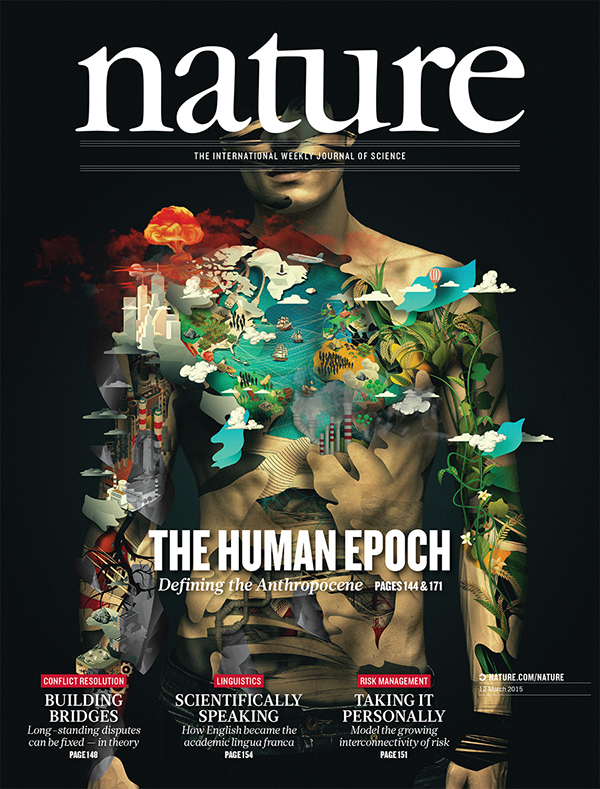
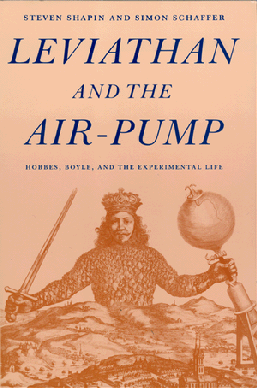
The lecture began with a visual comparison of Hobbes' famous frontispiece with a recent front cover from Nature.


Both are monstrous but in totally different ways. The Anthropocenic human juts out randomly, stupidly, headlessly. The Hobbesian sovereign is all measure, calculation and looming menace. This speaks to the real difference between them: Hobbes was proposing a solution to the problem of political order that had so drastically broken down in his time; Nature, on the contrary, is representing the problem of the Anthropocene, a problem of order – indeed, political order – without any apparent solution in sight. The problem of Nature's image, then, is precisely the disappearance of Nature as an organising principle of geopolitics in the fullest sense of that term.

This is one thing that I was trying to get at when I recently wrote at a fair bit of length about Latour's conception of geopolitics and, particularly, his reading of Gaia. The key feature of Gaia, taking James Lovelock's iteration somewhat creatively, is that it is not any sort of personal deity because it doesn't care one bit about the fate of any individual or species but, at the same time, Gaia is not Nature because it is not indifferent or external to human action – it reacts, it is perturbed, it is responsive. To quote myself:
"However, responsiveness is not responsibility. Gaia can summon no Leviathan; there is a Great Society but no Great Community [à la Dewey]. Of course, it is not that Gaia ‘lacks’ the appurtenances of a formalised polity per se – it is only we Earthbound that such a supplement impels; it is, rather, that Gaia, our past and our present, will only be our future – we will only have a future – if such an assembly is realised."
The image I had in mind at this time was precisely Hobbes' most famous image and the cohesiveness and unity of that ugly apparition looming over the English countryside. Nothing could be less true of the geopolitical predicament that Latour is addressing. There is no Global State – nor will there be. The things formerly known as natural do not bring unity; total knowledge of the Earth's surface in no way allowed it to be mastered (some of its occupants, perhaps, but this paramilitary victory was plainly overestimated); its complex spatiality greatly exceeds merely topographical imagings; the things formerly known as natural, in fact, disturb, destabilise and destroy the comforts of order and regulation, they do not and will never again give it a secure foundation. This realisation, to parrot Naomi Klein, changes everything.

Oliver Kessler mentioned in the closing panel of the conference that he wished that Latour had used the modified version of this image from Shapin & Schaffer's Leviathan and the Air-Pump.


That would have been an interesting connection but the point that Latour was making concerned political unity rather than the relation between science and politics per se. In any case, Latour's attempt to imagine a representative geopolitics of this Gaian situation was precisely the overarching theme of his lecture.

Representation in every sense of that word – political, scientific, artistic. And representation not in the vague, vain liberal sense of 'letting everyone have their say.' It was very clearly representation as a precondition of action. In other words, it was a question of collective will and adherence; of achieving the political infrastructures by which a collective could act – and a collective that is constituted by far more than just humans and their (delegated or imposed) spokespeople. A form of action that requires the alignment of actors of all kinds (and here the humanists leave the room…).

To self-indulgently quote myself again (because I can't think of a better way of putting it than this sentence that I spent months writing and re-writing):
"Gaia is not just the scene of politics, nor a violent interjection to it, but a dramatic, swirling convolution of world-convening relations – a collective constituted by all the constituents that she collects."
This is why Gaia is at the centre of Latour's geopolitics. It is not a unity. It is not a single, homogeneous, centred actor. It is not a totality and it is not nature. It has no one name. It is not something everywhere the same. It is impersonal but not indifferent. It is violent but not malevolent. It has intentionality but no teleology.
"There is only one Gaia but Gaia is not One."
It is, above all (and in more than one sense of that phrase), a sovereign. Here we see that, however 'flat' Latour's philosophy may or may not have been in the past, his 'Gaia-politics' presupposes an emphatic verticality; a power, a transcendence that vastly exceeds human actions but does not transcend them in the sense of being in any way exterior.

This must unground every sense of earth, terrain, territory on which International Relations, knowingly or unknowingly, has based its object.

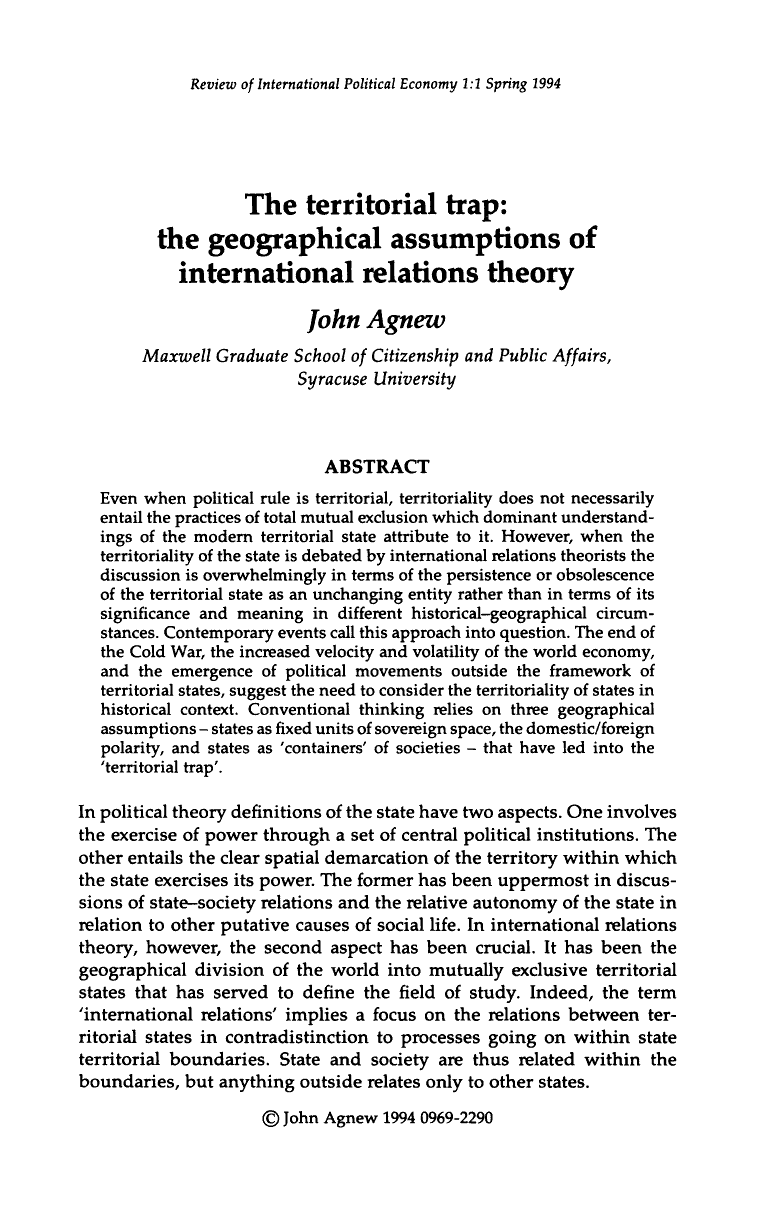
But here we should pause. Geopolitics is not IR. To re-hash John Agnew's famous article The Territorial Trap, IR has been consistently ignorant of the space, the materiality, the environments that its institutions presupposed.


Political geography was born as a discipline in the imperial struggles of the late nineteenth-century. Its reactionary extremes directed and enthusiastically served those ends – knowledge of the earth, its environments and climates was to found the efficient, ruthless administration of empire. This is, quite unambiguously, the root of 'geopolitics' (the word itself was coined, as 'Geopolitik,' in 1899).

Some would say that IR was born as a discipline in 1919 (at my home institution in Aberystwyth, from which I type these words); however, it only really got going as a disciplinary space and movement in the 1950s with sponsorship from the Rockefeller Foundation, among others. At this time, 'geopolitics' had all but disappeared from conversations in polite society as it had become had it become almost synonymous with Nazi expansionism via Karl Haushofer's association with the regime (a somewhat more complicated relationship than was recognised at the time but nevertheless).

Geopolitical ideas were soon revived by the likes of Henry Kissinger who reconstructed them for the new era of empires that the so-called Cold War brought about but human geography as an academic discipline on the whole lost its connection with international or global politics. IR, meanwhile, soaked as it was in the behavioural sciences and the realpolitik of its various émigrés, had little interest in the complexities of the ways that the world gets composed. The planet was, by this point, known rather well (or so they thought) and explanatory power was to be sought primarily in understanding the behavioural characteristics of human beings and their institutions. Their agenda was, variously, to secure peace and to overcome the non-liberal remnants of 'History,' in the Hegel/Fukuyama sense of the word.

This aside has a point, which I will now get to: 'environment' in IR has always been a special interest, a subfield, something to do with whales; 'earth' has been either an anachronism or an irrelevance; 'space' has been what you put satellites in.

Is there any discipline less prepared for what is coming than IR? I can hardly believe that there is. And yet, does this mean that IR must be brought to an end? Perhaps not.

Latour's lecture concluded with an overview of the 'Make It Work!' event – essentially a Latourised model UN – that was held in Paris this summer. The main point made by this event was that oceans, icecaps, forests, etc. – all these also require political representation, alongside corporations, NGOs and states.

And states. It is so very easy to denounce and demean this mode of geopolitical organisation, born out of the historical milieu that is encapsulated by Hobbes' towering phantasm. But let's be honest, the 'Westphalian state system is redundant' critique practically writes itself at this point, doesn't it?

"The old (but still useful) world of States" – this was on one of Latour's slides.

And this brings me to the Q&A session that followed the lecture. Two of the questioners made more or less the same point: Okay, so having non-state representatives representing beings other than humans is good but are we to believe that states do such a wonderful job of representing people? Verily, if (critical) IR scholars have achieved anything over these years it has been to demonstrate the vicious iniquities of state-based political complacency!

I was reminded at this point of the Olympics where stateless athletes are permitted to compete under an independent banner.


Of course, all of this raises questions of power. How does anything come to be represented politically? By demanding that it be so. In other words, through struggle. Or, to put it in more Latourian terms, how is a 'middle ground' ever formed from which diplomacy can begin? According to Richard White, this too is about power. All sides must be capable of compelling their other to meet on the middle ground rather than imposing a settlement from without.

But returning to my thread, if we are to extend representative politics to more than humans is this not a perfect time to reconsider how we represent human beings too? And is not a discipline such as IR not well placed to consider such a task? Well, perhaps. But not on its own. IR's ignorance of space and geography is well known but its connections with anthropology are not much better. The very concept of representation, for instance, was also born around the time of Hobbes – it is no more universal than 'Nature.'

Here it might be opportune to cast our minds back to Patrick Thaddeus Jackson's keynote at the Millennium conference last year:
"The way I understand it, the term ‘international’ picks out those aspects of anything that involves cross-boundary encounters with difference. The international aspect of a military manoeuver or a financial transaction does not simply begin at the moment that a formal territorial border is crossed, but as soon as the existence of some other—the alien, the foreigner, the stranger—is taken into account in the operation. Representations of otherness, which shape and structure what we come to regard as legitimate or acceptable or appropriate action towards or in reaction to those others, are the common thread connecting all of our myriad substantive concerns, and the ‘return’ of culture and identity to the scholarly agenda is better thought of as a clarification of what we were all already interested in in the first place."
This, to my mind, is a large step in the right direction but isn't quite there yet because it continues to pretend that other academic disciplines haven't been doing this for years and years in their own ways (and doing a very good job of it). It's still sectarian. What about anthropology, for instance? Cynthia Enloe was also present at this year's Millennium conference and was a perfect reminder of the importance of that connection to IR historically. But the larger part of these disciplines remain entirely estranged.

Plainly, there is a need for a complete re-evaluation of what the purpose of IR in this new world is. Reconsidering its relations to not only geography and Earth system science, etc. but also to anthropology and other forms of knowledge production besides. A comparative and interstitial sociology of social science.

Is there an appetite for such self-criticism within this most cloistered and jurisdictionally jealous of academic disciplines? Some, perhaps not enough. But it is a conversation worth having and a task worth attempting – and one that Latour's work will help us to initiate, even if he by no means has all the answers.

But perhaps I should end with the quote that titles this post. 'What's so wrong with arrows?', I hear you ask. Well, Latour tells us, you draw an arrow on a map when you need to account for something that the map itself (base map plus territorial outlines) says shouldn't be there – migration, movement, pollution, mess. In other words, if you need to draw an arrow it's because your map is inadequate to its representational task because it assumes a flat, stable base upon which everything else is projected rather than trying to capture the territorial complexes in motion and in their own complexity; that is to say, in the process of their ongoing assembly.

This is a difficult point to grasp without a thorough transformation of conceptual vocabularies. For example, this is how Latour describes 'territory':
"A territory is everything that you need to survive and that may suddenly fail you. […] Of course the territory does not resemble the nicely coloured geographical maps of our classrooms. It is not made of nation states – the only actors that Schmitt was ready to consider –but of interlocking, conflicting, entangled, contradictory networks that no harmony, no system, no ‘third party,’ no overall Providence may unify in advance. Ecological conflicts do not bear on the nationalistic Lebensraum of the past but they do deal with ‘space’ and‘life.’ The territory of an agent is the series of other agents that are necessary for it to survive on the long run, its Umwelt, its protective envelope."
To quote myself again, in attempting to think through this conception:
"[…] an economy does not distribute goods circulating across a given territory, it formats the territories themselves; globalisation has nothing to do with ‘levels’ or ‘scales’ but rather concerns intensifications and extensions of entangled dependencies; a Collective does not have a territory but rather as many territories as it has constituents; and geopolitics is not a matter of bickering over bounded surfaces but, rather, publicly contesting these polydimensional spaces."
What political agency such a kind of spatial formatting could have is questionable. However, it asks questions that are plainly unanswerable without a great degree of conversation between researchers and technicians with a range of different skills and disciplinary experiences – scientists, artists, theorists, ethnographers, programmers, organisers, and so on. It requires institutions such as Latour's own Medialab, for instance. (For all the talk of post-disciplinarity, let's not pretend that we can do away with institutions.)

That is an exciting prospect but not one that IR is well-prepared for. Nevertheless, I think we can most certainly all count ourselves as 'perturbed' – whether this way or that – by now. If nothing else, Latour is laying down a challenge that tremors right across the disciplinary landscape. To what extent it will uproot IR's usual comforts and homilies remains to be seen but it will be interesting to find out.

Wednesday, 17 June 2015

What is 'International'? A few reflections on Patrick Thaddeus Jackson's 'Must International Studies Be a Science?'

I didn’t go to the Millennium Journal of International Studies' conference at the LSE last year. (I did in 2012 and intend to attend this year.) However, a selection of the papers from the conference have just been published, including the keynote by Patrick Thaddeus Jackson ‘Must International Studies Be a Science?’ (His short answer: no.)

I don't want to go into the whole thing (or even the main of the thing) but just to draw out a few points that interest me.

The essay is set up with a good mixture of sweeping breadth and due humility:
“Depending on which authority one consults, ‘we’ are a group of scholars held together by our ‘great debates’, by our concern with the implications of inter-state anarchy, by our implication in a (neo)colonial project of establishing European hegemony, by a set of so-called ‘paradigms’ which almost no one claims to adhere to any longer even though we keep organising our introductory textbooks and courses according to them, etc. […]
I do not propose to resolve this controversy here. Instead, I will circumvent it by simply elucidating what I mean by ‘international studies’ so that my answer to my initial question becomes clearer.”
So, first of all, what about that troubling term ‘international’?
“The way I understand it, the term ‘international’ picks out those aspects of anything that involves cross-boundary encounters with difference. The international aspect of a military manoeuver or a financial transaction does not simply begin at the moment that a formal territorial border is crossed, but as soon as the existence of some other—the alien, the foreigner, the stranger—is taken into account in the operation. Representations of otherness, which shape and structure what we come to regard as legitimate or acceptable or appropriate action towards or in reaction to those others, are the common thread connecting all of our myriad substantive concerns, and the ‘return’ of culture and identity to the scholarly agenda is better thought of as a clarification of what we were all already interested in in the first place.”
A commendably open definition though this is, what portion of the human sciences does not deal with otherness (or, indeed, boundaries)? One might admit that anthropology, sociology, psychology, etc. do not primarily deal with otherness across 'boundaries' as such (although what is a boundary?); however, I think that the pivot point ‘primarily’ is a rather vulnerable 'single point of failure.' The question becomes: Why does one need a distinct discipline to deal with such things? Perhaps the answer could be that cross-boundary otherness comes in many forms and, while of course it is dealt with in a wide variety of epistemic milieus, it is important enough to demand a particular disciplinary focality, a programme of concentrated examination that would think through such phenomena taken together, regardless of their usual disciplinary partitionment.

IR (or IS) would then be essentially interdisciplinary. It would not have its own ontological ‘turf’ (the Durkheimian dominion-making assumption that a ‘science’ must have its own distinct ontological domain has dominated the discipline since at least Kenneth Waltz’s Theory of International Politics [1979]). Instead, it would draw together a range of concerns that no other discipline examines in an assembled and focused manner. Anthropology, sociology, psychology, geography, literature theory, etc. etc. – all these encounter ‘cross-boundary otherness’ but severally. This would be an interesting proposition. However, I’m not sure that this is what PTJ is arguing.

He does note that “the term [international] does not pick out a discrete realm or region of social life” (i.e. the boundaries in question are not just state boundaries). However, he redefines it (having first undefined it) not quite as I have described but rather:
“I would therefore locate the ‘international’ in ‘international studies’ not in the object of study, but in the way that we approach the object of study—which means that virtually everything has an ‘international’ aspect, potentially, depending on how we look at it.”
He goes on: “After all, ‘physics’ does not name an object of study, but a way of studying objects; why should ‘international’ be any different?”

I find this to be a strange and sudden segue. ‘Way of studying’ suggests methodology – and this is, of course, the theme on which the talk was to be given. However, there’s a confusion here between methodology and ontology, at the very least. Is physics a ‘way of studying’? This is a rather obscure abstraction. PTJ seems to want to avoid the ontology of domains by talking about methods (or at least practices) but this won't work. The whole notion of a ‘physical domain’ as categorically distinct from the chemical and biological is indeed rather outdated. However, the ‘monist’ claim that these disciplines engage ‘the same’ things from different perspectives leads us back down precisely the wrong path. A lamentable regression.

We should shed the terms ‘physics’ and ‘chemistry’ here. Every scientific research exercise addresses distinct entities. These are not the ‘domain’ that grants or guarantees scientificity and I do not deny overlaps all over the place but to sever science from its particular objects, or to melt everything into a single ‘world’ that is only broken apart again when engaged by human agents is, in my view at least, completely wrongheaded. Sciences are established neither by domains nor by ‘ways’ (whatever they are). The only means of making sense of what sciences are without the traditional distinctions is as networks and assemblages (here I am of course betraying my own philosophical preferences) – networks and assemblages that include distinct objects, distinct practices, distinct epistemic standards and norms…; none sovereign or permanent but none to be unduly confused or conflated, either.

PTJ goes on to discuss his heuristic take on knowledge production, expanding on technical and epistemic 'ways' of knowing and building on his The Conduct of Inquiry in International Relations: Philosophy of Science and Its Implications for the Study of World Politics (2010). I will skip over this as I want to concentrate on the aforementioned issues.

Long story short, I find that, ‘otherness across boundaries’ seems to overemphasise the ‘inter-’ and wash out the ‘national’ (or leave it crucially underexamined), leading to a disciplinary vision that at least risks being somewhat superfluous. PTJ does not note the etymology of ‘nation’; however, it is instructive:
“c. 1300, from Old French nacion ‘birth, rank; descendants, relatives; country, homeland’ (12c.) and directly from Latin nationem (nominative natio) ‘birth, origin; breed, stock, kind, species; race of people, tribe,’ literally ‘that which has been born,’ from natus, past participle of nasci ‘be born’ (Old Latin gnasci; see genus).”
Perhaps there is something in this (though we must tread carefully). We could say that where IR/IS/IP went wrong was in assuming that ‘national’ meant ‘nation state,’ or at least nation in a modern, mass mediated sense where humans are symbolically and technically conjoined in their millions. Tribe, village, family, city – these might all be involved in ‘international’ relations – and relations on their own scale, of their own kind – in this expanded sense, tied more definitely perhaps to a sense of birth and nurturing, culture and cultivation.

(Incidentally, this could be related to the world history interpretation offered by, for example, Barry Buzan and Richard Little in their International Systems in World History: Remaking the Study of International Relations [2000], where they explode any hint of presentism in the study of the relations between human groups in the longue durée.)

But, again, don’t think that what I’m describing here is what PTJ is arguing. He is in no way trying to prescribe what others should mean by ‘international’ (and the studies thereof); he is only articulating what he means by that term. However, he is nevertheless setting out his stall by articulating a kind of ideal typical vision of what ‘International Studies’ would be, then later breaking that down by proliferating 'ways' of knowing (and only of knowing). I wonder if this is not precisely the wrong way to approach disciplinarity; it is at least the wrong starting point. It is effectively saying: ‘here is my vision of disciplinary identity; you will surely have your own’ – and that’s commendable to some degree but the underlying assumption is that disciplinary identity is the issue at hand; that it is on this level that discussion should proceed.

I would prefer to begin by understand disciplinarity in a very particular manner, which only partially matches up to PTJ's arguments (and then only in his concluding remarks). A discipline can be understood as an environment, a milieu of sorts. It is a space within which knowledge production occurs. Its prevailing conditions, accidental or designed, variously enable, disable, orient and disorient the many actual and possible courses of research that are undertaken under that more or less actively conducive, more or less permeable, more or less flapping, fluttering, stuttering membrane.

Seen in this way, what a discipline ‘is’ is purely and simply a means of formatting that space. It is secondary and it is one formatting operation among others.

Given these principles, we might be able to think of efforts such as PTJ's as being interventions towards the pluralisation of the epistemic-possibilistic space that is the discipline of International [Whatever] (the fact that the name is variable doesn’t necessary meant that we’re not talking about a particular space – just more permeable). Indeed, he writes in conclusion:
“[…] the field should contain space for all of these kinds of knowing, and should resist the call to be exclusively a form of aesthetic expression, a mode of technical practice, a normative enterprise—or an epistemic science.
Instead of intending to produce one homogenous body of knowledge, the field of international studies and we scholars within it should work to become more comfortable with the irreducible plurality, plurivocality, and diversity of knowing. Such an attitude can, I think, best be cultivated not merely by our paying lip-service to the existence of other forms of knowing, but by our actively seeking to position ourselves as scholars in the spaces between these diverse ways of knowing.”
I couldn't agree more; however, this affirmation clashes, I think, with some of the presuppositions from which it issues (as I have attempted to explain, however inchoately). 'Ways' of knowing are too quickly abstracted from the rest of the world; 'the world' is too quickly defined as something singular that is only broken up by ways of knowing. 'Ways' are given too much credit, things not enough. He sets out his terms and definitions before he explores what the act of terming and defining does. As I hope I am making clear, I have many sympathies with this approach but find that it comes up short in a variety of ways.

I was first drawn into this epistemic-possibilistic space over a decade ago, during my undergraduate degree. It has for some time seemed to me that IR as a discipline has always been about 10-15 years behind the curve of the rest of the human sciences. It is an oddly introverted intellectual culture, especially given how quintessentially outward facing one might think it would be given its matters of concern (political geography, for example, is far better connected with its neighbours). Now that I am heading back into the hothouse, I do feel a little bit like holding my breath. However, the particular pocket into which I am to be immersed is a peculiarly breathable one. This much is reassuring!

Thursday, 6 September 2012

Yet more on Latour, Things and Geography

Patrick Jackson replies to my previous argument:
What we have here is a failure to communicate ;-) which is because your reading of Latour -- which I generally agree with -- links his scientific ontology of the social to a dualist/representational philosophical ontology that I think is neither what Latour is up to nor self-evidently what we social scientists/analysts ought to be engaged in. "If we live in an ontologically hybrid world we need modes of analysis suited to that world. Social constructivism or discourse analysis in the vein of Foucault, Laclau, Wittgenstein, etc. are well suited to particular areas of our world but they miss out entirely on vast swathes of it because of their blinkered and entirely unnecessary dualist predispositions..." I would disagree pretty fundamentally here, because like most philosophical mind-body dualists you're trying to "put ontology first" and make categorical claims about how we should study the world based on the character of the world -- a gesture that just side-steps the basic conundrum of how we might get to that character of the world without the conceptual equipment that you are suggesting follows from that character...leaving us with a profession of faith in the character of the world (in this case, that it is made up of "hybrid networks"). Instead of this, why not spend time demonstrating how regarding the world as made up of "hybrid networks" allows us to explain it better? Once one does that -- once one shifts one's philosophical ontology from dualism to monism, come to the dark side, we have cookies -- a lot of the supposed "controversy" dries up and withers away.

I'll say again: no discourse analyst who actually has read Foucault can consistently claim that discourse is somehow opposed to practice or "the material." The scientific-ontological duality you keep bringing up is a misreading of the social constructivist and discourse-theoretical claim, because it persistently misunderstands such explanations as ideational determinism. Which they are not. I am not putting a line between sociality and materiality, and you are not doing so in your Latour-inspired account of the social world. You are doing so only in the straw man you persistently attack ;-) Let it go, no one is actually arguing that here, and let's get down to business: whether Latour is better or worse than, say, Bourdieu or Foucault or Luhmann (or, what the heck, Gramsci or Braudel) as a way of making sense of the social world. In that vein, for my money what Latour is doing is relational discourse analysis, with a considerably broader sense of the extent of the relevant networks of discursive practice than most Foucauldians have and perhaps than Foucault himself had. Latour's networks make meaning possible, so we can sensibly refer to cities and the time and the results of an experiment; in that sense they're meaning-making practices just like Foucault's epistemic grammars are. So I personally don't see the fundamental difference.
I appreciate that our opinions are maybe not as different as I have suggested (oh, academic-types and their nitpicking!) but riddle me this: if discourse analysts by and large do nor operate on the basis of a 'bifurcation of nature,' as Whitehead put it, then why are the non-human things upon which ANT analyses focus almost completely absent from DA texts?

Let's back up: the ANT concept of 'actant' comes from semiotics (mostly from Propp and Greimas) where it can refer to any character or thing within a narrative that does something -- it can refer to mountains and unicorns, equally, if either of those things does something in the course of the narrative. (This is where the 'principle of symmetry' between human and non-human things in ANT comes from.)

Looking at an ANT analyses in these terms the actants in these texts are many and varied: Latour's aforementioned 'Paris: Invisible City' invokes bollards, security cameras and atoms as well as people, texts and so on. If you look at any given discourse analysis text in the same way you will find a far less heterogeneous assemblage of actants: you'll have signifiers, meanings, subjects, texts -- at a push you might have human bodies and printing presses and so on, but rarely (I don't think that Foucault is especially representative of this creed, as it happens).

DA texts just don't draw on the same range of resources as ANT ones do. Doesn't this suggest some more profound philosophical differences beyond simply substituting 'discourse' for 'network'?

To take another example, in his book on Pasteur, Latour describes an event that Pasteur hosted at Pouilly-le-fort in 1881. What Pasteur did was stage essentially an act of scientific theater. He gathered together scientists, journalists, politicians and others and made a grand wager: He took two groups of sheep and infected them with anthrax. One group were inoculated with his vaccine, others were not. The inoculated group would survive, Pasteur claimed, and the rest would be dead in a few days. If he was right he would have proved his theory of microbial infection (or at least he would have submitted an extremely convincing proof of it to all in attendance and, consequently, also to their colleagues, readers, constituents, etc.).

Latour considers the whole event as theater, quite literally. He shows how it was carefully stage managed down to the last detail in terms of how the farm-cum-lab was set up, how the guests were treated, how the vaccines were administered and so on. But, and this is the point, who (or what) is the star that comes onto the stage at the end -- the fat lady, if you will --, at the triumphant moment? It is the microbes themselves. They enter the fray as fully fledged actors when they kill the unvaccinated sheep and spare the vaccinated ones. Not the microbes as they are represented -- not microbes as linguistic terms or microbes reduced to their meaning (and he is very careful to make this point). Sure, the whole socio-linguistic apparatus was necessary to make their appearance thinkable but it is still the things themselves that enter into the performance, as actors or actants.

Could or would a discourse analyst ever write such a thing? Could a non-human actant ever occupy such a role in a DA text? Would a discourse analyst ever even be interested in such an event?

Of course this is an impossible argument in the abstract -- there is no such thing as 'Discourse Analysis' only discourse analyses. If we include, for instance, 'Discipline and Punish' within the corpus of 'discourse analysis' (and I'm not totally on board with that) then perhaps we can say that some DA texts do allow for non-human actants to enter the narrative on an equal basis with signifiers and so on. But even then such instances are extremely rare.

Which brings me back to my previous claim: DA texts are extremely actantially homogeneous compared to ANT texts. Why is this so if DA does not, by and large, bifurcate nature and bracket off a sociolinguistic realm from everything else? I believe that it does, although I appreciate that my own 'theater of proof' may be less than convincing and is somewhat under-evidenced.

p.s. I wasn't trying to be unduly polemical in previous comments -- although sometimes that mode of discourse can be fun ;)

This discussion now bears little resemblance to the original post but hopefully it has been interesting to someone, somewhere!

Related to the OP, I've just started reading Robert Kaplan's article 'Revenge of Geography' and I can see that geographical determinism of the most blunt and ignorant sort is very much alive and kicking. This is food for critique, yet I do think that ANT and the like stand a better chance of taking apart this sort of paleo-materialist block-headedness than social constructivism as it has been traditionally practiced -- and for the reasons I've mentioned above.

Sunday, 7 February 2010

Reply to Prof PTJ

Comment on: http://duckofminerva.blogspot.com/2010/02/two-philosophers-shoveling-snow.html

A very witty piece. I basically agree. However, I think something needs to be challenged: the notion of 'intersubjectivity' as the privileged site of knowledge (and thus 'reality') construction.

The primary disagreement between Roy and Will seems to be Roy's fury over Will's refusal to attribute the 'in-itself' (i.e. the snow in its 'intransigent' materiality) any 'agency' (loosely speaking) with regard to its own understanding. For Roy the snow has both transigent and intransigent qualities and while it can be understood differently by people with different sensory/cultural dispositions it nevertheless possesses a certain 'snowy-ness' that cannot be ignored; to ignore it, it is supposed, is to commit the 'epistemic fallacy', which assumes that mind arbitrarily 'makes' world (Alex Wendt's 'pigs don't fly just because you think they do' skit is a typical example of this reductio ad absurdum argument). In other words, as Will rightly points out, critical realists of this bent assume a dichotomy of possibilities where either mind is exterior to the 'real' world and imperfectly 'reflects' this reality or mind is coiled up in its own interiority 'creating' all fictive experience in the manner of an auteur. This, of course, assumes that mind can only ever be conceived of in the classical sense of an abstract ideational thing suspended in the ether, separate from 'reality' and (most likely) 'materiality' too. The likes of Will, on the other hand, take the mind to be far more extensive and always-already involved in and constituted by the 'real', which, instead of being the creative produce of a sovereign, rational, unproblematically legible mind, is produced intersubjectively (this is the key point).

So, this assumes that there exists a network of cultural-linguistic beings, all constituted by their shared reality. The 'epistemic fallacy' no longer works because the creation of reality no longer centres around the individual but rather is the product of the network of intersubjectivity, which precludes the narcissistic volitionalism of the subjective idealist that critical realists try to imagine all their opponents as. And yet the general thrust of the critical realist critique - that subjective idealism is narcissistic/solipsistic - is not, I think, rebutted - at least not entirely. I think this because the intersubjectivist theory remains resolutely anthropocentric. Why is it only subjects (i.e. humans) that get to play this game? For all our fancy tricks, what is so special about us flesh-bags?

We need another character; let's call him Alfred. Also a mind/world monist, Alfred agrees that knowledge is created intersubjectively but he wants to go further than this. He argues that 'experience' (his term) is a property common not just to subjects but to objects as well. He is, then, a panexperientialist - like a panpsychist (who thinks that all matter has the property of 'mind') but with a distinction made between experience and cognition. Knowledge and thus reality, for Alfred, are inter-objective productions (in the broadest sense that subjects are also objects - very distinct kinds of objects both existentially and ethically but objects nonetheless).

His theory is, like the intersubjectivist's, perspectival - what is 'real' depends entirely upon one's perspective, whether one is a subject or an object. In other words, there exist an infinite number of possible realities on one ontological plane. Humans are no longer the be-all-and-end-all that intersubjectivism would have them, yet every human individual's experience is distinct and each experience is a reality, just like intersubjectivism.

So, when Roy is raging about Will's refusal to take the snow's 'in-itself' as 'real' and Will, effectively, just shrugs it off, Alfred would be able to transcend both positions and come up with, I think, a far more satisfactory answer: the experience of shovelling snow is created inter-objectively with Will's culturally and linguistically imbued dispositions shaping the particular reality of the experience but the snow's 'actancy' (to borrow Alfred's grandson Bruno's term) also contributing in its own right. (The event of Will shovelling the snow is, then, in a manner of speaking, every bit as much a 'conversation' between two agentially empowered but relationally and processually constitued actants as the conversation between Will and Roy.)

Will maintains his monism and Roy's blood pressure can return to safer levels providing he can accept the loss of the 'in-itself' for the gain of the object as an 'actant', which, knowing Roy, he won't but that's his problem not Alfred's!