Showing posts with label philosophy. Show all posts

Friday, 3 February 2017

Away from 'theory as overlay'; or: On not being a philosopher

I make no claim to be a philosopher, although I philosophise (and maybe that is enough – need one philosophise well?). This reluctance perhaps derives from being Anglophone and thus born of a deeply anti-intellectual culture for which more or less the only legitimate meaning of 'philosopher' is as shorthand for a particular subsection of the academic profession (and not one given much respect).

However, the more philosophical reason for this reluctance is that I find myself ever more an empiricist. I am interested in ideas only if they do not lead away from experience but allow it to be extended or amplified in various ways. This is, I suspect, why I have always found a liking for pragmatism, actor-network theory, and so on.

Above all, I am sceptical – no, that is too polite: I cannot abide – the use of theory as overlay. That is, the situation where an abstract vocabulary becomes so sophisticatedly all-consuming that it does not enable surprising connections but rather precludes them – a universe unto itself. This is Whitehead’s "thought within a groove" – the stuff of the professional.

For example, I find myself unable to share the fascination of so many philosophically-inclined geographers* with the geophilosophy of Deleuze and Guattari. It seems to me that their conceptual vocabulary of territories and strata is, if anything, the least useful aspect of their continually transforming, runaway stagecoach of a philosophical project (I mean this as a compliment) for thinking about matters of earth, experience and politics.

By taking practically all of the conventional terms available to actors engaging in geographical/geological practices and making them into unconventional technical terms, there is no longer any easy way of relating the web of abstractions to said practices as such actors themselves describe them.

There is a decoupling at this moment that carves out 'philosophy' as an autonomous space. I cannot abide that space. In this much, I am not a philosopher.

This is not to suggest that words should not be made and remade in abstraction from convention – they should. However, as counterintuitive as it may be, it seems to me that a creative conceptual universe made from the lexicon of geography might be less useful for geography than a conceptual universe made from something else.

This would not be such a problem if the likes of D&G were read more creatively and less, for want of a better word, 'professionally.' There is a remarkable lack of creativity – indeed, often outright piety – in the parsing of these thoughts as though they were to be a system adequate to an object.

Theory as overlay is incapable of astringency, as Isabelle Stengers describes that term:
"[…] the function of scientific thought has less to do with its ‘truth’ than with its astringent effects, the way it stops thought from just turning in self-satisfying circles."
Self-satisfaction is a vice of the intellect.


____________
*I'm not a geographer either but let's save that for another day.

Sunday, 19 April 2015

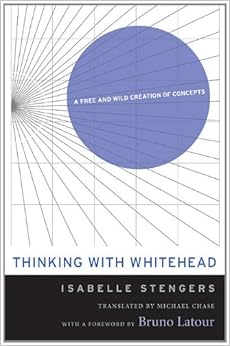
"My readers have now been warned"—halfway through Stengers' Thinking With Whitehead

At the end of chapter 16 of her book on the work of Alfred North Whitehead (just slightly over halfway through the text), Isabelle Stengers writes:
"My readers have now been warned. If they are fascinated by the heroic grandeur of refusal, and despise compromises; if they deplore the fact that the radical demands of every new position are recuperated by what was supposed to be subverted; if 'to deconstruct' is a goal in itself for them, and scandalizing self-righteous people is a testimony to truth; if they oppose the pure to the impure, the authentic to the artificial; if they cannot understand how the most 'unplatonic' of philosophers situated himself as a 'footnote' to the text of Plato ... let them close this book. Never will they see celebrated in it the power of a truth that is verified by the destruction of false pretenders. They will therefore find in it only disappointments and reasons for contempt." (Thinking With Whitehead, p.275-6)
And slightly different in French:
"Le lecteur est maintenant prévenu. Si, comme le Belzébuth mis en scène par Leibniz dans Confessio philosophi, dont la rage se déchaîne à l'offre de salut, il est fasciné par la pureté du refus et méprise les compromis, s'il déplore que les exigences radicales de toute position nouvelle se monnaient progressivement en contrastes enrichissant ce qu'il s'agissait de subvertir, s'il ne peut comprendre que le plus « non platonicien » des philosophes se soit situé lui-même comme « note en bas de page » au texte de Platon... qu'il referme ce livre. Jamais il n'y verra célébré le pouvoir d'une vérité qui se vérifie par la destruction de faux prétendants. Il n'y trouvera donc que déceptions et raisons de mépris." (Penser Avec Whitehead, p.310)
This is my third attempt to read this book and it's the first time that I am sure that I will reach the end. It is not that it is a 'difficult' book as such. Stengers, in her own inimitable way, writes with extraordinary precision. However, being something of an autodidact with respect to philosophy, I wasn't quite ready for such a dense and demanding text in the past.

It is a work that requires a very particular routine of reading. It cannot be read casually, put down and picked up a week or two later (not usefully, anyhow). At over 500 pages it is not something that can be read in one sitting, or several sittings, either. (There is no quick way through such a text—the whole point is that the reader slows down.) It requires, for me at least, extreme attention and focus. It's not something that I am able to read except when at my most clear headed, and then for a few hours at a time. Unfortunately, there aren't many windows like that in my week (I hope that soon this will change). I, out of necessity, do most of my own reading and research in the evenings—not a time of day conducive to this kind of endeavour.

Nevertheless, I am gradually working my way through the book—one immersion at a time—and it is most certainly worth the effort. It's the kind of book that, after having read it, I will never be able to read any other book in the same way again. It neither condescends to its reader nor indulges in unnecessary dissimulation. It attempts to be clear but, at the same time, transformative. This time around, I am finding that it succeeds in both respects. Again, I find that the best words for it are: precise but, at the same time, extraordinarily dense. It is the most exquisitely constructed thicket.

There is far, far too much in this book to even begin to summarise or select. However, I find the above quotation(s) to be a perfect signal of its tone and intentions. This dissuasion addressed directly to the reader is at the same time reassuring—I am assured that none of the things described appeal to me (and their sirenic allure is further muted with each and every passing page).

Friday, 10 April 2015

New materialism is the new poststructuralism

I think that this is true in more ways than one; however, one way is particularly important.

Like poststructuralism, new materialism is a signposting mechanism that allows (largely anglophone) academics to obscure the differences between (largely francophone) thinkers, mashing them into a single digestible lump.

New materialism doesn't exist at the level of the authors it claims to encompass, just as poststructuralism didn't. It only exists secondarily, as a way-finding supplement.

If we can make a distinction between the academic and the intellectual, new materialism and poststructuralism are emphatically of the former. They do not involve the unnerving risk of thought but rather the comforting stability of simplification.

They are ways of making a complex situation teachable. They are pedagogical terms—and are not, therefore, without value. However, we should be very suspicious when they are posited as intellectual concepts, as though their purpose were somehow creative.

The manner in which academia satisfies itself with such signposts accounts for a large part of its intellectual malaise. An inability to think beyond badly printed banners is by no means inevitable but it is strongly encouraged by an internal political economy that prizes 'expert knowledge' of trends occurring elsewhere more highly than it does the thought practices occurring (or not occurring) within its own walls.

This is one part of a generalised anglophonic anti-intellectualism that sees 'theory' as something to be imported, bussed in like fresh water to a desert state.

Saturday, 6 September 2014

The British view of French philosophers

The classic British satirical news programme The Day Today, created by Chris Morris and Armando Iannucci and broadcast in 1994, featured a character named Jacques 'Jacques' Liverot who appeared in several short cutaway scenes, dispensing pithy but incomprehensible musings on various issues.

Only a few of them are on Youtube but here they are:


From Wikiquote:
If we could see politics, what would it look like? A cube... but with all its corners on the inside.
Episode 3 (2 February 1994).

A man sees God in his car. He crashes.
Episode 3 (2 February 1994).

An optimist sees half a pint of milk. He says 'It is half full'. A pessimist sees half a pint of milk. He says "It is half empty". I see half a pint of milk, I say 'It is sour'.
Episode 4 (9 February 1994).

If democracy is a bra, then the monarchy are breasts. And we cannot imagine a society without breasts. Hélas.
Episode 4 (9 February 1994).

An old man stands naked in front of a mirror, eating soup. He is a fool.
Episode 4 (9 February 1994).

What is a 'gay'?
Episode 6 (23 February 1994).

When I drive my car, I am not driving. I am participating in a conspiracy called 'traffic'. I will walk.
Episode 6 (23 February 1994).

Thursday, 21 August 2014

Philosophers: where are your instruments?; or, On the defensive deflation of philosophy

One of the principle tasks that were given to the 'specbook'-writing participants at the final AIME workshops in July was to, in one and the same motion, both defend and deflate the institutions and the values of the Moderns. That is, to identify in these basic and cherished contours of collective life the most indispensable and valuable distributions of agency and then, at the same time, to cut science, politics, religion, economics and so on 'down to size,' to divest them of their excessive, unsustainably explosive pretensions so as to condition the possibility of finding them their proper, diplomatic accommodation amidst other, non-Modern cosmoses.

This had to be a symmetrical and simultaneous deflation—deflate politics and not economics and you've got neoliberalism; deflate science and not religion and you've got theological dogmatism; deflate religion and not politics and you've got a cold and authoritarian secularism, and so on. This work sought not to diminish or denounce any of the involved and invoked terms but, rather, to alleviate the tendency for each form of existence to imperially define the entire world in its own format, thus stoking the flames of war. The objective was not diminution but, rather, coexistence.

Following through the internal logic of AIME, it seems no less necessary that we must also deflate philosophy. This task is suggested by the fact that philosophy is accorded a particular mode of existence, namely [pre].

The deflationary effect can be understood by contrasting philosophy with science [pre·ref]. According to Latour, the sciences achieve their specific form of objectivity through the incremental construction of circulating chains of instrumented references that transport information at the cost of deformations at every stage. To refer is to instrument, there is no other way.

So, philosophers: where are your instruments?

To take up one of Graham Harman's phrases, it should be now clear that philosophy qua [pre] cannot possibly be a "philosophy of access." Philosophy does not access, that is the job of reference. Philosophy can, at best, aid and abet this movement; it can act with, it cannot act for.

For millennia, philosophers have insisted that their art involved the construction of objective knowledge about the abstract conditions of existence, conditions inaccessible to the mere senses and discernible only by the privileged intellect. This, it seems to me, is unequivocally refuted by AIME; a philosophy of access is a contradiction in terms, a category error.

This brings me to a section from The Prince and the Wolf, a transcript of a public conversation between Latour and Harman at the LSE.
Harman
[…] there has to be a point where contact [between objects] happens. And what I worry about is that if we don’t specify that point metaphysically, then it becomes just a kind of ad hoc practical decision, which of course is fine when writing history. You could say: “all right, it seems like the case of Joliot connecting politics and neutrons is interesting but Joliot and the eardrum is not that important, so we can stop there.” And that’s fine for purposes of writing history but not fine for metaphysics.

Latour
Why?

Harman
Why? Because you haven’t explained how the contact occurred.

Latour
But metaphysics is not for explaining. It is the first principle of [Alfred North Whitehead's] Process and Reality. Philosophy is not in the business of explaining anything. Actual occasions explain what happened, not philosophy. If there is one thing which philosophy should not do, it is to try to explain anything. That’s where our disagreement is. Philosophy is not in the business of explaining. This is not at all the same thing. Philosophy is in the business of allowing the explanation to go far enough, to help the explainers to move in the explanatory trajectory but not to provide an explanation. (66-7)
This is the disagreement between Harman and Latour, and it's the difference that Harman does not get to grips with anywhere in his writings on Latour's work (to date). Philosophy, for Latour, no more accesses than it explains. As Latour put it in Reassembling the Social:
As anthropologists have tirelessly shown, actors incessantly engage in the most abstruse metaphysical constructions by redefining all of the elements of the world. Only a researcher trained in the conceptual calisthenics [emphasis added] offered by the philosophical tradition could be quick, strong, daring, and pliable enough to painstakingly register what they have to say. (51)
The value of philosophy here is the same as in AIME's [pre]: it is the lability, agility and sensitivity that it affords the actors who have been trained its art, not the overview it gives on reality or the quasi-scientific loose ends it explanatorily ties up.

To somewhat egocentrically quote myself from a couple of posts ago:
It is here that the philosopher qua intervener enters the fray, not as an architect of the world, urban planner of the galaxy or master of the universe but as an acrobat of thinking, a flexer and folder of thought, a monkish sage—inheritor of long traditions of agility-focused self-development—whose skill involves not the freehand sketching of the beams and struts of the background of things but rather of the rendering-pliant of modes of connection and transformation in service of (or, better: in alliance with) those whose very subsistence is at stake.
This is precisely what I was trying to get at here: that philosophy is a calisthenic rather than explanatory disciplineMetaphysics is calisthenics or it's nothing. [The purpose of its art is conceptual creation in service of a situation, not fundamental explanation in service of the real. [ed. 22/08/14]]

After the example of AIME, if philosophers wish to refer to the objective existence of this or that then they should specify their empirically traceable referential chains. Anything else is Double Click [dc].

This rearticulation of philosophy is intrinsically social in the precise sense that there can no longer be such a thing as a philosopher-hermit—the philosopher is necessarily an associative, allied being; she has no other purpose than to work with others in the rendering-pliant of modes of connection and transformation in concrete, contested cases.

Deflated? Undoubtedly. But also defended[—if, by 'defence,' we mean not fortification but, rather, advocation [ed. 23/08/14]].

This rehousing and repurposing of philosophy—this empiricisation of philosophy in the most profound sense—is, in my humble and weightless opinion, perhaps Latour's most important philosophical contribution. This aspect of his thinking does not begin with his modes of existence project but can be found throughout his works, in varying stages of development (it is rooted in his long-standing commitment to a reformed ethnomethodology). And it is precisely this most crucial of insights that is erased when his work is turned into a series of dry pronouncements on the furniture of the universe—pronouncements that 'of course, might be wrong.'

This is why those who accuse Latour, and those who philosophise like him, of 'correlationism' and of insufficient 'realism' are missing the point. The philosopher, here, simply has no business 'explaining' the unchanging, overarching structure of the universe—if that is what 'realism' means then may it rest in peace.

This empiricised philosophical ethos is not, as I have argued, a matter of engendering 'humility' in philosophical practice; it is a far more pragmatic transformation than that. Humility is too self-denying a psycho-ethical disposition (too 'Christian' in the precise sense that Nietzsche excoriated so epoch-definingly). It is not a matter of limiting or constricting oneself as such—whole universes of beautiful speculation are still possible; it is a matter of undertaking a fundamental reconfiguration of philosophy and of the philosopher's role in the world.

To undertake this defensive deflation, and to thus desist from thinking Absolutely, is not to stop thinking—indeed, it may be to start.

Latour has by no means invented or initiated this progressive reassembly—nor has he undertaken it alone—but his works have massively contributed to the thorough pragmatisation and concomitant pluralisation of philosophy.

So, (Modern) philosophers: where are your instruments? Ovens, tables and balls of wax do not count.

Wednesday, 30 October 2013

Human exceptionalism

On the AIME reading group blog sam asks: "How else can we account for the uniqueness of human existence (if we can at all)?"

I’d say that we, as humans, can’t leave the uniqueness of human existence up to transcendental principles. If humans are unique it is because we make ourselves such – it’s down to what we do, not who we are (or, who we are is a result of what we do). So, the more valid question is: how do we exceptionalise ourselves (because surely we do)? And, if we answer that, we can then ask: how can we exceptionalise ourselves better (because surely we must)?

sam notes that "The hierarchy would not be simply given, but must be articulated through the cosmopolitical process of composition, which is to say, we have to make the truth (facere veritatem)."  That seems to be saying basically the same thing, although it implies a degree of self-awareness, deliberateness and futurity than differs from what I'm saying, which is that we already exceptionalise ourselves (and not just in our thoughts and self-representations) and we need to learn how to do this better.  The problem isn't the idea that human beings have unique qualities that must be understood, respect and celebrated, it is the belief that these qualities set us apart from the rest of existence - a practice that I have elsewhere called barbarism.

Is what we really need a kind of alter-humanism?

Friday, 25 October 2013

A philosophical mode of reasoning?; Finally understanding the religious mode (I think...)

Levi Bryant ponders whether one can conceive of philosophy as a 'mode' or 'sphere' in the senses of Latour or Luhmann.  I don’t have an answer to this question but I think I might have the beginnings of one.

At the start of A Pluralistic Universe James (whose influence on the modes project can hardly be overstated) argues that while any form of discourse can arrive at truths – even common sense, even accidentally – the distinctive quality of a philosophical truth is that it is reasoned.

On its own this is a bit simplistic.  Philosophy must be a distinct mode of reasoning, not reasoning itself.  However, I think it puts us on the right track.  Philosophy is distinct from mysticism because while mysticism may, in a way, concoct wisdom by concealing – it may instigate a particular kind of truth through the artful fabrication of experiences the authors of which are deliberately obscured and unattributed – it is not philosophy because it doesn't follow a philosophical thread of experience, a process of reasoning.  There may be mystical wisdom but that wisdom is not philosophical wisdom.  In fact they are opposites.

I read a chapter in a book a while ago (the names escape me, I need to look it up) on Plato's Statesman.  It was by a classicist who, undoubtedly, has forgotten more about Plato than I'll ever know but one thing struck me that he got absolutely and unequivocally wrong: after about a dozen pages of the dialogue Young Socrates objects that all these progressive distinctions layered upon distinctions upon distinctions (aiming to gradually arrive at the essence of the statesman) are a waste of time.  At that point the Stranger was still cutting through the different kinds of animals (two legged, four legged, etc.), having not yet arrived at the human.  ‘Why not cut right through all that and just say that there are humans on the one hand and non-humans on the other?,’ asks Young Socrates.  The Stranger explains, with joyous condescension, that this would fail to cut nature at its joints; it would do what Greeks do to non-Greeks, it would lump them into a whole category marked 'barbarians' (the root of which is the same as 'babble'; barbarians are those whose language one cannot understand, whose distinctions and differences one is insensitive to, ignorant of).  The Stranger points out that from the point of view of a crane (as in the bird) humans and all other animals may appear to be an undifferentiated mass, too.  I've written a few posts on this part of the dialogue before because I think it's fascinating.

Anyway, the really important point is that the classicist sided with Young Socrates.  He agreed that it was ridiculous that we had to go through all these distinctions layered upon distinctions when, in the end, we arrive at the same place: human beings (and then the statesman).  Why not ‘cut to the chase?’, he raged.  But this, for me, completely misunderstands philosophy.  Yes, the distinctive quality of a philosophical argument is that it is reasoned.  The process of reasoning is not extrinsic to the result of reasoning.  Philosophy is, then, intrinsically dialectical, dialogical.  We may, at the end of the dialogue, forget precisely how we got there but that isn’t the same thing as writing the whole process of reasoning off as a mere prelude, a preamble, a means to the end of the conclusion.  To ‘leap to the end’ (how fascinating that, in this dialogue, the Stranger argues against ‘straight talk’ and ‘double click’ – yes, it’s all footnotes…) would be to lose the thread of the argument, it would be a leap into mysticism, in a sense.

‘Cutting nature at its joints’ has always been understood as the realist, naturalist tenet par excellence.  And in a sense that’s accurate but the insight has been shallowly, thinly understood.  What cutting nature at its joints did in this dialogue was to expose the heterogeneity of being and at one and the same time it made our conclusion more difficult to reach rather than less.  We had to do much more work to get there and we emerged wiser for our efforts!  In order to get there we had to become more sensitive to the differences in the world and not less – the world became bigger and our thus our ignorance proliferated; we become more aware of our ignorance of the world because we came to know the world better.  We benefited from, we were transformed by, the whole thread experience, not just the conclusion.  And – this is key – we had to proliferate stages of reasoning in order to not arrive prematurely.  Had we arrived at our destination too quickly we would not really have arrived at all.

What is that urge?  The urge to ‘get there when we get there.’  Hmm, well that isn’t ‘philosophy’ but I think it is an aspect of the philosophical thread of experience.  At the very least this distinguishes philosophy from reference, as Latour describes it.  With reference [ref] it’s perfectly legitimate (indeed, it’s necessary) to paper over the mediators that got you from A to Z with the smoothing forces of habit [hab].  But philosophy is different.

You can’t just read the last few pages of a philosophy book (a good philosophy book, anyway) and ‘receive’ the whole argument in summary form.  If you can then it’s not philosophy.  The philosophical thread is a transformative thread.  You come out the other side different to how you went in.  Words no longer mean quite the same things; the world doesn’t appear quite the same way.  And as much as you try to explain these new-found insights to your friends and loved ones it is extremely difficult because you have to retrace large parts of the thread of experience that brought you to this point.  There is no substitute for the journey.  Merely stating the conclusions and smiling at them will only provoke blank stares and mutterings of ‘what a load of bollocks.’

Clearly there are ‘hiatuses’ that have to be overcome and threads that have to be followed, threads that cannot be short-circuited (by double-click reasoning) without destroying the paths themselves.  In Plato’s dialogue our becoming-wise depended upon the proliferation of stages, of problems, of hiatuses that had to be overcome not any-old-how but through a reasoned solution.  That ‘reasoned solution’ is the pass of this mode (if, indeed, it is a mode).  What is it that allows the simultaneous creation and solving of problems?  What distinguishes this particular kind of problem resolution?  What are the conditions of felicity that validate (or invalidate) these little leaps, these small steps for philosophy-kind?  What beings are engendered by these threads?

If we can answer those questions then we have our philosophical mode, our [phi].

Taking this further, there is a relationship with law that needs to be explored.  Law, for Latour, is a 'quasi-subjectifying' mode because it allows the attribution of actions to actors; law is the archive of action.  Mysticism, as I described it above, arrives at wisdom by breaking those threads and disavowing authority (it must have a relationship to metamorphosis [met] too but I don’t really understand that mode yet).  Philosophy doesn’t break links but it doesn’t preserve them in the same way as law (more evidence of its modal independence).  The steps needn’t be retraced as such (thus it differs from both law and reference), however the steps cannot be bypassed.  The journey is transformative.  It is similar to the religious mode in this sense (although I believe now that the [rel] mode is most likely two different things conflated together).

The religious mode is another quasi-subjectifying mode (politics makes the trinity).  Religion is really the archetypical instantiation of the mode rather than anything that ‘owns’ it (although it is articulated in purely religious language, confusingly).  The religious experience (and this is only my best understanding at the present moment, it’s not gospel truth!) that ‘personifies’ is the experience of the living (i.e. immanent) and (this point is essential) personal God.  The Word is the conversionary revelation that ‘Jesus died for your sins’ – not humanity’s sins, not yours by implication or association but yours specifically.  It's the statement that God loves you, that you have a personal relationship with Him.   This is metaphysically ‘personifying’ along the lines of Lacan’s mirror stage.  It is being recognised as a self by others that constitutes our self; our sense of self, our personhood, does not precede this recognition, it is not its cause but its consequence.

So, that’s why Latour builds the mode of personification around religion – because encountering the absolute, God, is the most personifying experience possible.  It’s not that it is the only form of personifying experience (he also gives the example of a couple’s declaration of love) but it is the most personifying, the essence of personification.  There are (at least) two problems with this: (1) building the whole personification mode from religious materials obscures non-religious forms of personification and makes the whole apparatus damned confusing and (2) I just don’t buy the whole idea of an immanent God.  However, as a technical term within his overall system religion as in [rel] does make sense because religious experience is, in principle, personification par excellence.

So, returning to what I was talking about before that cognitive RAM dump (I’ve been meaning to write that down all morning), philosophy is similar to religion in that it is transformative but it is transformative in a very different way.  It does not personify.  It is not focused inwards, or at least it has no specific direction in that way.  It changes how we see ourselves, yes, but also the world.

Philosophy tinkers with the very basis of our perceptions, of the structures that form our world as sensible, as meaningful, as structured.  Is philosophy essentially a critique of 'ideology,' then?  Perhaps.  We’d have to redress what we mean by critique (and, indeed, ideology) working within this modal framework but that would seem to be the conclusion I am led to.

Has this rambling string of words been rambling along the paths of philosophy?  Have I been doing philosophy, here?  I’ve certainly been doing it in Deleuze’s sense of writing at (and pushing past) the very limits of my understanding!!  I definitely didn’t know what how this was going to end up when I started.  In that sense I have been transformed, yes.  And I think I've been reasonable.  In that sense this has been philosophy.

Friday, 18 October 2013

From physiká to metaphysiká; Grand theories as 'portals'

In the comments to my last post dmf writes:
... personally I don't feel the need for a "meta" to physics and I think this ties in with our earlier discussion of Latour leaving the field/lab behind to take a perch for a more God's-eye view.
It's late and I'm not sure that I can think straight but this prompts some words to emerge from my brain, run through my nervous system and into my tippy-tappy, keyboard bothering fingers.  Here they are:

I don't think there's anything to be feared in shifting from physiká to metaphysiká.  If any discourse claims to be a god's eye view of reality it's surely modern physics!  A metaphysics that tries to explain things away or to denigrate the non-meta is a bad metaphysics but one that acknowledges the metaphysical presuppositions implicit in our physical experiences, gives them a vocabulary and thus makes them thinkable is alright in my book.  As long as it does something worthwhile it is worthwhile.  That it is intrinsically speculative is neither here nor there.

I think that we need to do away with the notion that metaphysics is the 'highest' form of knowledge.  In a way it's the lowest.  Below even common sense.  It's an expression not of knowledge but of ignorance; it's a way of muddling through despite our almost complete ignorance of that of which we speak.  It can be exciting but it's nothing to be exalted.

The same is broadly true of e.g. grand, macroscopic social and political theories.  These are usually accorded the grandest honours and greatest respect.  The more a theory is said to 'explain,' the wider the window it gazes from, the higher the vantage point it looks down from the more wonderful it is said to be.  This is nonsense.  The higher you rise up in your observation balloon the further you see, yes, but the worse you see it.  Reach increases as resolution declines.

The best that can be said of grand theories (and this is an important virtue, I'm not damning by faint praise) is that they are often extremely well connected.  Like a good map, you can use a grand theory to travel widely and securely with very little terra incognita roughing up your smooth ride.  A good map is a 'portal' that connects intimately to everywhere it represents but without even beginning to 'sum up,' much less 'explain away,' anything (or even trying).

If every pixel of a digital bitmap is a trajectory connected to a locality then you can either focus in closely on one thing and connect to it very intensively or step back and capture many things but be much less connected to any one of them.  That's a stretched analogy but hopefully it makes sense.  Grand theories as portals are valuable.  The trouble comes when we take grandiosity to suggest proximity to the real.  If anything the opposite is true, although a bad map connects to nowhere.

Monday, 14 October 2013

Modes: abstract/concrete

This is at risk of becoming an extremely prolific blogging day by my very low standards.  Terence writes more; this is the first sentence:
Traditions are polarised by Latour into abstract modes and concrete domains.
How abstract are the modes?  Or, in what way are they abstract?  They are produced qua philosophical objects by a process of abstraction, for sure.  They are essences abstracted from a more complex and chaotic milieux.  But they are not abstract like, say, Whitehead's eternal objects.  If Latour is right then the modes are instantiated in every event of their kind.  If they cease to be instantiated then they must surely disappear from existence.  They have to spread like viruses; to stop spreading is to go extinct.  If they are real then they cannot exist in any 'elsewhere' like eternal objects.  That sounds an awful lot like concreteness to me.

Consulting my trusty etymology dictionary I find that the root of abstract is the Latin abstractus meaning "drawn away."  In this sense the modes are the opposite to 'abstract' - they draw towards, draw together.  The modes themselves seem to be, in principle, utterly concrete; the drawing away comes when we divert them from their trajectories to be poked and prodded by our conceptual interrogations.  They are concrete beings that, like any being, can be abstracted by reference.  We shouldn't mistake their abstracted state for what they are (if we accept that the referential chains are valid).

Anyway, that's enough thinking for one day.

Yet more on ontological conservatism and the confluence of modes

Terence comments on Levi's comments on my comments on Latour's modes.  (How's that for a referential chain?)

On the 'prohibition of category mistakes arising from illegitimate crossings,' it is not all crossings that are said to be 'bad.'  Far from it - modes are co-dependent.  What use is REF without REP?  Were there nothing of the latter there'd be nothing to 'bring back.'  Likewise, TEC cannot function without beings of REP to hybridise.  In the habit chapter he gives the example that if a microphone goes out during a pastor's sermon then it takes an engineer to fix it and that's a REL/TEC crossing.  Every mode such as REL, LAW, POL, etc. is related to a specific form of HAB and various METs and NETs - these uber-modes.  The prohibition is on crossings that do violence to the modes and seek to erase one or the other of them.  So, there's clearly a conservatism or conservationism inherent in that but it's not crossings that are illegitimate per se, only certain forms of crossing that try to state one mode in terms of another, thereby erasing the former (at least that's my understanding).

That said, he's altering his argument subtly as the book progresses.  In the habit chapter he's now able to say that DC isn't all bad.  It's now the result of well ordered processes; it's an appearance and appearance has its own mode of existence, HAB (a mode itself pluralised by the fact that every other mode instantiates it differently).  Even the appearance of being 'critical' early on in the book vis-a-vis the 'evil genius' of DC was, in fact, just another mode to be asserted positively.  An addition to the pluriverse, not a subtraction from it.

What is this kind of ontological optimism lacking?  It doesn't prevent us from questioning or interrogating modes - indeed, the whole endeavour seeks to lay them bare, to de-habituate them and open them to appreciation (i.e. appreciation meaning an assessment of value).  It isn't 'uncritical' in that sense; it is de-habituating.  It doesn't stop us proposing new modes that transform the other modes by their entry into the ecosystem (indeed, this is highly encouraged).  It doesn't stop us from combining modes in new ways, provided that we do not attempt to define one mode in terms of another.  It doesn't necessarily mean that e.g. an ethnographer working with a church group must be essentially preoccupied with REL.  That group is a confluence of all kinds of modes and cannot even begin to be understood mono-modally.  Fieldwork is essentially polymodal, that much is clear.  Nor does it stop us from extending e.g. the REL mode to situations that are not conventionally 'religious.'  Indeed, as I mentioned before that mode is defined so abstractly that it could apply to almost anything.

However, this ontological optimism does tend to encourage us to 'keep our distance,' to let others just get on with their modal adventures unperturbed; to live and let live, so to speak.  And this brings me back to what I said about chapter 1 with Latour exoticising the other in order to construct it as that which must be absolutely respected - 'respected' to the point where it seems unclear as to how we could even engage with it (a common problem, in fairness).  An anthropology of almost any church group (to rejoin that example) would surely demonstrate that most Believers tend at least as much towards a kind of confluence of REF and DC overlaid with a hazy mysticism of HAB, speckled with flecks of MET, as they are to the translations described by REL.  That Jesus really was the son of God, that there are indisputable moral certainties and that the Bible 'proves' this in a very real and referential sense (pointing to the book to make a point, quoting chapter and verse to prove a point, etc., everything points towards reference!) is fundamental to these forms of life.

The assertion that these are really just crossings (however legitimate) and that REL is the true essence of religion is not a merely descriptive, empirical assertion - it is a proposition, a declaration of value, an appreciation of value.  It is an assertion that the proper form of religion is concentrated around the REL mode with crossings across that mode only serving its practical, institutional needs.  It is a value judgement.  And this is where Latour must depart (and if he does not do so then be deported!) from his self-styled evidentialist empiricism and reveals his true moral-political-philosophical colours.

These are not just neutral descriptions of modes as they really are but the distillation and rearticulation of the values of the Moderns - a kind of saving of the Moderns, an identification of what is valuable in their metaphysics, a flushing out of the poison and a reconstitution of the valuable materials as a carefully designed, rigorously controlled 'menu of values.'  Like a kind of tapas menu (if you permit me the analogy) where some items are necessary (the bread and butter modes) and you're encouraged to try everything but some items are optional.  All items, however, have been carefully crafted from many materials - an appropriately heterogeneous network.  It is a gourmet restaurant, the cuisine is often stunning in its subtly and ingenuity but it can hardly pass its wares off as raw - nor would it want to.  Everything is highly refined and, indeed, this is what makes the whole endeavour valuable; that is the chef's skill.  No mediations, no value.  Essential Latourism.

Long story short, the value menu is propositional, not simply descriptive.  It may be based upon experience both as a concept and in terms of some fieldwork but that doesn't change the fact that its menu items are highly philosophically refined.  Latour's rhetoric (for we really must distinguish it from the substance of his argument, there's no other way to read him) often implies an earthy, concrete empiricism-qua-evidentialism that is promised but never really delivered.  The empiricism-qua-trajectories-of-experience is perfectly valid - he channels some experiences and not others.  No problem there.  But he should be more direct in his representation of his endeavours.  His skill is great but he sometimes tries to pass it off as magic.  This must not be permitted.  A habit, an appearance of the worst sort.

REL isn't 'how religion works' (though I can accept that it may be part of how religion works), it's the part of religion that is asserted to be most valuable, the most appreciated.  A kind of mereological judgement (and therefore critique since judgement connotes critique) - looking into the assemblage, picking out the most valuable part according to your own predispositions and making this the essence of the thing, whether it is functionally essential or not (that is an open question - a lab without REF is surely unthinkable - it'd be a total failure - but the same may not be true of religious groups and REL).

By doing this across a range of domains one ends up with a system of essential values that can be debated with others and their interpretations of what's essential and what's not.  That's the way around the impasse of the rhetoric of description/empiricism vs. the reality of proposition/judgement.  Take them for what they are and then they can be properly debated; indeed, this is the condition of possibility for diplomacy.

The essences are not idealisations.  REL is not the idealisation of religious practice, it is one part of it - a part raised up and honoured by its identification.  The mereological judgement extracts and abstracts this one component and raises it to the level of essence.  Not because that's necessarily how things work but because that's how things work best - or so it is claimed.

If we take this approach to the modes then things open up and are pluralised again.  If we ignore the continual, nagging suggestion that these modes have been rigorously derived from experience of the way things are and simply accept that they are derived from particular, narrow portions of experience that have been abstracted, translated and submitted for debate and scrutiny then, personally, I find little more to object to on this issue as long as we're also able to say that e.g. REL isn't confined to religious practice but is simply typified by it; that religion is the archetypical instantiation of it but does not 'own' it.

If we can assume all of that (a double dislocation) then I don't see what is to stop someone (a) detaching REL from religious practice in observing it in other kinds of situations and (b) insisting that REF is the appropriate mode for exploring fundamental questions of cause and reason, that the piousness of REL is sometimes an appropriate form of translation but it's nothing to base a life around and that religious practice is for the most part a crossing of FIC/HAB with some thoroughly misunderstood MET thrown in for good measure all wrapped up with an often dangerous ribbon of POL and LAW.  That doesn't define any mode in terms of any other; its a perfectly legitimate diplomatic argument.  It doesn't deny the reality of REL, it simply recognises that religious practice is neither determined by that mode nor is that mode exhausted by religious practice.

Apologies to anyone who managed to read all of that.  I'm still working this out as I'm writing it!  There must be a shorter way of making the point but that's all I've got for now.

Saturday, 24 August 2013

Conspiracy theories are satanic

The recent network crashes of the Nasdaq stock exchange systems have prompted some to see conspiracies at work; shadowy cabals causing the breakdowns to further their malevolent agendas, and so on.

Scary stuff.  But isn't it scarier to think that nobody is actually in control and everyone is flying blind?  That these crashes really are the result of technical apparatuses that are too complex to be controlled or maintained?

Conspiracy theories are actually reassuring because they suggest that there is some uber-intelligence orchestrating everything - it might be easier to believe in an evil Plan than to face up to telos-less nothingness.

Conspiracy theorists are satanists in the sense that they believe that God exists and that He's evil.

A theo-political atheist must acknowledge that there are conspiracies, cabals and so on in this world but realise, furthermore, that they too are struggling against randomness, contingency and surprise - they just happen to be rather good at it.

Friday, 15 March 2013

Temperance, intemperance and the fevers of conversation

Temperance, oh temperance.  I am not emotionally invested in philosophy.  I've never studied it properly; I'm an amateur enthusiast at best – like one of those half-witted nineteenth-century gentlemen who netted and dissected butterflies to no particular end.  If I'm 'trained' in anything then it's social science, political science more particularly.  Within that hazy constellation of epistemic practices I've always gravitated towards the theoretical and philosophical.  But, nevertheless, I am not emotionally invested in philosophy – I am simply not competent enough to suffer from such an attachment

The tagline to this blog is "In which I form strong opinions about things I don't know enough about" – strong but not especially gut-felt; polemical, wry but, I hope, never rude or aggressive – these are the low standards to which I aspire.  I say this not to cast aspersions against those who are emotionally invested in philosophy and who get correspondingly fiery and confrontational when discussing it.  This is not judgemental, just confessional.

I frequently write things that I later regret because I realise them to have been stupid and ill-informed, though I don't regret writing in general.  There's a pleasure that comes from looking back over old posts and realising 'hey, that's not bad.'  Occasional cringe-worthy stupidity is the negative externality of that positive process.

I'm congenitally shy but I've always found a way to speak up in classrooms, seminars, conference fora, etc.  These situations invariably induce a profound degree of nervous excitement in me; raised heart-rate, dry throat, clammy palms – on edge.  This tension at once pulls me out of the conversation – since the thought of having an entire room's eyes and ears trained on me makes me dizzy – but also draws me in – the fight-or-flight infusion of heat, purpose and adrenaline makes every word and thought stand out as if outlined with a sharp, black marker pen.

This contradiction, this critical disposition can go either of two ways: frantic silence or eager loquation.  The trick is to break the fever early on – jump in head first, say whatever is on your mind.  There's always a good chance that these initial rat-a-tat-tatting bursts of first impressions will, like so many blog posts, later be regretted for their inchoate pretension – but they set the conversation, the dialogue, the dialectic into chuttering, whirring motion – they set aflame the fuel that fear and anxiety provide.  Stupidity, it seems, is the practical precondition of wisdom.

But it's not just social anxiety – disagreement too, even when imagined, is fecund for thought.  Bickering, however, is not.

The things we love enfever us.  Our nervous energies draw us in, sharpening our wits, forcing us to think; but they also pull us apart, closing our throats and raising our hackles.

All too often we choke.

Wednesday, 13 March 2013

Moving from 'therefore' to 'and yet'; Overcoming the lust for victorious arguments

Philosophy is dominated too much by the conjunction 'therefore' – as if truth is merely deducing conclusions from premises.  Philosophy, I think, should be more concerned with the phrase 'and yet.'

 - We never encounter the world itself, only representations, models or simulations of the world; and yet we navigate the world expertly, reliably, reproducably – at once all at sea and yet sure footed.
 - Science is produced out of local, particular networks; and yet these knowledges are consistently applicable to previously unencountered phenomena – at once particular and yet 'universal'.
 - Every existing thing is unique, evolving, divergent, following a singular and individual trajectory; and yet there are structural homologies that occur between things of little common ancestry, highly similar patterns found in highly different beings – at once sui generis and yet uncannily similar.

Most contemporary philosophers myopically militate for either one clause or the other in a fist-pumping, ball-swinging dialectical ballet born from lusting after victorious arguments.  They always make the same mistake: beginning from an observed fact and deducing a truth from it by a series of 'therefores'.

 - 'We only encounter representations of reality not reality itself; therefore, all representation is self-referential and relates only to itself.'
 - 'Our techno-scientific apparatuses work; therefore, our knowledge is true since it would be a miracle if our machines worked otherwise.'

Et cetera.

These arguments – and many others – can be made with startlingly complex and rigourous reasoning.  And yet (!) they miss the point: the role of philosophy should be to investigate the paradox, the way in which both sides are both right and wrong – the 'and yet' of the situation.

Thursday, 28 February 2013

Evidentialism vs. empiricism; Philosophy as an anthropological phenomenon

The other day I wrote that the world needs a concept of 'evidentialism' to supplant the perennial argument between rationalism and empiricism; it needs it because of the confusion between critical mindedness and plain, nasty and (dare I say it?) irrational cynicism.

Of course, when a lot of people say 'empiricism' they mean something a lot like 'evidentialism.'  Scientific empiricism is generally understood to involve the priority of experiment and the collection of evidence over abstract, a priori reasoning.  To this extent, 'evidentialism' is a superfluous coinage.  However, in stricter, more philosophical terms, the word 'empiricism' pertains to experience (and hence to a subject), rather than to evidence as such.  Evidence is the thing experienced but it is a secondary term -- something that enters into the equation once the grounds of experience have been established -- and it is these grounds that are the problem, not the evidence itself.

It is in this that empiricism and its other are all too similar; both empiricism and rationalism locate the problematique of knowledge in the subject -- in the mind that knows (or does not know).  And, as Latour, William James and others have argued, once the gap between mind and world is set out as something to be bridged it never goes away; the question of access, of the salto mortale, forever dominates the whole conversation.

The grounds of knowledge, as sociologists have demonstrated time and again, are in epistemic practices not abstract subjectivities.  These processes necessarily involve subjectivities, rationalities, modes of experience and so on but they are reducible to none of these and no one kind of subjectivity, rationality, etc. is germane to all epistemic situations.  Moreover, none of these things can be privileged more than the *evidence* itself. 

If we embrace evidentialism rather than 'empiricism' the experiencing subject is no longer primary and subject/object relations become but one consideration among many.  The processes highlighted by the notion of evidence involve both experiences and rationalities but also artifacts.  Evidentialism is, therefore, a social, practical, processual but also materialist concept.

Instead of subjectivities the artifacts and the processes by which they become artifacts -- i.e. items of evidence -- become primary and we begin from a real, worldly process rather than abstract subjectivity.  Understood in this way, experiences and rationalities are elements of epistemic processes; they are not the grounds of the epistemic in general.

But isn't this sociology of knowledge rather than epistemology?  Isn't this just turning a philosophical problem into a sociological one?  Yes and no; I think we need to think about philosophy itself slightly differently.

If knowledge is a worldly and practically, incrementally produced kind of entity then philosophy that is unrooted from the actual processes by which it is produced is a waste of time; it simply won't get us any closer to understanding what knowledge is or how it can be improved.  The philosopher as 'the critic of abstractions' (as Whitehead puts it) is not above or beyond the grubby complexities of evidence and sociology but, instead, embodies a set of critical capacities necessary for the proper execution of intellectual tasks.  This philosopher is a kind of critical subjectivity that any individual researcher should be able to embody and articulate in the course of research, to some degree.  In this sense 'we are all philosophers' -- although we're not all equally good at it.

Conceived in this way, philosophy is an anthropological phenomenon.  Philosophers as professional individuals simply embody these capacities full-time and (sometimes) get paid for it -- but they don't own any of it.  Individual philosophers most fully experience the mode of rationality particular to philosophy -- consequently they are its principle vehicles in the world.  Experience and reason are thus fully part of the process.

The pertinence of philosophy, thus conceived, to knowledge is that it is a form of rationality intrinsic to the academic or intellectual epistemic process, taken abstractly; it does not comment on the epistemic process from afar but, if it's doing its job, provides some of the tools by which it can occur at all.

That's a slightly jumbled and very schematic sketch of an idea, but I think it makes some sense (or at least it does to me).

Clarity in philosophical writing

While clarity is certainly a virtue in philosophical writing, all else being equal, I think there's a distinction to be made between writing clearly and writing well.  One can write clearly and still fail to write well.  Many philosophers manage to be perfectly clear but are stylistically drab, dull and ponderous.  Other philosophers may fail to be particularly clear but instead write enthrallingly.

The best writers can be clear and engaging at the same time.  There's a beauty and an elegance in really good writing that neither adopts the blunt, clunking, mechanical tone of a phone-book nor gives in to self-indulgent, quasi-poetic flights of fancy.  Neither extreme makes for good communication, which is what really counts.

As a rule of thumb I feel that a piece of writing is well written to the extent that it is rewarding to read -- consequently a lot of it depends on the quality of the ideas.  I've read many things that were perfectly clear but bored me to tears and, worse, lacked any redeemingly insightful content.  Equally, I've read things that I didn't immediately understand at all but which gripped me enough to make me do the hard work to come to understand them.

The very worst kind of writing is the sort that wantonly wastes its readers' time, mindlessly pummelling them with ugly, unnecessary, vacuous verbiage.  I find writing of this kind to be disrespectful and arrogant -- writing to be read is a privilege, not something to which anyone is entitled.  No one should have to wade through stodgy, artless, unedited word-stew just because the author can't write properly.

If your book takes 10 hours to read and 1000 people read it that's 10,000 hours of human existence -- of living, breathing human life -- that your writing has consumed.  Yes, usually people choose to read what they read but this is not always the case.  Regardless, I think it's the responsibility of the writer to make those 10,000 hours as rewarding and useful as possible -- and clarity is but one factor in that equation.

Tuesday, 26 February 2013

The enduring dualism of nature; A new concept of nature

Levi has some kind words for some of my previous posts on the subject of nature and naturalism.  I don’t always agree with Levi’s thinking – I don’t share his enthusiasm for Lacan, for one thing – but I find myself agreeing with him more often than not and I certainly end up blogging a lot more when he’s in a productive mood.

I’m still somewhat ambivalent about nature and naturalism as concepts but they interest me deeply.  I think they constitute, at present, more of a challenge than something positive.  However, I’ve been re-reading Lucretius and this has definitely revivified my interest in naturalism at its roots.  The problem, perhaps ironically, is less with the concept of nature as per its classical origins and more with how the term has been used in modernity.  Particularly problematic is the theological relationship that, I think, still structures the discourse today.

One thing about ‘nature’ in modernity is that it's invariably been defined in opposition to something else.  In particular, the natural was contrasted to the supernatural – with most modern philosophers taking the latter no less seriously than the former.  The interesting thing in this (broadly Christian) version is that Man, possessing an immortal soul, was both natural and supernatural at the same time.  Hence, human beings were immersed in the Sturm und Drang of natural life but, unlike the animal 'automata' so derided by Malebranche, etc., also breathed the rarefied air of worlds beyond the laws and dirt of mere nature.  Humans, unique among beings, belonged at once in the finite and the infinite.  Being made ‘in God’s image’ gave a very serious and definite meaning to the ‘bifurcation of nature’ – humans were not taken to be ‘other than nature’ for reasons of epistemology, critique, dialectic, linguistics or mere conceptual convenience but because this was a meaningful division in reality itself.

Although he was not alone in demonstrating that the supernatural was a superfluous hypothesis (e.g. Laplace with his famous “Sire, I did not need that hypothesis”) Darwin did more than anyone to demolish the dualist metaphysic, in its natural terms.  Nietzsche may have declared God dead vis-à-vis morals but it was Darwin who struck the mortal blow for God’s role in nature.  Humans were revealed to emerge from the same self-sufficient natural processes as any other living thing.  There was no remainder, no caveat – God was not critiqued so much as ignored.

The notion that nature is the Other of the human is, today, scarcely credible in scientific terms.  And yet this very opposition continues to structure almost everything anyone says about the subject, even among scientists.  Even though nature can no longer be contrasted to super-nature (and therefore soul-endowed humans can no longer be transcendently contrasted to soulless natural automata) we still use ‘nature’ and ‘natural’ in basically the same ways as before.  In everyday language we talk about going camping, say, as ‘going back to nature’ (even though there are few, if any, true wildernesses left on the planet, let alone in carefully managed national parks).  ‘Natural’ is still contrasted to ‘artificial’ in everything from art theory to soft drink commercials.  All kinds of taboo behaviour are denigrated as ‘unnatural,’ in contrast to some ideal of scripted, dictated harmony.

Even though God has been ‘dead’ for over a century the concept of nature is still bifurcated almost everywhere.  What’s worse, few seem to notice the absurdity of dualist naturalism in a godless world.  Many people who would unquestioningly concur with the proposition that humans are just one natural species among others nevertheless insist just as fervently that the natural and material ‘worlds’ must belong to a strictly separate dialectical and analytical category to the human, social or artificial. Even those who agree with and celebrate the disappearance of super-nature still cling to its consequences vis-à-vis Nature as Man’s Other.

Of course one could argue that, although super-nature is gone, nature as other than the human still makes sense if it’s defined in opposition to human capacities.  In the German Ideology Marx writes that “Men ... begin to distinguish themselves from animals as soon as they begin to produce their means of subsistence, a step which is conditioned by their physical organisation. By producing their means of subsistence men are indirectly producing their actual material life.”  This is, effectively, the historical materialist response (I’ve heard basically the same argument restated in other terms often enough).  Man diverges from Nature through the progress of History, which is initiated when Men self-consciously produce the means of their own subsistence rather than reactively ‘living off the land’ (assuming that such a world ever really existed).  The fact that humans can now control their own genetics, for example, can be brushed off as an historical development within the becoming of Man as a techno-scientific being.  Nature still exists, they can say – humans still don’t control gravity; they don’t make the tide come in; humanity still has an other; nature is still ‘out there.’

However, a nature defined as ‘that which is beyond the human,’ however ‘dialectically related’ the two things are, is inherently anthropocentric and consequently self-defeating because, by this definition, nature shrinks as human capacities expand – the very concept of ‘nature’ therefore presupposes and is defined by the human and its creeping empire.  Not only are these two things mutually defining in a mundane sense, as any binary opposition is, but ‘human’ is the primary term from which ‘nature’ derives; nature reacts to human advancement by shrinking, shirking, backing away meekly.  In truth it has no real definition of its own, it’s just the non-descript, frictionless ‘outside’ – a bookend to something more important.

So, the point I’m trying to make is that many supposed and even self-declared ‘naturalists’ maintain structuring oppositions that, I think, derive from the shadow of the supernatural.  So long as nature is thought to be anything other than wholly inclusive of humans and all their trials, tribulations and trinkets, naturalism remains haunted by the ghost of super-nature.

Wherever someone justifies animal cruelty by arguing that only humans have souls and animals are just natural brutes (or words to this effect), the theologically structured concept of nature is alive and well.  However, the same is true of whenever mountains, valleys, plains and deserts are taken to be nothing more than a collection of natural resources, simply lying there mute and disused, begging human intervention.  Wherever ‘nature’ is marked out as other to humanity, marked by lacking something – something that humans, to their great distinction, do not lack – this dualist naturalism is at work.

The challenge, then, is to produce a new concept of nature; to define nature as it exists in itself, not in opposition to anything supernatural or human.  Philosophically this necessitates realism since we should not use the phrase ‘in itself’ lightly.  Sociologically this necessitates materialism since only thus can we understand how human natures are tightly interwoven with other elements of nature.  However it also requires recognition of the politics of nature and how this concept is bound up in fierce ideological conflicts – that between the secular and the religious but also between the capitalist and the ecologist.

What is needed is not a dogmatic reassertion of scientific truths, simply because they are known by a possessed, possessing, possessive science.  Naturalism must be more than a litany of the prevailing facts of the day and, although natural sciences have an utterly pivotal and indispensable role to play, the new concept of nature must not simply be an abstract summary of popular science – nor must it be xenophobic when it comes to other truth regimes or traditions of wisdom.

The new concept of nature must be generated through a sophisticated, wide-ranging, synthetic project of philosophy that richly describes and thinks through what it is to live in a fully natural world without any outside or remainder.

Happily, it seems that such a project is already underway, though I could not yet comment on its success.

Wednesday, 31 October 2012

Pro-scientism or Anti-scientism? Yes!

Adam Kotsko has an interesting post on the "hottest new trend in continental philosophy", namely "scientism."

The question of scientism is an interesting one and it's not an easy question to resolve, despite the 'with us or against us' way that most people deal with it.  There are two things I have to say about it:

Firstly, I am a fully subscribed Latourian insofar as I see science as one kind of knowledge practice among others, albeit one that is tied into very peculiar and massively powerful networks and perhaps one that has its own modes of reference and so on.  So, I don't accept that on the one hand we have science and the other we have all other kinds of knowledge or that scientific knowledge is necessarily better in any given instance.  Science is itself a plurality and while it is quite different to other practices (politics, religion, pseudo-science etc.) these are differences within a plurality, not a duality.  So I'm rather anti-scientistic in how I specifically and explicitly cognise scientific practice -- I'm anti-scientistic, intellectually speaking.

But, then, secondly, am I not quite naively scientistic in my everyday practices?  Do I believe in evolution, global warming, atoms?  Of course I do.  When I get sick do I follow medical science or voodoo?  The former, of course.  Do I accept the claims of geocentrism just because it's just one cosmology among others?  Of course not, I accept whatever I understand of the prevailing scientific consensus is, however complex and processual I understand such consensus to be.  Insofar as science has a widely accepted answer for a question of fact I basically accept it (this probably isn't absolutely true but it's true enough).

So, I actually feel slightly dishonest when I repeat the Latourian/Foucauldian, etc. slogans about science .  I preach these lessons and I hold them to be true but don't I practice a whole different kind of truth, generally?

Of course the Latourian pluralism with respect to scientific knowledge qua practice that I describe above isn't actually *incompatible* with this kind of naive, 'grade school' scientism that I otherwise assume but nor are the two things really harmonious.  They're not irreconcilable but nor do they sit easily together.  I do experience some cognitive dissonance between the two -- why is this?  I don't know.

Science is one kind of knowledge among others, yes.  But am I prepared to give other kinds of knowledge an equal hearing on questions of fact?  Hardly.  Am I anti-scientism or pro-scientism?  Both!

Just a thought rather than an argument but hopefully people can see where I'm coming from.  For the time being I think that scientism makes for a more interesting open question than it is a debating topic with sides pre-decided, as if anyone has all the answers.  We should take its contradictions as indication that no one has adequate answers yet.

Tuesday, 28 August 2012

The Reductions of Irreduction


There's a little debate going on over at Installing (Social) Order with regard to irreduction: Hendrik argues that reduction is inevitable in order to explain, that irreduction is itself reductionist and asks what an irreductionist epistemology would look like.  In response Rowland asks "how do we reject (but not fully do away with) essentializing or reductive ideas?".

I think it's a misreading to take 'irreduction' to mean 'anti-reduction' or 'non-reduction.' It's a source of great error for proponents and critics, alike.

What's the first principle of that treatise? "Nothing is, by itself, either reducible or irreducible to anything else." It's important to note that this is, first and foremost, an ontological rather than an epistemological proposition.

Things exist insofar as they are irreducible to other things. If A is reducible to B then A cannot exist, only B can since A is literally nothing more than B. So, our bodies cannot be reduced to their constituent atoms, a painting cannot be reduced to the intentions and skills of the painter, etc. Everything is its own thing. Every thing is 'irreduced and set free' as Latour puts it.

But things are not hermetically sealed, eternal monads, transcending all else. Nothing is irreducible either. Nothing can be without something else, without something to translate and be translated by. Moreover, there are no categorical divisions in reality, cutting things off from one another -- , no nature, no ideality, no sociality, etc. Anything can be allied to anything else and any alliance is a reduction -- however, it is a partial one. If I eat an apple I have somehow reduced that apple to my being but not entirely since I do not control whether it makes me healthy or ill or whatever. I reduce it, it isn't irreducible, but I don't reduce it entirely, since that would make it, literally, a non-entity.

So what this means for inquiry is that preconceived, universal categories are wrong. You can't just pick up categories of nature, culture and so on and thereby exclude most of reality from your purview a priori. You don't ever know what is going to be important so you have to keep an open mind, or an open ontology at least.

But, furthermore, whatever actors, traces and trajectories you end up following you will never see them 'as they really are' because your own inquiry is itself reducing those things. A scientist isn't only an agent chopping up rat brains and pouring chemicals over neurons and so on. A scientist has a whole backstory, hopes and dreams and fears and ambitions; they had toast for breakfast, they've got a bad right knee -- but, so far as the study goes, that stuff only matters if it impacts upon the assay you are following. If you're interested in the chain of reductions or translations that the scientist is performing then you must set limits on what matters. You must yourself reduce.

So, of course, irreduction is a weapon against the kinds of reductionism that say either that life is reducible to DNA or physics to particles or human history to economics. Indeed, to 'perform an irreduction' means to 'escort things back inside their networks' and dispel their appearance of essential potency. Reductionisms point to one portion of reality and say that that is fully real and determinative and everything else is little more than an apparition emerging from what really matters. This is anathema to irreduction. But the point is emphatically not that we should therefore never reduce anything, that we must be anti- or non-reductionists. This is impossible. Every translation simplifies and misunderstands that which it translates -- and this is so because every translation is a reduction.

In this sense, irreduction doesn't end or dismiss reduction so much as it redefines it as something inherent in each and every translation, rather than something that occurs between two ontological realms, one real, the other derivative.

Friday, 22 June 2012

Bryant on Being Qua Mechanism; the Baggage Thereof

Levi Bryant writes:
What we need is not a conception of being composed of objects, but rather of machines. Nor is it a pan-psychism, organicism, or vitalism that we need, but rather a pan-mechanism.
It's a very long and interesting piece that's still in development and is well worth the read. I'm sympathetic to the general thrust of it but what concerns me is whether mechanism is really a good metaphor for being.

Machines aren't generally understood as dynamic or evolutionary. They remain operational only within fairly limited ontological parameters. If a machine's composition changes radically then this generally means that it breaks down. In this respect, it is fundamentally brittle and necessarily reliant upon maintenance. Its ontology is highly dependent upon other things and it only remains what it is while it remains more or less ontologically consistent or stationary.

Real machines are a little too rigid, fragile and needy to serve as a metaphor for beings altogether. Moreover, machines as they are popularly imagined tend towards the other extreme and appear far too rational, coherent and solid (e.g. in Newtonian physics/metaphysics, which implies mechanical aspects of reality to be timeless, rational and holistic, like clockwork).

On the one hand, machines are too weak for mechanism to be a useful metaphor for being. And, on the other hand, machines, as they are often understood, are also too strong to be a useful metaphor for being. Being in general seems much more plastic than mechanical. (Plastic in the sense used by William James: "plasticity ... the possession of a structure weak enough to yield to an influence, but strong enough not to yield all at once.")

The machine metaphor may be as old as philosophy itself but I'm not sure that it does justice to things.

That said, there are, of course, only so many words that we can appropriate for thought and I struggle to think of any that are obviously better (e.g. being qua organism has its own problems) but mechanism certainly carries some baggage with it.

Wednesday, 13 June 2012

The Archipelago Empire of Poststructuralism (The Beginnings of a Polemic)

The once vibrant and invigorating spirit of poststructuralism has ossified under the force of its own oscillations; flung to the 'margins' so far and so often, it has hardened into a dogma as sedimented and inflexible as any foundations that it once shook.  Indeed, the 'margins' once occupied by self-declared 'dissidents' no longer exist.  Today there are simply mainland empires and archipelago empires.

The cog-grinding, smog-belching industrial monolith of the positivist mainstream is as imperious, self-certain and xenophobic as ever; yet, fringing the shore, harboured on islets, cays and atolls, Lilliputian hegemons rule with fists no less iron than the grand girder-smelters of the mainland.  The poststructuralist’s archipelago empire can lay claim to no sprawling plains or ragged mountain ranges but within their own jurisdictions – certain journals, particular departments, chosen conferences and prescriptive seminars – their place is established, safe, proud, grey, boring, unquestioning, self-assured and fecund as dust.

The deterritorialisers have become territorialised.

The margins mirror the mainstream in miniature.

What once shook needs shaking.