The experiences which we have been studying during this hour (and a great many other kinds of religious experiences are like them) plainly show the universe to be a more many-sided affair than any sect, even the scientific sect, allows for. What, in the end, are all our verifications but experiences that agree with more or less isolated systems of ideas (conceptual systems) that our minds have framed? But why in the name of common sense need we assume that only one such system of ideas can be true? The obvious outcome of our total experience is that the world can be handled according to many systems of ideas, and is so handled by different men, and will each time give some characteristic kind of profit, for which he cares, to the handler, while at the same time some other kind of profit has to be omitted or postponed. Science gives to all of us telegraphy, electric lighting, and diagnosis, and succeeds in preventing and curing a certain amount of disease. Religion in the shape of mind-cure gives to some of us serenity, moral poise, and happiness, and prevents certain forms of disease as well as science does, or even better in a certain class of persons. Evidently, then, the science and the religion are both of them genuine keys for unlocking the world’s treasure-house to him who can use either of them practically. Just as evidently neither is exhaustive or exclusive of the other’s simultaneous use. And why, after all, may not the world be so complex as to consist of many interpenetrating spheres of reality, which we can thus approach in alternation by using different conceptions and assuming different attitudes, just as mathematicians handle the same numerical and spatial facts by geometry, by analytical geometry, by algebra, by the calculus, or by quaternions, and each time come out right? On this view religion and science, each verified in its own way from hour to hour and from life to life, would be co-eternal. (99-100)This brief note on mathematics reminds me of Isabelle Stengers' regular insistence on the importance of the fact that A. N. Whitehead was a mathematician. Far from granting transcendent access-authority to a higher realm of ideas, in this understanding mathematics heightens only one's capacity for perspective-shifting—that is, for pragmatism.
Showing posts with label pluralism. Show all posts
Showing posts with label pluralism. Show all posts
Sunday, 31 May 2015
William James on the conciliation of religion and science; also, mathematics and pragmatism
I'm presently reading William James' Varieties of Religious Experience. Like much of James' writing, some of it can be rather pedestrian and ponderous but then certain sections jump out like great glowing epiphanies. I like this section from the end of lecture 5 on "The religion of healthy-mindedness" in particular:


Wednesday, 12 November 2014
James, politics and prescriptive pluralism: part 2
Just to finish off what I raised in my last post now that I've finished that book (Kennan Ferguson's William James: Politics in the Pluriverse).
It's an easy read if a little tame; meek, even. Lightweight in both style and length (only 93 pages). Chapter 3 ('Sovereignty, Self-Determination and the Nation') is interesting as it ties James' pluralist political theory to International Relations literature (this hardly ever happens and so I'm very pleased when it does). Chapter 4 ('La philosophie américaine: James, Bergson, and intercontinental pluralism') does a good job of narrating James' relationship, personally and philosophically, with Henri Bergson. However, there is more to it than this. Particularly intriguing is a point made late in the chapter, specifically that James was popular in Russia around the turn of the century. This, of course, did not last.
It's an easy read if a little tame; meek, even. Lightweight in both style and length (only 93 pages). Chapter 3 ('Sovereignty, Self-Determination and the Nation') is interesting as it ties James' pluralist political theory to International Relations literature (this hardly ever happens and so I'm very pleased when it does). Chapter 4 ('La philosophie américaine: James, Bergson, and intercontinental pluralism') does a good job of narrating James' relationship, personally and philosophically, with Henri Bergson. However, there is more to it than this. Particularly intriguing is a point made late in the chapter, specifically that James was popular in Russia around the turn of the century. This, of course, did not last.
For Lenin, of course, pluralism was inadmissible; one could not doubt what actions to take, nor admit to more than one possibly right approach. (64)This would be an interesting case to develop further. The final chapter ('Onticology recapitulates philosophy') seems at times to posit a kind of 'object-oriented' James (Ferguson does discuss him in relation to object-oriented programming) but doesn't quite follow through; things never quite seem to achieve the status of differences that make differences, they are more like 'always-theres.' However, Ferguson certainly makes the case against the reduction of James to a thinker of 'flows' and 'streams.' In this reading, everything for James, in the end, comes down to the question of plurality—and this is better articulated in terms of things than flows.
Saturday, 8 November 2014
James, politics and prescriptive pluralism: part 1
I'm just starting to read Kennan Ferguson's William James: Politics in the Pluriverse, a book that I've been meaning to get hold of for some time. So far it's a good read.

The early part of the book attempts to dissociate James' pluralism, a term that he popularised in the late nineteenth century, from the course that word took in the twentieth.
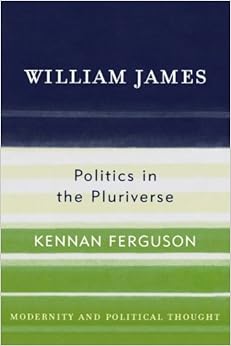
The early part of the book attempts to dissociate James' pluralism, a term that he popularised in the late nineteenth century, from the course that word took in the twentieth.
James created pluralism as an anti-Hegelian distrust of all universalist systematizing—an anti-teleological ethos that emphasizes the profound and meaningful differences in the worlds of different people. In short, James' pluralism was prescriptive.
Over the course of the twentieth century, however, the term pluralism came to primarily mean something far different, something merely descriptive. Pluralism is now understood as referring to the fact of human difference, the unpleasant and sometimes unavoidable incommensurability of values that threatens people's abilities to build political institutions, share meanings and even communicate. (15)Later the book goes into the connections between Continental and American philosophies and a Jamesian 'onticology' of objects.
Sunday, 2 November 2014
Pluralism—neither idealism nor realism but, above all, not absolutism
If philosophical absolutism can be defined as the expectation that a philosophical schema can (and should) be capable of incorporating any thing of any kind, anywhere at any time into its tenets, postulates and axioms with no remainder then we will notice that many philosophies termed ‘realist’ and ‘idealist’ have much in common.
A pluralist philosophy not only expects to encounter entities that baffle, dissemble and defy but welcomes such virtuous incomprehension—but then, of course, so may an inquisitive, curious and expansionist absolutism. What distinguishes pluralism is that it does not attempt to explain, subsume or incorporate as such; instead, it attempts to facilitate the terms of the encounter, to work through the situation as a specific event, to think through the middle, penser par le milieu.
Many ‘realisms’ would be better termed 'absolutisms'; and it would be well noted that they are not so dissimilar to their declared others. Pluralism does not mean idealism; on the contrary, it has no necessary affiliation to either side of that conflict. Pluralism needn’t grant ‘ideas,’ ‘mind,’ ‘language,’ ‘discourse’ or ‘consciousness’ any particular privilege. Indeed, it’s difficult to see how a properly pluralist philosophy ever could.
Pluralism must be realistic with regard to itself. All its realism must derive from—no, be subsequent to—this first demand (note: not first principle).
Realisms tend to operate with an implicit and more or less denied self-denial that I have characterised with the phrase ‘of course, I might be wrong.’ Few philosophers are such megalomaniacs as to think that they have finally—'at last!'—uncovered the real secret key to the hidden order of things. However, an all too thin concept of ‘speculation’ permits the argumentatively tentative (although often rhetorically bombastic) suggestion that this or that particular bundle of words and pages may, finally, have pinned down the butterfly, uncovered the thought that would allow us to stop thinking.
Pluralism operates, as I have written previously, with a much ‘thicker’ and more demanding notion of speculation. Philosophical action, not unlike action in general, results from existential demands. Its speculative character must be understood in relation to these demands. Thought untethered from a real problem is simply practice in the sense of 'today I practiced my guitar.' If a real, pressing, urgent problem is not present then one must be simulated. Nothing can be said against this but it is plainly an example practice qua preparation.
If philosophical thought—action—has a virtue (and I don't take the 'if' lightly) it is realised 'on stage,' as it were; in the midst, in the melee, in the milieu.
Pluralism can be distinguished from other comparable terms by the fact that it never takes 'reality' as its problem. The realist qua absolutist seems to say 'anything less than reality as a whole, without remainder, is not worth my time.' There is a political consequence that does not 'follow from' such philosophical pomposity but closely neighbours it: any ignorance, any foolishness, any deception relative to the Real that is the one and only real, perennial Problem is a matter of concern that must have Truth spoken to its power, to its plainly illegitimate Being. Pluralism, on the contrary, can choose its battles neither arbitrarily nor dogmatically. Not every disagreement on the register of knowledge must become public, political. In fact, many disagreements simply do not matter. That 'not mattering' is the new route to the good life. To live well is to live with, well enough—to 'I can live with that.'
This is perhaps the fault, then, of materialism, as generally conceived: it cannot ever reach the truly immaterial, that which simply does not matter. If everything, everywhere is of a common base and follows common laws and if avowed acknowledgement of all that is ontologically subtensive is a matter of public order then any divergence from reality, no matter how trivial, becomes a matter of public concern. On the contrary, if differences must do more than merely diverge in order to become a problem, and if 'reality' as such simply cannot ever become meaningfully 'problematic,' then coexistence becomes remarkably more thinkable.
The question then really becomes: is 'coexistence' that which we are working for? For many the answer to this is 'no' (they have other agendas) and that is the terrain on which arguments should proceed since this is what truly divides; this is terrain worthy of a friend/enemy declaration; endless feuds over relations and substances and so on are not at all as deserving—these are examples of philosophy for its own ends.
To the pluralists, problems; to the absolutists, perennials. This chasm runs far deeper than idealism versus realism, and is many times more urgent an area for exploration.
A pluralist philosophy not only expects to encounter entities that baffle, dissemble and defy but welcomes such virtuous incomprehension—but then, of course, so may an inquisitive, curious and expansionist absolutism. What distinguishes pluralism is that it does not attempt to explain, subsume or incorporate as such; instead, it attempts to facilitate the terms of the encounter, to work through the situation as a specific event, to think through the middle, penser par le milieu.
Many ‘realisms’ would be better termed 'absolutisms'; and it would be well noted that they are not so dissimilar to their declared others. Pluralism does not mean idealism; on the contrary, it has no necessary affiliation to either side of that conflict. Pluralism needn’t grant ‘ideas,’ ‘mind,’ ‘language,’ ‘discourse’ or ‘consciousness’ any particular privilege. Indeed, it’s difficult to see how a properly pluralist philosophy ever could.
Pluralism must be realistic with regard to itself. All its realism must derive from—no, be subsequent to—this first demand (note: not first principle).
Realisms tend to operate with an implicit and more or less denied self-denial that I have characterised with the phrase ‘of course, I might be wrong.’ Few philosophers are such megalomaniacs as to think that they have finally—'at last!'—uncovered the real secret key to the hidden order of things. However, an all too thin concept of ‘speculation’ permits the argumentatively tentative (although often rhetorically bombastic) suggestion that this or that particular bundle of words and pages may, finally, have pinned down the butterfly, uncovered the thought that would allow us to stop thinking.
Pluralism operates, as I have written previously, with a much ‘thicker’ and more demanding notion of speculation. Philosophical action, not unlike action in general, results from existential demands. Its speculative character must be understood in relation to these demands. Thought untethered from a real problem is simply practice in the sense of 'today I practiced my guitar.' If a real, pressing, urgent problem is not present then one must be simulated. Nothing can be said against this but it is plainly an example practice qua preparation.
If philosophical thought—action—has a virtue (and I don't take the 'if' lightly) it is realised 'on stage,' as it were; in the midst, in the melee, in the milieu.
Pluralism can be distinguished from other comparable terms by the fact that it never takes 'reality' as its problem. The realist qua absolutist seems to say 'anything less than reality as a whole, without remainder, is not worth my time.' There is a political consequence that does not 'follow from' such philosophical pomposity but closely neighbours it: any ignorance, any foolishness, any deception relative to the Real that is the one and only real, perennial Problem is a matter of concern that must have Truth spoken to its power, to its plainly illegitimate Being. Pluralism, on the contrary, can choose its battles neither arbitrarily nor dogmatically. Not every disagreement on the register of knowledge must become public, political. In fact, many disagreements simply do not matter. That 'not mattering' is the new route to the good life. To live well is to live with, well enough—to 'I can live with that.'
This is perhaps the fault, then, of materialism, as generally conceived: it cannot ever reach the truly immaterial, that which simply does not matter. If everything, everywhere is of a common base and follows common laws and if avowed acknowledgement of all that is ontologically subtensive is a matter of public order then any divergence from reality, no matter how trivial, becomes a matter of public concern. On the contrary, if differences must do more than merely diverge in order to become a problem, and if 'reality' as such simply cannot ever become meaningfully 'problematic,' then coexistence becomes remarkably more thinkable.
The question then really becomes: is 'coexistence' that which we are working for? For many the answer to this is 'no' (they have other agendas) and that is the terrain on which arguments should proceed since this is what truly divides; this is terrain worthy of a friend/enemy declaration; endless feuds over relations and substances and so on are not at all as deserving—these are examples of philosophy for its own ends.
To the pluralists, problems; to the absolutists, perennials. This chasm runs far deeper than idealism versus realism, and is many times more urgent an area for exploration.
Thursday, 21 August 2014
Philosophers: where are your instruments?; or, On the defensive deflation of philosophy
One of the principle tasks that were given to the 'specbook'-writing participants at the final AIME workshops in July was to, in one and the same motion, both defend and deflate the institutions and the values of the Moderns. That is, to identify in these basic and cherished contours of collective life the most indispensable and valuable distributions of agency and then, at the same time, to cut science, politics, religion, economics and so on 'down to size,' to divest them of their excessive, unsustainably explosive pretensions so as to condition the possibility of finding them their proper, diplomatic accommodation amidst other, non-Modern cosmoses.
This had to be a symmetrical and simultaneous deflation—deflate politics and not economics and you've got neoliberalism; deflate science and not religion and you've got theological dogmatism; deflate religion and not politics and you've got a cold and authoritarian secularism, and so on. This work sought not to diminish or denounce any of the involved and invoked terms but, rather, to alleviate the tendency for each form of existence to imperially define the entire world in its own format, thus stoking the flames of war. The objective was not diminution but, rather, coexistence.
Following through the internal logic of AIME, it seems no less necessary that we must also deflate philosophy. This task is suggested by the fact that philosophy is accorded a particular mode of existence, namely [pre].
The deflationary effect can be understood by contrasting philosophy with science [pre·ref]. According to Latour, the sciences achieve their specific form of objectivity through the incremental construction of circulating chains of instrumented references that transport information at the cost of deformations at every stage. To refer is to instrument, there is no other way.
So, philosophers: where are your instruments?
To take up one of Graham Harman's phrases, it should be now clear that philosophy qua [pre] cannot possibly be a "philosophy of access." Philosophy does not access, that is the job of reference. Philosophy can, at best, aid and abet this movement; it can act with, it cannot act for.
For millennia, philosophers have insisted that their art involved the construction of objective knowledge about the abstract conditions of existence, conditions inaccessible to the mere senses and discernible only by the privileged intellect. This, it seems to me, is unequivocally refuted by AIME; a philosophy of access is a contradiction in terms, a category error.
This brings me to a section from The Prince and the Wolf, a transcript of a public conversation between Latour and Harman at the LSE.
To somewhat egocentrically quote myself from a couple of posts ago:
After the example of AIME, if philosophers wish to refer to the objective existence of this or that then they should specify their empirically traceable referential chains. Anything else is Double Click [dc].
This rearticulation of philosophy is intrinsically social in the precise sense that there can no longer be such a thing as a philosopher-hermit—the philosopher is necessarily an associative, allied being; she has no other purpose than to work with others in the rendering-pliant of modes of connection and transformation in concrete, contested cases.
Deflated? Undoubtedly. But also defended[—if, by 'defence,' we mean not fortification but, rather, advocation [ed. 23/08/14]].
This rehousing and repurposing of philosophy—this empiricisation of philosophy in the most profound sense—is, in my humble and weightless opinion, perhaps Latour's most important philosophical contribution. This aspect of his thinking does not begin with his modes of existence project but can be found throughout his works, in varying stages of development (it is rooted in his long-standing commitment to a reformed ethnomethodology). And it is precisely this most crucial of insights that is erased when his work is turned into a series of dry pronouncements on the furniture of the universe—pronouncements that 'of course, might be wrong.'
This is why those who accuse Latour, and those who philosophise like him, of 'correlationism' and of insufficient 'realism' are missing the point. The philosopher, here, simply has no business 'explaining' the unchanging, overarching structure of the universe—if that is what 'realism' means then may it rest in peace.
This empiricised philosophical ethos is not, as I have argued, a matter of engendering 'humility' in philosophical practice; it is a far more pragmatic transformation than that. Humility is too self-denying a psycho-ethical disposition (too 'Christian' in the precise sense that Nietzsche excoriated so epoch-definingly). It is not a matter of limiting or constricting oneself as such—whole universes of beautiful speculation are still possible; it is a matter of undertaking a fundamental reconfiguration of philosophy and of the philosopher's role in the world.
To undertake this defensive deflation, and to thus desist from thinking Absolutely, is not to stop thinking—indeed, it may be to start.
Latour has by no means invented or initiated this progressive reassembly—nor has he undertaken it alone—but his works have massively contributed to the thorough pragmatisation and concomitant pluralisation of philosophy.
So, (Modern) philosophers: where are your instruments? Ovens, tables and balls of wax do not count.
This had to be a symmetrical and simultaneous deflation—deflate politics and not economics and you've got neoliberalism; deflate science and not religion and you've got theological dogmatism; deflate religion and not politics and you've got a cold and authoritarian secularism, and so on. This work sought not to diminish or denounce any of the involved and invoked terms but, rather, to alleviate the tendency for each form of existence to imperially define the entire world in its own format, thus stoking the flames of war. The objective was not diminution but, rather, coexistence.
Following through the internal logic of AIME, it seems no less necessary that we must also deflate philosophy. This task is suggested by the fact that philosophy is accorded a particular mode of existence, namely [pre].
The deflationary effect can be understood by contrasting philosophy with science [pre·ref]. According to Latour, the sciences achieve their specific form of objectivity through the incremental construction of circulating chains of instrumented references that transport information at the cost of deformations at every stage. To refer is to instrument, there is no other way.
So, philosophers: where are your instruments?
To take up one of Graham Harman's phrases, it should be now clear that philosophy qua [pre] cannot possibly be a "philosophy of access." Philosophy does not access, that is the job of reference. Philosophy can, at best, aid and abet this movement; it can act with, it cannot act for.
For millennia, philosophers have insisted that their art involved the construction of objective knowledge about the abstract conditions of existence, conditions inaccessible to the mere senses and discernible only by the privileged intellect. This, it seems to me, is unequivocally refuted by AIME; a philosophy of access is a contradiction in terms, a category error.
This brings me to a section from The Prince and the Wolf, a transcript of a public conversation between Latour and Harman at the LSE.
HarmanThis is the disagreement between Harman and Latour, and it's the difference that Harman does not get to grips with anywhere in his writings on Latour's work (to date). Philosophy, for Latour, no more accesses than it explains. As Latour put it in Reassembling the Social:
[…] there has to be a point where contact [between objects] happens. And what I worry about is that if we don’t specify that point metaphysically, then it becomes just a kind of ad hoc practical decision, which of course is fine when writing history. You could say: “all right, it seems like the case of Joliot connecting politics and neutrons is interesting but Joliot and the eardrum is not that important, so we can stop there.” And that’s fine for purposes of writing history but not fine for metaphysics.
Latour
Why?
Harman
Why? Because you haven’t explained how the contact occurred.
Latour
But metaphysics is not for explaining. It is the first principle of [Alfred North Whitehead's] Process and Reality. Philosophy is not in the business of explaining anything. Actual occasions explain what happened, not philosophy. If there is one thing which philosophy should not do, it is to try to explain anything. That’s where our disagreement is. Philosophy is not in the business of explaining. This is not at all the same thing. Philosophy is in the business of allowing the explanation to go far enough, to help the explainers to move in the explanatory trajectory but not to provide an explanation. (66-7)
As anthropologists have tirelessly shown, actors incessantly engage in the most abstruse metaphysical constructions by redefining all of the elements of the world. Only a researcher trained in the conceptual calisthenics [emphasis added] offered by the philosophical tradition could be quick, strong, daring, and pliable enough to painstakingly register what they have to say. (51)The value of philosophy here is the same as in AIME's [pre]: it is the lability, agility and sensitivity that it affords the actors who have been trained its art, not the overview it gives on reality or the quasi-scientific loose ends it explanatorily ties up.
To somewhat egocentrically quote myself from a couple of posts ago:
It is here that the philosopher qua intervener enters the fray, not as an architect of the world, urban planner of the galaxy or master of the universe but as an acrobat of thinking, a flexer and folder of thought, a monkish sage—inheritor of long traditions of agility-focused self-development—whose skill involves not the freehand sketching of the beams and struts of the background of things but rather of the rendering-pliant of modes of connection and transformation in service of (or, better: in alliance with) those whose very subsistence is at stake.This is precisely what I was trying to get at here: that philosophy is a calisthenic rather than explanatory discipline. Metaphysics is calisthenics or it's nothing. [The purpose of its art is conceptual creation in service of a situation, not fundamental explanation in service of the real. [ed. 22/08/14]]
After the example of AIME, if philosophers wish to refer to the objective existence of this or that then they should specify their empirically traceable referential chains. Anything else is Double Click [dc].
This rearticulation of philosophy is intrinsically social in the precise sense that there can no longer be such a thing as a philosopher-hermit—the philosopher is necessarily an associative, allied being; she has no other purpose than to work with others in the rendering-pliant of modes of connection and transformation in concrete, contested cases.
Deflated? Undoubtedly. But also defended[—if, by 'defence,' we mean not fortification but, rather, advocation [ed. 23/08/14]].
This rehousing and repurposing of philosophy—this empiricisation of philosophy in the most profound sense—is, in my humble and weightless opinion, perhaps Latour's most important philosophical contribution. This aspect of his thinking does not begin with his modes of existence project but can be found throughout his works, in varying stages of development (it is rooted in his long-standing commitment to a reformed ethnomethodology). And it is precisely this most crucial of insights that is erased when his work is turned into a series of dry pronouncements on the furniture of the universe—pronouncements that 'of course, might be wrong.'
This is why those who accuse Latour, and those who philosophise like him, of 'correlationism' and of insufficient 'realism' are missing the point. The philosopher, here, simply has no business 'explaining' the unchanging, overarching structure of the universe—if that is what 'realism' means then may it rest in peace.
This empiricised philosophical ethos is not, as I have argued, a matter of engendering 'humility' in philosophical practice; it is a far more pragmatic transformation than that. Humility is too self-denying a psycho-ethical disposition (too 'Christian' in the precise sense that Nietzsche excoriated so epoch-definingly). It is not a matter of limiting or constricting oneself as such—whole universes of beautiful speculation are still possible; it is a matter of undertaking a fundamental reconfiguration of philosophy and of the philosopher's role in the world.
To undertake this defensive deflation, and to thus desist from thinking Absolutely, is not to stop thinking—indeed, it may be to start.
Latour has by no means invented or initiated this progressive reassembly—nor has he undertaken it alone—but his works have massively contributed to the thorough pragmatisation and concomitant pluralisation of philosophy.
So, (Modern) philosophers: where are your instruments? Ovens, tables and balls of wax do not count.
Wednesday, 26 February 2014
Picking apart pluralism; suggestions for living
There's a really excellent new post by Adam Robbert at knowledge-ecology, joining in the pluralism debate. His musings moved me to fabricate the following:
I don't think that there are X kinds of pluralism; however, the word is clearly being used in a few different ways and this is causing some confusion. Here's my initial (and rather sleepy, 1 am) attempt at a disentanglement:
(1) Metaphysical pluralism in the sense of Leibniz, Whitehead and von Uexküll (if he's read metaphysically). That is, there exists a vast plurality of beings; every being has its own perspective on existence; there is no über-being that contains or determines all other beings; i.e. there is no universe but rather a pluriverse.
This basic tenet is common to many of the 'pluralisms' under discussion. In fact the above is probably unproblematic within this debate; I don't think that this is what anyone's disagreeing with.
(2) Pluralism as it's understood in political philosophy. This is complicated; to name but a few pluralists in this sense: Harold Laski, Isaiah Berlin, Robert Dahl, William Connolly, Chantal Mouffe... Many different ideas here. To some extent political pluralism responds to the basic fact that there are many different identities and ways of living and that these have to co-exist somehow; this problem is particularly acute in heterogeneous, multicultural, modern, liberal democratic societies, etc. etc. Pluralists embrace this diversity, argue for its virtue and try to think through ways of living together in this pluralistic condition.
(3) Bruno Latour's modal pluralism is a metaphysical pluralism in another sense: he argues not just for a plurality of beings but for the plurality of being itself ‒ that is, there are many ways of being; being is itself pluralistic. To be is to persist in being somehow but there are many ways of achieving that persistence (these ways are irreducible to the achievements of individual entities) and, so, being is pluralistic.
Bruno is not the first to come up with this basic idea (see Souriau, Simondon, Deleuze, etc.) but his is a striking and unusually sophisticated example of the genre.
(4) The order that I list the three above meanings (or circumstances) of 'pluralism' is not accidental. Latour's modal, metaphysical pluralism is also a kind of political pluralism; it would be well termed 'value pluralism writ-metaphysical.' There is his mode of politics [pol], of course, but the entire project is a matter of detecting, evaluating and re-instituting values. It is as much a political as a metaphysical pluralism in this sense. And so, at risk of gross oversimplification, we can say that (4) fundamentally differs from (1) because it passes through (2) and (3). It is a far deeper pluralism that places far greater demands on us, should we follow its lead.
Levi subscribes to (1) ‒ pluralism in the sense of umwelten ‒ but has seemingly little time for the others. He can thus pursue a scientistic, modernist pluralism (I'm not even sure he'd disagree with those adjectives at this point) that is a metaphysical but not political; a metaphysics that is pluralistic with regard to beings (1) but monistic with regard to being (3) and which endorses a disqualificatory attitude towards ontology and a politics of speaking truth to ignorance and irrationality.
Myself, I disagree with many of Latour's arguments but I follow him all the way to (4). My preferred understanding of his pluralism (i.e. an interpretation that is creative but, I hope, a fair translation of his texts) is summarised here. Politically, I understand it to be an agonistic pluralism much like that of Chantal Mouffe but extended to a metaphysical level through the modes philosophy.
My understanding of Isabelle Stengers' philosophy is that it is broadly compatible with the above also, perhaps with some differing nuances and emphases compared to Bruno but mostly on the same page, as they say.
Both, it seems to me, are committed to a pluralism that goes beyond cosmography (1) and enters into cosmopolitics (4). Their pluralisms are not disinterested or neutral, they are committed and committing ‒ that is, they commit us to certain ways of being with each other. They offer us not just a 'picture' of existence, framed as a multiplicity, but offer suggestions for living.
I don't think that there are X kinds of pluralism; however, the word is clearly being used in a few different ways and this is causing some confusion. Here's my initial (and rather sleepy, 1 am) attempt at a disentanglement:
(1) Metaphysical pluralism in the sense of Leibniz, Whitehead and von Uexküll (if he's read metaphysically). That is, there exists a vast plurality of beings; every being has its own perspective on existence; there is no über-being that contains or determines all other beings; i.e. there is no universe but rather a pluriverse.
This basic tenet is common to many of the 'pluralisms' under discussion. In fact the above is probably unproblematic within this debate; I don't think that this is what anyone's disagreeing with.
(2) Pluralism as it's understood in political philosophy. This is complicated; to name but a few pluralists in this sense: Harold Laski, Isaiah Berlin, Robert Dahl, William Connolly, Chantal Mouffe... Many different ideas here. To some extent political pluralism responds to the basic fact that there are many different identities and ways of living and that these have to co-exist somehow; this problem is particularly acute in heterogeneous, multicultural, modern, liberal democratic societies, etc. etc. Pluralists embrace this diversity, argue for its virtue and try to think through ways of living together in this pluralistic condition.
(3) Bruno Latour's modal pluralism is a metaphysical pluralism in another sense: he argues not just for a plurality of beings but for the plurality of being itself ‒ that is, there are many ways of being; being is itself pluralistic. To be is to persist in being somehow but there are many ways of achieving that persistence (these ways are irreducible to the achievements of individual entities) and, so, being is pluralistic.
Bruno is not the first to come up with this basic idea (see Souriau, Simondon, Deleuze, etc.) but his is a striking and unusually sophisticated example of the genre.
(4) The order that I list the three above meanings (or circumstances) of 'pluralism' is not accidental. Latour's modal, metaphysical pluralism is also a kind of political pluralism; it would be well termed 'value pluralism writ-metaphysical.' There is his mode of politics [pol], of course, but the entire project is a matter of detecting, evaluating and re-instituting values. It is as much a political as a metaphysical pluralism in this sense. And so, at risk of gross oversimplification, we can say that (4) fundamentally differs from (1) because it passes through (2) and (3). It is a far deeper pluralism that places far greater demands on us, should we follow its lead.
Levi subscribes to (1) ‒ pluralism in the sense of umwelten ‒ but has seemingly little time for the others. He can thus pursue a scientistic, modernist pluralism (I'm not even sure he'd disagree with those adjectives at this point) that is a metaphysical but not political; a metaphysics that is pluralistic with regard to beings (1) but monistic with regard to being (3) and which endorses a disqualificatory attitude towards ontology and a politics of speaking truth to ignorance and irrationality.
Myself, I disagree with many of Latour's arguments but I follow him all the way to (4). My preferred understanding of his pluralism (i.e. an interpretation that is creative but, I hope, a fair translation of his texts) is summarised here. Politically, I understand it to be an agonistic pluralism much like that of Chantal Mouffe but extended to a metaphysical level through the modes philosophy.
My understanding of Isabelle Stengers' philosophy is that it is broadly compatible with the above also, perhaps with some differing nuances and emphases compared to Bruno but mostly on the same page, as they say.
Both, it seems to me, are committed to a pluralism that goes beyond cosmography (1) and enters into cosmopolitics (4). Their pluralisms are not disinterested or neutral, they are committed and committing ‒ that is, they commit us to certain ways of being with each other. They offer us not just a 'picture' of existence, framed as a multiplicity, but offer suggestions for living.
Subscribe to:
Posts (Atom)