Showing posts with label alfred north whitehead. Show all posts

Tuesday, 14 February 2017

Isabelle Stengers on becoming a philosopher with Deleuze and Whitehead

Further to my last post on why I wouldn't feel comfortable calling myself a philosopher, Isabelle Stengers' recent essay in Roland Faber and Andrew Goffey's The Allure of Things is very interesting. She writes:
"I learned that I would become a philosopher when reading Deleuze and I experienced that philosophy is worth existing only if it accepts the risk of existing in the teeth of other practices, producing its own demanding concerns without needing to weaken theirs." (p.195)
That is more or less exactly my frustration with so many excessively pious and all-encompassing readings of 'geophilosophy.' She adds:
"If I learned what it feels to become a philosopher with Deleuze, it is with Whitehead that I learned what it means to answer this challenge by practicing philosophy as an openly speculative adventure."(p.196)
I must admit that I continue to feel un-carried away by Deleuze. The aspects of his thought I find compelling are those I find in either Stengers or Latour after him or James or Whitehead before (and with less intellectual indigestion). It may well be my failing.

Friday, 3 February 2017

Away from 'theory as overlay'; or: On not being a philosopher

I make no claim to be a philosopher, although I philosophise (and maybe that is enough – need one philosophise well?). This reluctance perhaps derives from being Anglophone and thus born of a deeply anti-intellectual culture for which more or less the only legitimate meaning of 'philosopher' is as shorthand for a particular subsection of the academic profession (and not one given much respect).

However, the more philosophical reason for this reluctance is that I find myself ever more an empiricist. I am interested in ideas only if they do not lead away from experience but allow it to be extended or amplified in various ways. This is, I suspect, why I have always found a liking for pragmatism, actor-network theory, and so on.

Above all, I am sceptical – no, that is too polite: I cannot abide – the use of theory as overlay. That is, the situation where an abstract vocabulary becomes so sophisticatedly all-consuming that it does not enable surprising connections but rather precludes them – a universe unto itself. This is Whitehead’s "thought within a groove" – the stuff of the professional.

For example, I find myself unable to share the fascination of so many philosophically-inclined geographers* with the geophilosophy of Deleuze and Guattari. It seems to me that their conceptual vocabulary of territories and strata is, if anything, the least useful aspect of their continually transforming, runaway stagecoach of a philosophical project (I mean this as a compliment) for thinking about matters of earth, experience and politics.

By taking practically all of the conventional terms available to actors engaging in geographical/geological practices and making them into unconventional technical terms, there is no longer any easy way of relating the web of abstractions to said practices as such actors themselves describe them.

There is a decoupling at this moment that carves out 'philosophy' as an autonomous space. I cannot abide that space. In this much, I am not a philosopher.

This is not to suggest that words should not be made and remade in abstraction from convention – they should. However, as counterintuitive as it may be, it seems to me that a creative conceptual universe made from the lexicon of geography might be less useful for geography than a conceptual universe made from something else.

This would not be such a problem if the likes of D&G were read more creatively and less, for want of a better word, 'professionally.' There is a remarkable lack of creativity – indeed, often outright piety – in the parsing of these thoughts as though they were to be a system adequate to an object.

Theory as overlay is incapable of astringency, as Isabelle Stengers describes that term:
"[…] the function of scientific thought has less to do with its ‘truth’ than with its astringent effects, the way it stops thought from just turning in self-satisfying circles."
Self-satisfaction is a vice of the intellect.


____________
*I'm not a geographer either but let's save that for another day.

Thursday, 8 December 2016

Alfred North Whitehead and the Logician's Nose

In his foreword to Isabelle Stengers’ Thinking With Whitehead, Bruno Latour writes:
“It could be one of those little games journalists play on television talk shows about books: “Who was the greatest philosopher of the twentieth century whose name begins with W?” Most learned people in America would answer “Wittgenstein.” Sorry. The right answer is “Whitehead” – another philosopher whose name begins with W to be sure, but one who is vastly more daring, and also, unfortunately, much less studied.”
Last week, here in Aber InterPol, we had a two-part reading group on A.N. Whitehead’s works. Being partial instigator, I got to choose the readings:
Session 1 – Whitehead’s Problem: The Bifurcation of Nature
The Concept of Nature, chapters I (“Nature and Thought”), II (“Theories of the Bifurcation of Nature”) and VIII (“Summary”). In these lectures (given 1919), Whitehead sets out his “problematique” for the first time, concentrating primarily on the philosophy of physics – something that is taken up and expanded in his later works. His argument here is crucial to many contemporary thinkers, such as Haraway, Barad, Latour and so on. 
Session 2 – Philosophy between Science, Art and Nature
Science and the Modern World chapters IV (“The Eighteenth Century”), V (“The Romantic Reaction”) and XIII (“Requisites for Social Progress”). In these lectures (given 1925), Whitehead fleshes out his problem historically, ranging much more widely than before. The fourth and fifth chapters are particularly interesting because they set out a distinction between natural philosophy and nature poetry, respectively, with Whitehead, as philosopher, taking both equally seriously.
We had been hoping to arrange something like this for a while; however, the occasion was provided by the annual visit of (Visiting Professor) Patrick Thaddeus Jackson from American University – noted Wittgensteinian (and Weberian, for that matter).

Besides myself, we had Milja Kurki, whose work on ‘relational cosmology’ gave us some really important parallels between Whitehead’s century-old works and contemporary physical thinking. Also, representatives of Lacanian psychoanalysis, Eliasian process sociology, and more.

Whitehead’s works are really important for my research at the moment, particularly regarding the place of ‘environment’ within his ‘philosophy of organism,’ and so it was extremely useful to get such a wide range of reactions. Having spent quite some time reading and absorbing Stengers’ reading of (or rather with) Whitehead, I am given to picking up particularly on his pragmatist tendencies. For example, from Science and the Modern World:
“You cannot think without abstractions; accordingly, it is of the utmost importance to be vigilant in critically revising your modes of abstraction. It is here that philosophy finds its niche as essential to the healthy progress of society. It is the critic of abstractions.” (p.59)
Patrick, on the other hand, was most struck by the ‘totalising’ ethic of endeavouring to combine all elements of experience and of scientific fact into a complete conceptual scheme, a theory of everything.

This impression derived particularly from recognition of Whitehead’s intellectual milieu. This being a few years before Gödel's incompleteness theorems were published (1931); a place and time where a ‘theory of everything’ was an objective that hardly needed explanation. Indeed, in our first reading, The Concept of Nature, Whitehead pointedly evades what he calls ‘metaphysics’ but sets out, quite straightforwardly, to construct a concept of nature that will enable the unification of the sciences. And, of course, we can hardly ignore that Whitehead was the mathematician who, with Bertrand Russell, attempted to do nothing less than provide a new foundation for mathematics in their Principia Mathematica (explicitly echoing Isaac Newton in the process).

Reading Whitehead's prose can seem, as Patrick put it, as though it's translated “from the original math.” We can see the ‘totalising’ aspect encapsulated very well on the very first page of Process and Reality (1927), where Whitehead describes “Speculative Philosophy” as:
“the endeavour to frame a coherent, logical, necessary system of general ideas in terms of which every element of our experience can be interpreted.” (p.3)
Of course, much hinges on what is understood by “our experience” but we can see the point.

My first reaction to this was that Whitehead’s project may have been totalising in this sense but it was not dogmatic. In other words, we should consider precisely what way it was totalising (partial, preliminary, fleeting – i.e. pragmatic). In Stengers’ words (taken by Latour as an epigraph): “Every synthesis begins ‘anew’ and has to be taken up from the start as if for the first time.” In Whitehead's own words: “The many become one, and are increased by one” (1927, p.21).

However, this all got me to thinking further about what I take from Whitehead, creatively rather than historically per se. My interest is not so much in ‘totalisation’ in the sense of insisting that conceptual schemes should necessarily involve consistent abstractions from “every element of our experience.” I am interested in avoiding arbitrary and premature delineations of intellectual boundaries – something for which Whitehead is evidently excellent.

However, I think the more interesting point concerns the profound obligation imposed by the requirement of logical consistency. The interesting aspect of logic, in this regard, is not so much the promise of cohesion into a permanent, solid, unshakeable whole. Rather, it is the unavoidable recognition of the fact that altering one part of the spider's web ripples through every other element. Change your concept of relation and this affects your understanding of life, knowledge, politics, dreams.

If Whitehead’s milieu compels us to interpret him as searching for the totality of the infinite, I am in a sense interested in the totality of the indefinite – stretching far beyond any given instance or expression, constantly rippling back, surprising and forcing reassessment of what could previously taken as totality. In other words, when we refuse to keep process cosmology out of the process of thought. When we give up trying to think the thought that would allow us to stop thinking.

In this sense, you need the logician’s nose to follow the flows. The genius of the tradition of rationalism that Whitehead embodies lies not so much in permanence but in its capacity for dealing with impermanence.

Thinking the thought that would allow us to stop thinking – was this Whitehead's objective? Maybe. But he provides plenty of possibilities for those seeking to kick the habit. Not trying to bring thought to an end but refusing to give up on the means yet developed for dealing with the exigencies of the indefinite.

Saturday, 7 November 2015

Matter, a concrete generality

Is it possible to sum up Alfred North Whitehead's metaphysics in a sentence? No. But here's a sentence anyway:

There are no concrete generalities.

For philosophical materialism, matter is a concrete generality. It is, quite simply, what is. In Whitehead's thought, there are only concrete particularities. That is, 'actual occasions.' But isn't actual occasion just then another way of saying 'matter'? I think not. To say that reality is constituted by actual occasions is to say absolutely nothing about what those occasions are like. Neither hot nor cold, wet nor dry, material nor immaterial. That's really rather the point of them. Contrast this to 'matter,' which is said to have all kinds of properties. For some it is dead, lifeless, inert. For others, it is active, lively, vibrant. These are variations on the same theme: matter as a concrete generality. On the contrary, actual occasions demand specificity – it is built into their very definition that nothing much can be said about them in general. Matter, then, appears as an abstraction. And there's nothing wrong with abstractions. As Whitehead affirms, one cannot so much as think without abstractions. However, we have to be careful as these things can get out of hand fast. 'Actual occasion' can then be understood as the minimal concept that permits wide-ranging abstract thought while safeguarding against the poison of concrete generality – i.e. against something fundamental, general and capable of being meaningfully described.

I'm going to be reading a lot more Whitehead in the near future, so we shall see whether this understanding is still standing in a little while. At the moment, this is basically an abridged version of my understanding of Isabelle Stengers' understanding of Whitehead.

Monday, 19 October 2015

New materialism doesn’t exist and flat ontology is a red herring—first reflections on Millennium 2015

I've just arrived back from the Millennium journal's conference for 2015 at the LSE in London. The headline act was Bruno Latour and I'll post some thoughts on his lecture when I get time. But, first things first, I feel like I need to get this off my chest.

'New materialism' as a cohesive body of thought doesn't exist and 'flat ontology' is a monumental red herring. Andrew Barry made the former point very well in a panel on Sunday afternoon. He very much voiced what I was thinking but I will try to expand on that.

Saying that there are new materialisms might be a step in the right direction but it's still not good enough if the analysis then continues to proceed on the basis of lowest common denominators (many of which are erroneously identified). For many of the thinkers who are being frequently identified by that term, it is quite questionable whether they are materialists at all. The metaphysics of Alfred North Whitehead, for example, is often referred to as materialist (didn't hear that at this conference but have done in the past) but what can this mean when he did not base his ontology on a conception of matter but rather of events (or rather 'actual occasions')? Latour himself has flirted with the term 'materialist' but this is far from a simple relationship (he is comfortably more Whiteheadist than materialist, by any reasonable estimation).

Being not-an-idealist is not the same as being a materialist – it is not an either/or equation. The presumption that we must all choose between these two preset options is a death blow to the possibility of thought. It's just much more complicated than that.

The loose family resemblance that the term new materialism identifies cannot serve as a starting point for any meaningful analysis or critique. That requires grappling with particular thinkers in their particularity. And that is a much more difficult task than casting around vague aspersions but it's also the only way to actually say anything. (Of course, the pressures of the 10 minute conference presentation tend to work against any and all forms of incisiveness and subtlety but nevertheless.)

Having said all of that, there are a handful of thinkers who place themselves under the flag of 'new materialism' and I don't wish to disparage whatever that term is doing for them. However, as the term is circulating within International Relations conversations (and to a large extent within human geography as well), I think it is quite clear what that term is doing there: shoehorning a rather varied range of thinkers into a neat-ish box that can be broadly and abstractly discussed on the basis of a handful of alleged, half-articulated lowest common denominators. It is all about dumbing down the conversation.

That may be a bit harsh but only a bit.

(I should add at this point that I am not aiming these comments at anyone in particular but at the general level of conversation around these issues. Those promoting new materialism and flat ontology might be as guilty as those criticising these terms, in this respect.)

I hasten to add also that I have nothing against '-isms' and other heuristic devices that allow the complexities of intellectual affiliations and trends to be signposted and made navigable. However, academics have a deeply unhealthy relationship with -isms, turns and the like. In IR, in particular, there is a long history of obsessing over trends and movements rather than authors and arguments. It's never innocent and always involves the suppression of various aspects of the landscape of possible thought.

If that sounds like rather a 'poststructuralist' thing to say (it may well do) then that term itself, I would argue, is not at all exempt from these problems. What was at stake in privileging structural linguistics in the intellectual inheritances of those authors grouped under the term 'poststructuralist' (they were all much more than this)? I have my theories. The main one is that this made it easier to turn a complex set of ideas into a 'theoretical framework' that could be taught, textbooked and 'applied.' But I digress.

Secondly, flat ontology. Until recently I had forgotten that this was a 'thing.' It gets thrown around in a variety of ways without what it's supposed to actually mean being made particularly clear in any given instance. More and more it seems to be used as a polemical tool which suggests that the likes of Actor-Network Theory flatten out all forms of hierarchy and have, therefore, no perception of or interest in questions of power and inequality (although see also). This rests on a conflation of ontology and method.

In ANT (itself a somewhat diverse array of scholars but, I think, just about cohesive enough to make the designation meaningful) it is an important principle of method that one does not presuppose that which one is attempting to account for. Thus, ANT effects a flattening of the social field in the sense that pre-established hierarchies and verticalities are not what is used to explain events on a level of generality but what is to be explained in terms of the specificity of each observed hierarchy.

Take a scientific fact. A fact that has won out over its rivals and been enshrined in textbooks, encyclopaedias, people's general knowledge, etc. Plainly, the situation I am describing is not 'flat' in the sense of there being no hierarchy. It is precisely because there is hierarchy that one should not take hierarchies for granted. The hierarchy is the thing that one wishes to explain and this explanation comes from an intensive description of the process by which human and non-human agencies are criss-crossed and assembled, each affecting and perturbing the overall formation as they are enrolled into it. That is, the hierarchy is assembled from a heterogeneous array of forces that one can never a priori place in a pre-given hierarchy. The field that is to produce the descriptive explanation is flattened insofar as order is not to be taken for granted and no one case is to be made the archetype for all other cases. That's all.

That doesn't mean that this approach is necessarily right or that it is universally applicable (I don't think that it is) but that it should be understood for what it is – at least as much about method as about ontology per se.

Relatedly, this is what Latour has to say about power in a recent interview. They don't use the term flat ontology but it could be easily read into the question.
– VD: We want to ask you about power. If we assume that ontologies are multiple and relational, where do we locate differences and power asymmetries? There has been a lot of criticism, especially in Latin America, that this idea of multiplicity erases conflict, hegemony, domination and asymmetries. So how would you answer to this criticism and include questions on asymmetries and power? 
– BL: I think you have to reverse the question and ask: when do people use the notions of power and asymmetry? What is the landscape that we imagine as the ideal? I always suspect when the landscape we imagine as the ideal is flat, where there would be no power relations and where all relations would be symmetrical. Behind the notion of power is the idea that power is something that should not be carried out, that it is a sort of deviation from the path represented by something we have in mind that is probably reason, or solidarity, or peacefulness. However, people like me never believe in peacefulness as symmetry. I don’t use so much the notion of power, because asymmetry, in the landscape we try to describe, is everywhere. If you describe a mountain from here to Buenos Aires, you will need to follow one calibrated instrument and describe how this one instrument registers differences, what in my work is actor‑network theory (ANT). For example, we think the pampa is very flat and then we see it goes up and down! So, to register asymmetry you need a notion that doesnot use the word power because when you use power there is always this idea that you could actually get rid of it. That power has to disappear, that it is abnormal. But asymmetry is the nature of the landscape you are describing. Moreover, if you mean by multiplicity association in the ANT sense of the word, that is as heterogeneous connections, which have to be composed, it means you have to be amazingly precise on the nature of the asymmetry. That is, this man here or this woman there is actually producing, in this specific place, a pattern which is spreading in this way and which has to be attacked. Is this power? Yes, of course it is power. But power doesn’t add anything to that description. The primary problem of the notion of power is that it withdraws something from the description, because it says: “Ideally, we could do without power”. So power is a drug, it isa sort of poison that is used because people feel good about doing so, “Ah, I’m describing power relations”. But the problem is that they never do it because in fact they replace the analysis of the asymmetry in a specific place, where specific effects have been produced, by this sort of overall ideal. They assume that if they speak about power, the work already is done. But as long as you are not able to identify where danger is being produced and modified, abstain from using the notion of power. That is why I’m very suspicious about people who use power. It is basically a left over from the Left, an old idea that assumes that we should address power because they imagine that they could get rid of it. 
– VD: Is it like a shortcut? 
– BL: Yes. Could you imagine describing a landscape where there would be no power? Actually, I put power at the heart where it was not supposed to be: in science! So, I’m not impressed by those criticisms. Others put power everywhere, but not in science. And in science, where we show it, asymmetry is everywhere, the scientist that published this here and not there, etcetera, everything is completely asymmetrical in science. But then, it doesn’t mean that you have to add the notion of power. Because if you add it, what do you add? This is a question I have never understood. What is added by adding the notion of power? Yes, it is asymmetrical. It is like saying the Andes are high. Yes they are high. Now, if you want to walk it up and down you need lots of trucks. Where are the trucks, how do we mobilize them, which road do we take, which tools do we need to walk it up. These are the questions we have to ask.
For Latour, power doesn't add to the description and is politically misleading, so out it goes. (Now, I think that there is still a need for a concept of power as a risk that any actor undertakes in channelling forces that might capture it but that's a topic for another day.)

What the ANT-type position does refuse at a properly ontological level is the dualist separation of nature/society, substructure/superstructure or anything of that sort (if that's what a 'flat ontology' is then, yes, it is flat – although it would be more accurate to say non-dualist). The critical realist separation between transitive and intransitive, for example, is, from this point of view, just another instance of the same old modernist bifurcation of nature, with a bit of a tweak. It is a depth ontology that operates on the basis of images of surface and subsurface, soil and bedrock, veil and reality. It's more of the same: the shallow ephemera of perception vs. the immutable depths of reality.

It is not so much that ANT et al. are 'flat' but rather that critical realism et al. are dualist (even if they sometimes claim not to be). The metaphor of depth carries within it the critique of flatness. To promote 'flat ontology' as a good thing is rather to promote a term of abuse. Neither flat nor deep – refuse the imposition of the choice.

So, yes, there are real and important differences to be identified and picked apart here, undoubtedly. But phrases like new materialism and flat ontology aren't nearly good enough to get at them. It's like trying to do heart surgery with a shovel.

Probably the principal difference to be picked apart, in my opinion, is the insistence upon empirical, idiographic, casuistic and descriptive studies. That is to say, the insistence that theory be what facilitates empirical research rather than being what substitutes for it, overlays it or provides the explanatory supplement that the things themselves lack; that studies focus intensively upon particular cases and attempt to understand them in their specificity, while at the same time accommodating their wider connectedness and historicity; that the only form of explanation should be a well-constructed description and that generalisation should be undercut at every opportunity.

These are principles that are eminently contestable and that would make for a conversation worth having. However, until we can get past such poorly constructed concepts that don't even make contact with the real disagreements, this will not happen.

Friday, 12 June 2015

Was Whitehead a materialist?

S.C. Hickman on the Dark Ecologies blog has a very nice short introduction to Whitehead's Process and Reality, particularly concentrating on its cosmological aspects. He writes, by way of a concluding parenthesis, that this is part of an "ongoing project of developing a materialist philosophy".

This got me thinking about something that's been bothering me for a while: why some often claim Whitehead as a 'materialist.' I'm not trying to pick on Hickman here (he didn't say that Whitehead was a materialist, only that he's using Whitehead in developing a materialist philosophy) but it's something that comes up quite often, one way or another.

My own inclination (no more thought through than that, to be honest) is to say that, in Whitehead's terms, materialism is a philosophy that makes matter its Ultimate. Following that on, Whitehead would have to be (in P&R at least) a creativist; Aristotle a substantialist, etc.

Whatever way matter is conceived (and there are of course indefinitely many ways of conceiving it), 'materialism' must surely be related to matter qua conceptual fundament -- that is, as the thing that explains nothing but is assumed so that the rest of existence can be conceptually constructed (as the Ultimate).

There's a lot of pretty wishy-washy talk of 'materialism' that just says 'things, therefore materialism,' which tends to result in platitudes rather than insights. (Perhaps that's just me being mean; but, then again, maybe not.) It generally presupposes that anything that isn't idealism -- i.e. anything that takes non-human things seriously -- is therefore materialism, which I find to be unhelpful at best (and part of a systematic stupidification of thought, at worst).

This is basically what I was getting at with a post I wrote on 'new materialism' a couple of months ago.

It's a poorly articulated irritation that I'm describing here but it derives from a complacency that is, I think, widespread and real.

Sunday, 31 May 2015

William James on the conciliation of religion and science; also, mathematics and pragmatism

I'm presently reading William James' Varieties of Religious Experience. Like much of James' writing, some of it can be rather pedestrian and ponderous but then certain sections jump out like great glowing epiphanies. I like this section from the end of lecture 5 on "The religion of healthy-mindedness" in particular:
The experiences which we have been studying during this hour (and a great many other kinds of religious experiences are like them) plainly show the universe to be a more many-sided affair than any sect, even the scientific sect, allows for. What, in the end, are all our verifications but experiences that agree with more or less isolated systems of ideas (conceptual systems) that our minds have framed? But why in the name of common sense need we assume that only one such system of ideas can be true? The obvious outcome of our total experience is that the world can be handled according to many systems of ideas, and is so handled by different men, and will each time give some characteristic kind of profit, for which he cares, to the handler, while at the same time some other kind of profit has to be omitted or postponed. Science gives to all of us telegraphy, electric lighting, and diagnosis, and succeeds in preventing and curing a certain amount of disease. Religion in the shape of mind-cure gives to some of us serenity, moral poise, and happiness, and prevents certain forms of disease as well as science does, or even better in a certain class of persons. Evidently, then, the science and the religion are both of them genuine keys for unlocking the world’s treasure-house to him who can use either of them practically. Just as evidently neither is exhaustive or exclusive of the other’s simultaneous use. And why, after all, may not the world be so complex as to consist of many interpenetrating spheres of reality, which we can thus approach in alternation by using different conceptions and assuming different attitudes, just as mathematicians handle the same numerical and spatial facts by geometry, by analytical geometry, by algebra, by the calculus, or by quaternions, and each time come out right? On this view religion and science, each verified in its own way from hour to hour and from life to life, would be co-eternal. (99-100)
This brief note on mathematics reminds me of Isabelle Stengers' regular insistence on the importance of the fact that A. N. Whitehead was a mathematician. Far from granting transcendent access-authority to a higher realm of ideas, in this understanding mathematics heightens only one's capacity for perspective-shifting—that is, for pragmatism.

Saturday, 23 May 2015

Reassembling geopolitics—a brief synopsis of my long-term project

For the past 8 or 9 months, I've been plotting and planning the long-term research project that, one way or another, I will pursue for the next several years. (In fact, this plan has been more or less complete since January but I'm just getting around to sharing it now.)

It takes Bruno Latour's work on geopolitics as its starting point but also departs from it in various ways. My recently published article Back down to Earth: reassembling Latour's Anthropocenic geopolitics is essentially a (very) long preface to this larger work.

The project is divided into six parts, each of which are substantially independent but also follow on from each other:

1. Earth and Cosmos
2. Geopolitics and Environment
3. Spherology and Fortification
4. Diplomacy and Territory
5. Possibilism and Possession
6. Geohistory and Geodesy

The first two parts suppose that if we are to reimagine what geopolitics might mean 'in the Anthropocene' or 'facing Gaia,' etc. then we really need to understand what some key terms mean (and have meant) in a broader historical context: Earth, first and foremost, but also the inherited Latin and Greek parallels of that Germanic term, terra and geo. Following on from Peter Sloterdijk's grand conceptual histories, Earth also has to be understood in its historical geo-ontological relation with cosmos. Geopolitics, as I've written in Back down to Earth, was coined in 1899; however, it has to be related to the much longer history of geography and then, in turn, to the entangled histories of words such as environment, climate, milieu, and so on. By the end of these first two parts/chapters, the various conceptual-historical issues surrounding 'geopolitics in the Anthropocene' should be well understood and a thorough reconstruction should therefore be possible.

The middle two parts focus on different sorts of techniques and technologies and how these produce differing configurations of exclusion and belonging. Techniques of fortification—walls, fences, barricades, etc.—carve up space and cement geopolitical arrangements. We are used to understanding such constructions along borders and on strategic high grounds as being geopolitical but increasingly it is not only humans that must be kept in/out: flood defences, dykes, geoengineering projects—these are all geopolitical forms of fortification in the new sense that I would like to articulate. Diplomacy, meanwhile, is not a technique of exclusion but a 'technology of belonging,' as Isabelle Stengers puts it. How differing forms of territory are negotiated (or not) is crucial to understanding the possibility of new forms of coexistence given mounting Anthropocenic pressures.

The final two parts investigate the role of the sciences in this nascent geopolitics in more detail, particularly focusing on problems of calculation, possibility and deep time in relation to matters of land, dispossession and resistance. Possibilism is a term taken from the historian Lucien Febvre. He opposed it to the alleged environmental determinism of the previous generation of geographers from Germany, such as Friedrich Ratzel. Linking to abovementioned investigations, I also want to think about compossibility in the sense of Leibniz and the concept of compossibilism as a diplomatic form of thought about possibilities of coexistence. Possession I take to mean both possession of and possession by—I want to relate geopolitics particularly and inextricably to matters of expropriation but also to mass movements and political passions. Geohistory I mean both in the sense of Fernand Braudel's geographical histories and of Martin Rudwick's history of the geological sciences. Related to the latter, geodesy is a somewhat archaic term meaning the science of measuring the shape of the Earth. However, etymologically the '-desy' also suggests division, which relates back to matters of apportionment, appropriation and nomos, in the sense of Carl Schmitt.

There is an enormous amount of work to be done on all of the above; however, I've already made a start on some of it.

My work-in-progress paper Varieties of diplomatic experience (with particular attention to the problem of territory), presented at a workshop in Windsor this week, investigates the conceptual side of the diplomacy/territory conundrum. I intend to do more empirical work on these issues, taking Richard White's The Middle Ground: Indians, Empires, and Republics in the Great Lakes Region, 1650–1815 as a starting point; however, working out some of the conceptual problems is a first step.

On possibilism and determinism, I've arranged a roundtable conference session at RGS-IBG in Exeter later this year: Determinism, environment and geopolitics: an interdisciplinary conversation. I'm hoping to assemble a variety of geographers and environmental scientists to talk through these issues from different perspectives and to form, however modestly, a research agenda on these topics that are so crucial for political geographers and earth-concerned thinkers of all sorts.

As the project develops over the coming months/years it'll be interesting to see how it changes relative to this initial envisagement!

Sunday, 19 April 2015

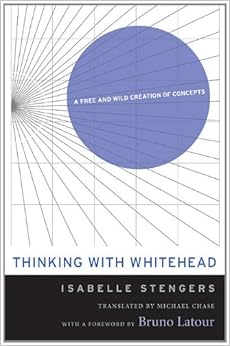
"My readers have now been warned"—halfway through Stengers' Thinking With Whitehead

At the end of chapter 16 of her book on the work of Alfred North Whitehead (just slightly over halfway through the text), Isabelle Stengers writes:
"My readers have now been warned. If they are fascinated by the heroic grandeur of refusal, and despise compromises; if they deplore the fact that the radical demands of every new position are recuperated by what was supposed to be subverted; if 'to deconstruct' is a goal in itself for them, and scandalizing self-righteous people is a testimony to truth; if they oppose the pure to the impure, the authentic to the artificial; if they cannot understand how the most 'unplatonic' of philosophers situated himself as a 'footnote' to the text of Plato ... let them close this book. Never will they see celebrated in it the power of a truth that is verified by the destruction of false pretenders. They will therefore find in it only disappointments and reasons for contempt." (Thinking With Whitehead, p.275-6)
And slightly different in French:
"Le lecteur est maintenant prévenu. Si, comme le Belzébuth mis en scène par Leibniz dans Confessio philosophi, dont la rage se déchaĂ®ne à l'offre de salut, il est fasciné par la pureté du refus et méprise les compromis, s'il déplore que les exigences radicales de toute position nouvelle se monnaient progressivement en contrastes enrichissant ce qu'il s'agissait de subvertir, s'il ne peut comprendre que le plus « non platonicien » des philosophes se soit situé lui-même comme « note en bas de page » au texte de Platon... qu'il referme ce livre. Jamais il n'y verra célébré le pouvoir d'une vérité qui se vérifie par la destruction de faux prétendants. Il n'y trouvera donc que déceptions et raisons de mépris." (Penser Avec Whitehead, p.310)
This is my third attempt to read this book and it's the first time that I am sure that I will reach the end. It is not that it is a 'difficult' book as such. Stengers, in her own inimitable way, writes with extraordinary precision. However, being something of an autodidact with respect to philosophy, I wasn't quite ready for such a dense and demanding text in the past.

It is a work that requires a very particular routine of reading. It cannot be read casually, put down and picked up a week or two later (not usefully, anyhow). At over 500 pages it is not something that can be read in one sitting, or several sittings, either. (There is no quick way through such a text—the whole point is that the reader slows down.) It requires, for me at least, extreme attention and focus. It's not something that I am able to read except when at my most clear headed, and then for a few hours at a time. Unfortunately, there aren't many windows like that in my week (I hope that soon this will change). I, out of necessity, do most of my own reading and research in the evenings—not a time of day conducive to this kind of endeavour.

Nevertheless, I am gradually working my way through the book—one immersion at a time—and it is most certainly worth the effort. It's the kind of book that, after having read it, I will never be able to read any other book in the same way again. It neither condescends to its reader nor indulges in unnecessary dissimulation. It attempts to be clear but, at the same time, transformative. This time around, I am finding that it succeeds in both respects. Again, I find that the best words for it are: precise but, at the same time, extraordinarily dense. It is the most exquisitely constructed thicket.

There is far, far too much in this book to even begin to summarise or select. However, I find the above quotation(s) to be a perfect signal of its tone and intentions. This dissuasion addressed directly to the reader is at the same time reassuring—I am assured that none of the things described appeal to me (and their sirenic allure is further muted with each and every passing page).

Sunday, 16 March 2014

Science as content provider/constituent producer

What's the difference between 'constructivism' Ă  la Latour, Stengers, Whitehead and 'realism' Ă  la Bryant, DeLanda, Morton, etc.?  Specifically, what's the difference with respect to their uses of scientific knowledge?

The 'realists' take science to be a content provider – that is, science provides and certifies a more or less stable list of entities with which the philosopher can justifiably populate the world as they see fit.

The 'constructivists' also want to populate the world with a wide range of entities and to grant these beings their autonomy, their powers, their dignity.  However, they (a) are not prepared to grant science the right of unilateral list-writing, (b) they emphasise the instability of the list (as a necessary precondition of science itself as much as anything else) and (c) they insist, above all, on making science a constituent producer – that is, the fact of scientific production as an ongoing process must be factored in to any substantial discussion of scientific facts, including their mobilisation in world-population exercises.

It is not that scientific facts are reducible to their construction or instauration (that is, this is not relativism in the vulgar sense) but rather that discussing scientific facts severed from their subtending networks results in a dogmatism that precludes politics and a simplicity that does no justice to science.  In other words, populating the cosmos is a shared interest but opinions differ on how it is to be done.

There's far more to this dispute than this one, only partially explicated difference, of course, but this is a key part of it, I think.  For one side 'realism' means that any discussion of scientific facts implies an understanding of scientific processes and that this implication must be made explicit in the discussion; for the other side 'realism' means that one can and should ignore this implication and sever, at least in rhetoric, the facts from their networks.  It's the difference between a realism that thinks it misleading or even meaningless to discuss scientific objects in abstraction from the processes that stabilise them as knowable and hence articulable entities and a realism that thinks it the quintessence of realism to do just this.

Speaking of God in the present tense

[I actually wrote this post last November and saved it as a draft (long before the recent pluralism hoopla, although it relates to those exact same issues).  I'd forgotten about it until now so it's just been sat there.  I'm not sure why I didn't post it originally.]

I am [or rather was!] just reading Isabelle Stengers' Thinking With Whitehead.  Actually, I am re-reading part of it.  I got about half way through it about 18 months ago and then gave up.  It is a tough read!

One thought: the even-handed way that Whitehead's God is treated is very interesting.  Not just for the ethically and politically 'diplomatic' reasons of engaging with values, nor simply for the scholarly reasons of articulating a philosophy in its own terms without reactionary judgement.

God is an awfully difficult figure to kill off.  First of all in philosophical terms.  He has played some kind of role in most philosophies.  Sometimes He was largely a political addendum designed to ward off accusations of heresy (often unsuccessfully).  However, quite often His presence was a technical necessity.  So it is for Whitehead (according to Stengers).  That technical requirement needs to be taken seriously.  We cannot simply assume that the heart of these philosophies can be ripped out and there will be no adverse consequences.  "I am afraid we cannot get rid of God because we still believe in grammar," as Nietzsche put it.  How many traces of God remain in our allegedly secular discourses because we believed that mere disavowal would be sufficient to drive a stake through His heart?

Second, in terms of sociology.  Religion has performed far more profound functions in our history than simply being a bunch of explanatory tenets that people 'hold.'  Human beings are not analytical philosophers.  The intensely political elements of religion can't be written off just by appeal to the crimes of this confluence.  The Inquisition doesn't prove or disprove anything in and of itself, nor do the Crusades.

Not only do we still believe in grammar but we structure our entire civilisation around the Invisible Hand.  That is the major inheritance we have received from our religious 'past.'  Societies structured around the machinations of this ghostly spectre are, ironically, gradually made irreligious as they become socially atomised.  Why do so few Europeans of Christian genealogies religiously participate these days?  It is certainly not due to people getting more intelligent or rational.  Nor is it even entirely due to increased scientific education.  Few of us go to church any more.  That locus, that heart of the community beats ever slower, ever emptier.  That is our principle religious inheritance.  The Invisible Hand that gradually erodes the outstretched, visible hands of community.

There is so much more to God and to religion than in the atheists' imaginations - this I can believe.

Atheists and secularists of all stripes need to take God very seriously and not just as something to 'fight against.'  God is not nothing.  We may convince ourselves that the wind whistling through the rafters is not a ghostly howling - but we can hardly write off the eerie draughts as non-entities.  We cannot shunt the whole assemblage into a category marked 'non-existent' and then forget about it.  We would be replacing draughts with a vacuum.  Likewise with God.  We needn't accept either the all powerful, transcendent God of Religion or the fragile, immanent God of certain philosophers but we would do well to heed the various philosophical, political, cultural, social Gods who have been very real within our communities in the past (and remain so in the present).

We may insist that God is an unholy amalgam but we should not write those parts off as trivial, nor expect that we will not miss them, nor arrogantly assume that they can be so easily replaced.

Monday, 3 March 2014

From the Earth/of the Earth; Earthling/Earthbound

Another really interesting post at knowledge-ecology on Kant, Sloterdijk, Whitehead and geocentrism.

I find 'monogeism' to be one of Sloterdijk's most useful coinages.  I don't think it's overstating the point to say that every philosophy must henceforth recognise the profundity of this condition: we are fundamentally bound to one planet, one earth; we are Earthbound, in Latour's terms.

And that very geocentrism is actually a necessary precondition of recognising the brutal indifference of the rest of the universe to us.  Planet Earth in its Gaian understanding is the only speck of existence that's even partially disposed towards our well-being - and its good favour is not guaranteed, indeed it's precarious.

That's not just an ecological or practical truth; any metaphysics that recognises life as something that figures on its register must now see that even if there is life 'out there,' or if, somewhere in the vastness of the cosmos, there is another celestial object that could possibly support life, it doesn't particularly matter.  Even if there are countless inhabited or potentially inhabitable orbs in existence the distance between them is almost certainly so vast that they effectively inhabit separate universes; and even if we find a planet or moon within a useful distance that has just the right mass, chemical composition, day and nighttime temperature, geological stability, shelteredness with regard to asteroids, etc. etc. Gaia-type theories tell us that even all this won't be enough to recreate another Earth.  And, regardless, we're now pressed into a civilisationary timescale where such fantasies as meeting aliens and colonising other planets seem utterly ludicrous and, worse, beside the point.

I think it says a lot that sci-fi is increasingly turning away from the old-school Star Trek groundplan of a lush, teeming universe towards an empty, impersonal universe, even one where the danger comes from exploration itself.  Gravity is an obvious case that springs to mind but there are more.  There are many, many differences between the original Battlestar Galactica and the remake but perhaps the most significant one cosmographically and dramatically is that the latter inhabited a largely empty universe without alien species, creating a feeling that was simultaneously claustro- and agora-phobic as the survivors cling to the insides of life-support systems that are always on the brink of failure.  Even the very Earth-like planet they colonise midway through the series is a harsh place unfit for much in the way of lifemaking.  Dr Who still operates in a lush, teeming universe but it realises a pure escapism; the TARDIS transcends time and space rather than travelling through it; it opts out of our situation rather than working through it.  Danny Boyle's Sunshine is an interesting one, too.  There's a moment when the crew are about to investigate an abandoned ship and are debating whether to split up or stick together; one of them says to another something along the lines of 'what, are you afraid we'll get picked off one by one by aliens?'  Obviously this sends up an old sci-fi cliche but, more than that, it demonstrates how far this universe is from the imaginaries of yore; the perils on which the drama hinges are technological, astronomical, elemental, psychological (and perhaps supernatural) but they are not alien.  Indeed, further on we learn that the central metaphysical question of the film itself (or at least of one of its characters) is that of human consciousness being universally sui generis and, consequently, imminent human extinction meaning the end of all awareness altogether.

It's a very different space we're in, these days.

I suppose it's the difference between being from the Earth and of the Earth; from being an Earthling and being Earthbound.

Friday, 7 June 2013

Lee Braver on Speculative Realism; The enduring allure of anti-realism (or subjective realism)

I've just been taking a look at the new issue of Speculations, particularly at Lee Braver's piece, which opens the issue.  As is typical of his prose the article is lyrical and beguiling but I do feel that he misses the point of many of the continental realisms and ends up hemming philosophy back into the traditional mind/world gap.
... [A]gainst the Speculative Realists, I still think that reality has to make some kind of contact with us for us to be able to talk about it. I don’t see how discussion of the ways that inanimate objects “experience” or “encounter” each other in the dark after we’ve all gone to bed could ever be more than mere speculation.
Instead he proposes a kind of "Transgressive Realism" which:
... emphasizes the way reality unsettles us. We can never settle down with a single way of understanding the world because it can always unexpectedly breach these. Such experiences do not get squeezed into our mental structures but instead violate them, cracking and reshaping our categories.
His Levinasian realism is interesting and well constructed, however he continues to locate the realist/anti-realist distinction in the gap between mind and world, reviving a mono-focal fixation on "mental structures," continuing to assume that we have a categorically more profound and privileged access to our own experiences such that we can describe these experiences without speculation; this in contrast to describing the experiences or beings of other things, which is a 'merely' speculative endeavour.  Braver is once again fixating on 'us' (whoever that is) -- 'we' are once again the benchmark of being.

What is so 'mere' about speculation?  It's only 'mere' if we contrast it to a kind of immanent certainty that could be spoken without any kind of risky inferential leap.  The accusation of 'mere speculation' suggests that our introspections aren't also speculative.  But when I describe my own experience, however transgressive or not, am I not also speculating somewhat?  Do I really know my own mind well enough to speak or act without speculating with regard to my own self (paging Dr Freud)?  If introspection is also intrinsically speculative then it makes no sense to take close hand experience as the benchmark of being in contrast to 'merely' speculating as to the experiences of other things, which we cannot possibly know.

Yes, it's true that "reality has to make some kind of contact with us for us to be able to talk about it".  No, we can't know the other in spite of or in abstraction from ourselves.  But nor can we know ourselves but imperfectly, speculatively.

Or, actually, to say that "reality has to make some kind of contact with us for us to be able to talk about it" is only partially true.  It's false insofar as it suggests that human beings are reality's passengers, passively awaiting perturbation.  On the contrary, it is through speculation we can bring hitherto untouched elements of reality into contact with ourselves!  Human beings aren't mute blocks of incomprehension randomly bumping around like un-piloted dodgem cars.  We're creative, manual, digital beings.  We can reach out and, yes, grasp things if only we speculate (and risk getting our fingers burnt).

What's more, what constitutes 'contact' differs by circumstance.  Things needn't be pressed hard against our noses in order for us to see them -- in fact distance aids focus.  Perhaps we can be 'in contact' with philosophical realities that broadly transcend us if only we rethink what we mean by contact.

Regardless, speculation isn't an epistemic or philosophical choice, it's a necessary condition of any persisting being.  Refusing to speculate as to the being of other beings apart from ourselves renders reality bifurcated: human mental structures -- mysteriously homogeneous -- and their attendant phenomenal apparitions on the one hand and every-bloody-thing-else 'out there' on the other.

Yes, discussing the being of other beings is speculative, abstract, imaginative even.  But so what?  So is everything else.  Of course, immanent self experiences are far richer, more immediate and more intensive than descriptions of the experiences of others can possibly be.  Perhaps we can thus say that describing the experience of an octopus is more speculative than describing my experience of an octopus.  But each is nevertheless speculative -- all translate.

Our real choice is not between speculation and something else.  We can either speculate on our own being as though it were somehow special, distinct and abstracted from the rest of existence or we can speculate more widely, ambitiously, inclusively and without the dead weight of the traditional bifurcations on our backs.  Such universal speculativeness makes true, foundational, untranslated, untranslatable, ahistorical knowledge impossible, sure.  But I know Braver doesn't mourn this loss with regard to knowledge of things so why does he seem to cling to it with regard to knowledge of selves?

Braver, for all his excellence, continues to judge philosophy according to the age old yard-sticks of certainty and human consciousness.  Just because we cannot know other things without speculating he judges that we should just stick to the disruptions of our own experiences.  But we cannot know these without speculation either!  The whole edifice falls in on itself no sooner than it has been lashed together.

Perhaps the problem is the 'speculative' element of speculative realism.  The likes of Brassier and Meillassoux aren't really speculative realists, they're realists.  Speculation has nothing to do with it (except for the fact that 'speculative philosophy' implies pre-Critical metaphysics, which is relevant for Meillassoux at least).  They really think that, via science and/or maths, they can discern the really real, the absolute, etc.  The only realists I'd describe as speculative in a substantial sense are those that follow Whitehead insofar as they recognise the inherent speculativeness of every entity, every actual occasion or object, in persisting in spite of unknowability.  If existence itself is speculative then there's nothing 'mere' about it.

Speculative philosophy is really just one variety of speculation.  The goal of describing the absolute or the being of other beings may well be so speculative as to be like reconstructing the Parthenon from a couple of shards of marble; but this wager is nevertheless necessary in order to avoid the many, assorted absurdities of a bifurcating philosophy fixated on only one side of an entirely false divide.  However comically it may teeter on the brink of impossibility the alternative is incomparably worse.

Transgressive Realism is just the same old anti-realism (aka subjective realism), differently nuanced.  It still puts humans and their bizarrely immanent, self-contained experiences at the centre of the universe; it still puts the anthropos at both the beginning and the end of philosophy.

Wednesday, 5 June 2013

The emptiness of philosophy, a pragmatic rendering

Levi Bryant argues that philosophy is empty and has no distinct subject matter.
The funny thing is that no one ever listens.  Scientists, for example, do just fine defining the epistemological and methodological requirements of their work and their eyes grow glassy whenever they are lectured by the philosopher about knowledge.
It's true that scientists don't need philosophers to put their abstractions in order.  However, it's also true that when scientists attempt to 'do' philosophy they often do so very badly.  Just because they don't need philosophers doesn't mean that their own implicit (or explicit) philosophies aren't dreadful and misguided, only that they function well enough for their purposes.

Actually, when thinking about what philosophy is I find it useful to start with what Geertz said of anthropology's relation to philosophy, which was that the role of anthropology is not to provide answers to the 'big questions' but to provide a record of the answers that various peoples have given to such questions.  If it is also true that, as Whitehead put it, the philosopher is the 'critic of abstractions' then it seems that we can anthropologise and pragmatise the practice of philosophy.

Not only scientists but even the denizens of remote, non-modern villages (i.e. the stereotypical subjects of anthropology) are perfectly capable of developing complex and sophisticated systems of abstractions.  Anyone capable of submitting such abstractions to some form of critique could be said to be philosophising.  What we call Philosophy is, then, simply the institutionalisation, formalisation and professionalisation of this function.  Which isn't to say that it is 'universal' but nor is it necessarily all that particular.  Perhaps some people are without a socio-linguistic capacity we could call 'critical' in this sense but wherever there *are* people with this capacity we can say that there is philosophy as an anthropological phenomenon.

So, in this sense scientists are already philosophers of their own life worlds.  As Latour has said so often, scientists are constantly doing metaphysics, constantly re-imagining how reality is stitched together.  If they lacked this capacity then they couldn't do their jobs.

But, then, how do I reconcile this with my previous point about scientists often making very bad philosophers?  Well, we could say that philosophy as a formalised, institutionalised phenomenon -- capital P Philosophy, if you like -- represents a canon of thought against which present philosophers are judged and through which an ongoing assemblage of competing and overlapping systems of rules, preferences and traditions are impressed upon present philosophers.

Or, in short, maybe everyone does philosophy but only a few do Philosophy -- only a few raise that basic anthropological function to a level of formality and deliberation that can be recognised as a distinct epistemic institution.  Scientists, for their part, are expert philosophers -- they have to be -- but they don't always make very good Philosophers -- because that requires a whole other set of experiences and competencies.

Thursday, 28 February 2013

Evidentialism vs. empiricism; Philosophy as an anthropological phenomenon

The other day I wrote that the world needs a concept of 'evidentialism' to supplant the perennial argument between rationalism and empiricism; it needs it because of the confusion between critical mindedness and plain, nasty and (dare I say it?) irrational cynicism.

Of course, when a lot of people say 'empiricism' they mean something a lot like 'evidentialism.'  Scientific empiricism is generally understood to involve the priority of experiment and the collection of evidence over abstract, a priori reasoning.  To this extent, 'evidentialism' is a superfluous coinage.  However, in stricter, more philosophical terms, the word 'empiricism' pertains to experience (and hence to a subject), rather than to evidence as such.  Evidence is the thing experienced but it is a secondary term -- something that enters into the equation once the grounds of experience have been established -- and it is these grounds that are the problem, not the evidence itself.

It is in this that empiricism and its other are all too similar; both empiricism and rationalism locate the problematique of knowledge in the subject -- in the mind that knows (or does not know).  And, as Latour, William James and others have argued, once the gap between mind and world is set out as something to be bridged it never goes away; the question of access, of the salto mortale, forever dominates the whole conversation.

The grounds of knowledge, as sociologists have demonstrated time and again, are in epistemic practices not abstract subjectivities.  These processes necessarily involve subjectivities, rationalities, modes of experience and so on but they are reducible to none of these and no one kind of subjectivity, rationality, etc. is germane to all epistemic situations.  Moreover, none of these things can be privileged more than the *evidence* itself. 

If we embrace evidentialism rather than 'empiricism' the experiencing subject is no longer primary and subject/object relations become but one consideration among many.  The processes highlighted by the notion of evidence involve both experiences and rationalities but also artifacts.  Evidentialism is, therefore, a social, practical, processual but also materialist concept.

Instead of subjectivities the artifacts and the processes by which they become artifacts -- i.e. items of evidence -- become primary and we begin from a real, worldly process rather than abstract subjectivity.  Understood in this way, experiences and rationalities are elements of epistemic processes; they are not the grounds of the epistemic in general.

But isn't this sociology of knowledge rather than epistemology?  Isn't this just turning a philosophical problem into a sociological one?  Yes and no; I think we need to think about philosophy itself slightly differently.

If knowledge is a worldly and practically, incrementally produced kind of entity then philosophy that is unrooted from the actual processes by which it is produced is a waste of time; it simply won't get us any closer to understanding what knowledge is or how it can be improved.  The philosopher as 'the critic of abstractions' (as Whitehead puts it) is not above or beyond the grubby complexities of evidence and sociology but, instead, embodies a set of critical capacities necessary for the proper execution of intellectual tasks.  This philosopher is a kind of critical subjectivity that any individual researcher should be able to embody and articulate in the course of research, to some degree.  In this sense 'we are all philosophers' -- although we're not all equally good at it.

Conceived in this way, philosophy is an anthropological phenomenon.  Philosophers as professional individuals simply embody these capacities full-time and (sometimes) get paid for it -- but they don't own any of it.  Individual philosophers most fully experience the mode of rationality particular to philosophy -- consequently they are its principle vehicles in the world.  Experience and reason are thus fully part of the process.

The pertinence of philosophy, thus conceived, to knowledge is that it is a form of rationality intrinsic to the academic or intellectual epistemic process, taken abstractly; it does not comment on the epistemic process from afar but, if it's doing its job, provides some of the tools by which it can occur at all.

That's a slightly jumbled and very schematic sketch of an idea, but I think it makes some sense (or at least it does to me).

Thursday, 14 February 2013

Whitehead, Latour, the reality of events, irreduction

Levi is back with some thoughts on realism, flat ontology and so on:
I just can’t agree with Whitehead regarding things like rainbows and the beauty of sunsets.  Oh sure, I think these things are real enough because they involve the properties of light coupled with brains. ... I draw a distinction between “exo-qualities” and “endo-qualities”.  An endo-quality is a quality that resides in the thing itself.  It’s there regardless of whether or not anything relates to it.  An exo-quality, by contrast, is something that only emerges in a relation between two or more entities.
Interesting stuff!  Forgive me my rambling:

Isn't 'light + rain + brain' an object itself?  Sure, they're objects individually and the rainbow qua aesthetic object only exists by their becoming related but, in Whitehead's terms, doesn't this combination of things forms a unique actual occasion?  In your terms doesn't it form an object, emergent from and irreducible to its component parts?  From the perspective of the rain droplets the rainbow may be merely exorelated as it is an event that the rain constitutes by entering into relationships with other things without exhausting the rain's own specificity.  However, from the perspective of the rainbow qua aesthetic event itself the rain droplets are endo-related because they are part of the event.

The fact that this event requires a brain is, therefore, neither here nor there -- it also requires a body, water, air, sun, particular atmospheric conditions, etc.  Rainbows aren't real in the same way that rain drops are real -- this is certainly true.  But this is a perspectival question since you could equally say that, from the perspective of an oxygen atom, the water molecule that it constitutes along with two hydrogen atoms isn't 'real' in the same way as the atoms themselves.  The water molecule isn't 'real, out there' because without the oxygen atoms there would be no molecule.  Similarly, the rainbow isn't 'real, out there' because without the perceiving brain there is no rainbow, only water in air forming a prism that diffracts light.

If there is a difference between these two examples it is because you have introduced a distinction between cognitive apprehension and other kinds of relations -- not an indefensible argument but one that must be made carefully.

So, beauty isn't a property of the droplets or the lightwaves or even these things together but we can definitely say that it is a property of the rainbow.  Beauty is a property of the rainbow so long as we accept that the rainbow is constituted by perceiving beings as well as rain, light, etc. -- that it is not an object perceived by a subject but an object that includes a subject.  The rainbow is not beautiful unless it includes a mind that perceives it as such but that doesn't mean that beauty is not a property of the rainbow itself, that beauty is confined to the mind.  It just means that it is contingent upon the precise constitution of the aesthetic event.

I'm just thinking 'out loud' now but we could say that two people looking at the 'same' rainbow won't experience beauty in the same way, therefore beauty is only in their minds.  But Whitehead could just say 'well, they're not looking at the same rainbows, then'.  They're looking at the same droplets and light rays, perhaps, but not the same rainbows.  So, rainbows are subjective, as is their beauty, but they are subjective in the sense that they include one and only one perceiving subject.  They are not a subjective apprehension of an external objective reality as this would mean perceiving subjects transcending objective reality, all looking out on the same, singular reality but experiencing it severally.  But they are a singularly subjective apprehension in the sense that these aesthetic events -- the rainbow qua beautiful thing -- can only include one perceiving subject.  When two or more people look at the 'same' rainbow they are experiencing two different events that merely share some constituent parts.

So, it's not a case of several subjects perceiving a singular reality but several aesthetic events involving an overlapping plurality.  This makes sense to me but it clearly requires a category of 'subject' distinct from other kinds of objects because there are many objects within a rainbow -- billions of water droplets, innumerable lightwaves, etc. -- but, for it to be a 'subjective experience' in the manner I described, it can contain only one subject.  Add another subject and you have two aesthetic events.

Although perhaps we are not trapped in our individual subjectivity.  Perhaps if we talk about, write about, paint about our experiences of beauty and if we share the same cognitive and aesthetic preconditions with other subjects then we can share experiences of beauty.  Perhaps through social, artistic processes we can draw our experiences together and perhaps we can meaningfully talk about multi-subject aesthetic events.  But those subjects would have to be drawn together by other conditions beyond the isolated events themselves.  We'd have to be drawing in further mediators, as it were.

Anyway, on Latour's principle of irreduction, people seem to forget what he actually says:
1.1.1 Nothing is, by itself, either reducible or irreducible to anything
else.
• I will call this the 'principle of irreducibility', but it is a prince
that does not govern since that would be a self-contradiction
That's his first principle in its entirety and each part of it is significant.  People often fixate on the 'irreducible' part and think that the principle is all about everything being unique and sui generis and nothing being articulable in terms of anything else.  I recall Ray Brassier in his review of Irreductions being most upset at how Latour said, first, that everything was irreducible but then proceeded to reduce everything -- even science, the horror! -- to his own terms.  He didn't realise that this is actually Latour's entire point! -- that the only way of understanding and perhaps even existing in the world is via an infralanguage (or something similar) that articulates other things in its own terms, thus reducing and rendering articulable what may be irreducible in its entirety but is not entirely irreducible.  (But then I don't think Brassier even really tried to understand that book -- his intention was damnation, not fair reading.)  Latour later calls this process 'formatting' and it's really the core of his whole philosophy.

Anyway, I'm all for unflattening the ontology.  Flattening it is just a first, critical step taken to erase all the fallacious distinctions that others have made in error.  Ultimately, having reduced everything to a single type, one must be able to make categorical distinctions within that typology.  Perhaps subjectivity can be suitably rearticulated in the manner I described above, or some other way.

Saturday, 19 November 2011

On 'Lenses'

Two sides of the ocular metaphor:
1. Tinted lenses: 'If only we could see things unimpeded! Our lenses shamefully limit us.'
2. Spectacles: 'Without our lenses there is only blurry continuum! Our lenses are all we have.'

(Aren't we told so often to 'be reasonable' and see through one type of lens with one eye and the another with the other? No wonder we get sea-sick on dry land!)

Both sides of the metaphor rely on a beginning a middle and an end: An 'outside' which somehow gets 'inside' via a liminal point that transforms and protects the outside and inside, respectively. Both versions of the metaphor require the tripartite schema. Thereby, a more elongated, complicated schema is rendered unthinkable; for example, a schema of trajectories, trains or chains with many points of transformation rather than just one.

It is not that there is no transformation (everything being essentially of the same underlying substance), it is that there is no one point of transformation where one substance is trans-substantiated into another (nature into mind, things into thought, world into words). We need to be able to understand transformations where they actually happen without being prejudiced a priori as to where they supposedly must happen (at the liminal point between 'inside and outside' -- always). The location of transformation is a question of fact rather than principle, as is the quality and quantity of transformations (we must assume that there are many).

We can't be the realists of the tinted lenses cursing our luck at the stubborn obduracy of these lenses, nor can we be the anti-realists dismissing all the outside as so much unseeable nebulous hazyness. We must be realists of transformation, wheresoever it occurs.

Therefore, the ocular metaphor is useless for us (unless we can perhaps come up an example of a delicately arrayed series of lenses that are all necessary but independently insufficient to their collective refraction -- but even then we might be reducing each lens to the whole, which would take us back to square one).

Monday, 7 November 2011

Process and Politics

An ontology in which things are always in process and nothing is ever fully achieved or closed is not in itself morally or politically superior to any other way of thinking. It simply solves some problems some of which are moral and political. In particular, one never has to draw a line between that which is achieved and henceforth settled, beyond dispute and universal and that which isn't.

It is an axiom of experience and so of common sense that not everything is settled, beyond dispute and universal (Parmenides notwithstanding) and so to say that there are some things like this means that there must be a line. The drawing of this line is one of the main problems of modern philosophy and seems irresolvable (as does the question of such resolution's desirability). Doing away with the line does away with the problem, which is both philosophical and political.

We could revive Parmenides but that doesn't seem very plausible or useful (this is dismissive but probably fair, particularly if we take experience as the spur of conceptualisation a la Whitehead). The opposite is plausible and can be shown to work, to generate greatly conceptually sophisticated schemas that are able to do justice to all sorts of aspects of reality while redefining what we mean by reality itself.

If this leads to moral and political sophistication too then this is excellent. Yet these are not the only problems that such conceptual work resolves nor the only problems that it is a response to.

If a term is valuable it must be a 'meso' term. Too general and it becomes meaningless, too global. Too specific and it is too inapplicable, too local. Politics is like this. When politics becomes the question that dominates any given consideration it becomes effectively meaningless because there ceases to be any way of distinguishing between different kinds of good, different valuations. It is valuationally hegemonic - and this is bad for all sorts of reasons, including political ones!

If politics is too easily achieved (if 'everything's political') then there is no reason to do anything in particular in order to achieve politics. If politics is too rare (only appearing in epochal fissures or 'events') then despondency sets in (what agency could anyone have in bringing about something that is by definition vast and impersonal?).

Politics must be accessible but not without effort: just like everything. Moreover, it shouldn't be the only kind of value as this both eliminates other kinds of valuation but also makes politics total, which also makes it meaningless (and so you've lost all kinds of values but also lost politics - worst of all worlds).

Above all politics must be an achievement and this makes process ontology fit it perfectly. The alternative, where elements of reality are absolute, unchanging and beyond dispute, means that the passing and contingent can be subordinated to this fundamentally ulterior realm. Those with access to that realm - which is always already achieved and need only be accessed - thereby become legislators, even dictators, for those who merely splash around in what is contingent. This is intolerable.

For the above reasons: Politics (as I would like to describe it) needs process but process must be justified for more than political reasons. Other valuations must be involved.

Pluralism must also mean that politics is only one value among others. This is what too many people forget.

Thursday, 22 September 2011

On Perspective

Henceforth, my dear philosophers, let us be on guard against the dangerous old conceptual fiction that posited a "pure, will-less, painless, timeless knowing subject"; let us guard against the snares of such contradictory concepts as "pure reason," absolute spirituality," "knowledge in itself": these always demand that we should think of an eye that is completely unthinkable, an eye turned in no particular direction, in which the active and interpreting forces, through which alone seeing becomes seeing something, are supposed to be lacking; these always demand of the eye an absurdity and a nonsense. There is only a perspective seeing, only a perspective "knowing"; and the more affects we allow to speak about one thing, the more eyes, different eyes, we can use to observe one thing, the more complete will our "concept" of this thing, our "objectivity," be.
- Nietzsche, The Genealogy of Morals (iii: 12)

What a monstrous notion: a truth is only true from a perspective. Doesn’t it follow that the mob rules? The truth of a hundred wretched thugs automatically overwhelms and outweighs that of a single, solitary beautiful mind. Could there be anything more threatening to civilisation?

Perhaps some would relish the rise of the baying mob. Yet to interpret ‘more eyes, different eyes’ as meaning simply ‘more people’ seems, to me, to be a little simplistic. When we re-read something we wrote a length of time ago do we not say that we are doing so ‘with fresh eyes’? When presented with fresh experience who doesn’t ‘change their minds’? What Latour says of scientists is true of everyone (and perhaps everything): we never stand in our standpoints (Pandora’s Hope, p.66).

Place a scientist, a painter, a builder, a journalist, a historian and a politician in front of a statue. If they are made to stand completely still, unable to move a muscle what will they be able to tell you about that statue? ‘There is a statue.’ Nothing. From a single perspective nothing can be said. But what if each are allowed to move, to follow whatever trajectory they please? Then you will see that each move differently. The scientist may examine the statue closely and perhaps take a sample of the stone and head towards a laboratory. A painter may set up an easel, size the object with thumb and forefinger and mix paints to match the weathered hue of the stone. A builder might wander up, kick and prod at the base and wonder how ‘they’ fixed it there. A journalist might walk around, asking other people what they think. A historian might head away from the statue and dig around in archives to discover what other people have thought. A politician might stand up and address the crowd, hoping to get a statue of her own!

Each subject, armed with its own interests and abilities, proliferates perspectives. This is why we should understand ‘perspective’ absolutely literally. If you stand bit to the left you are in a new perspective. If you close one eye, that is a new perspective too. This may seem ridiculous until you realise that the manner in which one (a) proliferates perspectives and (b) joins those perspectives together differs enormously. No one ‘stands in their standpoint’ but some shift in and out of frames of reference faster than others and there are as many ways of shifting in and out as there are subjects.

Perspectivism is only agnostic – not knowing – if we imagine each subject as a fixed point, forever condemned to see the same world through the same eyes. Perspectivism only leads to not knowing if we imagine each subject as a statue. Perspectives proliferate and they translate in various ways. Once we recognise this we become aware that we can follow the proliferation and translation of perspectives. The process of epistemic realisation becomes ontological, therefore experiential, therefore empirical.

But are statues ‘statues’? Do they remain fixed to their own standpoint? Hardly! They move and creak and groan. Some have captured the gaze of humans for centuries, even millennia. Conquerors and colonialists may have had no respect for those they raped, murdered and enslaved but they respected the statues they brought home with them. Statues might not prance, ponder, paint or pontificate but their reality is their own. They go about subsisting in their own way. And they might not ‘think’ but they do ‘act’ upon us. Their reality is not our own.

It should have been obvious – few philosophers despised the masses more than Nietzsche – but ‘mob rule’ and perspectivism have nothing to do with each other. If some have celebrated the descent of truth from a twinkle in a star-gazers’ eye to a cloud of spittle launched from a wild-eyed horde then they have been clutching very much the wrong end of the stick. If from a crowd of ten people you count ten perspectives then you have somehow remained stuck in three dimensions; you have forgotten time.

Everyone shifts perspectives but the (a) rate and (b) manner of this shifting is widely variable. Our task is to understand these variables.

Henceforth, my dear philosophers, let us be on guard against all those who would forget time and lock each and every person into ‘their’ standpoint.

Sunday, 7 February 2010

Reply to Prof PTJ

Comment on: http://duckofminerva.blogspot.com/2010/02/two-philosophers-shoveling-snow.html

A very witty piece. I basically agree. However, I think something needs to be challenged: the notion of 'intersubjectivity' as the privileged site of knowledge (and thus 'reality') construction.

The primary disagreement between Roy and Will seems to be Roy's fury over Will's refusal to attribute the 'in-itself' (i.e. the snow in its 'intransigent' materiality) any 'agency' (loosely speaking) with regard to its own understanding. For Roy the snow has both transigent and intransigent qualities and while it can be understood differently by people with different sensory/cultural dispositions it nevertheless possesses a certain 'snowy-ness' that cannot be ignored; to ignore it, it is supposed, is to commit the 'epistemic fallacy', which assumes that mind arbitrarily 'makes' world (Alex Wendt's 'pigs don't fly just because you think they do' skit is a typical example of this reductio ad absurdum argument). In other words, as Will rightly points out, critical realists of this bent assume a dichotomy of possibilities where either mind is exterior to the 'real' world and imperfectly 'reflects' this reality or mind is coiled up in its own interiority 'creating' all fictive experience in the manner of an auteur. This, of course, assumes that mind can only ever be conceived of in the classical sense of an abstract ideational thing suspended in the ether, separate from 'reality' and (most likely) 'materiality' too. The likes of Will, on the other hand, take the mind to be far more extensive and always-already involved in and constituted by the 'real', which, instead of being the creative produce of a sovereign, rational, unproblematically legible mind, is produced intersubjectively (this is the key point).

So, this assumes that there exists a network of cultural-linguistic beings, all constituted by their shared reality. The 'epistemic fallacy' no longer works because the creation of reality no longer centres around the individual but rather is the product of the network of intersubjectivity, which precludes the narcissistic volitionalism of the subjective idealist that critical realists try to imagine all their opponents as. And yet the general thrust of the critical realist critique - that subjective idealism is narcissistic/solipsistic - is not, I think, rebutted - at least not entirely. I think this because the intersubjectivist theory remains resolutely anthropocentric. Why is it only subjects (i.e. humans) that get to play this game? For all our fancy tricks, what is so special about us flesh-bags?

We need another character; let's call him Alfred. Also a mind/world monist, Alfred agrees that knowledge is created intersubjectively but he wants to go further than this. He argues that 'experience' (his term) is a property common not just to subjects but to objects as well. He is, then, a panexperientialist - like a panpsychist (who thinks that all matter has the property of 'mind') but with a distinction made between experience and cognition. Knowledge and thus reality, for Alfred, are inter-objective productions (in the broadest sense that subjects are also objects - very distinct kinds of objects both existentially and ethically but objects nonetheless).

His theory is, like the intersubjectivist's, perspectival - what is 'real' depends entirely upon one's perspective, whether one is a subject or an object. In other words, there exist an infinite number of possible realities on one ontological plane. Humans are no longer the be-all-and-end-all that intersubjectivism would have them, yet every human individual's experience is distinct and each experience is a reality, just like intersubjectivism.

So, when Roy is raging about Will's refusal to take the snow's 'in-itself' as 'real' and Will, effectively, just shrugs it off, Alfred would be able to transcend both positions and come up with, I think, a far more satisfactory answer: the experience of shovelling snow is created inter-objectively with Will's culturally and linguistically imbued dispositions shaping the particular reality of the experience but the snow's 'actancy' (to borrow Alfred's grandson Bruno's term) also contributing in its own right. (The event of Will shovelling the snow is, then, in a manner of speaking, every bit as much a 'conversation' between two agentially empowered but relationally and processually constitued actants as the conversation between Will and Roy.)

Will maintains his monism and Roy's blood pressure can return to safer levels providing he can accept the loss of the 'in-itself' for the gain of the object as an 'actant', which, knowing Roy, he won't but that's his problem not Alfred's!