Bruno Latour's keynote from the Millennium conference in London last October has now been published: Onus Orbis Terrarum: About a Possible Shift in the Definition of Sovereignty. Alongside it is an interview conversation between Latour, Mark Salter, William Walters and Iver Neumann: Bruno Latour Encounters International Relations: An Interview.
In the latter, one of the interviewers mentions a point I made (to be cited: still very much a novelty for me!) in my article on Latour's geopolitics, published last year. Specifically, I suggested that his work had shifted in the last 10 or 15 years from a conceptual vocabulary mostly concerned with parliaments and procedures to one perhaps better characterised by the term, borrowed from Jenny Edkins and Maja Zehfuss, the 'generalised international.'
This connection is something that I really just threw in to the article without much explanation. The point that Edkins and Zehfuss were making in their article was that 'the international' is generally understood, in International Relations (as an academic discipline) at least, as a realm of contingency, uncertainty, negotiation and open-endedness. In other words, of anarchy (see also Alex Prichard on this point). This realm is then generally pathologised relative to the 'domestic' arena of order, law, certainty and control. Their appeal, therefore, in 'generalising the international' is to embrace this more anarchic political sensibility not as the illegitimate other of the domestic but as a general condition of a politics 'open to the future.'
The connection to Latour's work is, I think, not completely straightforward or equivalent. However, from at least his War of the Worlds: What about Peace?, published in 2002, Latour has not only tended towards a predominantly 'geopolitical' conceptual vocabulary rather than a 'parliamentary' one, but he has increasingly emphasised the importance of Carl Schmitt's distinction between war and police operations as distinguishing fundamentally different political conditions.
The major difference that I papered over in my passing allusion is that, for Latour, the 'anarchic' political situation is not necessarily the preferable one. A state of war may be 'open to the future' in a way that a police operation is not – recognising this state is the precondition of negotiating a peace that is more than nominal. However, it is more a matter of recognising the state that we are in than it is opting for a political imaginary that is morally preferable in any general sense. And so, I suppose, in the end, we meet with different meanings of 'generalisation.'
Showing posts with label millennium conference. Show all posts
Showing posts with label millennium conference. Show all posts
Tuesday, 19 April 2016
Tuesday, 20 October 2015
"My enemy is arrows. I want to get rid of arrows" – Bruno Latour on maps, earth and International Relations
One of the first academic conferences I went to was that of the Millennium journal of International Relations in 2012. The theme was 'Materialism and World Politics' and IR, always late to any bandwagon, was doing its best to catch up. One striking pattern that was immediately evident was the proliferation of references to a certain Bruno Latour in many papers and presentations, particularly amongst students and early career academics. Up to that point, his name was almost completely unknown amongst IR scholars – surely one of the last provinces of the social sciences and humanities to remain so unperturbed.
Three years on and Latour was Millennium's headline act, delivering the keynote lecture. This was filmed and will presumably be made available online in the next few days. Consequently, I will not try to summarise it but will just offer some thoughts.
The lecture began with a visual comparison of Hobbes' famous frontispiece with a recent front cover from Nature.
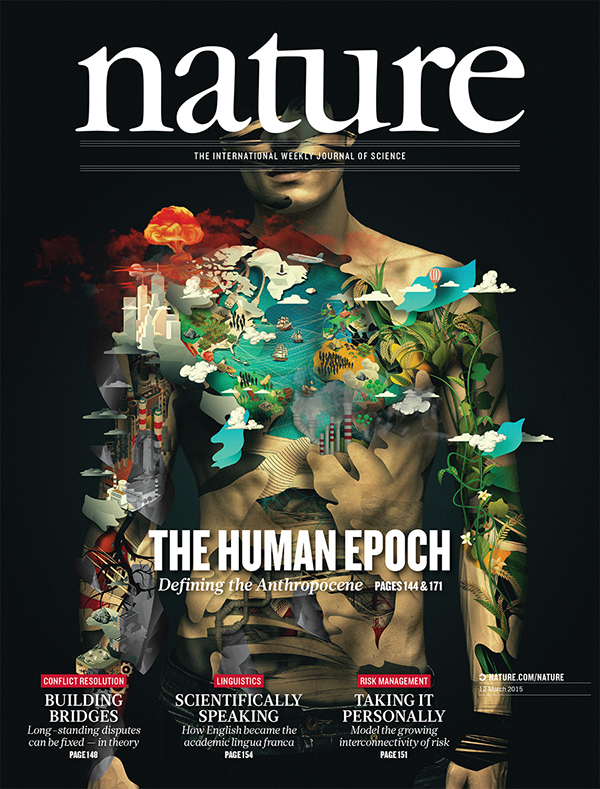

Both are monstrous but in totally different ways. The Anthropocenic human juts out randomly, stupidly, headlessly. The Hobbesian sovereign is all measure, calculation and looming menace. This speaks to the real difference between them: Hobbes was proposing a solution to the problem of political order that had so drastically broken down in his time; Nature, on the contrary, is representing the problem of the Anthropocene, a problem of order – indeed, political order – without any apparent solution in sight. The problem of Nature's image, then, is precisely the disappearance of Nature as an organising principle of geopolitics in the fullest sense of that term.
This is one thing that I was trying to get at when I recently wrote at a fair bit of length about Latour's conception of geopolitics and, particularly, his reading of Gaia. The key feature of Gaia, taking James Lovelock's iteration somewhat creatively, is that it is not any sort of personal deity because it doesn't care one bit about the fate of any individual or species but, at the same time, Gaia is not Nature because it is not indifferent or external to human action – it reacts, it is perturbed, it is responsive. To quote myself:
Oliver Kessler mentioned in the closing panel of the conference that he wished that Latour had used the modified version of this image from Shapin & Schaffer's Leviathan and the Air-Pump.
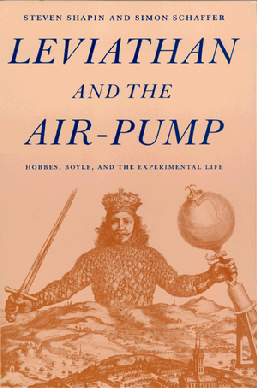
That would have been an interesting connection but the point that Latour was making concerned political unity rather than the relation between science and politics per se. In any case, Latour's attempt to imagine a representative geopolitics of this Gaian situation was precisely the overarching theme of his lecture.
Representation in every sense of that word – political, scientific, artistic. And representation not in the vague, vain liberal sense of 'letting everyone have their say.' It was very clearly representation as a precondition of action. In other words, it was a question of collective will and adherence; of achieving the political infrastructures by which a collective could act – and a collective that is constituted by far more than just humans and their (delegated or imposed) spokespeople. A form of action that requires the alignment of actors of all kinds (and here the humanists leave the room…).
To self-indulgently quote myself again (because I can't think of a better way of putting it than this sentence that I spent months writing and re-writing):
This must unground every sense of earth, terrain, territory on which International Relations, knowingly or unknowingly, has based its object.
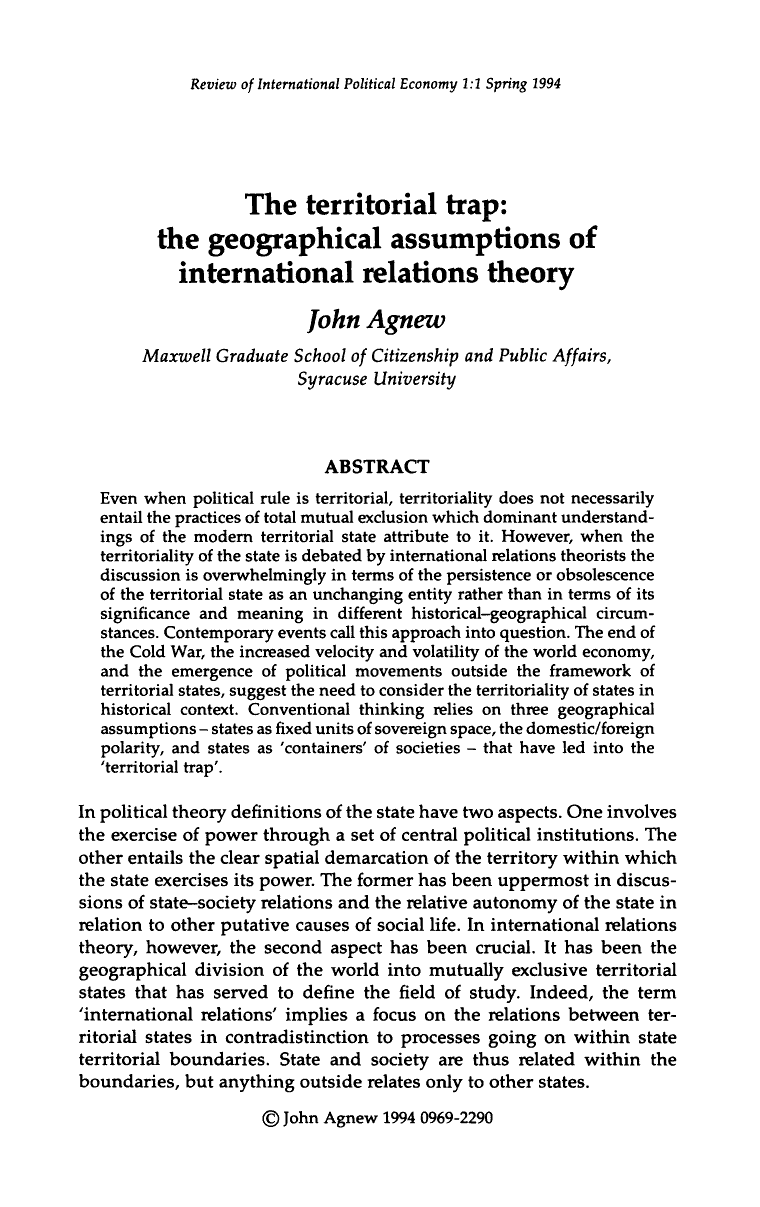
But here we should pause. Geopolitics is not IR. To re-hash John Agnew's famous article The Territorial Trap, IR has been consistently ignorant of the space, the materiality, the environments that its institutions presupposed.

Political geography was born as a discipline in the imperial struggles of the late nineteenth-century. Its reactionary extremes directed and enthusiastically served those ends – knowledge of the earth, its environments and climates was to found the efficient, ruthless administration of empire. This is, quite unambiguously, the root of 'geopolitics' (the word itself was coined, as 'Geopolitik,' in 1899).
Some would say that IR was born as a discipline in 1919 (at my home institution in Aberystwyth, from which I type these words); however, it only really got going as a disciplinary space and movement in the 1950s with sponsorship from the Rockefeller Foundation, among others. At this time, 'geopolitics' had all but disappeared from conversations in polite society as it had become had it become almost synonymous with Nazi expansionism via Karl Haushofer's association with the regime (a somewhat more complicated relationship than was recognised at the time but nevertheless).
Geopolitical ideas were soon revived by the likes of Henry Kissinger who reconstructed them for the new era of empires that the so-called Cold War brought about but human geography as an academic discipline on the whole lost its connection with international or global politics. IR, meanwhile, soaked as it was in the behavioural sciences and the realpolitik of its various émigrés, had little interest in the complexities of the ways that the world gets composed. The planet was, by this point, known rather well (or so they thought) and explanatory power was to be sought primarily in understanding the behavioural characteristics of human beings and their institutions. Their agenda was, variously, to secure peace and to overcome the non-liberal remnants of 'History,' in the Hegel/Fukuyama sense of the word.
This aside has a point, which I will now get to: 'environment' in IR has always been a special interest, a subfield, something to do with whales; 'earth' has been either an anachronism or an irrelevance; 'space' has been what you put satellites in.
Is there any discipline less prepared for what is coming than IR? I can hardly believe that there is. And yet, does this mean that IR must be brought to an end? Perhaps not.
Latour's lecture concluded with an overview of the 'Make It Work!' event – essentially a Latourised model UN – that was held in Paris this summer. The main point made by this event was that oceans, icecaps, forests, etc. – all these also require political representation, alongside corporations, NGOs and states.
And states. It is so very easy to denounce and demean this mode of geopolitical organisation, born out of the historical milieu that is encapsulated by Hobbes' towering phantasm. But let's be honest, the 'Westphalian state system is redundant' critique practically writes itself at this point, doesn't it?
"The old (but still useful) world of States" – this was on one of Latour's slides.
And this brings me to the Q&A session that followed the lecture. Two of the questioners made more or less the same point: Okay, so having non-state representatives representing beings other than humans is good but are we to believe that states do such a wonderful job of representing people? Verily, if (critical) IR scholars have achieved anything over these years it has been to demonstrate the vicious iniquities of state-based political complacency!
I was reminded at this point of the Olympics where stateless athletes are permitted to compete under an independent banner.

Of course, all of this raises questions of power. How does anything come to be represented politically? By demanding that it be so. In other words, through struggle. Or, to put it in more Latourian terms, how is a 'middle ground' ever formed from which diplomacy can begin? According to Richard White, this too is about power. All sides must be capable of compelling their other to meet on the middle ground rather than imposing a settlement from without.
But returning to my thread, if we are to extend representative politics to more than humans is this not a perfect time to reconsider how we represent human beings too? And is not a discipline such as IR not well placed to consider such a task? Well, perhaps. But not on its own. IR's ignorance of space and geography is well known but its connections with anthropology are not much better. The very concept of representation, for instance, was also born around the time of Hobbes – it is no more universal than 'Nature.'
Here it might be opportune to cast our minds back to Patrick Thaddeus Jackson's keynote at the Millennium conference last year:
Plainly, there is a need for a complete re-evaluation of what the purpose of IR in this new world is. Reconsidering its relations to not only geography and Earth system science, etc. but also to anthropology and other forms of knowledge production besides. A comparative and interstitial sociology of social science.
Is there an appetite for such self-criticism within this most cloistered and jurisdictionally jealous of academic disciplines? Some, perhaps not enough. But it is a conversation worth having and a task worth attempting – and one that Latour's work will help us to initiate, even if he by no means has all the answers.
But perhaps I should end with the quote that titles this post. 'What's so wrong with arrows?', I hear you ask. Well, Latour tells us, you draw an arrow on a map when you need to account for something that the map itself (base map plus territorial outlines) says shouldn't be there – migration, movement, pollution, mess. In other words, if you need to draw an arrow it's because your map is inadequate to its representational task because it assumes a flat, stable base upon which everything else is projected rather than trying to capture the territorial complexes in motion and in their own complexity; that is to say, in the process of their ongoing assembly.
This is a difficult point to grasp without a thorough transformation of conceptual vocabularies. For example, this is how Latour describes 'territory':
That is an exciting prospect but not one that IR is well-prepared for. Nevertheless, I think we can most certainly all count ourselves as 'perturbed' – whether this way or that – by now. If nothing else, Latour is laying down a challenge that tremors right across the disciplinary landscape. To what extent it will uproot IR's usual comforts and homilies remains to be seen but it will be interesting to find out.
Three years on and Latour was Millennium's headline act, delivering the keynote lecture. This was filmed and will presumably be made available online in the next few days. Consequently, I will not try to summarise it but will just offer some thoughts.
The lecture began with a visual comparison of Hobbes' famous frontispiece with a recent front cover from Nature.
Both are monstrous but in totally different ways. The Anthropocenic human juts out randomly, stupidly, headlessly. The Hobbesian sovereign is all measure, calculation and looming menace. This speaks to the real difference between them: Hobbes was proposing a solution to the problem of political order that had so drastically broken down in his time; Nature, on the contrary, is representing the problem of the Anthropocene, a problem of order – indeed, political order – without any apparent solution in sight. The problem of Nature's image, then, is precisely the disappearance of Nature as an organising principle of geopolitics in the fullest sense of that term.
This is one thing that I was trying to get at when I recently wrote at a fair bit of length about Latour's conception of geopolitics and, particularly, his reading of Gaia. The key feature of Gaia, taking James Lovelock's iteration somewhat creatively, is that it is not any sort of personal deity because it doesn't care one bit about the fate of any individual or species but, at the same time, Gaia is not Nature because it is not indifferent or external to human action – it reacts, it is perturbed, it is responsive. To quote myself:
"However, responsiveness is not responsibility. Gaia can summon no Leviathan; there is a Great Society but no Great Community [à la Dewey]. Of course, it is not that Gaia ‘lacks’ the appurtenances of a formalised polity per se – it is only we Earthbound that such a supplement impels; it is, rather, that Gaia, our past and our present, will only be our future – we will only have a future – if such an assembly is realised."The image I had in mind at this time was precisely Hobbes' most famous image and the cohesiveness and unity of that ugly apparition looming over the English countryside. Nothing could be less true of the geopolitical predicament that Latour is addressing. There is no Global State – nor will there be. The things formerly known as natural do not bring unity; total knowledge of the Earth's surface in no way allowed it to be mastered (some of its occupants, perhaps, but this paramilitary victory was plainly overestimated); its complex spatiality greatly exceeds merely topographical imagings; the things formerly known as natural, in fact, disturb, destabilise and destroy the comforts of order and regulation, they do not and will never again give it a secure foundation. This realisation, to parrot Naomi Klein, changes everything.
Oliver Kessler mentioned in the closing panel of the conference that he wished that Latour had used the modified version of this image from Shapin & Schaffer's Leviathan and the Air-Pump.
That would have been an interesting connection but the point that Latour was making concerned political unity rather than the relation between science and politics per se. In any case, Latour's attempt to imagine a representative geopolitics of this Gaian situation was precisely the overarching theme of his lecture.
Representation in every sense of that word – political, scientific, artistic. And representation not in the vague, vain liberal sense of 'letting everyone have their say.' It was very clearly representation as a precondition of action. In other words, it was a question of collective will and adherence; of achieving the political infrastructures by which a collective could act – and a collective that is constituted by far more than just humans and their (delegated or imposed) spokespeople. A form of action that requires the alignment of actors of all kinds (and here the humanists leave the room…).
To self-indulgently quote myself again (because I can't think of a better way of putting it than this sentence that I spent months writing and re-writing):
"Gaia is not just the scene of politics, nor a violent interjection to it, but a dramatic, swirling convolution of world-convening relations – a collective constituted by all the constituents that she collects."This is why Gaia is at the centre of Latour's geopolitics. It is not a unity. It is not a single, homogeneous, centred actor. It is not a totality and it is not nature. It has no one name. It is not something everywhere the same. It is impersonal but not indifferent. It is violent but not malevolent. It has intentionality but no teleology.
"There is only one Gaia but Gaia is not One."It is, above all (and in more than one sense of that phrase), a sovereign. Here we see that, however 'flat' Latour's philosophy may or may not have been in the past, his 'Gaia-politics' presupposes an emphatic verticality; a power, a transcendence that vastly exceeds human actions but does not transcend them in the sense of being in any way exterior.
This must unground every sense of earth, terrain, territory on which International Relations, knowingly or unknowingly, has based its object.
But here we should pause. Geopolitics is not IR. To re-hash John Agnew's famous article The Territorial Trap, IR has been consistently ignorant of the space, the materiality, the environments that its institutions presupposed.
Political geography was born as a discipline in the imperial struggles of the late nineteenth-century. Its reactionary extremes directed and enthusiastically served those ends – knowledge of the earth, its environments and climates was to found the efficient, ruthless administration of empire. This is, quite unambiguously, the root of 'geopolitics' (the word itself was coined, as 'Geopolitik,' in 1899).
Some would say that IR was born as a discipline in 1919 (at my home institution in Aberystwyth, from which I type these words); however, it only really got going as a disciplinary space and movement in the 1950s with sponsorship from the Rockefeller Foundation, among others. At this time, 'geopolitics' had all but disappeared from conversations in polite society as it had become had it become almost synonymous with Nazi expansionism via Karl Haushofer's association with the regime (a somewhat more complicated relationship than was recognised at the time but nevertheless).
Geopolitical ideas were soon revived by the likes of Henry Kissinger who reconstructed them for the new era of empires that the so-called Cold War brought about but human geography as an academic discipline on the whole lost its connection with international or global politics. IR, meanwhile, soaked as it was in the behavioural sciences and the realpolitik of its various émigrés, had little interest in the complexities of the ways that the world gets composed. The planet was, by this point, known rather well (or so they thought) and explanatory power was to be sought primarily in understanding the behavioural characteristics of human beings and their institutions. Their agenda was, variously, to secure peace and to overcome the non-liberal remnants of 'History,' in the Hegel/Fukuyama sense of the word.
This aside has a point, which I will now get to: 'environment' in IR has always been a special interest, a subfield, something to do with whales; 'earth' has been either an anachronism or an irrelevance; 'space' has been what you put satellites in.
Is there any discipline less prepared for what is coming than IR? I can hardly believe that there is. And yet, does this mean that IR must be brought to an end? Perhaps not.
Latour's lecture concluded with an overview of the 'Make It Work!' event – essentially a Latourised model UN – that was held in Paris this summer. The main point made by this event was that oceans, icecaps, forests, etc. – all these also require political representation, alongside corporations, NGOs and states.
And states. It is so very easy to denounce and demean this mode of geopolitical organisation, born out of the historical milieu that is encapsulated by Hobbes' towering phantasm. But let's be honest, the 'Westphalian state system is redundant' critique practically writes itself at this point, doesn't it?
"The old (but still useful) world of States" – this was on one of Latour's slides.
And this brings me to the Q&A session that followed the lecture. Two of the questioners made more or less the same point: Okay, so having non-state representatives representing beings other than humans is good but are we to believe that states do such a wonderful job of representing people? Verily, if (critical) IR scholars have achieved anything over these years it has been to demonstrate the vicious iniquities of state-based political complacency!
I was reminded at this point of the Olympics where stateless athletes are permitted to compete under an independent banner.

Of course, all of this raises questions of power. How does anything come to be represented politically? By demanding that it be so. In other words, through struggle. Or, to put it in more Latourian terms, how is a 'middle ground' ever formed from which diplomacy can begin? According to Richard White, this too is about power. All sides must be capable of compelling their other to meet on the middle ground rather than imposing a settlement from without.
But returning to my thread, if we are to extend representative politics to more than humans is this not a perfect time to reconsider how we represent human beings too? And is not a discipline such as IR not well placed to consider such a task? Well, perhaps. But not on its own. IR's ignorance of space and geography is well known but its connections with anthropology are not much better. The very concept of representation, for instance, was also born around the time of Hobbes – it is no more universal than 'Nature.'
Here it might be opportune to cast our minds back to Patrick Thaddeus Jackson's keynote at the Millennium conference last year:
"The way I understand it, the term ‘international’ picks out those aspects of anything that involves cross-boundary encounters with difference. The international aspect of a military manoeuver or a financial transaction does not simply begin at the moment that a formal territorial border is crossed, but as soon as the existence of some other—the alien, the foreigner, the stranger—is taken into account in the operation. Representations of otherness, which shape and structure what we come to regard as legitimate or acceptable or appropriate action towards or in reaction to those others, are the common thread connecting all of our myriad substantive concerns, and the ‘return’ of culture and identity to the scholarly agenda is better thought of as a clarification of what we were all already interested in in the first place."This, to my mind, is a large step in the right direction but isn't quite there yet because it continues to pretend that other academic disciplines haven't been doing this for years and years in their own ways (and doing a very good job of it). It's still sectarian. What about anthropology, for instance? Cynthia Enloe was also present at this year's Millennium conference and was a perfect reminder of the importance of that connection to IR historically. But the larger part of these disciplines remain entirely estranged.
Plainly, there is a need for a complete re-evaluation of what the purpose of IR in this new world is. Reconsidering its relations to not only geography and Earth system science, etc. but also to anthropology and other forms of knowledge production besides. A comparative and interstitial sociology of social science.
Is there an appetite for such self-criticism within this most cloistered and jurisdictionally jealous of academic disciplines? Some, perhaps not enough. But it is a conversation worth having and a task worth attempting – and one that Latour's work will help us to initiate, even if he by no means has all the answers.
But perhaps I should end with the quote that titles this post. 'What's so wrong with arrows?', I hear you ask. Well, Latour tells us, you draw an arrow on a map when you need to account for something that the map itself (base map plus territorial outlines) says shouldn't be there – migration, movement, pollution, mess. In other words, if you need to draw an arrow it's because your map is inadequate to its representational task because it assumes a flat, stable base upon which everything else is projected rather than trying to capture the territorial complexes in motion and in their own complexity; that is to say, in the process of their ongoing assembly.
This is a difficult point to grasp without a thorough transformation of conceptual vocabularies. For example, this is how Latour describes 'territory':
"A territory is everything that you need to survive and that may suddenly fail you. […] Of course the territory does not resemble the nicely coloured geographical maps of our classrooms. It is not made of nation states – the only actors that Schmitt was ready to consider –but of interlocking, conflicting, entangled, contradictory networks that no harmony, no system, no ‘third party,’ no overall Providence may unify in advance. Ecological conflicts do not bear on the nationalistic Lebensraum of the past but they do deal with ‘space’ and‘life.’ The territory of an agent is the series of other agents that are necessary for it to survive on the long run, its Umwelt, its protective envelope."To quote myself again, in attempting to think through this conception:
"[…] an economy does not distribute goods circulating across a given territory, it formats the territories themselves; globalisation has nothing to do with ‘levels’ or ‘scales’ but rather concerns intensifications and extensions of entangled dependencies; a Collective does not have a territory but rather as many territories as it has constituents; and geopolitics is not a matter of bickering over bounded surfaces but, rather, publicly contesting these polydimensional spaces."What political agency such a kind of spatial formatting could have is questionable. However, it asks questions that are plainly unanswerable without a great degree of conversation between researchers and technicians with a range of different skills and disciplinary experiences – scientists, artists, theorists, ethnographers, programmers, organisers, and so on. It requires institutions such as Latour's own Medialab, for instance. (For all the talk of post-disciplinarity, let's not pretend that we can do away with institutions.)
That is an exciting prospect but not one that IR is well-prepared for. Nevertheless, I think we can most certainly all count ourselves as 'perturbed' – whether this way or that – by now. If nothing else, Latour is laying down a challenge that tremors right across the disciplinary landscape. To what extent it will uproot IR's usual comforts and homilies remains to be seen but it will be interesting to find out.


Monday, 19 October 2015
New materialism doesn’t exist and flat ontology is a red herring—first reflections on Millennium 2015
I've just arrived back from the Millennium journal's conference for 2015 at the LSE in London. The headline act was Bruno Latour and I'll post some thoughts on his lecture when I get time. But, first things first, I feel like I need to get this off my chest.
'New materialism' as a cohesive body of thought doesn't exist and 'flat ontology' is a monumental red herring. Andrew Barry made the former point very well in a panel on Sunday afternoon. He very much voiced what I was thinking but I will try to expand on that.
Saying that there are new materialisms might be a step in the right direction but it's still not good enough if the analysis then continues to proceed on the basis of lowest common denominators (many of which are erroneously identified). For many of the thinkers who are being frequently identified by that term, it is quite questionable whether they are materialists at all. The metaphysics of Alfred North Whitehead, for example, is often referred to as materialist (didn't hear that at this conference but have done in the past) but what can this mean when he did not base his ontology on a conception of matter but rather of events (or rather 'actual occasions')? Latour himself has flirted with the term 'materialist' but this is far from a simple relationship (he is comfortably more Whiteheadist than materialist, by any reasonable estimation).
Being not-an-idealist is not the same as being a materialist – it is not an either/or equation. The presumption that we must all choose between these two preset options is a death blow to the possibility of thought. It's just much more complicated than that.
The loose family resemblance that the term new materialism identifies cannot serve as a starting point for any meaningful analysis or critique. That requires grappling with particular thinkers in their particularity. And that is a much more difficult task than casting around vague aspersions but it's also the only way to actually say anything. (Of course, the pressures of the 10 minute conference presentation tend to work against any and all forms of incisiveness and subtlety but nevertheless.)
Having said all of that, there are a handful of thinkers who place themselves under the flag of 'new materialism' and I don't wish to disparage whatever that term is doing for them. However, as the term is circulating within International Relations conversations (and to a large extent within human geography as well), I think it is quite clear what that term is doing there: shoehorning a rather varied range of thinkers into a neat-ish box that can be broadly and abstractly discussed on the basis of a handful of alleged, half-articulated lowest common denominators. It is all about dumbing down the conversation.
That may be a bit harsh but only a bit.
(I should add at this point that I am not aiming these comments at anyone in particular but at the general level of conversation around these issues. Those promoting new materialism and flat ontology might be as guilty as those criticising these terms, in this respect.)
I hasten to add also that I have nothing against '-isms' and other heuristic devices that allow the complexities of intellectual affiliations and trends to be signposted and made navigable. However, academics have a deeply unhealthy relationship with -isms, turns and the like. In IR, in particular, there is a long history of obsessing over trends and movements rather than authors and arguments. It's never innocent and always involves the suppression of various aspects of the landscape of possible thought.
If that sounds like rather a 'poststructuralist' thing to say (it may well do) then that term itself, I would argue, is not at all exempt from these problems. What was at stake in privileging structural linguistics in the intellectual inheritances of those authors grouped under the term 'poststructuralist' (they were all much more than this)? I have my theories. The main one is that this made it easier to turn a complex set of ideas into a 'theoretical framework' that could be taught, textbooked and 'applied.' But I digress.
Secondly, flat ontology. Until recently I had forgotten that this was a 'thing.' It gets thrown around in a variety of ways without what it's supposed to actually mean being made particularly clear in any given instance. More and more it seems to be used as a polemical tool which suggests that the likes of Actor-Network Theory flatten out all forms of hierarchy and have, therefore, no perception of or interest in questions of power and inequality (although see also). This rests on a conflation of ontology and method.
In ANT (itself a somewhat diverse array of scholars but, I think, just about cohesive enough to make the designation meaningful) it is an important principle of method that one does not presuppose that which one is attempting to account for. Thus, ANT effects a flattening of the social field in the sense that pre-established hierarchies and verticalities are not what is used to explain events on a level of generality but what is to be explained in terms of the specificity of each observed hierarchy.
Take a scientific fact. A fact that has won out over its rivals and been enshrined in textbooks, encyclopaedias, people's general knowledge, etc. Plainly, the situation I am describing is not 'flat' in the sense of there being no hierarchy. It is precisely because there is hierarchy that one should not take hierarchies for granted. The hierarchy is the thing that one wishes to explain and this explanation comes from an intensive description of the process by which human and non-human agencies are criss-crossed and assembled, each affecting and perturbing the overall formation as they are enrolled into it. That is, the hierarchy is assembled from a heterogeneous array of forces that one can never a priori place in a pre-given hierarchy. The field that is to produce the descriptive explanation is flattened insofar as order is not to be taken for granted and no one case is to be made the archetype for all other cases. That's all.
That doesn't mean that this approach is necessarily right or that it is universally applicable (I don't think that it is) but that it should be understood for what it is – at least as much about method as about ontology per se.
Relatedly, this is what Latour has to say about power in a recent interview. They don't use the term flat ontology but it could be easily read into the question.
What the ANT-type position does refuse at a properly ontological level is the dualist separation of nature/society, substructure/superstructure or anything of that sort (if that's what a 'flat ontology' is then, yes, it is flat – although it would be more accurate to say non-dualist). The critical realist separation between transitive and intransitive, for example, is, from this point of view, just another instance of the same old modernist bifurcation of nature, with a bit of a tweak. It is a depth ontology that operates on the basis of images of surface and subsurface, soil and bedrock, veil and reality. It's more of the same: the shallow ephemera of perception vs. the immutable depths of reality.
It is not so much that ANT et al. are 'flat' but rather that critical realism et al. are dualist (even if they sometimes claim not to be). The metaphor of depth carries within it the critique of flatness. To promote 'flat ontology' as a good thing is rather to promote a term of abuse. Neither flat nor deep – refuse the imposition of the choice.
So, yes, there are real and important differences to be identified and picked apart here, undoubtedly. But phrases like new materialism and flat ontology aren't nearly good enough to get at them. It's like trying to do heart surgery with a shovel.
Probably the principal difference to be picked apart, in my opinion, is the insistence upon empirical, idiographic, casuistic and descriptive studies. That is to say, the insistence that theory be what facilitates empirical research rather than being what substitutes for it, overlays it or provides the explanatory supplement that the things themselves lack; that studies focus intensively upon particular cases and attempt to understand them in their specificity, while at the same time accommodating their wider connectedness and historicity; that the only form of explanation should be a well-constructed description and that generalisation should be undercut at every opportunity.
These are principles that are eminently contestable and that would make for a conversation worth having. However, until we can get past such poorly constructed concepts that don't even make contact with the real disagreements, this will not happen.
'New materialism' as a cohesive body of thought doesn't exist and 'flat ontology' is a monumental red herring. Andrew Barry made the former point very well in a panel on Sunday afternoon. He very much voiced what I was thinking but I will try to expand on that.
Saying that there are new materialisms might be a step in the right direction but it's still not good enough if the analysis then continues to proceed on the basis of lowest common denominators (many of which are erroneously identified). For many of the thinkers who are being frequently identified by that term, it is quite questionable whether they are materialists at all. The metaphysics of Alfred North Whitehead, for example, is often referred to as materialist (didn't hear that at this conference but have done in the past) but what can this mean when he did not base his ontology on a conception of matter but rather of events (or rather 'actual occasions')? Latour himself has flirted with the term 'materialist' but this is far from a simple relationship (he is comfortably more Whiteheadist than materialist, by any reasonable estimation).
Being not-an-idealist is not the same as being a materialist – it is not an either/or equation. The presumption that we must all choose between these two preset options is a death blow to the possibility of thought. It's just much more complicated than that.
The loose family resemblance that the term new materialism identifies cannot serve as a starting point for any meaningful analysis or critique. That requires grappling with particular thinkers in their particularity. And that is a much more difficult task than casting around vague aspersions but it's also the only way to actually say anything. (Of course, the pressures of the 10 minute conference presentation tend to work against any and all forms of incisiveness and subtlety but nevertheless.)
Having said all of that, there are a handful of thinkers who place themselves under the flag of 'new materialism' and I don't wish to disparage whatever that term is doing for them. However, as the term is circulating within International Relations conversations (and to a large extent within human geography as well), I think it is quite clear what that term is doing there: shoehorning a rather varied range of thinkers into a neat-ish box that can be broadly and abstractly discussed on the basis of a handful of alleged, half-articulated lowest common denominators. It is all about dumbing down the conversation.
That may be a bit harsh but only a bit.
(I should add at this point that I am not aiming these comments at anyone in particular but at the general level of conversation around these issues. Those promoting new materialism and flat ontology might be as guilty as those criticising these terms, in this respect.)
I hasten to add also that I have nothing against '-isms' and other heuristic devices that allow the complexities of intellectual affiliations and trends to be signposted and made navigable. However, academics have a deeply unhealthy relationship with -isms, turns and the like. In IR, in particular, there is a long history of obsessing over trends and movements rather than authors and arguments. It's never innocent and always involves the suppression of various aspects of the landscape of possible thought.
If that sounds like rather a 'poststructuralist' thing to say (it may well do) then that term itself, I would argue, is not at all exempt from these problems. What was at stake in privileging structural linguistics in the intellectual inheritances of those authors grouped under the term 'poststructuralist' (they were all much more than this)? I have my theories. The main one is that this made it easier to turn a complex set of ideas into a 'theoretical framework' that could be taught, textbooked and 'applied.' But I digress.
Secondly, flat ontology. Until recently I had forgotten that this was a 'thing.' It gets thrown around in a variety of ways without what it's supposed to actually mean being made particularly clear in any given instance. More and more it seems to be used as a polemical tool which suggests that the likes of Actor-Network Theory flatten out all forms of hierarchy and have, therefore, no perception of or interest in questions of power and inequality (although see also). This rests on a conflation of ontology and method.
In ANT (itself a somewhat diverse array of scholars but, I think, just about cohesive enough to make the designation meaningful) it is an important principle of method that one does not presuppose that which one is attempting to account for. Thus, ANT effects a flattening of the social field in the sense that pre-established hierarchies and verticalities are not what is used to explain events on a level of generality but what is to be explained in terms of the specificity of each observed hierarchy.
Take a scientific fact. A fact that has won out over its rivals and been enshrined in textbooks, encyclopaedias, people's general knowledge, etc. Plainly, the situation I am describing is not 'flat' in the sense of there being no hierarchy. It is precisely because there is hierarchy that one should not take hierarchies for granted. The hierarchy is the thing that one wishes to explain and this explanation comes from an intensive description of the process by which human and non-human agencies are criss-crossed and assembled, each affecting and perturbing the overall formation as they are enrolled into it. That is, the hierarchy is assembled from a heterogeneous array of forces that one can never a priori place in a pre-given hierarchy. The field that is to produce the descriptive explanation is flattened insofar as order is not to be taken for granted and no one case is to be made the archetype for all other cases. That's all.
That doesn't mean that this approach is necessarily right or that it is universally applicable (I don't think that it is) but that it should be understood for what it is – at least as much about method as about ontology per se.
Relatedly, this is what Latour has to say about power in a recent interview. They don't use the term flat ontology but it could be easily read into the question.
– VD: We want to ask you about power. If we assume that ontologies are multiple and relational, where do we locate differences and power asymmetries? There has been a lot of criticism, especially in Latin America, that this idea of multiplicity erases conflict, hegemony, domination and asymmetries. So how would you answer to this criticism and include questions on asymmetries and power?
– BL: I think you have to reverse the question and ask: when do people use the notions of power and asymmetry? What is the landscape that we imagine as the ideal? I always suspect when the landscape we imagine as the ideal is flat, where there would be no power relations and where all relations would be symmetrical. Behind the notion of power is the idea that power is something that should not be carried out, that it is a sort of deviation from the path represented by something we have in mind that is probably reason, or solidarity, or peacefulness. However, people like me never believe in peacefulness as symmetry. I don’t use so much the notion of power, because asymmetry, in the landscape we try to describe, is everywhere. If you describe a mountain from here to Buenos Aires, you will need to follow one calibrated instrument and describe how this one instrument registers differences, what in my work is actor‑network theory (ANT). For example, we think the pampa is very flat and then we see it goes up and down! So, to register asymmetry you need a notion that doesnot use the word power because when you use power there is always this idea that you could actually get rid of it. That power has to disappear, that it is abnormal. But asymmetry is the nature of the landscape you are describing. Moreover, if you mean by multiplicity association in the ANT sense of the word, that is as heterogeneous connections, which have to be composed, it means you have to be amazingly precise on the nature of the asymmetry. That is, this man here or this woman there is actually producing, in this specific place, a pattern which is spreading in this way and which has to be attacked. Is this power? Yes, of course it is power. But power doesn’t add anything to that description. The primary problem of the notion of power is that it withdraws something from the description, because it says: “Ideally, we could do without power”. So power is a drug, it isa sort of poison that is used because people feel good about doing so, “Ah, I’m describing power relations”. But the problem is that they never do it because in fact they replace the analysis of the asymmetry in a specific place, where specific effects have been produced, by this sort of overall ideal. They assume that if they speak about power, the work already is done. But as long as you are not able to identify where danger is being produced and modified, abstain from using the notion of power. That is why I’m very suspicious about people who use power. It is basically a left over from the Left, an old idea that assumes that we should address power because they imagine that they could get rid of it.
– VD: Is it like a shortcut?
– BL: Yes. Could you imagine describing a landscape where there would be no power? Actually, I put power at the heart where it was not supposed to be: in science! So, I’m not impressed by those criticisms. Others put power everywhere, but not in science. And in science, where we show it, asymmetry is everywhere, the scientist that published this here and not there, etcetera, everything is completely asymmetrical in science. But then, it doesn’t mean that you have to add the notion of power. Because if you add it, what do you add? This is a question I have never understood. What is added by adding the notion of power? Yes, it is asymmetrical. It is like saying the Andes are high. Yes they are high. Now, if you want to walk it up and down you need lots of trucks. Where are the trucks, how do we mobilize them, which road do we take, which tools do we need to walk it up. These are the questions we have to ask.For Latour, power doesn't add to the description and is politically misleading, so out it goes. (Now, I think that there is still a need for a concept of power as a risk that any actor undertakes in channelling forces that might capture it but that's a topic for another day.)
What the ANT-type position does refuse at a properly ontological level is the dualist separation of nature/society, substructure/superstructure or anything of that sort (if that's what a 'flat ontology' is then, yes, it is flat – although it would be more accurate to say non-dualist). The critical realist separation between transitive and intransitive, for example, is, from this point of view, just another instance of the same old modernist bifurcation of nature, with a bit of a tweak. It is a depth ontology that operates on the basis of images of surface and subsurface, soil and bedrock, veil and reality. It's more of the same: the shallow ephemera of perception vs. the immutable depths of reality.
It is not so much that ANT et al. are 'flat' but rather that critical realism et al. are dualist (even if they sometimes claim not to be). The metaphor of depth carries within it the critique of flatness. To promote 'flat ontology' as a good thing is rather to promote a term of abuse. Neither flat nor deep – refuse the imposition of the choice.
So, yes, there are real and important differences to be identified and picked apart here, undoubtedly. But phrases like new materialism and flat ontology aren't nearly good enough to get at them. It's like trying to do heart surgery with a shovel.
Probably the principal difference to be picked apart, in my opinion, is the insistence upon empirical, idiographic, casuistic and descriptive studies. That is to say, the insistence that theory be what facilitates empirical research rather than being what substitutes for it, overlays it or provides the explanatory supplement that the things themselves lack; that studies focus intensively upon particular cases and attempt to understand them in their specificity, while at the same time accommodating their wider connectedness and historicity; that the only form of explanation should be a well-constructed description and that generalisation should be undercut at every opportunity.
These are principles that are eminently contestable and that would make for a conversation worth having. However, until we can get past such poorly constructed concepts that don't even make contact with the real disagreements, this will not happen.
Friday, 10 April 2015
2015 Millennium Conference: 'Failure and Denial in World Politics' (keynote: Bruno Latour)—an opportunity for rethinking critique?
The theme for this year's Millennium conference at the LSE has been announced: "Failure and Denial in World Politics." The keynote speaker will be Bruno Latour.
This is an interesting development (not surprising as Latour has a long standing relationship with the LSE, but nevertheless). Until just a few years ago, Latour's work was almost completely unknown in the field of International Relations (the field that provided ma formation, as the French say).
At the 2012 Millennium conference on "Materialism and World Politics" (at which I presented a somewhat inchoate paper on actor-network theory and offshore tax havens) there were what seemed like dozens of graduate students drawing on Latour's work and actor-network theory more broadly. The larger proportion of senior academics, however, ranged from indifference to hostility to this trend. And the hostile did not hold their tongues—all the familiar tropes were wheeled out: "networks are neoliberal!"; "this reduces humans to rocks!", etc. One objector even suggested, with all the indignation of a die-hard humanist, that this 'flat ontology' business was proto-fascist.
Actor-network theory, 'new materialism,' object-oriented philosophy and the like have gained ground within IR with remarkable speed—like an invasive species flourishing in a hitherto blissfully isolated island ecosystem! I would not be surprised if at this conference there were some kind of revanchist backlash from Critical Theorists attempting to regain lost territory.
Besides all that, it should be a very exciting conference. I've not attended since 2012 but I've never heard anything but good things. The Millennium conference is run by the remarkable and prestigious graduate-run journal of the same name. It has none of the fusty self-importance of the larger, more grimly institutionalised professional conferences but, at the same time, is large and well-known enough to attract a really top-notch group of participants.
I'll have to give some thought regarding what I'd like to present (the deadline for abstracts is the 3rd of July). It would be a good opportunity to visit the problem of science critique in relation to science denial. This is a troubling issue for IR, which is far more deeply wedded, at least amongst some sections, to the practice of critique than science studies ever was (and for good reasons, I'd argue).
If the impressions and expectations I've described above are correct, the time would be very ripe for attempting to think through critique once more. Not so as to dismiss it—how could one conscionably study the arms trade or the Israel/Palestine conflict without doing so, in some sense, 'critically'?—but in order to think it 'par le milieu,' as it were.
If the classic will to "ruthless criticism of all that exists" can no longer license the usual pompous, faux-radical stupidity (not the context in which that line originated but very much what it has become), and I believe that it cannot, that does not mean that critique as such can be dispensed with. What if critique is also an atmospheric phenomenon, a necessary precondition of our continuing to breathe? What if the minute perforations it instils are necessary for the stability of any enshrouding coexistential manifold? What would a more incisive and selective critique or decompositionism—not 'of all that exists' but necessarily relative to some situational decision—look like?
These are the kinds of questions that, I think, will need to be asked.
This is an interesting development (not surprising as Latour has a long standing relationship with the LSE, but nevertheless). Until just a few years ago, Latour's work was almost completely unknown in the field of International Relations (the field that provided ma formation, as the French say).
At the 2012 Millennium conference on "Materialism and World Politics" (at which I presented a somewhat inchoate paper on actor-network theory and offshore tax havens) there were what seemed like dozens of graduate students drawing on Latour's work and actor-network theory more broadly. The larger proportion of senior academics, however, ranged from indifference to hostility to this trend. And the hostile did not hold their tongues—all the familiar tropes were wheeled out: "networks are neoliberal!"; "this reduces humans to rocks!", etc. One objector even suggested, with all the indignation of a die-hard humanist, that this 'flat ontology' business was proto-fascist.
Actor-network theory, 'new materialism,' object-oriented philosophy and the like have gained ground within IR with remarkable speed—like an invasive species flourishing in a hitherto blissfully isolated island ecosystem! I would not be surprised if at this conference there were some kind of revanchist backlash from Critical Theorists attempting to regain lost territory.
Besides all that, it should be a very exciting conference. I've not attended since 2012 but I've never heard anything but good things. The Millennium conference is run by the remarkable and prestigious graduate-run journal of the same name. It has none of the fusty self-importance of the larger, more grimly institutionalised professional conferences but, at the same time, is large and well-known enough to attract a really top-notch group of participants.
I'll have to give some thought regarding what I'd like to present (the deadline for abstracts is the 3rd of July). It would be a good opportunity to visit the problem of science critique in relation to science denial. This is a troubling issue for IR, which is far more deeply wedded, at least amongst some sections, to the practice of critique than science studies ever was (and for good reasons, I'd argue).
If the impressions and expectations I've described above are correct, the time would be very ripe for attempting to think through critique once more. Not so as to dismiss it—how could one conscionably study the arms trade or the Israel/Palestine conflict without doing so, in some sense, 'critically'?—but in order to think it 'par le milieu,' as it were.
If the classic will to "ruthless criticism of all that exists" can no longer license the usual pompous, faux-radical stupidity (not the context in which that line originated but very much what it has become), and I believe that it cannot, that does not mean that critique as such can be dispensed with. What if critique is also an atmospheric phenomenon, a necessary precondition of our continuing to breathe? What if the minute perforations it instils are necessary for the stability of any enshrouding coexistential manifold? What would a more incisive and selective critique or decompositionism—not 'of all that exists' but necessarily relative to some situational decision—look like?
These are the kinds of questions that, I think, will need to be asked.
Subscribe to:
Posts (Atom)