Showing posts with label leviathan. Show all posts

Wednesday, 18 February 2015

“We scientists are on a warpath” – Gaia: Global Circus

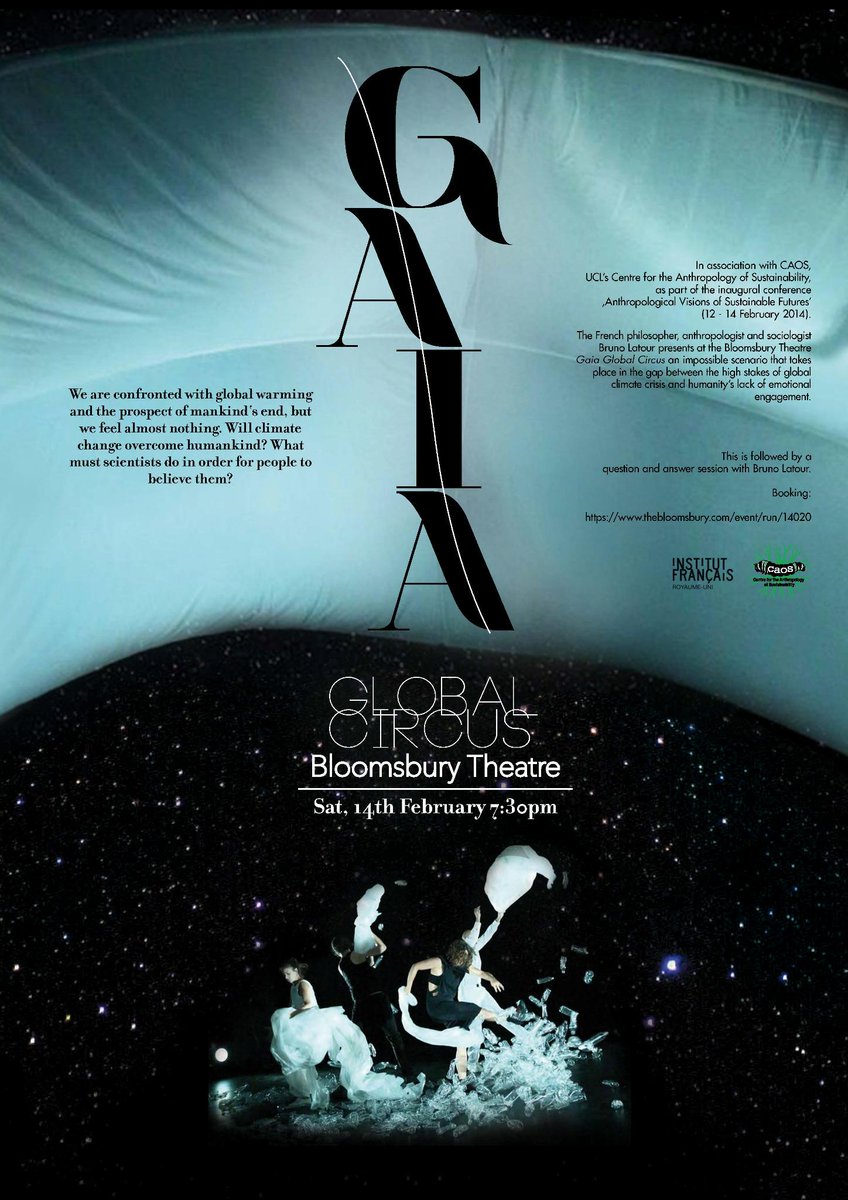
Last Saturday evening, I had the great pleasure of attending the first UK performance (and, indeed, the first in English) of a play written by Pierre Daubigny and organised by Bruno Latour – ‘Gaia: Global Circus.’


It should be noted immediately that I am a total and complete plebeian when it comes to the theatre. Nevertheless, some thoughts:

What is Gaia? I am tempted to quote Hobbes and say a ‘mortal god.’ However, if we think of the famous frontispiece to Hobbes’ book, we find a problem with this allusion.


Hobbes' Leviathan, at least as it is visualised here, suggests something organ-ised in the most profound sense. Gaia, on the contrary, does not have – does not have yet – any sort of apparatus or dispositif (political, legal, religious, scientific) that could broadcast her 'eviction notices,' as I have called them, with anything approaching a singular, booming 'old Testament' kind of a voice. The phenomenology is more that of earth-shaking claps of thunder and blinding bolts of lightning that we are all stumbling around, bumping into each other trying to understand.

Galileo's 'and yet it moves' (apocryphal or not) is a crucial phrase. Oh, he had no idea! Certainly, Gaia has the authority to decide to 'move' as she pleases 'whether we like it or not' – so much more so than Galileo could even have imagined; however, one scientist's self-righteous mutterings does nothing for the problems we face.

It is this not-yet-assembledness that, I think, 'Gaia: Global Circus' explored. I will not attempt to summarise it in detail. It was too inventive and multi-layered to be précised in any useful way. From the very first scene, events constantly folded back on themselves, going one way and then stopping, resetting and approaching their topic from another angle, with an ever shifting array of personae.

The star of the show was perhaps the canvas, the canopia or the ‘sheet with balloons attached to it,’ as one audience member commented, that dominated the stage. It could be manipulated in such a way that it was facing the audience and acting as a projection screen; at other times, it was pulled and tussled so as to convulse and summon up a storm; it lurked above the stage for a time before being pulled down so as to conceal and partition the space; finally, and by way of finale, it floated out over the audience, encapsulating them. This was an impressive technical achievement (although one of the actors did remark at the end on the difficulties they would be in if a balloon burst!), however it was also a poetic one as the device never seemed extraneous to the performance – on the contrary, it was integral.

A few words must be added for the four actors whose performances were remarkable, particularly considering that portions of the play relied heavily on improvisation and that they were doing this outside their first language. Being that funny and that engaging under those conditions deserves applause in itself.

And on that point, humour! A play on something as serious as climate change and environmental destruction could easily lapse into a kind of dour, pious sagacity. This was averted by simply being consistently very funny (as one might well expect from a Bruno Latour production).

The most important point is that the play attempted to enact the stuttering, uncertain beginnings of the representative invocation of a sovereign. We are not yet ready to carve Gaia’s image in brass, all her features clear and distinct. In terms of Gaia’s fictive representation, we remain at a much more impressionistic stage, for political, religious, artistic and scientific reasons. A stage well suited to... the stage!

On this point, a tangent beckons me... It'd also be interesting to investigate, in the style of von Uexküll, how Gaia perceives us. What are we to her? We are not ambulating beings, wandering around, faces wobbling, eyes blinking – we are chemicals and heat; we are a chemical burn, an itch. Perhaps that should be factored into our representations. Gaia is 'ticklish' but only in response to very specific stimuli. Our pleas will not be heard! She should not be imagined as having eyes, ears. Perhaps she should have a nose, a giant and over-sensitive nose. She will be monstrous, in any case. Maybe less a task for a fine artist than a cartoonist. Something out of H.P. Lovecraft.

Gaia can call on no Leviathan; by this I mean that there is no assembly so coherently assembled as to legitimately declare itself the medium of her 'Word' and, therefore, the task of translating her coded, gaseous missives into affective and cognisable messages falls on Earthbound scientists, politicians, religionists, etc.

At perhaps the pivotal moment in the play, one character declares with defiant force: "we scientists are on a warpath!" I’ve been critical of Latour’s use of ‘war’ as a concept previously. As I mentioned in the conclusion to my recent article, there are problems of translation when adapting these ideas for political geography (which is my interest). The matters of concern that must be taken into account there involve ISIS in Iraq, Putin in Ukraine, Obama's drones in Pakistan, the walls and fences being built in Israel, Texas, India, Saudi Arabia's plan to build a fence around their entire territory (!), and so on. Consequently, one must be very careful when talking about 'war' and violence in this context.

And, in light of that, I think 'warpath' is good alternative to 'war.' It indicates an attitude – which is serious, passionate, angry, implacable, forceful, being prepared for violence – but doesn't conflate what we are doing with what we are trying to prevent ('all out' or 'total' war). In Lippmann's Phantom Public he remarks that a war could perhaps be fought for democracy but it couldn't be fought democratically. We are most definitely on the path to war. Those fences on the borders of the EU, those migrants drowning in the Mediterranean, those drones in the sky – these are geogovernance and geostrategy at work (and the Pentagon is not where you'll find the climate deniers...).

However, if we accept that 'politics is war by other means' then we should conclude not that politics and war are one and the same but that politics is not war because it is by other means. In other words, the means matter. To somewhat egocentrically quote myself:
A climate scientist arguing fiercely with a denialist at a public meeting may lack a ‘sovereign’ to whom he can appeal to settle the dispute; however, no matter how much they bellow – no matter even if they brawl – they are not ‘at war’ in a sense that should be so easily literalised. [...] We would do well to remember the difference between heated arguments and charred flesh, even if we are staring at a future that is going up in flames.
So, the sense of 'being on a warpath' modifies this vocabulary notably. It becomes possible to state that we are engaged in a secret war with Gaia but, for the most part, a nervous peace amongst ourselves. There are relations of domination, violence and injustice, of course, but 'total war' is, for now, absent. Those 'on a warpath' must insist that, if we are not very careful, we are headed for worse. Those walls, fences and other fortifications are there for a reason and Gaia will not differentiate between polluters and non-polluters. Nothing proves that the crimes of the last century are unrepeatable.

More could be said, much more (particularly by someone who knew what they were talking about). Nevertheless, the play has achieved what it set out to do, from my perspective at least: to provoke thought.

Wednesday, 31 December 2014

My top ten films of 2014

I watched a lot of films this year. Of those released (in the UK) in 2014 here are some of the best:

1) Under The Skin: Mesmerising, disturbing and haunting on every level. Something utterly, brilliantly singular. The pick of a very good bunch.

2) Pride: I cried with laughter, joy, sadness and regret for the loss, or near loss, of a world where solidarity still meant something. Achieving its seamless combination of politics and entertainment is a brilliant achievement.

3) Boyhood: It's amazing that no one has tried this before—although perhaps no one else could have pulled it off. Watching these people age before your eyes in this way is more moving than I thought possible. A perfectly realised vision.

4) Two Days, One Night [Deux jours, une nuit]: Marion Cotillard's portrayal of the egg-shell fragility of depression is heartbreakingly on the mark and the manner in which she musters the strength to discover and accept the love, friendship and solidarity of those around her when it really does seem like the world is against her is astounding. No film has stayed with me more than this one this year.

5) Frank: Funny, brilliantly constructed and with some incredible music. Maggie Gyllenhaal learned the theremin for her role in this film. Nuff said.

6) Leviathan: A complex, intelligent and brave piece of film-making. Utterly without the upliftingness of the other political films on my list but perhaps its lead-coat fatalism is an important counterpoint. Also, no one does alcoholism like Russian alcoholics. Blimey.

7) The Grand Budapest Hotel: Yes, it looks like a cake—but what a cake! Stylised to within an inch of its life but erring just on the right side of brilliant.

8) The Past [Le passé]: A perfectly constructed drama that somehow has all the twists and turns of a thriller. Bérénice Bejo's performance I can only describe as the most explosively kinetic I've ever seen.

9) Calvary: Clunky and heavy-handedly allegorical at times but with a redeeming charm and thoughtfulness. All in all a very clever look at the place of the Catholic Church in Irish society without ever for a moment being, dare I say it, preachy.

10) Blue Ruin: Shoe-string film-making at its best. There are other films I enjoyed more this year but I can't leave this one out. I'll never be able to watch a 'revenge thriller' in the same way again and it's not often that a film permanently transforms your sense of a genre.

And ten of the rest that didn't make it into the above:

The Lego Movie: I enjoyed this as much as any film this year but it is essentially a feature length advert...

Guardians of the Galaxy: Rip-roaring fun. Didn't see Chris Pratt as a muscle-rippling movie star but he wears it very well indeed. Can't wait to see future instalments.

Maps to the Stars: It's quite amazing that Julianne Moore's paranoid, narcissistic monster of a character isn't even the nastiest on show. A dark-hearted piece, for sure.

Snowpiercer: I liked it but didn't love it. It's an interesting concept and was very well realised but I found it to drag a little. I'm not sure why I didn't like it more.

Locke: The kind of film that cannot possibly sound as good on paper as it does on the screen. A bravura one man show from Tom Hardy. I can't imagine anyone else in the role.

Nightcrawler: Very nearly in my top 10. A spot-on satire of the horror economy of cable news with a spookily gaunt and superlatively sociopathic Jake Gyllenhaal.

Mr Turner: Timothy Spall is brilliant and the story was perfectly interesting. However, not exactly life-changing. Probably a little over-hyped.

Foxcatcher: Again, brilliant performances (particularly from Steve Carrell although Channing Tatum's emotionally stunted athleticism is also well done) but not enough to put it anywhere near my top 10.

Cold in July: Michael C. Hall is never less than excellent and this film hops genres with aplomb.

Interstellar: A stunning spectacle (I'd love to see it in IMAX) but 'problematic', as cultural critics like to say.

(Other films could have featured depending on what one counts as the release date. I've counted 12 Years a Slave as a 2013 release, as most people seem to have done. Inherent Vice isn't out here yet but I'm looking forward to it.)

I've by no means seen everything that I've wanted to. Particularly notable in their absence: Ida, The Imitation Game, Winter Sleep, '71, Citizenfour, Merchants of Doubt, The Golden Dream. I'll hopefully catch up with at least a few of these over what remains of my Christmas break (which, so far, has been anything but!).

Tuesday, 18 November 2014

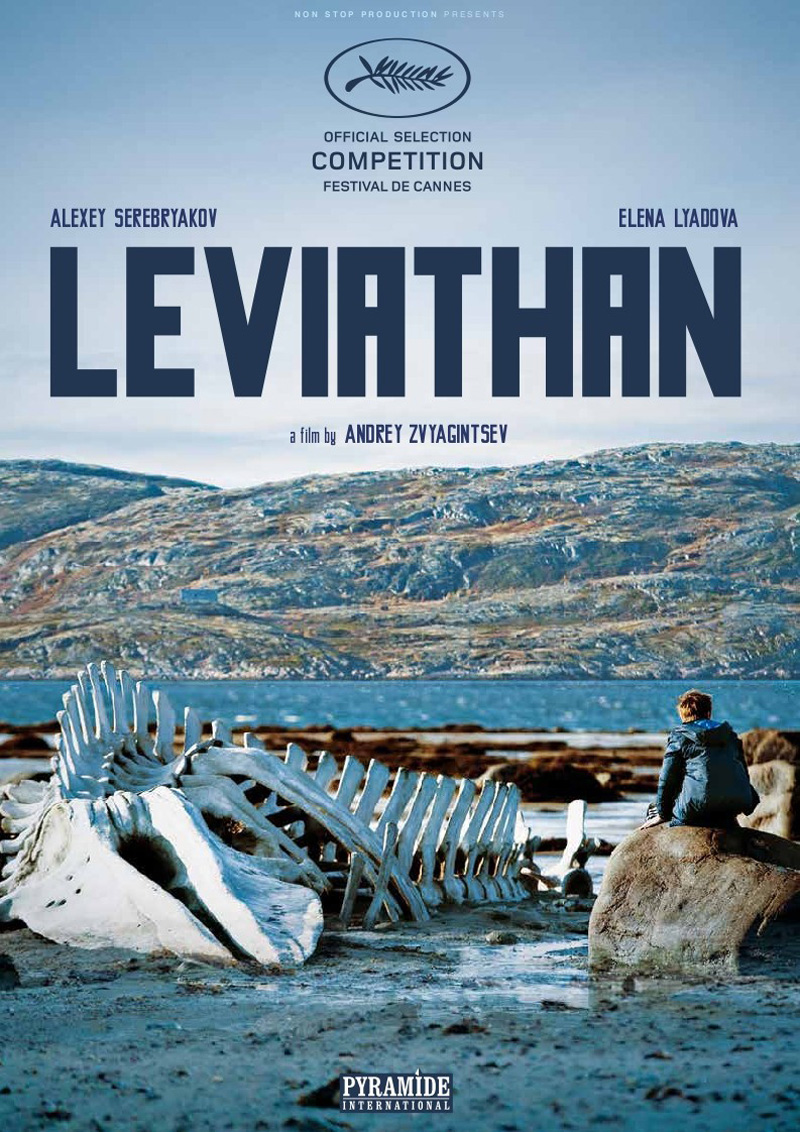
"that Mortall God" — Zvyagintsev's Leviathan; law, structure and the state

"This is the Generation of the great Leviathan, or rather (to speake more reverently) of that Mortall God, to which we owe under the Immortal God, our peace, and defence." — Thomas Hobbes

Although Andrey Zvyagintsev's highly (and justly) celebrated film Leviathan obviously connotes Thomas Hobbes' famous treatise, it should perhaps also be linked with one of Nietzsche's most famous lines, specifically when he called the state "the coldest of all cold monsters". 'Leviathan' gives this film not only its title but its whole sense of world; it is a film about structure, about the crushing, irresistible weight of this great, horrible, monstrous, but also mortal being.

If it can be summed up so simply, the film reflects on the immense, destructive, tragic but also transient force of assembled societal power; a power that seems utterly vast and yet will, in time, crumble like everything else. Churches will become ruins in which teenagers hang out, powerful leaders will become jokes (albeit private ones), whales will wash up and leave only their skeletons on the beaches.
"Canst thou draw out Leviathan with a fishhook?" (Job 41:1)
There is a strong sense of anger but also, overwhelmingly, futility in this film. Non-resistance seems to be the only means of survival for any of these characters (indeed, the Book of Job-speaking priest offers precisely this advice at one point). The protagonists perturb the status quo in the first act but, like a sturdy ship, it rights itself and it is as if that wave had never rolled in. The state's fragility (and here taking 'state' in its broadest sense, including the church, organised crime, and so on), its transience, its mutability is of no comfort to those caught up in its wheels and cogs. It is something that is only even really perceptible on a broader scale of time than that of a human life. It would take the whole 140 years that Job is said to have lived in order to make anything of this mortality. The skeleton on the beach, while deeply symbolic, doesn't suggest any real possibility of resistance. Structural mortality and fatalism come together, without contradiction.

There is far more to this film than I am able to go into here. Despite its bleak themes, it is often very funny and is beautifully shot. Many shots of the decaying ships in the harbour recall the cinema of Tarkovsky so strongly that had they been held for 50 seconds rather than 5 one could have been excused for mistaking parts of Leviathan for his Stalker.

In short, the film is about church, state, Russia past and present. The fact that it was sponsored by the Institute Of Modern Russian Culture is interesting in itself. The film treads an extremely fine and precarious line with regard to the current regime. Overt criticism is more or less avoided but the subtext sounds out like a foghorn. The various portraits of Putin hanging about the place, the Orthodox figures of Jesus staring from every mantlepiece (and dashboard), the scene with the portraits of past Russian leaders, the brief glimpse of the words 'Pussy Riot' on a TV screen. Iconographically the film is incredibly rich and it'd take someone far better qualified than me to do any of it justice. It is a remarkably critical film in many ways although clearly one that has elected to mind its historical moment (one character says precisely this in one of the film's most crucial political scenes — a scene that occurs, tellingly, far out in the wilderness, 100km from the small town in which the film is mostly set).

The one other thing I'd like to mention is the law. One of the most striking scenes in the film is found in a court room where the presiding official reads through the judgement so fast that the words become just a blur, a solid block of somehow insignificant signification, a stream of pronouncement without even the slightest hesitation; she barely even pauses to breathe and when she does it seems almost reluctant. It is a barrage, an avalanche, a volley of legalese. The force of the power on display is its total incontestability. Never mind 'getting in a word edgeways,' there is no gap for any objection whatsoever.

It is also quite amazing how surprised everyone at the police station and courts appear when the hotshot lawyer from Moscow swans in and presents them with legal argument (with the ever so naive belief that this will have some force). It is not only that they do not accept its force, it is that the very notion that they would appears to be the strangest thing in the world. 'What? That is not how things work here,' they seem to be saying. For the most part this is without any particular maliciousness (except for where the principle antagonist is concerned, who is nothing but malevolence, maliciousness and greed). It simply is not the way things are done. It is an alien proposition.

Here we are presented with the institution of law without its process. The hollowed out shell, the great fleshless ribcage of the social in a society corrupted, captured by organised crime of one sort or another. Although this is a film on the most ostensive level about law there is precious little legality within it. All legal utterances fall flat against an edifice that has simply rendered them not unspeakable but inaudible. (And here perhaps it would be interesting to reflect on the preoccupation of structuralism with speech — 'can the subaltern speak?' In the case of the main character, a socially privileged male in some respects but utterly incapable of engaging with bureaucratic formality on its own terms, he clearly cannot speak or act in the language of law. And yet when his incomparably more nuanced, cultured lawyer friend speaks for him in perfect, considered, calm but also forceful and pointed sentences he meets an infrastructure simply incapable of hearing his flawless, metropolitan speech acts.) This is a world in which law has, to all intents and purposes, died; reduced to procedure; reduced to a tool of power, of organisation.

Like so many excellent films, this one has, its excellence notwithstanding, perhaps been a little overhyped. I went into the screening with mildly overinflated expectations. It is not an epic. It is a low budget film with a relatively small cast but, most importantly, big ideas. It is the epitome of what film making should be; however, I certainly didn't find it to be life-changing or anything of the sort. An absolute must watch for anyone interested in political or legal theory, or simply anyone who likes slow moving, beautifully made, slightly dystopian tragedies. Since I tick all of those boxes it is a film that I'll be thinking about for some time to come.