Saturday, 7 June 2014

William Connolly on Latour's Gifford Lectures; Pluralist conflux

William E. Connolly has posted an interesting piece on Latour's Gifford Lectures on his blog.

Well, I say it's on Latour's Gifford Lectures—for the most part Connolly takes these lectures as a jumping off point for a reflection on his own micropolitical interests; stuff that'll be familiar to anyone who's read his most recent work, particularly The Fragility of Things.

I think that he thoroughly misinterprets Latour's use of the word 'secular.' Connolly takes this to be referring to the 'new secularists' and their role as a political group. I see no evidence of that whatsoever. When Latour says that Gaia is 'secular' he means it, as I understand him, by contrast to Nature, which is an insufficiently 'secularised theological concept' (to use the phrase of Schmitt); it is because Nature presupposes transcendence and Gaia immanence that Gaia is secular—literally 'worldly.' Connolly is reading too much into that, I feel; although, it would be interesting to think how the new secularists would receive such ideas (not well, I'd imagine!).

Connolly also understands Latour as making a distinction between lab scientists and theoretical scientists—I must have missed that but I recall no such distinction being made, nor such a divide having any real importance. Latour waxes lyrical about the 'Earthbound scientists' but seemingly all manners of scientific praxis are included under this umbrella. The key point is that both lab and theoretical sciences must be irreduced, that is escorted back inside their networks; he has this to say about Stephen Hawking, for instance:
It is hard to point out a more situated knowledge than this one: from this very local place on Free School Lane, in the hands of a great scientist, electrons are supposed to have spread successfully to populate all chemical bonding and all computers! But in the next minute, the same physicists will have no qualms about admiring how Steven Hawkings’ mind roams through the whole cosmos in intimate dialog with the Creator, wishfully ignoring that Hawking’s mind benefits not only from a brain but also from a ‘corporate body’ described by Hélène Mialet in her book Hawking incorporated, as composed of a vast network of computers, chairs, instruments, nurses, helpers and synthesizers that are necessary for the step by step flow of his equations. With such a bifocal view of science, it is hard to reconcile the view from nowhere with the highly localised classrooms, office spaces, laboratory benches, computer centres, meeting rooms, expeditionary treks and field stations, where scientists have to locate themselves when they begin to really talk about their findings or to really write their papers. (86)
If anything Latour refuses the distinction between theoretical and lab sciences—both are fully instrumented, incarnated endeavours and that's the important thing about them. The Earthbound need theorists and lab scientists, both—and who embodies that fusion better than Dr Lovelock?

Connolly writes in conclusion:
I am glad Bruno Latour gave these lectures. They focus attention on the severity of the planetary issue and the denials and evasions attached to it. I am also moved by the spirituality that infuses them.
Latour's theology is about as heterodox as one is likely to find anywhere. He refutes the possibility of any kind of fundamental transcendence; God is only what is assembled in the reverential networks of his followers; religious practice transfers no information, only the transformations of love and tradition. Latour's theology jars with most religious theory at least as much if not more so than his thinking jars with most theories of science. However, in these Lectures he also insists upon the translatability of different deities; taking up Jan Assmann's work on mono/polytheism to suggest that we must conceive of Nature, Gaia or OWWAAB (Out of Which We Are All Born) as secular divinities that are at least potentially comparable, translatable with the divinities of others (as were the divinities of the pre-monotheistic world), thus facilitating a geo- or cosmo-politics that removes (or at least de-emphasises) one unnecessary and, frankly, stupid point of confrontation: whether or not there's a God.

This very much plays into Connolly's project of conceiving of political alliances being built across ostensive cultural and religious divides; heterogeneous assemblages that cultivate a certain political vibrancy in anticipation of Events that will draw them together and produce a General Strike, or some-such. (I have my doubts about Connolly's working-through of this point but there's something to it.)

It might be a stretch to call Latour a 'spiritual' philosopher because his theology is so very anti-transcendence (even more so perhaps than Connolly, self-described 'immanent materialist'!). I don't think many of his fellow Catholics would consider him spiritual on the basis of his thinking. His recent book (recently published in English, anyway) on religion—Rejoicing: Or the Torments of Religious Speech—is a paragon of sensitivity and counterintuition but it is really questionable to what extent it is religious in the sense most people understand that (i.e. as spirituality). Just what is the point of a totally immanent God? Latour's theology is religious in the sense that Michel Serres describes religion as rooted in religiens, which is the opposites of negligens—i.e. 'religion is the opposite of negligence' (as he defines it in The Natural Contract). That is an extremely fecund point; I am converted inasmuch as this: 'Whoever has no religion should not be called atheist or unbeliever, but negligent.' To act religiously is an essential part of life, god or no god.

The real meeting point of Connolly and Latour is, however, pluralism—a pluralism that is political, not just metaphysical. It is this meeting point that presents the challenge; it is here that Latour's whole project of 'diplomacy' (taking up Stengers' term) comes into play. It'd be interesting to read a more sustained engagement by Connolly on this matter. There are clear, strong and (dare I said it?) vibrant parallels between these philosophies but also serious differences. Connolly, for me, leans too heavily on the notions of self-organisation. His reading of Hayek in Fragility is nowhere near critical enough either of Hayek's politics nor of the notion of self-organisation itself.

The problem with self-organisation (and I think this is a critique that needs to be impressed upon many, many... let's say post-Deleuzians who take up self-organisation as their ontological aesthetic of choice) is not the organisation aspect, it's the self—what is the self doing the organising? Gaia is, of course, a self-organising system but her 'self' is something that Latour takes some time discussing. She is not a 'super-organism' and not a final cause but rather the product of all the individual organisms, each of whom are their own final cause, their own providence, their own telos, each of whom follow their own interests but, in doing so, produce an effect, an agency in excess of themselves, an effective being that has maintained atmospheric and chemical conditions conducive to life (whatever that has meant in any given era) for billions of years.

For Hayek, of course, the importance of self-organisation is that it validates extreme market-based individualism (although Hayekian neoliberals are well aware of the need for a coercive state to force people to obey their own true selves...). The 'self' here is that of homo economicus, however contrived and enforced his existence may be. A methodological maxim: never speak of self-organisation without speaking also of a self.

Ramble ends.

Geopolitics and varieties of soil

In Latour's recent Gifford Lectures he attempts to redefine geopolitics as the politics of the Earth itself, the central premiss of this being that we must learn to understand the 'soil' to which we are attached and then to find ways of defending that soil. He does not, of course, mean 'soil' literally or straight-forwardly; certainly not reactionarily:
To insist on the soil is to be reactionary in the old way—appealing to ‘Blut und Boden.’ Reactionaries of all hues and colours have always insisted on how criminal it was to attempt to leave the ancient land, to abandon the old soil, to forget the limits of the old nomos, to be emancipated and cosmopolitan. (108)
Although Latour channels Carl Schmitt extensively he does not want to go back to that horrendous, reactionary geopolitics of yore.
[...] there might be another meaning to being attached to the old soil, this time to the Earth. (108)
Our 'soil' is everything that we need to survive; it's also the air that we breathe and the climate that we perturb. However, the actual soil itself is also part of our 'soil.' George Monbiot points to how certain farming methods are literally washing Britain into the sea and how the land-owner lobby in the UK has utterly captured its own regulatory apparatus, making matters worse and more stupid by the day.
The people who got this directive ditched claim to love their country. But they’ve ensured that it will continue to run down the rivers and into the sea. You want to get Britain out of Europe? Well how about ensuring that our soils stop ending up on the coastlines of France and Holland and Germany?
This is an interesting confluence of political imagery and an extremely apt issue for considering a post-Natural politics that is resolutely not post-national.

We have certainly come a long way since the days of General Haushofer (from The Geopolitics Reader, p.33):
While the theoretical foundations of Geopolitik were laid only in recent times, its practical application—the instinctive sense for geopolitical possibilities, the realization of its deep influence on political development—is as old as history itself. Geopolitical vision inspired daring leaders who guided their people along novel never-before-travelled roads. Powerful new states emerged because their creators, with the sensitivity of the true statesman, understood the geopolitical demands of the hour. Without such insight, violence and arbitrariness would have charted the course of history. Nothing with lasting value could have been created. All structures of state which might have been erected would sooner or later have crumbled into dust and oblivion before the eternal forces of soil and climate.
To be sure, the powerful will of a great and strong man may tear masses and nations away from soil-bound existence into roads other than nature had provided for them. But such actions are short-lived. In the end every people will sink back into its accustomed ways; its lasting earthbound traits will eventually win out.
Neither the soil nor the climate can be taken for granted; much less can their immutability found the dark dreams of imperial domination—that very dream of imperial supremacy, oriented towards 'nature,' has shattered its own illusion. It is indeed time for a new politics of the soil—but also of the air and the sea and ecosystems and so on. A geopolitics finally worthy of the name—of both sides of the name, geo and politics.

Haushofer committed suicide with his wife in 1946; supposedly he died under a tree, clutching the very Bavarian soil that he so cherished. At the end of the film Gravity, the protagonist clutches the sludgy earth she has landed on between her exhausted, trembling fingers. There are whole galaxies between these two relations to the soil—the departure and the return.

Latour's geopolitics is overly naive in the sense that it doesn't engage with historical (or disciplinary) geopolitics in any way; he simply appropriates the phrase and moves on. This isn't good enough. However, I think that his project is an important one. The soil, in the literal sense, is both the cherished basis of the worst kinds of geopolitics from the past and is, evidently, not something that even a powerful state can simply rely on at present. It is a case that this 'new' geopolitics must somehow pass.

Philosophy-wise I'm quite interested in how Peter Sloterdijk's work can be brought into this debate. Latour dedicated his Gifford Lectures to Sloterdijk and his ideas abound throughout the series. While very different thinkers in some ways their work meshes remarkably well.

Weaponising climate change; the American political system

I have my reservations about Ezra Klein but this is a splendid paragraph:
If you were going to weaponize an issue to take advantage of the weak points in the American political system — to highlight all the blind spots, dysfunctions, and irrationalities — you would create climate change. And then you would stand back and watch the world burn.

NB RE PB: a partial retraction

A note with regard to my previous post on plant being, etc.: Michael Marder corrected my misunderstandings on a few points. I added a comment to this effect at the bottom of the post in question.

Friday, 6 June 2014

Another nail in the coffin of the Holocene


From Science:
Plastic may be with us a lot longer than we thought. In addition to clogging up landfills and becoming trapped in Arctic ice, some of it is turning into stone. Scientists say a new type of rock cobbled together from plastic, volcanic rock, beach sand, seashells, and corals has begun forming on the shores of Hawaii.

Luce Irigaray and Michael Marder on 'Meeting through the Vegetal World'

I had the distinct pleasure of attending an extremely interesting event last night, a joint lecture between Luce Irigaray and Michael Marder on the subject of 'plant-being,' 'plant thought,' 'the vegetal world' (as you prefer). They are working to produce a kind of eco-phenomenology of plants. Here's the blurb from last night's talk:
Climate change, resource-related conflict, pressures on food supplies, and the contamination of air and water continue to intensify, despite efforts to put environmental concerns on the political agenda. How can a more collaborative relationship with other living beings, including plants and animals, help ensure a sustainable future? Join two of the world’s leading philosophers for a public lecture on one of the most pressing problems of our age: how to develop a relational ethics through the natural world.
They were both charming and involving; both extremely prolific too (see Marder's website for his list of publications, all downloadable; Irigaray is famous enough that she needs no bibliographing, I'm sure).

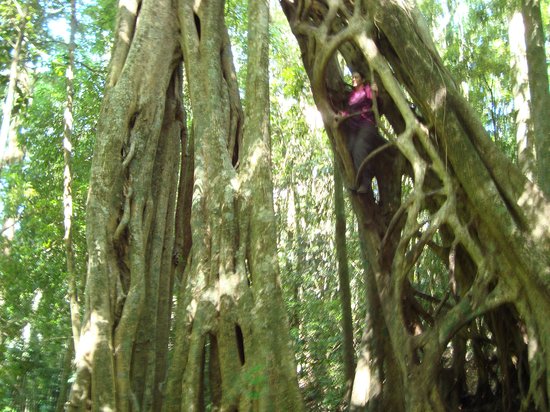
During the Q&A at the end I commented that the picture of the plant world that Marder sketched out (Irigaray's contribution was less programmatic and more reflexive) seemed awfully pacific and genteel. There were lots of trees, grasses and shrubs of various sorts but none of the more ugly and violent kinds of plants. The venus fly trap of course springs to mind but also the nightmarish ophiocordyceps unilateralis – a fungus (okay, not technically a plant) that infects ants, takes over their bodies, compels them to move somewhere warm and humid before the ant dies and a stalk sprouts out of its head which releases more spores. Or, less grotesquely but still rather violently, the so-called 'strangler figs' that wrap themselves around trees, climbing towards the light, eventually crushing their hosts and leaving hollow plaits of ivy as the trunks rot away.


For that matter there was also (and this didn't occur to me to ask until this morning) a rather excessive emphasis on rooted plants such that we might find in a park or garden. Algae, by far the most important kind of photosynthesiser there ever was or ever will be, wasn't mentioned (or if it was I missed it).

I was very conscious in mentioning all of this (although I may have been unsuccessful in warding off this impression) that I wasn't trying to assert a masculine view of nature as blood and thunder, vicious competition – green in thorn and barb, we might say – over a feminised one of it as serene coexistence; however, I did get the impression that it is only a small fraction of the vegetal world that this philosophy is prepared to consider. For me, a philosophy of nature can't just pick and choose the nice bits (to do this is to treat science as a content provider rather than a constituent producer).

This is from a recent article published by both in the Guardian:
The plant world shows us in silence what faithfulness to life consists of. It also helps us to a new beginning, urging us to care for our breath, not only at a vital but also at a spiritual level. We must, in turn, care for it, opposing any sort of pollution that destroys both our world and that of plants. The interdependence to which we must pay the closest attention is that which exists between ourselves and the vegetal world. Often described as "the lungs of the planet", the woods that cover the earth offer us the gift of breathable air by releasing oxygen. But their capacity to renew the air polluted by industry has long reached its limit. If we lack the air necessary for a healthy life (or, indeed, for any kind of life), it is because we have filled it with chemicals and undercut the ability of plants to regenerate it. As we know, rapid deforestation combined with the massive burning of fossil fuels, which are largely the remnants of past plants, is an explosive recipe for an irreversible disaster.
It's all a bit too kumbaya for me, if I'm honest. I don't recall them using the word 'harmony' but it's altogether too much implied. Where's the danger? Where's the non-human agency? It is all about scolding humans for their nasty exploitations with no recognition of the fact that things themselves might strike back...

The more important point I was trying to make by reference to the ugly side of plants was that perhaps in order to revere the non-human world we also need to fear it. Irigaray said that she didn't understand my comment (translation was an issue and I was quite nervous as I tried to articulate myself so it may not be her fault!) but she did say that to fear plants is to fear life itself. For her that is clearly a terrible, horrible thing. But I can't accept that. Yoda had it wrong: 'fear leads to anger, anger leads to hate...'. Fear is an important part of human existence. We can fear well and fear badly. We should fear the right things.

I didn't think that my comments would be received well and they weren't especially (although Marder was very gracious and accepted that it went to the heart of the matter). There's no place for fear, for violence or for that kind of negativity in these sorts of philosophies of nature. They are pick-and-mixes of the pluriverse that simply ignore the nastier sides of things. (Although, I must add another caveat and say that someone told me last night that Marder's book mentions poisonous plants; I will have to read it before I can really make any really bold claims in this regard.)

Marder doesn't believe that plants are capable of 'violence.' His reason for this is Hegelian: plants are, he says, incapable of self-negation. Now, I'm not altogether sure what that means (doubtless my fault) but my impression is that plants cannot do otherwise; immobile, they simply are (being immobile, he added, they cannot be territorial – something else I don't agree with). Devoid of animalistic intentionality they provide us with a model for being ourselves, otherwise, without the exploitative relation with other things that is brought on (this was also made clear in the Q&A) not by capitalism as such but by the specific relation towards logos inaugurated by the Greeks (capitalism being simply the latest product of this mode of thought).

Marder insisted that he didn't want to give a pacific picture of the plant world – it isn't that plants don't do damage to other things but that this isn't violence per se. Plants can be neither pacific nor violent, they just are. I don't think that this is a very good definition of violence. Moreover, I am of the Darwinian opinion that intentionality precedes awareness; all life is intentional because all life is goal-oriented, even if the only goal is survival and procreation.

When a fly trap dissolves an insect alive it isn't 'aware' of that insect in the way that an entity with a central nervous system is, of course, but I'm not sure why that matters. What difference does it make that the plant cannot uproot and move off, or retreat from a conflict with its tail between its legs? The plant destroys the insect, making it a means to its own ends. In this way, although it seems like Marder goes far too far in talking about 'plant thought' and so on, I think he doesn't go nearly far enough.

Plants in this phenomenological ontology of Irigaray-Marder aren't fully agential in the Latourian sense. Consequently they lack the capacity to demand our reverence; they cannot stoke fear in us; they cannot endanger us; they cannot unnerve us; and, consequently, they are entirely dependent upon our good will towards them. The vector of our moral obligation towards our green others always begins with the active, cognising human; the plants, however essential to our oxygen-hungry being they are acknowledged to be, cannot make demands on us, cannot really perturb us because they simply are – and their simple unindividuated thereness is what, for these authors, makes 'plant thinking' a model (or at least a partial model) for our own modes of thought.

I think it's quite the contrary: we need to be threatened by the non-human world again. People revere in large part that which they fear (when I said that at the lecture someone towards the front audibly snorted with derision – I feel I was not amongst like-minded people!). People used to fear nature – many still do who live in less homogenised, emaciated ecosystems than ours in the towns and cities (and the biochemically annihilated farmlands) of the Western world. That fear is proper, it's necessary. It's all very well insisting that we must recognise our extreme indebtedness to our plants others, etc, etc. but by itself this is still idealism. Humans neither revere nor respect just out of the kindness of their hearts nor through the workings of their rationality. Nothing is a simple as that.

This event was very thought provoking and I'm sticking my neck out since I've only read a tiny bit of the oeuvres of either of these extremely impressive intellectuals. However, this is not a naturphilosophie that I think I can get on board with. It actually, despite many explicit and very assertive insistences to the contrary, reproduces the modernist attitude towards non-human things because it makes humans the root of every vector of moral evaluation. Plants are there and they do stuff but they are at our mercy; they are prostrate before us; we are to be scoldingly reproached for our exploitation but human supremacy is to be presupposed and baked into the settlement. This isn't a break with whatever modes of thought the Greeks loaded on us; it's more of the same, differently nuanced.

I prefer what Latour calls an ethos of 'Optimism': all entities evaluate means and ends; it is as impossible to make the whole world a means for us, as per the modernist dream of progress (because immutable, eternal Nature doesn't exist and that attitude therefore leads to environmental catastrophe); however, it is equally impossible to make all the world our ends (we have to eat, breathe, etc.). The moral imperative is, first, to introduce a moment of hesitation in action where we are uncertain of how means and ends are distributed; second, it is to perpetually renew the search for the Optimum, for the best distribution of means and ends for a collective. This philosophy necessary requires political decision (in the literal sense of de-scission, cutting off). This is cosmopolitics (or geopolitics, if you prefer). It has nothing to do with harmony but rather spheres of influence; exploitation isn't a dirty word, we just have to know our limits and the limits of the world around us.

This brings me to Gaia (largely a vegetal entity though emphatically one not in a 'vegetal state'!), the whole point of which is that she is fiercely dangerous to us. She is a danger in the proper etymological sense (from Old French dangier 'power, power to harm, mastery, authority, control'). She is 'sovereign,' according to Latour.

Marder has a paper on Carl Schmitt ('The Elemental Regimes of Carl Schmitt') that I'm looking forward to reading. I'll conclude this over-long ramble with a quote from Latour discussing Schmitt. I think it's pertinent:
The great virtue of dangerous and reactionary thinkers like Schmitt is to force us to make a choice much starker than that of so many wishy-washy ecologists still swayed by unremitting hope. Schmitt’s choice is terribly clear: either you agree to tell foes from friends, and then you engage in politics, sharply defining the borderlines of real enough wars — ‘wars about what the world is made of’ —; or you shy away from waging wars and having enemies, but then you do away with politics [...] (105).
From living plant-like to living dangerously – there's a world of difference between these programmes.

[Update (07/06/14):

I received an email from Michael Marder which politely informed me that I'd gotten the wrong end of the stick about a couple of things!:
1. I never said that plants are immobile. Their being-in-place precludes locomotion, but not other kinds of movement, as I discuss everywhere in my writings. (In fact, even a certain long-distance locomotion is possible for plant seeds and pollen, as I always note.) 
2. Plant-Thinking is in large part dedicated to an exploration of the plant's intentionality. You will notice this as soon as you open the book, but especially if you reach Ch. 5 on The Wisdom of Plants.
On the first point, I meant 'immobile' in the sense of locomotion; in the sense that animals are not immobile but plants are—that is a fair point of clarification.

Second, I do need to read more of his books. The tagline of this blog 'In which I form strong opinions about things I don't know enough about' was never more appropriate!

This is a very interesting naturphilosophie and I encourage others to take it up. Hopefully one day I can give it the critique it deserves—i.e. an informed one!]

Wednesday, 28 May 2014

The madness of compound interest

According to Einstein it is the 'eighth wonder of the world'; compound interest certainly is a mathematical marvel – and a political disaster.
Let us imagine that in 3030BC the total possessions of the people of Egypt filled one cubic metre. Let us propose that these possessions grew by 4.5% a year. How big would that stash have been by the Battle of Actium in 30BC? This is the calculation performed by the investment banker Jeremy Grantham. 
Go on, take a guess. Ten times the size of the pyramids? All the sand in the Sahara? The Atlantic ocean? The volume of the planet? A little more? It's 2.5 billion billion solar systems.
Perpetual growth on a finite planet, etc. etc.

Saturday, 24 May 2014

More on Fuller and ANT

Steve Fuller replies to my comments that were reposted on the ANTHEM blog. There's a long comment and then a shorter one. Here's the latter:
Take home lesson: While I realize that there may be some value in trying to keep the ANT doctrine philosophically pure from interlopers like Land by the scholastic means you have, you would be smarter to deal with him on the political level at which he’s pitching his claims because he is one of the few people who makes the idea of ‘ontological levelling’ interesting beyond the sort of surprising intellectual party trick that guys like Timothy Morton are still dining out on.
I think his comments are quite fair, actually. This is the problem with talking so curtly, at such levels of abstraction—i.e. blogging. Language: tricky. Doubtless the early ANT accounts were lacking in reflexivity (and deliberately so). Their authors eventually acknowledged the faults of this approach. I suppose we are quibbling over the 'canon.' When I think 'ANT' I'm thinking of Annemarie Mol's 'Body Multiple' as much as I am of Callon's scallops—no one can say that the former wants for reflexivity.

R.E. Land, my understanding is that he is very much more a Deleuze-Guattarian rather than a Latourian. I honestly don't know if he's drawing on Latour at all but I've never seen any mention of it. Morton et al. certainly are, shall we say, post-Latourian and I've been very critical of them in the past. This was my take on Morton's 'Hyperobjects':
It's a writing style [...] where a single vocabulary, a single style of speech, a single mode of assembly suffices to address any kind of thing wheresoever, whensoever, howsoever, whatsoever. [...] The world becomes a frozen lake across which the bricoleur glides, slides or tumbles, depending on his skill. The relational labour required to forge any particular connection seems minimal, almost inconsequential – it is enough that the words are on the same page, conjoined by puns.
This seems to be something that Fuller finds objectionable in ANT and it's there, for sure. It'll be interesting to see how Harman, Morton, etc. respond to Latour's modes of existence project since it is explicitly intended to overcome this kind of all-too-easy ice-skating effect.

Friday, 23 May 2014

Anti-politics, UKIP and the incompetence of the political classes

A source said: "You do not deal with an anti-politics party by calling them names. What you should do is call them out."
Quite so, and this is what all the major parties have singularly failed to do to the UK Independence Party, which has made substantial gains in yesterday's local and European elections. There are dissenting voices within the Labour party claiming that the leadership didn't go after UKIP strongly enough, assuming that they would do more harm to the Conservatives than to Labour. This was surely misguided, if true.

The predominant strategy against UKIP from all quarters has been to label them racist, loudly, and to create as many sensational headlines as they can from the odd, nasty and objectionable views of their more extreme candidates. This has only played into UKIP's hands, perfectly complementing their narration of themselves as anti-establishment outsiders (who just happen to be led by a former City-boy millionaire, who just happens to have a socially conservative, economically libertarian agenda).

If UKIP are anti-politics then I'm not sure what the rest of the parties are. They're certainly not 'pro-politics.' They have no interest in actually engaging with those who, rightly or wrongly, feel marginalised or providing alternative narratives that explain these peoples' problems. They're anti-politics in a whole other way. In this sense the Ukippers have a point: there stands before us a strong and insular British Establishment, resplendent in its self-congratulatory cronyism, that stupidly lashes out at anything it perceives to derive from outside its empire. Where Ukippers are wrong is in not realising that, however outside the Establishment many of their candidates and voters may hail from, their politics squarely follows that of the most venally establishmentarian elements of the Conservative party; see Rees-Mogg for details.

Whether or not they are a 'racist party,' they most assuredly have significant numbers of racist members and their election posters have been dog-whistles for the far right. However, reactionarily labelling such a fractious group of millions of people 'racist' in the name of anti-prejudice, as so many in politics and the media have done in the past few weeks, is not only wrong, it's politically stupid. The way to counter racist stupidity is not with non-racist stupidity.

Many who voted UKIP yesterday did so because they yearn for the imaginary halcyon days of racial and cultural homogeneity - but by no means all. Treating Ukippers like they're all, every one of them, just jackbooted thugs in disguise doesn't help anyone. It makes matters worse.

UKIP's policies alone should be enough to discredit them. No one should ever apologise for or distract from racism in politics but nor is the R word a silver bullet - treating it as such only lets racism slither along further, beneath the stampede.

Steve Fuller on 'Dark Ecology'

At the slowlorisblog there's an interesting guest post from Steve Fuller. It's a good read but I have a quibble with one of his comments:
To understand OOO and dark ecology (I take the latter as a specific extension of the former), one needs to understand the intuitive appeal of actor-network theory, which is that you’re better placed to understand the full range of agency in the world if you yourself are not an agent, but simply a mouthpiece for agency.
I really like the essay but that's false. There are plenty of human actors and agents in ANT. The central tenet of ANT is that every node in a chain of translations transforms what it carries, conducts, transmits. Therefore, humans can't be written off as mouthpieces; or, equally, even mouthpieces translate what they mouth.

The problem with ANT is that it's a method that got out of hand; that it got exploded into being a complete philosophy of everything. Somewhere Latour remarks that ANT is a combination of Garfinkel's ethnomethodology and Greimas' semiotics. OOO ignores the former and only takes up the latter. So, OOO eradicates what remnants of phenomenology there was remaining in ANT. It's essentially a dumbing down and, simultaneously, a massive overextension that arbitrarily excludes the ethno-sociological heart of the matter (which is very much there, and beating, if you look closely).

To understand Prof. Fuller's take on this one needs to understand that he's been waging war on ANT, etc. for decades and his readings are always uncharitable—sometimes productively so but, for my tastes, he's a way off the mark.

More constructively: I think the principle intellectual-political product of this 'dark ecology' would be the whole 'accelerationism' thing. This explicitly grows out of Nick Land's sophomore-entrancing shtick and is very zeitgeisty at the moment. Moreover, it explicitly sets itself up as a radical political project rather than just an intellectual one.

Friday, 16 May 2014

Reflections on [fic]tion

I missed that the latest post on the AIME reading group blog had gone up two weeks ago. Belatedly I've formulated some thoughts on chapter 9.

First things first, it's an excellent summary by Andre Ling.

One interesting thing for me is where [fic] fits into this third group of modes, sandwiched as it is inbetween [tec] and [ref]. Latour is very clear that there is a kind of temporal succession to these modes in terms of when they are first invented (or, better, instaured). From the online version of the book:
We can say that the three regimes divert each other successively: [tec] diverts metamorphoses to transform them into folds, which leads to a diversion of [fic] and an expression of forms in materials, and these in turn are diverted by [ref] to keep open a pathway through the successive transformations of material expression by maintaining a constant. Not only do these regimes divert one another, they are dependent on each other. 
The three modes align along a roughly sketched history of humanization – because with the second group we enter the human domain, à la Leroi-Gourhan, via the irruption of quasi-objects: technical, first of all, then fiction objects, then, much later, science. We are no longer talking about the background of the world, as with the first group, but about the irruption of new ways of differing, technology serving as a transition as a result of its ubiquity even in the non-human world.
So, taking him at his word here it seems impossible to maintain that [fic] might bear any relation to a sort of panpsychism, etc. [fic] is very obviously a relatively recent invention (in evolutionary terms), coming after technology (which has been around for hundreds of thousands of years at least) and before reference (which has been around for perhaps centuries).

However, there is something of a tension – actually this is a tension found throughout the book. Just how ‘hemmed in’ can we take the modes to be? How generalised can they be? How far does their metaphysic stretch?

Latour approvingly quotes the following from Deleuze & Guattari on percepts:
Percepts are no longer perceptions; they are independent of a state of those who experience them. Affects are no longer feelings or affections; they go beyond the strength of those who undergo them. Sensations, percepts, and affects are beings whose validity lies in themselves and exceeds any lived. They could be said to exist in the absence of man because man, as he is caught in stone, on the canvas, or by words, is himself a compound of percepts and affects. The work of art is a being of sensation and nothing else: it exists in itself.
He writes of this passage: "See the beautiful analysis of what Deleuze and Guattari call “percepts” in their search for contrasting the mode called here [fic]"

In other words, D&G were in search of this mode, too. Now, of course, percept for D&G certainly is not something limited to human invention. So, my fundamental question regarding [fic] is this: what of birdsong (to take a classic example)? Is that [fic]? Non-humans (including birds, not just hominids) are said to be tool users [tec] so does the same go here for fictions also? Should we interpret the Leroi-Gourhan indebted evolutionary history of the modes to indicate only one specific lineage of these modal possibilities? (i.e. this is where we ourselves came across these modes, other species have found their own acquaintances with them.)

[fic] can be summarised simply if abstractly as that mode that folds [tec] beings further by creating entities that shift from material to material without ever transcending their media. But isn’t that really the human instantiation of these capabilities? What of birdsong?

Thursday, 15 May 2014

Atelier de réécriture diplomatique

So, it seems that I'm going to Paris for Bruno Latour's much anticipated diplomatic 'summit' at the end of July—the conclusion of his AIME project.

A whole week of bilingual philosophical discussion. Yikes. I need to brush up on my French—and by 'brush up' I mean transform it entirely! I've been taking lessons but at a fairly low level. If I can get there, survive for a week and get home that'll be a victory.

I don't anticipate being able to follow all of the discussion but it'll certainly be an experience!

Saturday, 26 April 2014

More on contents and constituents

I've been thinking a bit more about opposing science as a 'content provider' to science as a 'constituent producer.'

To encounter scientific knowledge as constituent rather than content is to encounter it as a problem. This is not to say that the knowledge in question is 'problematic' qua knowledge—indeed, it is the very objectivity of such knowledge that makes it a concern. No, to say that scientific knowledge is to be treated as a constituent, as a problem, does not necessarily mean that the knowledge is questionable or needs questioning in the register of knowledge—it means that these items of knowledge have an uncertain and not-yet-settled place in our world. What transformational demands does such knowledge make on us? How can it be accommodated within our collective in such a way that it is not destructive? What are the potential consequences of its non-accommodation? Such knowledge, having attained a powerful objectivity, must now be addressed in a political register; it is its very weight and durability as knowledge that makes it a problem for politics; its objectivity isn't what raises it outside the melee of politics but rather what plunges it into it.

This is the important point: the mere objective facticity of a knowledge-item does not result in its immediate, automatic accommodation within a collective—that would only follow if the real were rational and if politics were a mere pedagogical matter of knowledge dissemination. We cannot ignore the fragility of objective knowledge; the modernist war cry
“Burn them all; the Real will recognize its own!” (Latour AIME, 19)
is as cynically neglectful of the needs of objective knowledge as it is of difference and life.

'Content provider' and 'constituent producer' should not be thought of as a straightforward binary opposition. It would be more accurate to say that to address knowledge as constituent is to receive an added obligation, to be burdened with extra labour, to have to think more carefully, to have to reason further, to be more reasonable.

When contemporary philosophy takes science as a content provider in the sense that science provides the opportunity, alongside and continuous with art and literature, for creative, expressive thought, this is undoubtedly part of what makes for a healthy collective attitude towards science. It is part of the solution; however, it is not enough on its own. Such philosophy hasn't yet recognised its full obligations and, as such, remains a part of the problem at the same time.

When contemporary philosophy—and this does happen—takes science to be a content provider in the sense that it provides a list of entities that, thus certified, can be justly asserted dogmatically as the background reality within which our politics and ethics and so on operates: this is something else entirely; this is not part of what makes for a healthy collective attitude towards science since it blows up all roads and bridges between content provision and constituent production; it renders its own neglect permanent; worse, it surrenders objective knowledge to an unobserved, unpoliticised fate.

The real may, ultimately, recognise its own; but to believe that we are the real's chosen creed—that is a travesty of thought.

Thursday, 24 April 2014

Cornwall recognised by EU

Cornwall has been granted national minority status by the European Framework Convention for the protection of national minorities. Though by no means a nationalist of any sort I am Cornish by birth and most of my family still live there; I have been an émigré since I was 18 (I say that very much tongue-in-cheek; I live all of 150 miles away from where I grew up!). It's good news for the county, which is one of the poorest regions in Europe and should have a louder voice politically as well as qualifying for more EU funds.

I sometimes identify as Cornish rather than English, British or even European though not because of any deep-rooted atavism. I suppose it's because all those alternative labels have such awful historical affiliations while 'Cornish' seems fairly benign by comparison. There is a Cornish nationalist movement and I'm sure that it has its share of reactionaries but, all things considered, there's not a lot of mud that will stick to it.

But it's not just that; there's a stronger element to the identification. I do feel at home when I'm in Cornwall; there is an atmosphere and a sensibility that is particular to it and that'll never leave me. I don't necessarily always like that atmosphere and sensibility—it can suffocating—and I have no desire to go back there any time soon but it does feel like home. Yes, proud to be Cornish—why not? I'd rather be that than a citizen of 'the world'—that vainglorious, superficially benignant motto of cosmopolitan transcendence. No one is from nowhere. The trick is to not make where you're from such a big deal.

Physics, common sense and habit

Terence Blake writes about Latour's take on physics versus common sense appearances:
[Latour] does not allow himself the facility of such a traditional metaphysical move, which costs nothing to advance, a labour-saving philosophy for the intellectually indigent. No, he claims that the “popularizer” of quantum complexity believed in the simplicity of our common-sense world because “it cost him nothing to believe that the microphone into which he was speaking, the rostrum from which he was pontificating, his own body, his genes, the walls of the room, the assembly that he was carrying along in his frenzy, all that too was bathed in a Euclidean space”. It costs him nothing to believe this simple fable because he does not do the work necessary to explore the contours of the common sense world, to investigate its multiple dimensions.
The important thing left unspoken here, I think, is the crossing with which [ref]erence is engaged. Is it [ref·dc] or [ref·hab]? Latour is clear that: 'Appearances are not shams'; on the contrary, appearances and [hab]its are what make the word 'habitable' (AIME: 268-270).

There's nothing necessarily wrong with habits or simplifications as such. High school physics classes needn’t descend into detailed exegeses of the infrastructural history of physics (although students might well benefit from some sociology of science mixed into their curriculum!). Most of the time the fact that we cannot speak of the objects made known by science except through the networks of science is trivial and needn’t be given a second thought. However, this is not true in instances of contestation, of disputation (scientific or political). In these cases the networks do have to be made explicit—morally, politically and epistemologically. At these points the test of a good versus a bad [hab]it is raised: does it retain the memory of what 'launched' it? can it switch back to the other modes of action necessary to unravel networks and comprehend indecision without undue confusion?

To go down the road of [ref·dc] (double click), on the other hand, is to embrace dogmatism, to make the ineradicable necessity of referential, mediative circuits only a 'matter of fact'; to hold out on the possibility of 'in principle' knowing without mediation; to make science a content provider rather than a constituent producer.

Another way of putting it might be that not all representational thinking necessarily leads to the "dogmatic image of thought," as Deleuze put it. Such dogmatism is the result of bad habits that are unable to shift back into other modes that allow the unravelling of networks. They create an illusion of transcendence and thus power but in fact radically weaken because they leave existents lost and alone, unable to shift out of a single register.

Wednesday, 16 April 2014

Interrogating 'complexity'

A really interesting post on Deterritorial Investigations on the limitations of complexity theory, cybernetics, etc. for critical social and cultural thinking.

I think this is a really important point.  Complexity, etc. has been such a privileged resource for 'critical' thought for so very long that it's quite strange that the concept has received so little critical interrogation from within.  It amazes me that people hardly ever draw a connection between the Deleuzian complexity aesthetic and that of Friedrich Hayek.  For both, writing around the same time, the allure is the same: spontaneous self-organisation does away with the need for any centralised decision making process, i.e. the State (which is something of a bogeyman in both their vocabularies).  Now, that isn't to make a lazy 'Deleuze is a neoliberal' comment, I don't believe that for a second.  But the whole spontaneously organising communism thing has always struck me as a neoliberal fantasy.

Saturday, 12 April 2014

Language is not a mode of existence—wouldn't the 1970s be scandalised?

Clive Barnett of Pop Theory writes an interesting and lengthy musing on Latour's AIME (helpfully linked to by the ever helpful ANTHEM blog).  He draws a number of very useful links between Latour's use of speech act and other elements of linguistic philosophy.

I think he may be right about Latour overstating the language-reductiveness of speech act theory, etc. and analytic philosophers certainly are interested in being as well as language.  However, I think it's also fair to say that Latour goes a long way beyond where any of these people end up.

In AIME he argues the following (I paraphrase loosely but, I think, accurately) with regard to language and metaphysics: everything relates with or 'passes through' something else in order to continue existing; therefore everything joins things together, everything 'articulates'; each mode is a particular kind of articulation, a particular way of relating; thus every mode can be understood as having different truth procedures or standards of meaning; everything articulates, everything interprets, everything judges—from tics to popes, as Latour puts it at one point; language is just one way of articulating, among others, though it is not a mode itself but a mixture, presumably, of [tec]hnology, [fic]tion and others; when we speak or write we are simply taking advantage of a capacity that already exists in the world—namely, articulation; language is an invention that utilises and renders unusually explicit and dynamic what was there all along; thus we can understand the world in language, not as a 'lens' or anything of the sort but as something with real purchase on how things are because meaningful articulation is how things are.

Making AIME all about language is, therefore, rather misleading.  Although it makes use of lots of linguistic philosophy it's utterly metaphysical at heart.  To suggest that 'ontology' and 'metaphysics' are empty signifiers because it's really all about language—that misses the whole point of what Latour is trying to do.  Saying that 'practices' also have a meaningful structure and therefore discourse theory, etc. isn't all about language isn't sufficient either—that's like an agoraphobic setting one foot outside his front door and saying that he's been around the world and back.

For Latour the evolution of sea algae in and of itself is as meaningful and articulated as this sentence, as any sentence.  I can't see Searle et al. getting on board with that!  Now, that's not to say that there can't be all sorts of productive conversations between these thinkers of language and meaning but, suffice to say, I don't think that ontology and metaphysics are empty signifiers.

Wednesday, 9 April 2014

'Largest volcanic eruption in human history changed the 19th century as much as Napoleon'

There's a truly fascinating post by one Gillen D'Arcy Wood over at The Conversation—a very interesting blog (or rather set of blogs):
Most have heard of the Battle of Waterloo, but who has heard of the volcano called Tambora? No school textbook I’ve seen mentions that only two months before Napoleon’s final defeat in Belgium on June 18, 1815, the faraway Indonesian island of Sumbawa was the site of the most devastating volcanic eruption on Earth in thousands of years.
Read the whole thing, it's superb.  It's also funny that the title is the way around that it is.  Isn't it remarkable that Napoleon is the thing that the volcano is having to measure up to?!  In the comments the author suggests that the reason why this event is almost unknown while the far less devastating eruption at Krakatoa in 1883 is legendary is that telegraph systems were up and running by that time and thus everyone in the West heard about it almost immediately instead of just experiencing a bunch of strange climatological and atmospheric goings-on indirectly.

Maybe one day volcanoes will set the benchmarks for warmongering statesmen to measure up to.

He also has a book coming out on the subject in the near future (first chapter available here):


Monday, 7 April 2014

Plato on materialists

The materialists pull everything down from the sky and out of the invisible world onto the earth as if they wanted to clench rocks and oak trees in their fists. They grasp them, and stubbornly maintain that the only objects that exist are those that are tangible and comprehensible. They believe that the physical existence of an object is existence itself, and look down smugly on other people — those who acknowledge another area of existence separate from the physical. But they are totally unwilling to listen to another point of view. 
(Plato, Sophists)
(Taken from the epigraph of Jakob von Uexküll's essay The Theory of Meaning.)

Douglas Adams on philosophy and philosophers

From the Hitchhiker's Guide to the Galaxy, of course:
There are of course many problems connected with life, of which some of the most popular are Why are people born? Why do they die? Why do they want to spend so much of the intervening time wearing digital watches? 
Many many millions of years ago a race of hyperintelligent, pandimensional beings (whose physical manifestation in their own pan-dimensional universe is not dissimilar to our own) got so fed up with the constant bickering about the meaning of life which used to interrupt their favourite pastime of Brockian Ultra Cricket (a curious game which involved suddenly hitting people for no readily apparent reason and then running away) that they decided to sit down and solve their problems once and for all. 
And to this end they built themselves a stupendous super computer which was so amazingly intelligent that even before the data banks had been connected up it had started from I think therefore I am and got as far as the existence of rice pudding and income tax before anyone managed to turn it off. 
It was the size of a small city. 
Its main console was installed in a specially designed executive office, mounted on an enormous executive desk of finest ultramahagony topped with rich ultrared leather. The dark carpeting was discreetly sumptuous, exotic pot plants and tastefully engraved prints of the principal computer programmers and their families were deployed liberally about the room, and stately windows looked out upon a tree-lined public square. 
On the day of the Great On-Turning two soberly dressed programmers with brief cases arrived and were shown discreetly into the office. They were aware that this day they would represent their entire race in its greatest moment, but they conducted themselves calmly and quietly as they seated themselves deferentially before the desk, opened their brief cases and took out their leather-bound notebooks.  
Their names were Lunkwill and Fook. 
For a few moments they sat in respectful silence, then, after exchanging a quiet glance with Fook, Lunkwill leaned forward and touched a small black panel. 
The subtlest of hums indicated that the massive computer was now in total active mode. After a pause it spoke to them in a voice rich resonant and deep. 
It said: "What is this great task for which I, Deep Thought, the second greatest computer in the Universe of Time and Space have been called into existence?" 
Lunkwill and Fook glanced at each other in surprise. 
"Your task, O Computer..." began Fook. 
"No, wait a minute, this isn't right," said Lunkwill, worried. "We distinctly designed this computer to be the greatest one ever and we're not making do with second best. Deep Thought," he addressed the computer, "are you not as we designed you to be, the greatest most powerful computer in all time?" 
"I described myself as the second greatest," intoned Deep Thought, "and such I am." 
Another worried look passed between the two programmers. Lunkwill cleared his throat. 
"There must be some mistake," he said, "are you not a greatest computer than the Milliard Gargantubrain which can count all the atoms in a star in a millisecond?" 
"The Milliard Gargantubrain?" said Deep Thought with unconcealed contempt. "A mere abacus - mention it not." 
"And are you not," said Fook leaning anxiously forward, "a greater analyst than the Googleplex Star Thinker in the Seventh Galaxy of Light and Ingenuity which can calculate the trajectory of every single dust particle throughout a five-week Dangrabad Beta sand blizzard?" 
"A five-week sand blizzard?" said Deep Thought haughtily. "You ask this of me who have contemplated the very vectors of the atoms in the Big Bang itself? Molest me not with this pocket calculator stuff." 
The two programmers sat in uncomfortable silence for a moment. Then Lunkwill leaned forward again. 
"But are you not," he said, "a more fiendish disputant than the Great Hyperlobic Omni-Cognate Neutron Wrangler of Ciceronicus 12, the Magic and Indefatigable?" 
"The Great Hyperlobic Omni-Cognate Neutron Wrangler," said Deep Thought thoroughly rolling the r's, "could talk all four legs off an Arcturan MegaDonkey - but only I could persuade it to go for a walk afterwards." 
"Then what," asked Fook, "is the problem?" 
"There is no problem," said Deep Thought with magnificent ringing tones. "I am simply the second greatest computer in the Universe of Space and Time." 
"But the second?" insisted Lunkwill. "Why do you keep saying the second? You're surely not thinking of the Multicorticoid Perspicutron Titan Muller are you? Or the Pondermatic? Or the..." 
Contemptuous lights flashed across the computer's console. 
"I spare not a single unit of thought on these cybernetic simpletons!" he boomed. "I speak of none but the computer that is to come after me!" 
Fook was losing patience. He pushed his notebook aside and muttered, "I think this is getting needlessly messianic." 
"You know nothing of future time," pronounced Deep Thought, "and yet in my teeming circuitry I can navigate the infinite delta streams of future probability and see that there must one day come a computer whose merest operational parameters I am not worthy to calculate, but which it will be my fate eventually to design." 
Fook sighed heavily and glanced across to Lunkwill. 
"Can we get on and ask the question?" he said. 
Lunkwill motioned him to wait. 
"What computer is this of which you speak?" he asked. 
"I will speak of it no further in this present time," said Deep Thought. "Now. Ask what else of me you will that I may function. Speak." 
They shrugged at each other. Fook composed himself. 
"O Deep Thought Computer," he said, "the task we have designed you to perform is this. We want you to tell us..." he paused, "...the Answer!" 
"The answer?" said Deep Thought. "The answer to what?" 
"Life!" urged Fook. 
"The Universe!" said Lunkwill. 
"Everything!" they said in chorus. 
Deep Thought paused for a moment's reflection. 
"Tricky," he said finally. 
"But can you do it?" 
Again, a significant pause. 
"Yes," said Deep Thought, "I can do it." 
"There is an answer?" said Fook with breathless excitement." "A simple answer?" added Lunkwill. 
"Yes," said Deep Thought. "Life, the Universe, and Everything. There is an answer. But," he added, "I'll have to think about it." 
A sudden commotion destroyed the moment: the door flew open and two angry men wearing the coarse faded-blue robes and belts of the Cruxwan University burst into the room, thrusting aside the ineffectual flunkies who tried to bar their way. 
"We demand admission!" shouted the younger of the two men elbowing a pretty young secretary in the throat. 
"Come on," shouted the older one, "you can't keep us out!" He pushed a junior programmer back through the door. 
"We demand that you can't keep us out!" bawled the younger one, though he was now firmly inside the room and no further attempts were being made to stop him. 
"Who are you?" said Lunkwill, rising angrily from his seat. "What do you want?" 
"I am Majikthise!" announced the older one. 
"And I demand that I am Vroomfondel!" shouted the younger one. Majikthise turned on Vroomfondel. "It's alright," he explained angrily, "you don't need to demand that." 
"Alright!" bawled Vroomfondel banging on an nearby desk. "I am Vroomfondel, and that is not a demand, that is a solid fact! What we demand is solid facts!" 
"No we don't!" exclaimed Majikthise in irritation. "That is precisely what we don't demand!" 
Scarcely pausing for breath, Vroomfondel shouted, "We don't demand solid facts! What we demand is a total absence of solid facts. I demand that I may or may not be Vroomfondel!" 
"But who the devil are you?" exclaimed an outraged Fook. 
"We," said Majikthise, "are Philosophers." 
"Though we may not be," said Vroomfondel waving a warning finger at the programmers. 
"Yes we are," insisted Majikthise. "We are quite definitely here as representatives of the Amalgamated Union of Philosophers, Sages, Luminaries and Other Thinking Persons, and we want this machine off, and we want it off now!" 
"What's the problem?" said Lunkwill. 
"I'll tell you what the problem is mate," said Majikthise, "demarcation, that's the problem!" 
"We demand," yelled Vroomfondel, "that demarcation may or may not be the problem!" 
"You just let the machines get on with the adding up," warned Majikthise, "and we'll take care of the eternal verities thank you very much. You want to check your legal position you do mate. Under law the Quest for Ultimate Truth is quite clearly the inalienable prerogative of your working thinkers. Any bloody machine goes and actually finds it and we're straight out of a job aren't we? I mean what's the use of our sitting up half the night arguing that there may or may not be a God if this machine only goes and gives us his bleeding phone number the next morning?" 
"That's right!" shouted Vroomfondel, "we demand rigidly defined areas of doubt and uncertainty!" 
Suddenly a stentorian voice boomed across the room. 
"Might I make an observation at this point?" inquired Deep Thought. 
"We'll go on strike!" yelled Vroomfondel. 
"That's right!" agreed Majikthise. "You'll have a national Philosopher's strike on your hands!" 
The hum level in the room suddenly increased as several ancillary bass driver units, mounted in sedately carved and varnished cabinet speakers around the room, cut in to give Deep Thought's voice a little more power. 
"All I wanted to say," bellowed the computer, "is that my circuits are now irrevocably committed to calculating the answer to the Ultimate Question of Life, the Universe, and Everything," - he paused and satisfied himself that he now had everyone's attention, before continuing more quietly, "but the programme will take me a little while to run." 
Fook glanced impatiently at his watch. 
"How long?" he said. 
"Seven and a half million years," said Deep Thought. Lunkwill and Fook blinked at each other. 
"Seven and a half million years!.." they cried in chorus. 
"Yes," declaimed Deep Thought, "I said I'd have to think about it, didn't I? And it occurs to me that running a programme like this is bound to create an enormous amount of popular publicity for the whole area of philosophy in general. Everyone's going to have their own theories about what answer I'm eventually to come up with, and who better to capitalize on that media market than you yourself? So long as you can keep disagreeing with each other violently enough and slagging each other off in the popular press, you can keep yourself on the gravy train for life. How does that sound?" 
The two philosophers gaped at him. 
"Bloody hell," said Majikthise, "now that is what I call thinking. Here Vroomfondel, why do we never think of things like that?" 
"Dunno," said Vroomfondel in an awed whisper, "think our brains must be too highly trained Majikthise." 
So saying, they turned on their heels and walked out of the door and into a lifestyle beyond their wildest dreams.