Showing posts with label silent running. Show all posts

Saturday, 21 November 2015

The value of science fiction for history

There is no more vivid encapsulation of an historical moment than that which is captured in a futural vision that no longer passes for futuristic. They are troves, these archaic futurities.

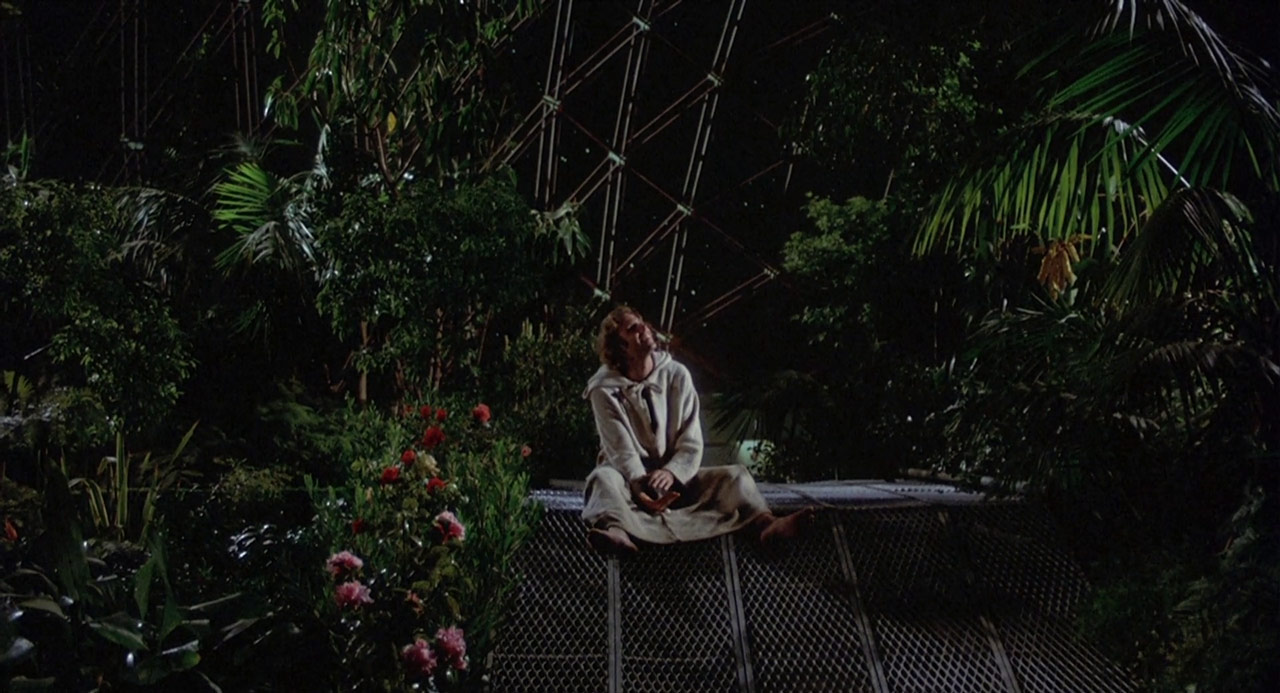
This is part of my ongoing semi-obsession with the film Silent Running (1972). It quite beautifully articulates a very particular understanding of what an environment is – an understanding that now stands out as being something from another era altogether. And the fact that it does so through such a rich medium serves more important purposes than the simply illustrative (although there's that too).


Of course, when reading or watching science fictions past, it is often striking just how much they get right and there is far more to such texts and reels than their out-datedness. But there is something particularly striking in moments that jar with the present rather than resonate with it. Something irreducibly valuable.

And all of this is why I would much prefer to pursue a 'history of ideas' than an 'intellectual history.' How staid and textureless is the latter as a flag for thought? That is not to condemn the close, focused concern with the texts that such a term designates, far from it. It is just to prise open the possibility of there being no useful or interesting distinction to be made between 'cultural' history and that of the 'intellectual.' To regard the separation of 'high' and 'low' not so much with scorn as with humour. (What is funnier than the vain, indignant defence of a hierarchy that has already crumbled?)

Tuesday, 17 March 2015

Anomie and atmosphere in Douglas Trumbull's 'Silent Running'—Now with words and pictures

As previously advertised, I gave a talk yesterday at a seminar run by the Performance Research Group at King's College London, the theme of which was 'The Anomaly in Art and Modes of Existence.' The paper, complete with illustrations, is here if anyone is interested. I spoke about a film that has been the subject of previous blog posts; namely, Silent Running.

Some version of this paper (probably greatly modified) is going to be submitted for the catalogue of Bruno Latour's 'Reset Modernity!' exhibition that is running from April to August next year at ZKM in Karlsruhe. I've already had a few ideas about how to approach these themes and issues a little differently after yesterday. It'll need to be a fair bit shorter, for one thing.

The talk on Monday was a lot of fun (the warmest thanks to the organisers!). It was the first time I'd been invited to go and speak somewhere, so that was nice. I rambled on for longer than I intended but I think I managed to keep everyone awake!

Wednesday, 11 March 2015

'It's not a pathology, it’s a project!—Sociology, anomie and atmosphere'

I'm very much looking forward to speaking at a seminar run by the Performance Research Group at King's College London next Monday (the 16th). The theme of the series is 'the anomalous' and this session in particular is titled 'The Anomaly in Art and Modes of Existence.' I'll be speaking alongside Penny Newell, the organiser. I'll be presenting something drawn from my ongoing interest in the 1972 science fiction film Silent Running. I'm in the slow but gradually progressing process of turning this interest into something concrete.

The presentation will have three parts: first, an illustrated summary of the film; second, a consideration of Émile Durkheim's concept of anomie relative to the themes presented (the main idea I take from the film is that of 'tragic modernism'—where the basic tenets of modernism are fully and naively accepted but lamented as a tragedy); and third, a reconstruction of this concept in dialogue with the AIME project, trying to understand its socio- or geo-political importance with respect to, in a phrase, air-conditioning our collective atmospheres (this then linking back to the film and its beautifully, movingly nuanced illustration of what happens when affective and social atmospheres, no less than oxygenated ones, are stripped away).

The title captures the essential point I'm trying to make: anomie is poorly understood as an anomalous pathology afflicting the social organism, as per Durkheim. Anomie—defined by Durkheim as the destructive de-restriction and derangement (dérèglement) of collective moral-legal bonds—is precisely the objective of the modernist project! To remove all bonds, all obligations with regard to other humans and, crucially and most intensively, to non-humans is precisely the point. They called it 'rationalisation.'

Durkheim cannot see this, or at least he cannot see it fully (his condemnation of economic theory for its anomie-inducing reductionism notwithstanding), because he has already fully and completely accepted the primary consequence of the anomie of the moderns: the fundamental separation of the social and the natural.

Durkheim was actively participating in this anomie-exacerbation (ever the 'rationaliser'). His condemnations were failures since he was reproducing the most fundamental principles of the very ideologies that he was condemning. This, I think, can be demonstrated through a close reading of the film, although I am still figuring out just how to construct this argument (very much a work in progress!).

To what extent the concept of anomie can (or should) be reconstructed is debatable but, I hope, it is at least worth debating. Connecting Durkheim to Latour's work is undoubtedly a provocative move! However, I think it could be a productive one (albeit one that will inevitably raise more questions than I am able to answer at present).

Monday, 27 October 2014

'Silent Running' at the Eden Project—Some reflections on cinema and its world

Following on from a post I wrote recently, the 1972 sci-fi classic film Silent Running was shown last night at the Eden Project in Cornwall.
The event was kicked off by the performance of a quite gorgeous sci-fi-inspired, ambient piece of music by Adrian Utley (Portishead) and Will Gregory (Goldfrapp), with Adrian Lee and Tim Allen, in the Mediterranean biome. (Among the celebrity Cornishmen in attendance—this needs to be mentioned as there really aren't many of them!—was the artist usually known as Aphex Twin.)

With dozens of speakers dotted around the place, the band's magnificently brooding, droning, chirping sound-waves reverberated all around the biome, mixing and melding with the rippling rhythms of talking, walking, dropping things... It was an immersive aural delight.

Afterwards, back in the main building and overlooking the domes, Utley and Gregory described how they were inspired particularly by the soundtrack for Forbidden Planet (1956) and its cobbled-together, hugely experimental techniques of sound-scaping.

Then came Mark Kermode's hilarious and heartfelt introduction to the film. I expect that a video of this will emerge on Eden's Youtube page soon, though it hasn't yet.

I'd watched the film five or six times before but never on a big screen, nor with a crowd of people. (Nor, indeed, on film as opposed to the DVD version.) It was quite remarkable how different the experience was under properly 'cinematic' conditions. I saw so many things in the film that I hadn't before (I am sure that it was differently edited to the DVD version, although it seemed to come in at the same running time); moreover, I felt many things watching the film that I had not previously. Scenes which previously slid by with little to mark them as remarkable became pivotal moments; the rhythm, pacing and structure of the film seemed to somehow reveal themselves; jokes that seemed only mildly humorous became hilarious ('laugh and the whole world...'), while the pathos of the film's closing act was stunningly magnified by the sheer silence of the audience as the events unfolded.

The film has its moments of kitsch and inadvertent humour (whatever the bird is that lands on Lowell's arm during the first Joan Baez song never fails to have them rolling in the aisles). In many ways, as even Kermode conceded, the film doesn't hold together; in many ways it is rather dated. However, there really is something very special about it as a work of art, especially when viewed in its proper environment—that is, when viewed cinematically.

The fact that some of the film's more naive moments provoked laughter only served to emphasise the degree to which its more sensitive moments were still able to move deeply, to make present sentiments that were utterly relatable, despite all the distancing effects of time and the ageing process of technical progression.

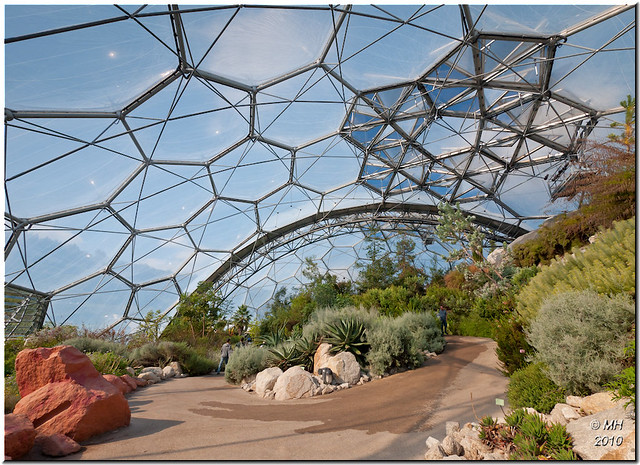
While the film was screened in a conference room rather than a proper cinema this hardly mattered. In fact the setting couldn't have been more perfect. The room was set up in such a way that Eden's domes, the architecture of which was inspired by the film, were visible just to the right of the screen. As the credits begin to roll we see one dome gradually drifting off into the distance. As Kermode noted rather excitedly, it appeared more or less the same size on the screen as the domes that were visible out of the window.

I can't think of a film that has been connected to its worldly consequences in the mere fact and technique of its projection as intimately as this one. What could sunder all pretences of textualism or filmic internalism more than this moment? Projection as a technical art is an intimate part of the broader art of cinema—this much is clear. And film is of the world. It is an ever transforming assemblage; it acts, it moves, it builds.

As I mentioned in my previous post, I'm planning on writing an article on all of this, taking this film as a case study for thinking about space and spatiality in film. It seems to me that for all the countless pages written on time in film there is precious little that concentrates on space—as though that were somehow either given or uninteresting. Neither of those things seem to me to be true. I am now quite excited about getting to work on this project!

Tuesday, 30 September 2014

Silent Running and the Eden Project—The founder's and architect's views

Further to my last post, on the Guardian website this evening there are (very) short interviews with the founder of the Eden Project, Tim Smit, and one of the architects, Jolyon Brewis; here's what the latter has to say:
Most architects dream of creating a new world on a scale that eclipses all that’s gone before. And many of us love the sci-fi film Silent Running, too, in which giant greenhouses are attached to spacecraft. So in the early days, when there was always the threat of construction being stopped because of lack of money, all the companies involved carried on regardless: we were so enthralled by the vision. 
Our first designs were for different locations, including a tent-like structure for a hillside, then Smit discovered the china clay quarry at Bodelva. It had a romantic, lost world feel since it would be hidden from view until you were almost upon it. I thought it was a wonderful idea: land that had been desecrated by humans being returned to fecundity by humans. [...]

Thursday, 25 September 2014

Silent Running at the Eden Project / Sci-fi in the Anthropocene

As one of several plates that I'm currently spinning, I'm writing (or, rather, at the moment planning) an article on the 1972 science-fiction film Silent Running.


In a nutshell, the article is about space in the Anthropocene, analysing this film in the context of sci-fi film more widely in order to understand how our collectively imagined attitudes to nature, ecology, space and outer-space have changed, are changing and need to change further.

Fortuitously, as part of its 'Days of Fear and Wonder' series, the BFI (British Film Institute) is putting the film on at the Eden Project in Cornwall – a tourist attraction I grew up just a few miles from.

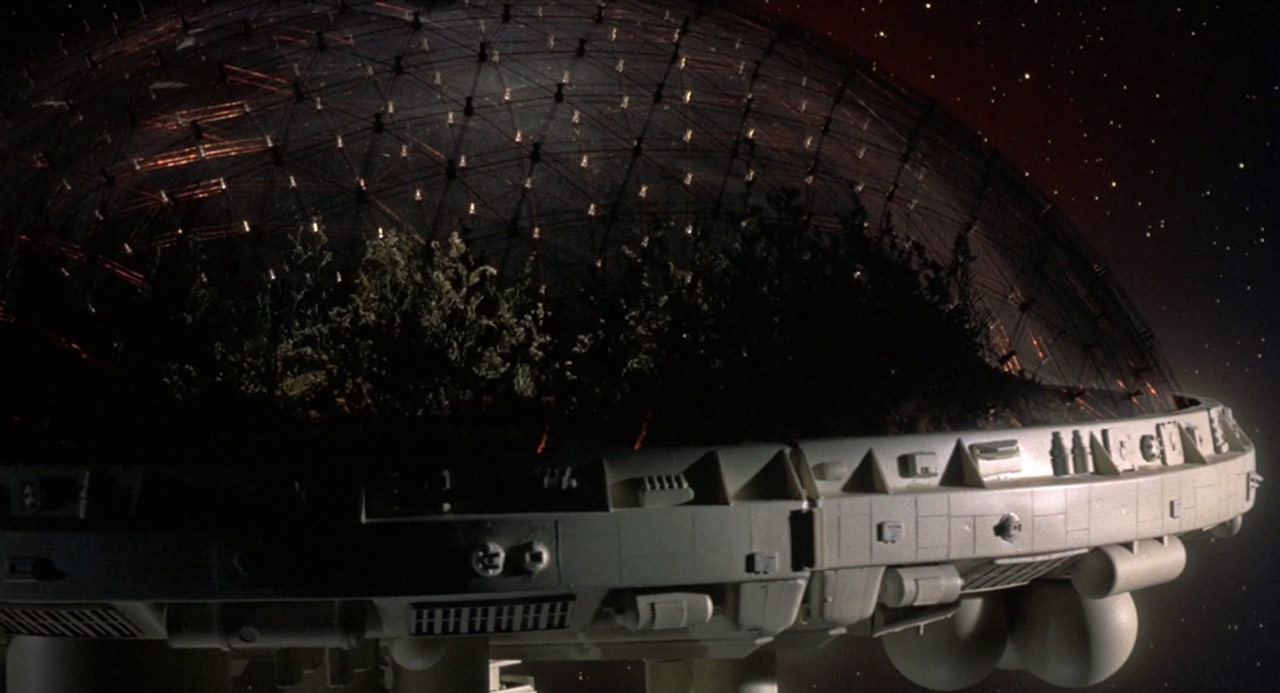
Silent Running's geodesic biodomes inspired the domes at Eden, as one can plainly see:


I am very much looking forward to it!

Incidentally, the last time I went to Eden was to see Sigur Rós perform there last year, which was an experience bordering on transcendent.


The most ethereal, other-worldly music in the most surreal, other-worldly setting. I've seen Sigur Rós perform nearly a dozen times and this was the most perfect mise-en-scène for them.

There's certainly something about these spaces that is musically inspiring. Adrian Utley of Portishead and Will Gregory of Goldfrapp have composed pieces to be played in the Mediterranean biome before the screening of the film.


(Sadly the film will not be shown in the biomes themselves but rather in the visitor centre that overlooks the site.)

Another slightly eccentric rock band, 65daysofstatic, re-scored Silent Running and have performed their version live a number of times (never gotten to see that though, unfortunately):


(By the by, if you've not seen the film before I'd recommend watching the original before the 65daysofstatic version, as brilliant as their score is.)

The film critic Mark Kermode, who has a BFI-curated book on Silent Running coming out soon, is also going to introduce the picture.

All in all, I'm pretty excited! It's provoking lots of thoughts for me with regard to my research. I've started reading semiotics for this project and it's very challenging to think about how I can conceptualise the 'intertext' of the film, so broad and 'beyond-textual' as it all is.

The film's director, Douglas Trumbull, rose to prominence for being one of the foremost special effects wizards on Kubrick's 2001: A Space Odyssey. Off the back of that success he was given $1m by Universal Studios, as a directorial debutant, to make whatever film he wanted. He describes Silent Running as the 'human' reaction to 2001 – it's a film all about emotion, relation and affect; where 2001 is cold and impersonal, Silent Running is warm and intensely personal.

It is often dismissed as an out-of-date, hippy-era melange of preachy nature-worship – and there is that element to it, for sure (see the painfully kitsch Joan Baez song 'Rejoice in the Sun' that was written for the soundtrack, for example); however, its beating heart is the incredible lead performance by Bruce Dern.

(Griemas & Fontanille's The Semiotics of Passion: From States of Affairs to States of Feelings is interesting in this regard, though I don't yet know enough semiotics to really understand it properly. It's an intimidatingly technical discipline.)

It's both the outdated ontology of nature implicit within the film's political aesthetics and the intense, emotional core of the story that I'm interested in. These things together are what make this such an interesting film.

Beyond the narrow 'intertext,' there's also the tourist-ecological relation in the fact that these domes, or derivatives of them, were materialised on a grand scale in an abandoned quarry in a sleepy, quiet and rather impoverished part of Cornwall. And, of course, these are not the only such domes in the world.

Then there's the author-biographical fact that I grew up close to where these domes are and know the area. This, I think, affects how I experience the space of the domes and, consequently, perhaps the film. It will be an interesting phenomenological experience.

There's also a 'making of' documentary that reveals much about how the film was produced and the motivations and mindsets of the performers. Crucial, I think, is that there are no women in this film whatsoever besides a little girl whose picture on the wall is gestured to rhetorically by the main character at one point (and at a pivotal moment in the film, I might add). In this documentary we see that, as one might expect of the time, women are pretty much nowhere to be seen on the production side of things. I find this interesting because of the lead character who blends a sometimes ferocious masculinity with a sensitivity that might have been quite strikingly effeminate in context. Dern recounts jogging around the naval base at which the filming was taking place and being left in no doubt that the world wasn't ready for a long-haired hippy running about the place. The only women in the 'making of' are seemingly either organisational or ornamental; in the film itself there's almost no trace of women-kind whatsoever. And yet the lead character is far from being a straightforward 'man's man,' although he is far from being 'unmanly.' Does he project a progressive masculinity or simply a man's idea of what progressive masculinity would look like? The latter, I think; however, it's interesting either way, especially given the ecological context of the film.


Finally, the spaceship on which the film is set is named the Valley Forge, after the aircraft carrier on which it was filmed, which in turn was named after an important site in the American Revolution:
Valley Forge in Pennsylvania was the site of the military camp of the American Continental Army over the winter of 1777–1778 during the American Revolutionary War. It is approximately 20 miles northwest of Philadelphia. Starvation, disease, and exposure killed nearly 2,500 American soldiers by the end of February 1778.
Ecology and terror are baked into the film's very pretext.

I think it'll be impossible to weave all these threads together into a neat and perfect plait. However, there's certainly plenty to be working with. Here's the abstract as it's been proposed:
This paper examines ontologies of nature and their cognate concepts of space as they are represented in popular culture, particularly in science fiction. It does this through a close, contextualised and intertextualised reading of Douglas Trumbull’s 1972 film Silent Running. It proceeds in two parts. First, the ontologies of space and nature that are implicit within SR’s ecological mise-en-scène are examined alongside Bruno Latour’s rendering of James Lovelock’s concept of Gaia. This is used to theorise the ‘counter-Copernican revolution’ whereby our futural spatial imaginaries are turned around and transformed – as the protagonist in Christopher Nolan’s Interstellar (2014) puts it: “We used to look up at the sky and wonder at our place in the stars, now we just look down and worry about our place in the dirt.” The second section detects deeper and more sophisticated space-creative processes in the manner by which SR’s protagonist, Freeman Lowell, fabricates a life for himself alone aboard the damaged, drifting, dome-clad spaceship in which he is ensconced. This inner-space construction is analysed in terms of Peter Sloterdijk’s ‘microspherology.’ This paper therefore relates to a number of issues in contemporary spatial and cultural theory: the effect of the Anthropocene and the ‘irruption of Gaia’ upon our cosmic spatial imaginaries; affective, postphenomenological theories of the construction of space and their ecological politics; and, finally, the relationship between Latour and Sloterdijk, two major theorists of space whose work has not yet been compared in adequate detail. In short, this paper examines what happens to spatial, terrestrial, imaginative, immunological existence when it is realised that, as Latour (2013) puts it, “we are imprisoned in [the Earth’s] tiny local atmosphere” – when space ceases to be ‘the final frontier.’