Friday, 16 May 2014

Reflections on [fic]tion

I missed that the latest post on the AIME reading group blog had gone up two weeks ago. Belatedly I've formulated some thoughts on chapter 9.

First things first, it's an excellent summary by Andre Ling.

One interesting thing for me is where [fic] fits into this third group of modes, sandwiched as it is inbetween [tec] and [ref]. Latour is very clear that there is a kind of temporal succession to these modes in terms of when they are first invented (or, better, instaured). From the online version of the book:
We can say that the three regimes divert each other successively: [tec] diverts metamorphoses to transform them into folds, which leads to a diversion of [fic] and an expression of forms in materials, and these in turn are diverted by [ref] to keep open a pathway through the successive transformations of material expression by maintaining a constant. Not only do these regimes divert one another, they are dependent on each other. 
The three modes align along a roughly sketched history of humanization – because with the second group we enter the human domain, à la Leroi-Gourhan, via the irruption of quasi-objects: technical, first of all, then fiction objects, then, much later, science. We are no longer talking about the background of the world, as with the first group, but about the irruption of new ways of differing, technology serving as a transition as a result of its ubiquity even in the non-human world.
So, taking him at his word here it seems impossible to maintain that [fic] might bear any relation to a sort of panpsychism, etc. [fic] is very obviously a relatively recent invention (in evolutionary terms), coming after technology (which has been around for hundreds of thousands of years at least) and before reference (which has been around for perhaps centuries).

However, there is something of a tension – actually this is a tension found throughout the book. Just how ‘hemmed in’ can we take the modes to be? How generalised can they be? How far does their metaphysic stretch?

Latour approvingly quotes the following from Deleuze & Guattari on percepts:
Percepts are no longer perceptions; they are independent of a state of those who experience them. Affects are no longer feelings or affections; they go beyond the strength of those who undergo them. Sensations, percepts, and affects are beings whose validity lies in themselves and exceeds any lived. They could be said to exist in the absence of man because man, as he is caught in stone, on the canvas, or by words, is himself a compound of percepts and affects. The work of art is a being of sensation and nothing else: it exists in itself.
He writes of this passage: "See the beautiful analysis of what Deleuze and Guattari call “percepts” in their search for contrasting the mode called here [fic]"

In other words, D&G were in search of this mode, too. Now, of course, percept for D&G certainly is not something limited to human invention. So, my fundamental question regarding [fic] is this: what of birdsong (to take a classic example)? Is that [fic]? Non-humans (including birds, not just hominids) are said to be tool users [tec] so does the same go here for fictions also? Should we interpret the Leroi-Gourhan indebted evolutionary history of the modes to indicate only one specific lineage of these modal possibilities? (i.e. this is where we ourselves came across these modes, other species have found their own acquaintances with them.)

[fic] can be summarised simply if abstractly as that mode that folds [tec] beings further by creating entities that shift from material to material without ever transcending their media. But isn’t that really the human instantiation of these capabilities? What of birdsong?

Thursday, 15 May 2014

Atelier de réécriture diplomatique

So, it seems that I'm going to Paris for Bruno Latour's much anticipated diplomatic 'summit' at the end of July—the conclusion of his AIME project.

A whole week of bilingual philosophical discussion. Yikes. I need to brush up on my French—and by 'brush up' I mean transform it entirely! I've been taking lessons but at a fairly low level. If I can get there, survive for a week and get home that'll be a victory.

I don't anticipate being able to follow all of the discussion but it'll certainly be an experience!

Saturday, 26 April 2014

More on contents and constituents

I've been thinking a bit more about opposing science as a 'content provider' to science as a 'constituent producer.'

To encounter scientific knowledge as constituent rather than content is to encounter it as a problem. This is not to say that the knowledge in question is 'problematic' qua knowledge—indeed, it is the very objectivity of such knowledge that makes it a concern. No, to say that scientific knowledge is to be treated as a constituent, as a problem, does not necessarily mean that the knowledge is questionable or needs questioning in the register of knowledge—it means that these items of knowledge have an uncertain and not-yet-settled place in our world. What transformational demands does such knowledge make on us? How can it be accommodated within our collective in such a way that it is not destructive? What are the potential consequences of its non-accommodation? Such knowledge, having attained a powerful objectivity, must now be addressed in a political register; it is its very weight and durability as knowledge that makes it a problem for politics; its objectivity isn't what raises it outside the melee of politics but rather what plunges it into it.

This is the important point: the mere objective facticity of a knowledge-item does not result in its immediate, automatic accommodation within a collective—that would only follow if the real were rational and if politics were a mere pedagogical matter of knowledge dissemination. We cannot ignore the fragility of objective knowledge; the modernist war cry
“Burn them all; the Real will recognize its own!” (Latour AIME, 19)
is as cynically neglectful of the needs of objective knowledge as it is of difference and life.

'Content provider' and 'constituent producer' should not be thought of as a straightforward binary opposition. It would be more accurate to say that to address knowledge as constituent is to receive an added obligation, to be burdened with extra labour, to have to think more carefully, to have to reason further, to be more reasonable.

When contemporary philosophy takes science as a content provider in the sense that science provides the opportunity, alongside and continuous with art and literature, for creative, expressive thought, this is undoubtedly part of what makes for a healthy collective attitude towards science. It is part of the solution; however, it is not enough on its own. Such philosophy hasn't yet recognised its full obligations and, as such, remains a part of the problem at the same time.

When contemporary philosophy—and this does happen—takes science to be a content provider in the sense that it provides a list of entities that, thus certified, can be justly asserted dogmatically as the background reality within which our politics and ethics and so on operates: this is something else entirely; this is not part of what makes for a healthy collective attitude towards science since it blows up all roads and bridges between content provision and constituent production; it renders its own neglect permanent; worse, it surrenders objective knowledge to an unobserved, unpoliticised fate.

The real may, ultimately, recognise its own; but to believe that we are the real's chosen creed—that is a travesty of thought.

Thursday, 24 April 2014

Cornwall recognised by EU

Cornwall has been granted national minority status by the European Framework Convention for the protection of national minorities. Though by no means a nationalist of any sort I am Cornish by birth and most of my family still live there; I have been an émigré since I was 18 (I say that very much tongue-in-cheek; I live all of 150 miles away from where I grew up!). It's good news for the county, which is one of the poorest regions in Europe and should have a louder voice politically as well as qualifying for more EU funds.

I sometimes identify as Cornish rather than English, British or even European though not because of any deep-rooted atavism. I suppose it's because all those alternative labels have such awful historical affiliations while 'Cornish' seems fairly benign by comparison. There is a Cornish nationalist movement and I'm sure that it has its share of reactionaries but, all things considered, there's not a lot of mud that will stick to it.

But it's not just that; there's a stronger element to the identification. I do feel at home when I'm in Cornwall; there is an atmosphere and a sensibility that is particular to it and that'll never leave me. I don't necessarily always like that atmosphere and sensibility—it can suffocating—and I have no desire to go back there any time soon but it does feel like home. Yes, proud to be Cornish—why not? I'd rather be that than a citizen of 'the world'—that vainglorious, superficially benignant motto of cosmopolitan transcendence. No one is from nowhere. The trick is to not make where you're from such a big deal.

Physics, common sense and habit

Terence Blake writes about Latour's take on physics versus common sense appearances:
[Latour] does not allow himself the facility of such a traditional metaphysical move, which costs nothing to advance, a labour-saving philosophy for the intellectually indigent. No, he claims that the “popularizer” of quantum complexity believed in the simplicity of our common-sense world because “it cost him nothing to believe that the microphone into which he was speaking, the rostrum from which he was pontificating, his own body, his genes, the walls of the room, the assembly that he was carrying along in his frenzy, all that too was bathed in a Euclidean space”. It costs him nothing to believe this simple fable because he does not do the work necessary to explore the contours of the common sense world, to investigate its multiple dimensions.
The important thing left unspoken here, I think, is the crossing with which [ref]erence is engaged. Is it [ref·dc] or [ref·hab]? Latour is clear that: 'Appearances are not shams'; on the contrary, appearances and [hab]its are what make the word 'habitable' (AIME: 268-270).

There's nothing necessarily wrong with habits or simplifications as such. High school physics classes needn’t descend into detailed exegeses of the infrastructural history of physics (although students might well benefit from some sociology of science mixed into their curriculum!). Most of the time the fact that we cannot speak of the objects made known by science except through the networks of science is trivial and needn’t be given a second thought. However, this is not true in instances of contestation, of disputation (scientific or political). In these cases the networks do have to be made explicit—morally, politically and epistemologically. At these points the test of a good versus a bad [hab]it is raised: does it retain the memory of what 'launched' it? can it switch back to the other modes of action necessary to unravel networks and comprehend indecision without undue confusion?

To go down the road of [ref·dc] (double click), on the other hand, is to embrace dogmatism, to make the ineradicable necessity of referential, mediative circuits only a 'matter of fact'; to hold out on the possibility of 'in principle' knowing without mediation; to make science a content provider rather than a constituent producer.

Another way of putting it might be that not all representational thinking necessarily leads to the "dogmatic image of thought," as Deleuze put it. Such dogmatism is the result of bad habits that are unable to shift back into other modes that allow the unravelling of networks. They create an illusion of transcendence and thus power but in fact radically weaken because they leave existents lost and alone, unable to shift out of a single register.

Wednesday, 16 April 2014

Interrogating 'complexity'

A really interesting post on Deterritorial Investigations on the limitations of complexity theory, cybernetics, etc. for critical social and cultural thinking.

I think this is a really important point.  Complexity, etc. has been such a privileged resource for 'critical' thought for so very long that it's quite strange that the concept has received so little critical interrogation from within.  It amazes me that people hardly ever draw a connection between the Deleuzian complexity aesthetic and that of Friedrich Hayek.  For both, writing around the same time, the allure is the same: spontaneous self-organisation does away with the need for any centralised decision making process, i.e. the State (which is something of a bogeyman in both their vocabularies).  Now, that isn't to make a lazy 'Deleuze is a neoliberal' comment, I don't believe that for a second.  But the whole spontaneously organising communism thing has always struck me as a neoliberal fantasy.

Saturday, 12 April 2014

Language is not a mode of existence—wouldn't the 1970s be scandalised?

Clive Barnett of Pop Theory writes an interesting and lengthy musing on Latour's AIME (helpfully linked to by the ever helpful ANTHEM blog).  He draws a number of very useful links between Latour's use of speech act and other elements of linguistic philosophy.

I think he may be right about Latour overstating the language-reductiveness of speech act theory, etc. and analytic philosophers certainly are interested in being as well as language.  However, I think it's also fair to say that Latour goes a long way beyond where any of these people end up.

In AIME he argues the following (I paraphrase loosely but, I think, accurately) with regard to language and metaphysics: everything relates with or 'passes through' something else in order to continue existing; therefore everything joins things together, everything 'articulates'; each mode is a particular kind of articulation, a particular way of relating; thus every mode can be understood as having different truth procedures or standards of meaning; everything articulates, everything interprets, everything judges—from tics to popes, as Latour puts it at one point; language is just one way of articulating, among others, though it is not a mode itself but a mixture, presumably, of [tec]hnology, [fic]tion and others; when we speak or write we are simply taking advantage of a capacity that already exists in the world—namely, articulation; language is an invention that utilises and renders unusually explicit and dynamic what was there all along; thus we can understand the world in language, not as a 'lens' or anything of the sort but as something with real purchase on how things are because meaningful articulation is how things are.

Making AIME all about language is, therefore, rather misleading.  Although it makes use of lots of linguistic philosophy it's utterly metaphysical at heart.  To suggest that 'ontology' and 'metaphysics' are empty signifiers because it's really all about language—that misses the whole point of what Latour is trying to do.  Saying that 'practices' also have a meaningful structure and therefore discourse theory, etc. isn't all about language isn't sufficient either—that's like an agoraphobic setting one foot outside his front door and saying that he's been around the world and back.

For Latour the evolution of sea algae in and of itself is as meaningful and articulated as this sentence, as any sentence.  I can't see Searle et al. getting on board with that!  Now, that's not to say that there can't be all sorts of productive conversations between these thinkers of language and meaning but, suffice to say, I don't think that ontology and metaphysics are empty signifiers.

Wednesday, 9 April 2014

'Largest volcanic eruption in human history changed the 19th century as much as Napoleon'

There's a truly fascinating post by one Gillen D'Arcy Wood over at The Conversationa very interesting blog (or rather set of blogs):
Most have heard of the Battle of Waterloo, but who has heard of the volcano called Tambora? No school textbook I’ve seen mentions that only two months before Napoleon’s final defeat in Belgium on June 18, 1815, the faraway Indonesian island of Sumbawa was the site of the most devastating volcanic eruption on Earth in thousands of years.
Read the whole thing, it's superb.  It's also funny that the title is the way around that it is.  Isn't it remarkable that Napoleon is the thing that the volcano is having to measure up to?!  In the comments the author suggests that the reason why this event is almost unknown while the far less devastating eruption at Krakatoa in 1883 is legendary is that telegraph systems were up and running by that time and thus everyone in the West heard about it almost immediately instead of just experiencing a bunch of strange climatological and atmospheric goings-on indirectly.

Maybe one day volcanoes will set the benchmarks for warmongering statesmen to measure up to.

He also has a book coming out on the subject in the near future (first chapter available here):


Monday, 7 April 2014

Plato on materialists

The materialists pull everything down from the sky and out of the invisible world onto the earth as if they wanted to clench rocks and oak trees in their fists. They grasp them, and stubbornly maintain that the only objects that exist are those that are tangible and comprehensible. They believe that the physical existence of an object is existence itself, and look down smugly on other people — those who acknowledge another area of existence separate from the physical. But they are totally unwilling to listen to another point of view. 
(Plato, Sophists)
(Taken from the epigraph of Jakob von Uexküll's essay The Theory of Meaning.)

Douglas Adams on philosophy and philosophers

From the Hitchhiker's Guide to the Galaxy, of course:
There are of course many problems connected with life, of which some of the most popular are Why are people born? Why do they die? Why do they want to spend so much of the intervening time wearing digital watches? 
Many many millions of years ago a race of hyperintelligent, pandimensional beings (whose physical manifestation in their own pan-dimensional universe is not dissimilar to our own) got so fed up with the constant bickering about the meaning of life which used to interrupt their favourite pastime of Brockian Ultra Cricket (a curious game which involved suddenly hitting people for no readily apparent reason and then running away) that they decided to sit down and solve their problems once and for all. 
And to this end they built themselves a stupendous super computer which was so amazingly intelligent that even before the data banks had been connected up it had started from I think therefore I am and got as far as the existence of rice pudding and income tax before anyone managed to turn it off. 
It was the size of a small city. 
Its main console was installed in a specially designed executive office, mounted on an enormous executive desk of finest ultramahagony topped with rich ultrared leather. The dark carpeting was discreetly sumptuous, exotic pot plants and tastefully engraved prints of the principal computer programmers and their families were deployed liberally about the room, and stately windows looked out upon a tree-lined public square. 
On the day of the Great On-Turning two soberly dressed programmers with brief cases arrived and were shown discreetly into the office. They were aware that this day they would represent their entire race in its greatest moment, but they conducted themselves calmly and quietly as they seated themselves deferentially before the desk, opened their brief cases and took out their leather-bound notebooks.  
Their names were Lunkwill and Fook. 
For a few moments they sat in respectful silence, then, after exchanging a quiet glance with Fook, Lunkwill leaned forward and touched a small black panel. 
The subtlest of hums indicated that the massive computer was now in total active mode. After a pause it spoke to them in a voice rich resonant and deep. 
It said: "What is this great task for which I, Deep Thought, the second greatest computer in the Universe of Time and Space have been called into existence?" 
Lunkwill and Fook glanced at each other in surprise. 
"Your task, O Computer..." began Fook. 
"No, wait a minute, this isn't right," said Lunkwill, worried. "We distinctly designed this computer to be the greatest one ever and we're not making do with second best. Deep Thought," he addressed the computer, "are you not as we designed you to be, the greatest most powerful computer in all time?" 
"I described myself as the second greatest," intoned Deep Thought, "and such I am." 
Another worried look passed between the two programmers. Lunkwill cleared his throat. 
"There must be some mistake," he said, "are you not a greatest computer than the Milliard Gargantubrain which can count all the atoms in a star in a millisecond?" 
"The Milliard Gargantubrain?" said Deep Thought with unconcealed contempt. "A mere abacus - mention it not." 
"And are you not," said Fook leaning anxiously forward, "a greater analyst than the Googleplex Star Thinker in the Seventh Galaxy of Light and Ingenuity which can calculate the trajectory of every single dust particle throughout a five-week Dangrabad Beta sand blizzard?" 
"A five-week sand blizzard?" said Deep Thought haughtily. "You ask this of me who have contemplated the very vectors of the atoms in the Big Bang itself? Molest me not with this pocket calculator stuff." 
The two programmers sat in uncomfortable silence for a moment. Then Lunkwill leaned forward again. 
"But are you not," he said, "a more fiendish disputant than the Great Hyperlobic Omni-Cognate Neutron Wrangler of Ciceronicus 12, the Magic and Indefatigable?" 
"The Great Hyperlobic Omni-Cognate Neutron Wrangler," said Deep Thought thoroughly rolling the r's, "could talk all four legs off an Arcturan MegaDonkey - but only I could persuade it to go for a walk afterwards." 
"Then what," asked Fook, "is the problem?" 
"There is no problem," said Deep Thought with magnificent ringing tones. "I am simply the second greatest computer in the Universe of Space and Time." 
"But the second?" insisted Lunkwill. "Why do you keep saying the second? You're surely not thinking of the Multicorticoid Perspicutron Titan Muller are you? Or the Pondermatic? Or the..." 
Contemptuous lights flashed across the computer's console. 
"I spare not a single unit of thought on these cybernetic simpletons!" he boomed. "I speak of none but the computer that is to come after me!" 
Fook was losing patience. He pushed his notebook aside and muttered, "I think this is getting needlessly messianic." 
"You know nothing of future time," pronounced Deep Thought, "and yet in my teeming circuitry I can navigate the infinite delta streams of future probability and see that there must one day come a computer whose merest operational parameters I am not worthy to calculate, but which it will be my fate eventually to design." 
Fook sighed heavily and glanced across to Lunkwill. 
"Can we get on and ask the question?" he said. 
Lunkwill motioned him to wait. 
"What computer is this of which you speak?" he asked. 
"I will speak of it no further in this present time," said Deep Thought. "Now. Ask what else of me you will that I may function. Speak." 
They shrugged at each other. Fook composed himself. 
"O Deep Thought Computer," he said, "the task we have designed you to perform is this. We want you to tell us..." he paused, "...the Answer!" 
"The answer?" said Deep Thought. "The answer to what?" 
"Life!" urged Fook. 
"The Universe!" said Lunkwill. 
"Everything!" they said in chorus. 
Deep Thought paused for a moment's reflection. 
"Tricky," he said finally. 
"But can you do it?" 
Again, a significant pause. 
"Yes," said Deep Thought, "I can do it." 
"There is an answer?" said Fook with breathless excitement." "A simple answer?" added Lunkwill. 
"Yes," said Deep Thought. "Life, the Universe, and Everything. There is an answer. But," he added, "I'll have to think about it." 
A sudden commotion destroyed the moment: the door flew open and two angry men wearing the coarse faded-blue robes and belts of the Cruxwan University burst into the room, thrusting aside the ineffectual flunkies who tried to bar their way. 
"We demand admission!" shouted the younger of the two men elbowing a pretty young secretary in the throat. 
"Come on," shouted the older one, "you can't keep us out!" He pushed a junior programmer back through the door. 
"We demand that you can't keep us out!" bawled the younger one, though he was now firmly inside the room and no further attempts were being made to stop him. 
"Who are you?" said Lunkwill, rising angrily from his seat. "What do you want?" 
"I am Majikthise!" announced the older one. 
"And I demand that I am Vroomfondel!" shouted the younger one. Majikthise turned on Vroomfondel. "It's alright," he explained angrily, "you don't need to demand that." 
"Alright!" bawled Vroomfondel banging on an nearby desk. "I am Vroomfondel, and that is not a demand, that is a solid fact! What we demand is solid facts!" 
"No we don't!" exclaimed Majikthise in irritation. "That is precisely what we don't demand!" 
Scarcely pausing for breath, Vroomfondel shouted, "We don't demand solid facts! What we demand is a total absence of solid facts. I demand that I may or may not be Vroomfondel!" 
"But who the devil are you?" exclaimed an outraged Fook. 
"We," said Majikthise, "are Philosophers." 
"Though we may not be," said Vroomfondel waving a warning finger at the programmers. 
"Yes we are," insisted Majikthise. "We are quite definitely here as representatives of the Amalgamated Union of Philosophers, Sages, Luminaries and Other Thinking Persons, and we want this machine off, and we want it off now!" 
"What's the problem?" said Lunkwill. 
"I'll tell you what the problem is mate," said Majikthise, "demarcation, that's the problem!" 
"We demand," yelled Vroomfondel, "that demarcation may or may not be the problem!" 
"You just let the machines get on with the adding up," warned Majikthise, "and we'll take care of the eternal verities thank you very much. You want to check your legal position you do mate. Under law the Quest for Ultimate Truth is quite clearly the inalienable prerogative of your working thinkers. Any bloody machine goes and actually finds it and we're straight out of a job aren't we? I mean what's the use of our sitting up half the night arguing that there may or may not be a God if this machine only goes and gives us his bleeding phone number the next morning?" 
"That's right!" shouted Vroomfondel, "we demand rigidly defined areas of doubt and uncertainty!" 
Suddenly a stentorian voice boomed across the room. 
"Might I make an observation at this point?" inquired Deep Thought. 
"We'll go on strike!" yelled Vroomfondel. 
"That's right!" agreed Majikthise. "You'll have a national Philosopher's strike on your hands!" 
The hum level in the room suddenly increased as several ancillary bass driver units, mounted in sedately carved and varnished cabinet speakers around the room, cut in to give Deep Thought's voice a little more power. 
"All I wanted to say," bellowed the computer, "is that my circuits are now irrevocably committed to calculating the answer to the Ultimate Question of Life, the Universe, and Everything," - he paused and satisfied himself that he now had everyone's attention, before continuing more quietly, "but the programme will take me a little while to run." 
Fook glanced impatiently at his watch. 
"How long?" he said. 
"Seven and a half million years," said Deep Thought. Lunkwill and Fook blinked at each other. 
"Seven and a half million years!.." they cried in chorus. 
"Yes," declaimed Deep Thought, "I said I'd have to think about it, didn't I? And it occurs to me that running a programme like this is bound to create an enormous amount of popular publicity for the whole area of philosophy in general. Everyone's going to have their own theories about what answer I'm eventually to come up with, and who better to capitalize on that media market than you yourself? So long as you can keep disagreeing with each other violently enough and slagging each other off in the popular press, you can keep yourself on the gravy train for life. How does that sound?" 
The two philosophers gaped at him. 
"Bloody hell," said Majikthise, "now that is what I call thinking. Here Vroomfondel, why do we never think of things like that?" 
"Dunno," said Vroomfondel in an awed whisper, "think our brains must be too highly trained Majikthise." 
So saying, they turned on their heels and walked out of the door and into a lifestyle beyond their wildest dreams. 

Thursday, 3 April 2014

Latour the polytheist

There are some really interesting bits and pieces hidden away, sequestered in the AIME website (which continues to evolve).  Here's the entry for God:
By convention, we retain the word "God" with a capital letter to designate the "truth requirement" carried by [rel] beings, as opposed to the deities that the specific frameworks of [met] beings explore relentlessly. It is this conflict that orchestrated the fight against idolatry (and, by extension, a great deal of anthropology). But we can also use the word god, lowercase this time, to designate the unifying principle of each mode; we need to be able to protect the various specifications that are particular to those entities too quickly confused in the so-called "sociology of religions" or the notion of belief.  
In aime there are as many "gods" as there are modes: there is a [rep] god, a [law]god, a [rel] god - responsible for emphasizing the contrast with the "end of days" - but also a [pre] god, the god of philosophers, and a [ref] god, the god of scholars. This is a practical polytheism which is added to the specific polytheism of [rel]'s God - He who is Father, Son, Spirit, Church, each latter reprising the former. There are as many gods as there are forms of enunciation, not because each enunciation has a different view "of" one God but because the word "god" resumes, for each mode, the unification and continuity obtained by the trajectory of each mode. This is why there is a [ref] god - of the laws of nature - as well as a [rep] or [tec] god, and an [org] god, of course, in the form of Providence or oeconomia. 
For aime, the question of God is resolutely constructivist in that it is necessary to completely invert its b.a.b. meaning - that which is lasting and guarantees duration - by its b.a.o. meaning - that which does not last and which must be constructed, maintained, faithfully preserved etc. At the same time, the critical constructivist inversion ("men make God in their own image") was not sufficient to grasp the [rel] meaning that Western history found and then lost, lacking the power to extract it from its parasitical notion of substance. With relation to God, aime must at once refrain from appealing to substance and critiquing it. And yet the outstanding feature of this mode of existence, ultimately, is God's dependence on man.
This would seem to tie into Latour's use of Jan Assmann's notion of translatability in his Gifford lectures - that ancient peoples saw their gods as being translatable, roughly equivalent, not necessarily incommensurable and even drew up tables of translation to formalise these translations.  Assmann's The Price of Monotheism details this.  Not read it yet but it's on my list...  Latour suggests that it's a cosmopolitical necessity to become able to see secular gods such as Gaia as being translatable with their religious counterparts—that's his 'peace proposal,' at least.

The principle of charity: moral or epistemological?

Is the principle of charity a moral or epistemological principle?  Both, really, but it's often taken to be the former.  If anything I'd lean towards it being more valuable as the latter.

The worst argumentative style of a group of academics I have ever come across is the critical realists.  Their discursive style is one of eliminating an opponent.  If caricature and defamation does that, all the better.  (Okay, I suppose the above is a bit of a caricature itself but I'll stand by the assertion that there's a strong family resemblance between those who identify as critical realists and their discursive styles.)  Bhaskar himself endlessly repeats the line about Hume once saying that there's no more reason to walk out of a front door than out of a third floor window (I've heard him speak a few times and he always wheels it out).  Plainly that isn't what Hume meant, there was a broader argument going on there, but it's repeated on and on as if he was just an idiot.  A nice, easy knock-down argument, as Humpty Dumpty would have said.  We needn't agree with Hume (and I wouldn't) but making him out to be stupid doesn't constitute an argument, indeed it detracts from the arguments that are then presented (and in fairness to Bhaskar he certainly does present thorough arguments, albeit against straw-based lifeforms).

It's not so much that this style is morally objectionable, although this militancy can often degenerate into macho posturing, it's that it's epistemologically indolent.  To take apart an argument while granting that argument the strongest, most reasonable interpretation you can honestly muster: that's a challenge.

I'm not against rhetoric in philosophy by any means but all too often it becomes a crutch for self-important hectoring.  (Then again, so does blogging so I'll leave it at that!...)

Tuesday, 1 April 2014

Stengers on anthropocentrism and accelerationism

There's a load of really interesting stuff in this new book on Architecture in the Anthropocene (discovered courtesy of ANTHEM).  In particular the interview with Isabelle Stengers has some interesting moments.  I wrote a few weeks ago that there seems to be an ongoing competition among some academic-types to be ever more anti-anthropocentric than everyone else—i.e. anthropocentrism might be the new 'presence.'  Stengers says something similar:
The position of the critic will not get humans out of the trap. On the contrary, it will probably produce new ways of commenting on art, in a trendy race for the most radical manner of moving away from a human-centred view. This is exactly what I fear with the Anthropocene thesis; it proposes a “future perfect continuous” tense, which puts theorists into a very agreeable position. The mess can now be forgotten, swallowed in a continuity that can be theorized in a single shot. Abysmal aporia will flourish, happily confronted by theoreticians hunting down shades of anthropocentrism in other theoreticians’ writings—a beautiful prospect for generations of doctoral students and aesthetic ventures in the art world. (178)
Also, she has this to say in response to a question on the accelerationism of Nick Land, etc.:
I decline contrasting Cosmopolitics, whatever its shortcomings, with that trash—they are male chauvinist pigs, that’s all. I am only sorry for the memory of Félix Guattari, which they deface. (179)
I've heard tell of her capacity for brutal putdowns but that is quite something.  Ouch.

Monday, 24 March 2014

Re-reading AIME: Still insensitive to the Word

I'm making good progress re-reading Latour's AIME book.  I've just finished the chapter 'Welcoming the Beings Sensitive to the Word.'  I found this chapter much easier going this time, much like the book as a whole.  The first time around I felt exhausted and irritated by the end; this time I found it quite interesting.

However, I can't help but come back to exactly the criticism I had before: it seems to me that religious transcendence (i.e. the [rel·dc] crossing) is a feature, not a bug; the only reason anyone has heard of a Jesus of Nazareth is because of the Platonism that was mixed into it in about the second century.  Religious transcendence wasn't an invention of Moderns, it didn't come about in reaction to science, it's been there all along.

Secondly, if the churches have instituted the mode of existence as poorly as Latour suggests then why continue in their vein?  He attempts to justify this, channelling Charles Péguy (of whom I admittedly know almost nothing).  But if religion is love then what need have we of all that existing dogma?  Why cling to the gods of our parents?  Why the conservatism?  What awful fate will befall us if we attempt to reinvent our communal being in a more ambitious and adventurous way rather than stodgily, deferentially nudging our inherited trajectories this way a bit or that way a bit?

I'm still resolutely insensitive to the Word, evidently.

Leibniz, Spinoza and Whitehead

A really interesting post on Leibniz, Spinoza and Whitehead on the Footnotes 2 Plato blog. I like the last line of this a lot:
Whitehead certainly owed a lot to both Spinoza and Leibniz. His speculative system is a re-assemblage of many of their most insightful concepts. But in re-assembling them, Whitehead also drastically alters their meaning. Leibniz’s monads are turned into process-relational actual occasions; they are, unlike Leibniz’s ultimate entities, almost all window.
Stengers is interesting on Leibniz because she takes his diplomatic profession very seriously.
In order trace the escape route from this major key, I could contrast Benedict de Spinoza and Gottfried Leibniz. It has been said that while Spinoza did entertain an optimistic conception of the power of truth, Leibniz was pessimistic; and I would add that he had plenty of reasons to be pessimistic since his time was the time of religious wars, killing in the name of God and Truth. It may well be that Spinoza's so-called optimism is much too tricky to figure as an example of 'major key' thinking, even if he has come to be an inspiration for some of them. But the very discomfort surrounding Leibniz, the thinker of diplomacy about whom it was said 'Herr Leibniz glaubt nichts [believes nothing]', marks him as a 'minor key' thinker. I think Leibniz would have understood Bartlebys 'I would prefer not to' – I would prefer not to appeal to the strong drug of Truth, or to the power to denounce and judge, to deconstruct and criticise. The strong drug of enlightenment against illusion.
Isabelle Stengers, An Ecology of Practices, 187-8.
It seems that for Stengers the dismissal of Leibniz as a liar is as much a hatred of politics as anything else – a very modernist tendency.  The almost evangelical preference for Spinoza over Leibniz shown by some historians of philosophy would seem to play into this – the beautifully souled, misunderstood outsider versus the corrupted, duplicitous insider.

Friday, 21 March 2014

Serres' Statues – Translation forthcoming


Michel Serres' Statues (first published in 1989) is getting a long overdue English translation courtesy of Bloomsbury Publishing.  November 2014 is the claim.  I find that Serres can be hit and miss but I'll be looking forward to this one.

Thursday, 20 March 2014

AIME Reading Group Redux

The AIME Reading Group returns!

My post on chapter 8 of An Inquiry into Modes of Existence – 'Making the Beings of Technology Visible' – has just appeared on the blog, thanks to Adam Robbert. It includes some background, a short summary of the main themes and a speculative application of the ideas to thinking about 'artificial' and 'natural' borders within the context of critical geopolitics.

Overall I think the idea of a materialism based on materials rather than matter per se is an important one. Other people are producing somewhat similar ideas – Tim Ingold's Materials against materiality springs to mind – but Latour's iteration of the notion is powerful and provocative. It's certainly one of my favourite chapters of the book.

Monday, 17 March 2014

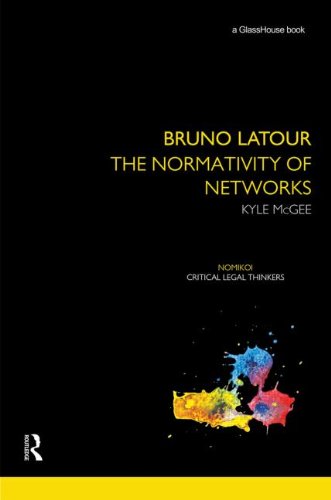
Kyle McGee's 'Bruno Latour: The Normativity of Networks'


I'm currently reading the above.  I had to order it on inter-library loan (all the way from Scotland; thanks University of Glasgow!) as it's only available in hardback and for an utterly stupid price.  I hope it comes out in paperback soon; it's really very good.

For a start it's easily the best introduction to Latour's work I've read.  It is right up to date, including a discussion of the modes of existence project but that's not its only quality – it's written with stunning clarity, has absolutely no wasted words and is just generally very fluid and readable while at the same time being impeccably precise.  It comes as no surprise that the author is a practicing lawyer as well as being a legal philosopher!

I'm yet to get deep into the philosophy of law part so I'll reserve judgement on that for now.  But, based on early impressions, I highly recommend it to anyone wanting an introduction to Latour's work in general and, of course, anyone interested in socio-legal studies or anything of the sort should get their hands on it if they possibly can.

There are three extracts from the book on the AIME website (registration required):
The co-presence of [pol] and [law]
The ontology of lawyer jokes
Legal reasoning as de-stratification

I may write a (somewhat) more substantial review when I've finished the book.

Sunday, 16 March 2014

Science as content provider/constituent producer

What's the difference between 'constructivism' à la Latour, Stengers, Whitehead and 'realism' à la Bryant, DeLanda, Morton, etc.?  Specifically, what's the difference with respect to their uses of scientific knowledge?

The 'realists' take science to be a content provider – that is, science provides and certifies a more or less stable list of entities with which the philosopher can justifiably populate the world as they see fit.

The 'constructivists' also want to populate the world with a wide range of entities and to grant these beings their autonomy, their powers, their dignity.  However, they (a) are not prepared to grant science the right of unilateral list-writing, (b) they emphasise the instability of the list (as a necessary precondition of science itself as much as anything else) and (c) they insist, above all, on making science a constituent producer – that is, the fact of scientific production as an ongoing process must be factored in to any substantial discussion of scientific facts, including their mobilisation in world-population exercises.

It is not that scientific facts are reducible to their construction or instauration (that is, this is not relativism in the vulgar sense) but rather that discussing scientific facts severed from their subtending networks results in a dogmatism that precludes politics and a simplicity that does no justice to science.  In other words, populating the cosmos is a shared interest but opinions differ on how it is to be done.

There's far more to this dispute than this one, only partially explicated difference, of course, but this is a key part of it, I think.  For one side 'realism' means that any discussion of scientific facts implies an understanding of scientific processes and that this implication must be made explicit in the discussion; for the other side 'realism' means that one can and should ignore this implication and sever, at least in rhetoric, the facts from their networks.  It's the difference between a realism that thinks it misleading or even meaningless to discuss scientific objects in abstraction from the processes that stabilise them as knowable and hence articulable entities and a realism that thinks it the quintessence of realism to do just this.

Speaking of God in the present tense

[I actually wrote this post last November and saved it as a draft (long before the recent pluralism hoopla, although it relates to those exact same issues).  I'd forgotten about it until now so it's just been sat there.  I'm not sure why I didn't post it originally.]

I am [or rather was!] just reading Isabelle Stengers' Thinking With Whitehead.  Actually, I am re-reading part of it.  I got about half way through it about 18 months ago and then gave up.  It is a tough read!

One thought: the even-handed way that Whitehead's God is treated is very interesting.  Not just for the ethically and politically 'diplomatic' reasons of engaging with values, nor simply for the scholarly reasons of articulating a philosophy in its own terms without reactionary judgement.

God is an awfully difficult figure to kill off.  First of all in philosophical terms.  He has played some kind of role in most philosophies.  Sometimes He was largely a political addendum designed to ward off accusations of heresy (often unsuccessfully).  However, quite often His presence was a technical necessity.  So it is for Whitehead (according to Stengers).  That technical requirement needs to be taken seriously.  We cannot simply assume that the heart of these philosophies can be ripped out and there will be no adverse consequences.  "I am afraid we cannot get rid of God because we still believe in grammar," as Nietzsche put it.  How many traces of God remain in our allegedly secular discourses because we believed that mere disavowal would be sufficient to drive a stake through His heart?

Second, in terms of sociology.  Religion has performed far more profound functions in our history than simply being a bunch of explanatory tenets that people 'hold.'  Human beings are not analytical philosophers.  The intensely political elements of religion can't be written off just by appeal to the crimes of this confluence.  The Inquisition doesn't prove or disprove anything in and of itself, nor do the Crusades.

Not only do we still believe in grammar but we structure our entire civilisation around the Invisible Hand.  That is the major inheritance we have received from our religious 'past.'  Societies structured around the machinations of this ghostly spectre are, ironically, gradually made irreligious as they become socially atomised.  Why do so few Europeans of Christian genealogies religiously participate these days?  It is certainly not due to people getting more intelligent or rational.  Nor is it even entirely due to increased scientific education.  Few of us go to church any more.  That locus, that heart of the community beats ever slower, ever emptier.  That is our principle religious inheritance.  The Invisible Hand that gradually erodes the outstretched, visible hands of community.

There is so much more to God and to religion than in the atheists' imaginations - this I can believe.

Atheists and secularists of all stripes need to take God very seriously and not just as something to 'fight against.'  God is not nothing.  We may convince ourselves that the wind whistling through the rafters is not a ghostly howling - but we can hardly write off the eerie draughts as non-entities.  We cannot shunt the whole assemblage into a category marked 'non-existent' and then forget about it.  We would be replacing draughts with a vacuum.  Likewise with God.  We needn't accept either the all powerful, transcendent God of Religion or the fragile, immanent God of certain philosophers but we would do well to heed the various philosophical, political, cultural, social Gods who have been very real within our communities in the past (and remain so in the present).

We may insist that God is an unholy amalgam but we should not write those parts off as trivial, nor expect that we will not miss them, nor arrogantly assume that they can be so easily replaced.