Thursday, 3 April 2014

Latour the polytheist

There are some really interesting bits and pieces hidden away, sequestered in the AIME website (which continues to evolve).  Here's the entry for God:
By convention, we retain the word "God" with a capital letter to designate the "truth requirement" carried by [rel] beings, as opposed to the deities that the specific frameworks of [met] beings explore relentlessly. It is this conflict that orchestrated the fight against idolatry (and, by extension, a great deal of anthropology). But we can also use the word god, lowercase this time, to designate the unifying principle of each mode; we need to be able to protect the various specifications that are particular to those entities too quickly confused in the so-called "sociology of religions" or the notion of belief.  
In aime there are as many "gods" as there are modes: there is a [rep] god, a [law]god, a [rel] god - responsible for emphasizing the contrast with the "end of days" - but also a [pre] god, the god of philosophers, and a [ref] god, the god of scholars. This is a practical polytheism which is added to the specific polytheism of [rel]'s God - He who is Father, Son, Spirit, Church, each latter reprising the former. There are as many gods as there are forms of enunciation, not because each enunciation has a different view "of" one God but because the word "god" resumes, for each mode, the unification and continuity obtained by the trajectory of each mode. This is why there is a [ref] god - of the laws of nature - as well as a [rep] or [tec] god, and an [org] god, of course, in the form of Providence or oeconomia. 
For aime, the question of God is resolutely constructivist in that it is necessary to completely invert its b.a.b. meaning - that which is lasting and guarantees duration - by its b.a.o. meaning - that which does not last and which must be constructed, maintained, faithfully preserved etc. At the same time, the critical constructivist inversion ("men make God in their own image") was not sufficient to grasp the [rel] meaning that Western history found and then lost, lacking the power to extract it from its parasitical notion of substance. With relation to God, aime must at once refrain from appealing to substance and critiquing it. And yet the outstanding feature of this mode of existence, ultimately, is God's dependence on man.
This would seem to tie into Latour's use of Jan Assmann's notion of translatability in his Gifford lectures - that ancient peoples saw their gods as being translatable, roughly equivalent, not necessarily incommensurable and even drew up tables of translation to formalise these translations.  Assmann's The Price of Monotheism details this.  Not read it yet but it's on my list...  Latour suggests that it's a cosmopolitical necessity to become able to see secular gods such as Gaia as being translatable with their religious counterparts—that's his 'peace proposal,' at least.

The principle of charity: moral or epistemological?

Is the principle of charity a moral or epistemological principle?  Both, really, but it's often taken to be the former.  If anything I'd lean towards it being more valuable as the latter.

The worst argumentative style of a group of academics I have ever come across is the critical realists.  Their discursive style is one of eliminating an opponent.  If caricature and defamation does that, all the better.  (Okay, I suppose the above is a bit of a caricature itself but I'll stand by the assertion that there's a strong family resemblance between those who identify as critical realists and their discursive styles.)  Bhaskar himself endlessly repeats the line about Hume once saying that there's no more reason to walk out of a front door than out of a third floor window (I've heard him speak a few times and he always wheels it out).  Plainly that isn't what Hume meant, there was a broader argument going on there, but it's repeated on and on as if he was just an idiot.  A nice, easy knock-down argument, as Humpty Dumpty would have said.  We needn't agree with Hume (and I wouldn't) but making him out to be stupid doesn't constitute an argument, indeed it detracts from the arguments that are then presented (and in fairness to Bhaskar he certainly does present thorough arguments, albeit against straw-based lifeforms).

It's not so much that this style is morally objectionable, although this militancy can often degenerate into macho posturing, it's that it's epistemologically indolent.  To take apart an argument while granting that argument the strongest, most reasonable interpretation you can honestly muster: that's a challenge.

I'm not against rhetoric in philosophy by any means but all too often it becomes a crutch for self-important hectoring.  (Then again, so does blogging so I'll leave it at that!...)

Tuesday, 1 April 2014

Stengers on anthropocentrism and accelerationism

There's a load of really interesting stuff in this new book on Architecture in the Anthropocene (discovered courtesy of ANTHEM).  In particular the interview with Isabelle Stengers has some interesting moments.  I wrote a few weeks ago that there seems to be an ongoing competition among some academic-types to be ever more anti-anthropocentric than everyone else—i.e. anthropocentrism might be the new 'presence.'  Stengers says something similar:
The position of the critic will not get humans out of the trap. On the contrary, it will probably produce new ways of commenting on art, in a trendy race for the most radical manner of moving away from a human-centred view. This is exactly what I fear with the Anthropocene thesis; it proposes a “future perfect continuous” tense, which puts theorists into a very agreeable position. The mess can now be forgotten, swallowed in a continuity that can be theorized in a single shot. Abysmal aporia will flourish, happily confronted by theoreticians hunting down shades of anthropocentrism in other theoreticians’ writings—a beautiful prospect for generations of doctoral students and aesthetic ventures in the art world. (178)
Also, she has this to say in response to a question on the accelerationism of Nick Land, etc.:
I decline contrasting Cosmopolitics, whatever its shortcomings, with that trash—they are male chauvinist pigs, that’s all. I am only sorry for the memory of Félix Guattari, which they deface. (179)
I've heard tell of her capacity for brutal putdowns but that is quite something.  Ouch.

Monday, 24 March 2014

Re-reading AIME: Still insensitive to the Word

I'm making good progress re-reading Latour's AIME book.  I've just finished the chapter 'Welcoming the Beings Sensitive to the Word.'  I found this chapter much easier going this time, much like the book as a whole.  The first time around I felt exhausted and irritated by the end; this time I found it quite interesting.

However, I can't help but come back to exactly the criticism I had before: it seems to me that religious transcendence (i.e. the [rel·dc] crossing) is a feature, not a bug; the only reason anyone has heard of a Jesus of Nazareth is because of the Platonism that was mixed into it in about the second century.  Religious transcendence wasn't an invention of Moderns, it didn't come about in reaction to science, it's been there all along.

Secondly, if the churches have instituted the mode of existence as poorly as Latour suggests then why continue in their vein?  He attempts to justify this, channelling Charles Péguy (of whom I admittedly know almost nothing).  But if religion is love then what need have we of all that existing dogma?  Why cling to the gods of our parents?  Why the conservatism?  What awful fate will befall us if we attempt to reinvent our communal being in a more ambitious and adventurous way rather than stodgily, deferentially nudging our inherited trajectories this way a bit or that way a bit?

I'm still resolutely insensitive to the Word, evidently.

Leibniz, Spinoza and Whitehead

A really interesting post on Leibniz, Spinoza and Whitehead on the Footnotes 2 Plato blog. I like the last line of this a lot:
Whitehead certainly owed a lot to both Spinoza and Leibniz. His speculative system is a re-assemblage of many of their most insightful concepts. But in re-assembling them, Whitehead also drastically alters their meaning. Leibniz’s monads are turned into process-relational actual occasions; they are, unlike Leibniz’s ultimate entities, almost all window.
Stengers is interesting on Leibniz because she takes his diplomatic profession very seriously.
In order trace the escape route from this major key, I could contrast Benedict de Spinoza and Gottfried Leibniz. It has been said that while Spinoza did entertain an optimistic conception of the power of truth, Leibniz was pessimistic; and I would add that he had plenty of reasons to be pessimistic since his time was the time of religious wars, killing in the name of God and Truth. It may well be that Spinoza's so-called optimism is much too tricky to figure as an example of 'major key' thinking, even if he has come to be an inspiration for some of them. But the very discomfort surrounding Leibniz, the thinker of diplomacy about whom it was said 'Herr Leibniz glaubt nichts [believes nothing]', marks him as a 'minor key' thinker. I think Leibniz would have understood Bartlebys 'I would prefer not to' – I would prefer not to appeal to the strong drug of Truth, or to the power to denounce and judge, to deconstruct and criticise. The strong drug of enlightenment against illusion.
Isabelle Stengers, An Ecology of Practices, 187-8.
It seems that for Stengers the dismissal of Leibniz as a liar is as much a hatred of politics as anything else – a very modernist tendency.  The almost evangelical preference for Spinoza over Leibniz shown by some historians of philosophy would seem to play into this – the beautifully souled, misunderstood outsider versus the corrupted, duplicitous insider.

Friday, 21 March 2014

Serres' Statues – Translation forthcoming


Michel Serres' Statues (first published in 1989) is getting a long overdue English translation courtesy of Bloomsbury Publishing.  November 2014 is the claim.  I find that Serres can be hit and miss but I'll be looking forward to this one.

Thursday, 20 March 2014

AIME Reading Group Redux

The AIME Reading Group returns!

My post on chapter 8 of An Inquiry into Modes of Existence – 'Making the Beings of Technology Visible' – has just appeared on the blog, thanks to Adam Robbert. It includes some background, a short summary of the main themes and a speculative application of the ideas to thinking about 'artificial' and 'natural' borders within the context of critical geopolitics.

Overall I think the idea of a materialism based on materials rather than matter per se is an important one. Other people are producing somewhat similar ideas – Tim Ingold's Materials against materiality springs to mind – but Latour's iteration of the notion is powerful and provocative. It's certainly one of my favourite chapters of the book.

Monday, 17 March 2014

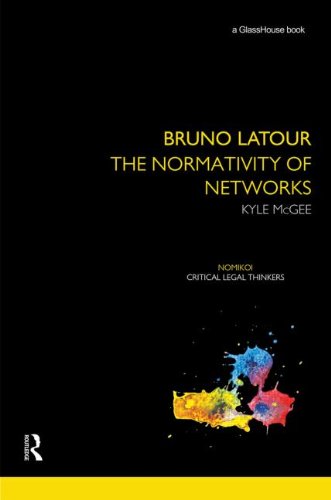
Kyle McGee's 'Bruno Latour: The Normativity of Networks'


I'm currently reading the above.  I had to order it on inter-library loan (all the way from Scotland; thanks University of Glasgow!) as it's only available in hardback and for an utterly stupid price.  I hope it comes out in paperback soon; it's really very good.

For a start it's easily the best introduction to Latour's work I've read.  It is right up to date, including a discussion of the modes of existence project but that's not its only quality – it's written with stunning clarity, has absolutely no wasted words and is just generally very fluid and readable while at the same time being impeccably precise.  It comes as no surprise that the author is a practicing lawyer as well as being a legal philosopher!

I'm yet to get deep into the philosophy of law part so I'll reserve judgement on that for now.  But, based on early impressions, I highly recommend it to anyone wanting an introduction to Latour's work in general and, of course, anyone interested in socio-legal studies or anything of the sort should get their hands on it if they possibly can.

There are three extracts from the book on the AIME website (registration required):
The co-presence of [pol] and [law]
The ontology of lawyer jokes
Legal reasoning as de-stratification

I may write a (somewhat) more substantial review when I've finished the book.

Sunday, 16 March 2014

Science as content provider/constituent producer

What's the difference between 'constructivism' à la Latour, Stengers, Whitehead and 'realism' à la Bryant, DeLanda, Morton, etc.?  Specifically, what's the difference with respect to their uses of scientific knowledge?

The 'realists' take science to be a content provider – that is, science provides and certifies a more or less stable list of entities with which the philosopher can justifiably populate the world as they see fit.

The 'constructivists' also want to populate the world with a wide range of entities and to grant these beings their autonomy, their powers, their dignity.  However, they (a) are not prepared to grant science the right of unilateral list-writing, (b) they emphasise the instability of the list (as a necessary precondition of science itself as much as anything else) and (c) they insist, above all, on making science a constituent producer – that is, the fact of scientific production as an ongoing process must be factored in to any substantial discussion of scientific facts, including their mobilisation in world-population exercises.

It is not that scientific facts are reducible to their construction or instauration (that is, this is not relativism in the vulgar sense) but rather that discussing scientific facts severed from their subtending networks results in a dogmatism that precludes politics and a simplicity that does no justice to science.  In other words, populating the cosmos is a shared interest but opinions differ on how it is to be done.

There's far more to this dispute than this one, only partially explicated difference, of course, but this is a key part of it, I think.  For one side 'realism' means that any discussion of scientific facts implies an understanding of scientific processes and that this implication must be made explicit in the discussion; for the other side 'realism' means that one can and should ignore this implication and sever, at least in rhetoric, the facts from their networks.  It's the difference between a realism that thinks it misleading or even meaningless to discuss scientific objects in abstraction from the processes that stabilise them as knowable and hence articulable entities and a realism that thinks it the quintessence of realism to do just this.

Speaking of God in the present tense

[I actually wrote this post last November and saved it as a draft (long before the recent pluralism hoopla, although it relates to those exact same issues).  I'd forgotten about it until now so it's just been sat there.  I'm not sure why I didn't post it originally.]

I am [or rather was!] just reading Isabelle Stengers' Thinking With Whitehead.  Actually, I am re-reading part of it.  I got about half way through it about 18 months ago and then gave up.  It is a tough read!

One thought: the even-handed way that Whitehead's God is treated is very interesting.  Not just for the ethically and politically 'diplomatic' reasons of engaging with values, nor simply for the scholarly reasons of articulating a philosophy in its own terms without reactionary judgement.

God is an awfully difficult figure to kill off.  First of all in philosophical terms.  He has played some kind of role in most philosophies.  Sometimes He was largely a political addendum designed to ward off accusations of heresy (often unsuccessfully).  However, quite often His presence was a technical necessity.  So it is for Whitehead (according to Stengers).  That technical requirement needs to be taken seriously.  We cannot simply assume that the heart of these philosophies can be ripped out and there will be no adverse consequences.  "I am afraid we cannot get rid of God because we still believe in grammar," as Nietzsche put it.  How many traces of God remain in our allegedly secular discourses because we believed that mere disavowal would be sufficient to drive a stake through His heart?

Second, in terms of sociology.  Religion has performed far more profound functions in our history than simply being a bunch of explanatory tenets that people 'hold.'  Human beings are not analytical philosophers.  The intensely political elements of religion can't be written off just by appeal to the crimes of this confluence.  The Inquisition doesn't prove or disprove anything in and of itself, nor do the Crusades.

Not only do we still believe in grammar but we structure our entire civilisation around the Invisible Hand.  That is the major inheritance we have received from our religious 'past.'  Societies structured around the machinations of this ghostly spectre are, ironically, gradually made irreligious as they become socially atomised.  Why do so few Europeans of Christian genealogies religiously participate these days?  It is certainly not due to people getting more intelligent or rational.  Nor is it even entirely due to increased scientific education.  Few of us go to church any more.  That locus, that heart of the community beats ever slower, ever emptier.  That is our principle religious inheritance.  The Invisible Hand that gradually erodes the outstretched, visible hands of community.

There is so much more to God and to religion than in the atheists' imaginations - this I can believe.

Atheists and secularists of all stripes need to take God very seriously and not just as something to 'fight against.'  God is not nothing.  We may convince ourselves that the wind whistling through the rafters is not a ghostly howling - but we can hardly write off the eerie draughts as non-entities.  We cannot shunt the whole assemblage into a category marked 'non-existent' and then forget about it.  We would be replacing draughts with a vacuum.  Likewise with God.  We needn't accept either the all powerful, transcendent God of Religion or the fragile, immanent God of certain philosophers but we would do well to heed the various philosophical, political, cultural, social Gods who have been very real within our communities in the past (and remain so in the present).

We may insist that God is an unholy amalgam but we should not write those parts off as trivial, nor expect that we will not miss them, nor arrogantly assume that they can be so easily replaced.

Saturday, 15 March 2014

Inventing space, determining location: Accounting as geography; or, Consider the banana …

This post is based on research I did for a paper presented at the Materialism and World Politics conference at the LSE in 2012.

1:
[…] consider the banana. 
Each bunch takes two routes into your fruit bowl.  The first route involves a Honduran worker employed by a multinational who picks the bananas, which are packaged and shipped to Britain.  The multinational sells the fruit to a big supermarket chain, which sells it to you. 
The second route - the accountants' paper trail - is more roundabout.  When a Honduran banana is sold in Britain, where are the profits generated, from a tax point of view?  In Honduras?  In the British supermarket?  In the multinational's head office?  How much do management expertise, the brand name, or insurance contribute to profits and costs?  Nobody can say for sure.  So the accountants can, more or less, make it up. 
Nicholas Shaxson, Treasure Islands: Tax havens and the men who stole the world (2011), p.11.
Accountancy is a key but almost completely neglected geographical practice.  Accountancy literally geo-graphs because it decides where things happen and what institutions are responsible for what events.  It is also the site of considerable political contestation between activists, journalists, politicians, capitalists and accountants themselves.

I propose to investigate a number of documents produced by or associated with the Tax Justice Network.  The TJN is an independent international advocacy network founded in 2003 that is comprised primarily of accountancy professionals; it is "dedicated to high-level research, analysis and advocacy in the field of international tax and the international aspects of financial regulation."  In the aftermath of the recent financial crises the TJN was highly successful in engaging media, publics and political institutions at a variety of levels.  The TJN also publish their accounts online.

2:

Defining the Secrecy World: Rethinking the language of ‘offshore’, part of the 'Mapping the Faultlines' project.  A paper by chartered accountant and political activist Richard Murphy.  In this paper Murphy attempts to precisely define concepts such as 'offshore,' 'tax haven,' 'secrecy jurisdiction' and 'secrecy world.'  He also examines the peculiar topology of so-called 'offshore' spaces.

Highlights of the paper: the 'secrecy world' or 'offshore' is:
[…] a space that has no specific location. This space is created by tax haven legislation […] the illicit financial flows that are the cause of concern with the secrecy world do not flow through locations as such, but do instead flow through the secrecy space that secrecy jurisdictions create (secrecy jurisdictions being the new term tax havens). As the paper shows, to locate these transactions in a place is not only impossible in many cases, it is also futile: they are not intended to be and cannot be located in that way. They float over and around the locations which are used to facilitate their existence as if in an unregulated ether. This suggests that any attempt to measure or regulate them solely on a national basis will always be problematic. […] Secrecy jurisdictions enable the creation of two distinct places, ‘here’ and ‘elsewhere’. The former is a regulated, onshore, domestic space. The latter is the offshore space that is ‘elsewhere’. Elsewhere is deemed by the secrecy jurisdiction to be somewhere distinctly different and outside its own domain.
It is demonstrated that accountancy is geography, that accountants (and lawyers) define both where things happen and which political-legal apparatuses are responsible for the regulation of spatially indeterminate events.  Accountancy is, therefore, intimately related with both [law] and [pol] as well as the economic modes.  I think this also demonstrates that space needs to be thought polymodally - that the modes create space in their own particular ways and any concrete spatial assemblage is a confluential compound of multiple modal factors.

Richard Murphy was a founder of the Tax Justice Network and writes one of the most popular economics blogs in the UK.

3:

The Financial Secrecy Index is a project of the Tax Justice Network.  The FSI project "ranks jurisdictions according to their secrecy and the scale of their activities."  By quantifying secretiveness it is hoped that pressure can be brought on financial jurisdictions to engage in more open and transparent practices.  In other words, the FSI is a metrological device produced by politically activist accountants that makes tax issues public.

4:
Of every three litres of oil sold on open markets, at least one comes from Switzerland. As regards coffee, the proportion is one coffee bean out of two; and with cereals it is one kilo out of three.
Of course, these commodities do not physically pass through Switzerland but rather are traded through the burgeoning Swiss commodities markets.  The Berne Declaration is a Swiss NGO that works "towards equitable North-South relations" by monitoring "the role of Swiss corporations, banks, and government agencies."  The BD's recent publication Commodities - Switzerland's most dangerous business examines what it calls
one of globalisation’s biggest winners, a powerful industry whose dealings often take it into dangerous areas. In the last decade Switzerland has emerged as one of the world’s dominant trading hubs for commodities, handling from 15 to 25 per cent of world trade. All the world’s largest trading houses operate partly or mainly out of this seemingly peaceful and innocent country. But while these powerful companies experience an unprecedented boom, the population of many resource-rich developing countries remain mired in poverty. This book tackles the question of why.
This document demonstrates how the geography of [att] is unthinkable (indeed, unwriteable) without accountancy.  Moreover, accountancy is unthinkable without [pol] and [mor].  Finally, it provides further evidence of the complex topology of trade, tax, and 'offshore.'

5:

Apple iTunes Europe's registered address in Luxembourg.  Allegedly all the company's European correspondence passes [or rather passed; apparently it has been moved] through this one inconspicuous mailbox.  A potent symbol of the spatial complexities (or absurdities, if you prefer) of 'offshore' and of the astonishing feats of accountancy qua geo-graphy.


6:

1209 North Orange Street, Wilmington, Delaware - the legal address of 285,000 separate businesses, including "American Airlines, Apple, Bank of America, Berkshire Hathaway, Cargill, Coca-Cola, Ford, General Electric, Google, JP Morgan Chase, and Wal-Mart."


This brings to mind the folds of [tec]:
The hammer that I find on my workbench is not contemporary to my action today: it keeps folded heterogenous temporalities, one of which has the antiquity of the planet, because of the mineral from which it has been moulded, while another has that of the age of the oak which provided the handle, while still another has the age of the 10 years since it came out of the German factory which produced it for the market. When I grab the handle, I insert my gesture in a ‘garland of time’ as Michel Serres has put it, which allows me to insert myself in a variety of temporalities or time differentials, which account for (or rather imply) the relative solidity which is often associated with technical action. What is true of time holds for space as well, for this humble hammer holds in place quite heterogenous spaces that nothing, before the technical action, could gather together: the forests of the Ardennes, the mines of the Ruhr, the German factory, the tool van which offers discounts every Wednesday on Bourbonnais streets, and finally the workshop of a particularly clumsy Sunday bricoleur. 
Bruno Latour, Morality and Technology: The End of the Means (2002), p.249.
The folds of the engineers are impressive, no doubt, but what about the folds of the lawyers and accountants?!  Any more space-time compression and we'd need Dr Who…

Friday, 14 March 2014

'Nature/culture'

To be natural is to be nurtured; to be cultural is to be cultivated.

'Mind'

'Mind' is an artefact of being locked in an oven.

Tuesday, 11 March 2014

Anti-anthropocentrism: it's not a competition

There's a long history of one-upmanship in leftist academe (and in leftism generally). Whether it's trying to be further 'left,' more 'radical' or more 'critical' than everyone else it seems that there's always a rush to go further, faster, more fastidiously, lest one be accused of being 'conservative,' 'unradical,' 'uncritical' or whatever.

It seems to me that anthropocentrism might be taking on that mantle - that is, there's an ongoing competition to be ever more anti-anthropocentric than everyone else. No narcissistic wound is ever fatal enough; no number of decentrings will ever spin the human subject far enough into oblivion; no amount of uncritically imbibed pop science will ever cement the deep, dark nihilism that is apparently necessary to properly cleanse thought of its subject-centred pretensions.

Now, I'm broadly on board with the notion that anthropocentrism is a supreme vice that philosophy, the humanities, the social sciences and perhaps even the Western world at large have been unpardonably guilty of; I fully accept the need for decentrings, for the need to recognise and cognise our narcisstic wounds, to understand our smallness and insignificance in the cosmic scheme of things, etc.

However, anti-anthropocentrism can't be a competition. An absolutely non- anthropocentric philosophy would be a rather self-indulgently pointless thing, even if it were possible. If thought isn't motivated by worldly concerns from an embodied, socialised, air-conditioned point of view then what can it be motivated by? What animates it? What's its purpose?

There's a degree of anthropocentrism that is not only inevitable, it's also desirable, is it not?

All this stuff about how we have to be able to think the absolutely inhuman in order to properly understand our natural, natal, cosmic predicament - this has some merit. Certainly we have to come to understand that existence is in no way given to us or predisposed towards us; that all we have is this planet, one planet only; that Earth, even in its terrifying fragility, is vastly more powerful and enduring than we are; that it (and life) will comfortably outlive us, and so on.

But even this urge to cut human pretensions down to size, this kind of will-to- diminution is anthropocentric in quite an irreducible, unavoidable sense. Stengers writes: 'Of the Earth, the present subject of our scenarios, we can presuppose a single thing: it doesn’t care about the questions we ask about it.' If we accept this it must also mean that the Earth doesn't care if we think about it in a mathematical, scientific or nihilistic way or in a way that reduces it to images and poetry or spirits and demons. So, who or what are we trying to impress with our absolute, unreserved decentredness?

I'm not sure that I can 'think' the absolutely inhuman but I can certainly imagine something like it. It takes very little effort to mentally conjure up an image of a world after humans, all overgrown (or rather regrown) and moved on with its life, all traces of human existence either crumbled or buried. All this I can imagine quite readily, in fact, thanks in no small part to film and literature. But I find it difficult to maintain an entirely disembodied, affectless point of view on the scene (and utterly impossible to imagine the scene with no point of view at all). It provokes feeling; it's melancholy, like walking past a former lover who doesn't recognise you. The viewpoint is inextricably part of that world so long as I inhabit it; it is a precondition of that world's imagining.

So, no, I can't imagine the absolutely inhuman, absent all filterings and formattings. And yet imagining (rather than 'thinking,' whatever that means) the almost-but-not-completely-inhuman doesn't seem to be particularly difficult. And isn't this good enough?

The whole 'thinking the inhuman' thing seems to be a rather bloated, overblown, overstated problem. Representations of the literally post-human are a problem for art and science as much as they are for philosophy, perhaps even more so. If we are able to vividly imagine the world beyond, before and after humans and their attachments it is because of these very same well-nourished, expertly-assembled, diligently-arrayed complexes, networks, assemblages.

And, so, why bemoan the impossibility of thinking the outside in all its purity? The inside is what draws the outside in and paints it in such vivid colours. Shouldn't we spend a little more time mixing our paints and a little less hankering after transcendence?

Sunday, 9 March 2014

Something is missing from [pol]itics

I've been meaning to write this up for months.  Finally I have a first draft (which is all it is!).

Reading the Inquiry into Modes of Existence book last time I was struck by a lack, something missing, something implicit in the political mode when it assumes all of the following:

1) No issue, no politics: publics (and hence politics) are provoked into being by problems, issues, things.

2) Politics has no inertia; it "has to constantly start over"; if an issue is truly resolved its public dissolves. A group is always 'on the move,' nomadic.

3) [pol] is not restricted to the domain of politics; [pol] can be found not just in parliaments and embassies but also offices, churches, rotary clubs, family homes… Politics can be found wherever collectives are traced out, whatever their shape, size, form, durability or purpose.

Individually I find these three tenets of AIME to be acceptable. However, I cannot shake a sense of unease when I look at the above… Isn't something missing? Doesn't something just not add up? It's a jarring sensation, a feeling of dislocation, a contrast. Yes, something is certainly amiss.

Politics is provoked by issues; it becomes obvious, explicated at times of strife, tumult, stress - in 'interesting times,' as the proverb has it. And politics, we are told, has always to start from scratch. At the termination of every bout of representation (bout is the right word in so many ways) the clock is reset to zero, the multitude goes back to a several, disloyal plurality. For every issue a new politics; no inertia. Okay, fine. But if we look around ourselves we see nothing that matches this description. All the world is replete with coagulations, clumps, clusters huddled together for warmth, joined together with endlessly variegated bonds, laughing, sharing stories, bartering, fighting. When the clock chimes for midnight do they scatter, disaggregate, deny that they know one another? Of course not. The carriage stays a carriage, the pumpkin a pumpkin, the husband a husband. It is self-evident that human groups stick together through political changes of all sorts, even the breakdown of the greatest, most godly and god-awful institutions, let alone mere political issues.

'Ah, but you've forgotten habit [hab]. Of course groups hang together over time; politics is messy, issues overlap, politics is instituted and habits blur the edges of political occasions. Of course political patterns fall into ruts, patterns, routines; that's inevitable, it comes with the fact of institutions, the fact of complexity.' A fair point but, no, this will not do. The difference is much deeper.

What, then?

It's something that's often said in times of crisis, upheaval, stress, bereavement. 'I'm here for you; I'll always be here for you, no matter what.' What kind of speech act could be more important to us? What intimacy could be more essential to our security, our stability, to our very sense of self? To know that, to hear that promise: 'whatever issues cross our paths we will persist together, our relationship will prevail; no, it will be stronger for all of this; issues, however terrible, will only bring us closer together.'

Politics, habituated or not, cannot possibly absorb these sentiments; they are totally and completely at odds with it - they pass it by at exactly 90 degrees. This other, non-political mode of speech is also issue-based (or at least it is issue-related) but it reacts to issues in another way entirely. When an issue is resolved the political group has no bonds remaining, it scatters; this other kind of group, contrariwise, is left strengthened by the trial; closer, more bonded, more intimate than ever.

'Always, no matter what': this is the root of the contrast; not its only instantiation but the instance we can see it most clearly. I would like to call it kinship [kin].

'That's not how we do things in this family,' 'if you're under my roof you'll abide by my rules,' 'speak for yourself,' 'you're not the boss of me'. What family hasn't experienced moments like these? Yes, family is political, no doubt. But that's not all. How awful it would be if our groups only held together through speech acts like these.

A convenient etymological relation can be drawn here: kinship shares a root with kindness. To be kin is to be there for another ('no matter what'). Of course all we really have is promises. There can be betrayal; therefore, there can be felicity conditions. 'You said you'd be there for me but you left me all alone!' A kin relation is certainly fragile; certainly it needs upkeep, just like anything else.

Another thing should be clear: this is not a metaphysical rationalisation of the nuclear family. Just what form the being-thereness takes is a complex and entirely open (indeed, empirical) question. I am 'there for' all kinds of people (and things) in many different ways. I will happily be-there-for a stranger asking for the time or for directions; I will of course aid some unknown person who is injured or in distress. However, my thereness, my sensitivity, my openness has limits. I am there-for my sisters, friends, grandparents in stronger ways; I am much more sensitive to their needs, much more receptive to their requests. There are varieties and gradations of my being-there-for; as many nuances as there are relations, in fact.

And so it is with scorn that I must regard the Modernist [dc·kin] crossing: 'I am a citizen of the world!' says Socrates (and every self-congratulatory cosmopolitan since).  All merely local ties wash away in the face of the Globe.  But who is this world-citizen of such infinite time, energy and attention? With the best will in the world no one can be-there-for even the tiniest fraction of their worldly cohabitants. We are finite. So, we are reliant, once more, on institutions. And isn't this the chief virtue of the welfare state? (This, the greatest Modern achievement, no? Is that too strong?) I am not there-for a man diagnosed with cancer in Glasgow; how could I be? This is a country of millions and I live nowhere near! And yet do I not play some small part in his treatment, thanks to the institutions of the National Health Service and Inland Revenue? That is what we might call institutionalised collective solidarity; or, to use a vulgar simplification, society.

Does the world-citizen pay taxes? Pah! We have world-citizens, today. They live on yachts and will fly to space to avoid the taxman. Might we call this world-citizen John Galt? I'd prefer Eric Packer (of Don Delillo's novel Cosmopolis and the David Cronenberg film of the same name). He is the world-citizen of cyber-capital - in his armoured limousine, blithely, sleepily consulting his Chief of Theory while the outside tears itself apart. Yes, the 1% read philosophy, too. I am sure that it makes them feel warm inside.

If there is to be anything like a world-citizen worthy of the name it is only through institutions that this can be realised. The most selfless, giving, caring person can, on their own, only be-there-for the tiniest fraction of the cosmopolis. What institutions maximise our sensitivities, our therenesses?

The Family of Man was a work of propaganda. The Family of the Earthbound is a messianic fantasy. Very well…

Friday, 7 March 2014

Latour's Inquiry into Modes of Existence: A second attempt

I'm just starting to re-read Latour's AIME book for an article that I'm writing. When I get to the chapter on technology [tec] I'm going to write up a short post for the AIME Reading Group, which fell into something of a deep freeze at the end of last year. Presumably most of those who were participating have now finished the book; it'd be nice to get that discussion back on the road as we only covered a small part of the text (and it gets more interesting in the later parts).

Initial (second) impressions of the first few chapters: I'm liking the book a lot more the second time around, now that I know where it's all going. I found it to be a very frustrating read last time. It doesn't really show its hand with regard to its purpose and goals until right at the end and many of the modes are described with such circuitous opacity that I felt like giving up once or twice! It's not just a difficult book, at times it's an exhausting one.

However, having finished the book, and having had several months to mull it over, I think the whole apparatus is actually pretty simple. It's broadly continuous with Latour's previous ANT work in two ways. First, ANT is incorporated in the [net] mode. Secondly, AIME is, as Latour himself puts it, the 'colour version' of ANT, which sees the world only in black and white. AIME turns up the contrast. Where ANT simply and freely traces all the heterogeneous relations and transformations that go into or are implicit in any given event or occasion, deliberately disregarding the form, kind, register, resonance of those relations, AIME demands attentiveness (via the [pre] mode) to the particular ways in which things relate, transform, translate, become, etc. Each mode discerns a particular way of becoming; AIME documents these ways, collaboratively.

Many of the modes ([tec] [ref] [pol] [law] [rel] [org] and [mor], at a minimum) are nothing new to readers of Latour's work; AIME simply gives them an explicit, quasi-systematic framework. The political mode [pol], for instance, is expounded at length in Latour's 2003 article 'What if we talked politics a little?' (published in French in 2002); [ref], meanwhile, is worked out in chapter 2 of Pandora's Hope, in the essay on circulating reference (published in French in 1993).

AIME and ANT aren't really separate projects; ANT is simultaneously prelude, parallel and part with regard to AIME, depending on how you look at it.

I still think that there are a lot of problems with the project but I've warmed to the philosophy and am looking forward to the rest of the re-read.

Monday, 3 March 2014

From the Earth/of the Earth; Earthling/Earthbound

Another really interesting post at knowledge-ecology on Kant, Sloterdijk, Whitehead and geocentrism.

I find 'monogeism' to be one of Sloterdijk's most useful coinages.  I don't think it's overstating the point to say that every philosophy must henceforth recognise the profundity of this condition: we are fundamentally bound to one planet, one earth; we are Earthbound, in Latour's terms.

And that very geocentrism is actually a necessary precondition of recognising the brutal indifference of the rest of the universe to us.  Planet Earth in its Gaian understanding is the only speck of existence that's even partially disposed towards our well-being - and its good favour is not guaranteed, indeed it's precarious.

That's not just an ecological or practical truth; any metaphysics that recognises life as something that figures on its register must now see that even if there is life 'out there,' or if, somewhere in the vastness of the cosmos, there is another celestial object that could possibly support life, it doesn't particularly matter.  Even if there are countless inhabited or potentially inhabitable orbs in existence the distance between them is almost certainly so vast that they effectively inhabit separate universes; and even if we find a planet or moon within a useful distance that has just the right mass, chemical composition, day and nighttime temperature, geological stability, shelteredness with regard to asteroids, etc. etc. Gaia-type theories tell us that even all this won't be enough to recreate another Earth.  And, regardless, we're now pressed into a civilisationary timescale where such fantasies as meeting aliens and colonising other planets seem utterly ludicrous and, worse, beside the point.

I think it says a lot that sci-fi is increasingly turning away from the old-school Star Trek groundplan of a lush, teeming universe towards an empty, impersonal universe, even one where the danger comes from exploration itself.  Gravity is an obvious case that springs to mind but there are more.  There are many, many differences between the original Battlestar Galactica and the remake but perhaps the most significant one cosmographically and dramatically is that the latter inhabited a largely empty universe without alien species, creating a feeling that was simultaneously claustro- and agora-phobic as the survivors cling to the insides of life-support systems that are always on the brink of failure.  Even the very Earth-like planet they colonise midway through the series is a harsh place unfit for much in the way of lifemaking.  Dr Who still operates in a lush, teeming universe but it realises a pure escapism; the TARDIS transcends time and space rather than travelling through it; it opts out of our situation rather than working through it.  Danny Boyle's Sunshine is an interesting one, too.  There's a moment when the crew are about to investigate an abandoned ship and are debating whether to split up or stick together; one of them says to another something along the lines of 'what, are you afraid we'll get picked off one by one by aliens?'  Obviously this sends up an old sci-fi cliche but, more than that, it demonstrates how far this universe is from the imaginaries of yore; the perils on which the drama hinges are technological, astronomical, elemental, psychological (and perhaps supernatural) but they are not alien.  Indeed, further on we learn that the central metaphysical question of the film itself (or at least of one of its characters) is that of human consciousness being universally sui generis and, consequently, imminent human extinction meaning the end of all awareness altogether.

It's a very different space we're in, these days.

I suppose it's the difference between being from the Earth and of the Earth; from being an Earthling and being Earthbound.

Wednesday, 26 February 2014

Picking apart pluralism; suggestions for living

There's a really excellent new post by Adam Robbert at knowledge-ecology, joining in the pluralism debate.  His musings moved me to fabricate the following:

I don't think that there are X kinds of pluralism; however, the word is clearly being used in a few different ways and this is causing some confusion.  Here's my initial (and rather sleepy, 1 am) attempt at a disentanglement:

(1) Metaphysical pluralism in the sense of Leibniz, Whitehead and von Uexküll (if he's read metaphysically).  That is, there exists a vast plurality of beings; every being has its own perspective on existence; there is no über-being that contains or determines all other beings; i.e. there is no universe but rather a pluriverse.

This basic tenet is common to many of the 'pluralisms' under discussion.  In fact the above is probably unproblematic within this debate; I don't think that this is what anyone's disagreeing with.

(2) Pluralism as it's understood in political philosophy.  This is complicated; to name but a few pluralists in this sense: Harold Laski, Isaiah Berlin, Robert Dahl, William Connolly, Chantal Mouffe...  Many different ideas here.  To some extent political pluralism responds to the basic fact that there are many different identities and ways of living and that these have to co-exist somehow; this problem is particularly acute in heterogeneous, multicultural, modern, liberal democratic societies, etc. etc.  Pluralists embrace this diversity, argue for its virtue and try to think through ways of living together in this pluralistic condition.

(3) Bruno Latour's modal pluralism is a metaphysical pluralism in another sense: he argues not just for a plurality of beings but for the plurality of being itself ‒ that is, there are many ways of being; being is itself pluralistic.  To be is to persist in being somehow but there are many ways of achieving that persistence (these ways are irreducible to the achievements of individual entities) and, so, being is pluralistic.

Bruno is not the first to come up with this basic idea (see Souriau, Simondon, Deleuze, etc.) but his is a striking and unusually sophisticated example of the genre.

(4) The order that I list the three above meanings (or circumstances) of 'pluralism' is not accidental.  Latour's modal, metaphysical pluralism is also a kind of political pluralism; it would be well termed 'value pluralism writ-metaphysical.'  There is his mode of politics [pol], of course, but the entire project is a matter of detecting, evaluating and re-instituting values.  It is as much a political as a metaphysical pluralism in this sense.  And so, at risk of gross oversimplification, we can say that (4) fundamentally differs from (1) because it passes through (2) and (3).  It is a far deeper pluralism that places far greater demands on us, should we follow its lead.

Levi subscribes to (1) ‒ pluralism in the sense of umwelten ‒ but has seemingly little time for the others.  He can thus pursue a scientistic, modernist pluralism (I'm not even sure he'd disagree with those adjectives at this point) that is a metaphysical but not political; a metaphysics that is pluralistic with regard to beings (1) but monistic with regard to being (3) and which endorses a disqualificatory attitude towards ontology and a politics of speaking truth to ignorance and irrationality.

Myself, I disagree with many of Latour's arguments but I follow him all the way to (4).  My preferred understanding of his pluralism (i.e. an interpretation that is creative but, I hope, a fair translation of his texts) is summarised here.  Politically, I understand it to be an agonistic pluralism much like that of Chantal Mouffe but extended to a metaphysical level through the modes philosophy.

My understanding of Isabelle Stengers' philosophy is that it is broadly compatible with the above also, perhaps with some differing nuances and emphases compared to Bruno but mostly on the same page, as they say.

Both, it seems to me, are committed to a pluralism that goes beyond cosmography (1) and enters into cosmopolitics (4).  Their pluralisms are not disinterested or neutral, they are committed and committing ‒ that is, they commit us to certain ways of being with each other.  They offer us not just a 'picture' of existence, framed as a multiplicity, but offer suggestions for living.

Saturday, 22 February 2014

Reply to Levi on pluralism, etc.

Levi responds (in the comments) to one of my previous posts on pluralism:
I find this post perplexing. First, it seems to me that this is a wildly implausible interpretation of the modernist. The modernist does not see the critical investigation of idols as a-political, but as a deeply political project. The whole motive behind "smashing idols" is that these idols have very real political effects and a very real impact on people's lives. Given that, there's really no alternative but to engage in that "warfare". Here I wonder whether some of this blase attitude towards these idols doesn't arise from different political circumstances in the US and Britain. I take it, for example, that Britain doesn't have people resisting climate change policy on religious grounds-- they claim to know how the world will end --or pushing Middle Eastern foreign policy based on end times theology; not to mention the issues of abortion, gay marriage, contraceptives, sex education, evolution, attitudes towards capitalism filtered through Calvinism, etc; nothing in American politics can be understood without understanding the role played by these idols and these idols have very real domestic and international effects. 
Second, I just don't think this is an accurate reading of Latour and that this post reflects Deleuze's description of the "beautiful soul" in Difference and Repetition. The beautiful soul holds that there can be a confederation of peaceful differences. I think we hope for this and strive for it as much as possible, but I also think that there are a number of circumstances where there are just irreducible antagonisms. There's really no way to align the interests of the worker and the owner. They'll always be at odds with one another. Similarly, there's no way to align the interests of the fundamentalist and the GLBT person. One really has to choose in these circumstances and unfortunately there's "war"; though hopefully of the peaceful variety (though the bombing of abortion clinics suggests otherwise). The premise here seems to be that the problem lies in people not being politically pluralistic, but it seems to me that antagonisms arise from elsewhere and from very real differences. 
Finally, it's important to recall the relationship between "trials of strength" and truth in Latour. Latour argues that every "truth" is produced through trials of strength that determine its capacity to stand or not (note his warlike language here). You seem to say that religion and science are on equal grounds with their fragility. Perhaps, perhaps not. Many religions have undergone trials of strength through the formation of collectives, institutions, and rituals that make them incredibly sturdy. Here I think of Dennett's version of meme theory where religions, for example, create memes such as "you will go to hell if you question doctrine" creating for themselves an "autoimmune system" that's extremely effective in producing endurance of these collectives. And, of course, religion engages in all the sorts of anti-pluralistic warfare you decry in this post. Science has also gone through its trials of strength through the experiment, the creation of instruments, the invention of "speaking objects" (the events that take place in experiments and that are observed by a variety of people), journals, institutions, etc. I don't think either of these things are particularly fragile. Both have aligned all sorts of actants to sustain their existence. As Latour says, those black boxes can always be opened and questioned anew, but in the case of science-- and depending on what scientific claim we're talking about --the bar is pretty high for justifying the opening of those boxes, e.g., there's not much reason to question the black box of vaccination at this point.
I don't doubt that there are differences in experience between where you are, Levi, and over on this side of the pond; in fact I know that there are and I appreciate how that creates a difference in perspective.  However, if anything that fact strengthens my argument.  I couldn't have been any more explicit in saying that sometimes idols need to be smashed, could I?  If they are destructive and deleterious to collective life then smash away!  You have not only a right to do so but a duty.  But do they all need to be smashed?  Really?

My whole point is that idol-smashing is an act that requires a decision, that it can't be auto-justified by appeal to a higher order of Nature or Rationality.  And I really do think that this is one of the central pillars of Modernism - that any action is justified if it's enforcing more Rationalism upon the world, if it's extending the light-curtain of Enlightenment that extra inch; that violence isn't really violence if it's in service of Rationalisation.

If you don't recognise the whole 'I am merely tearing the veil from your eyes; pain is character building, thank me' thing in Modernism then I'm not sure what to say.  Pretty much the entire discourse of European colonialism was built on this kind of thinking.  And it's not gone anywhere.  'Oh, you think this forest is sacred?  Adorable.  Bring in the bulldozers.  You'll thank us when your economy is rationalised.'

But the most important thing politically (or diplomatically) is that the world will never be Enlightened, Reason will never reign - so, we have to find ways of living together in spite of all that.

Which brings me to the second point.  'Living together' doesn't mean all holding hands in a circle and singing Kumbaya.  It might merely mean not kicking the shit out of each other.  Peace doesn't mean harmony and I don't think anything I've written can be taken to mean that.  My interpretation of Latour's whole cosmopolitical thing is that it's basically a more metaphysically ambitious version of Chantal Mouffe's agonistic pluralism.  Both are based on Carl Schmitt, for goodness sake (I almost wrote 'for heaven's sake...!').

The thing with Latour in his political writings (his later ones at least, e.g. On the Modern Cult of the Factish Gods) is that his tone often suggests the perspective of a middle-of-the-road bourgeois liberal imploring us along the lines of 'aw shucks, can't we all just get along?'; but if you look at the philosophical resources he's drawing on he's always gone for the political realists.  In the '80s it was Spinoza, Hobbes, Machiavelli.  Today it's Schmitt.  Nothing cuddly about these folks, nothing beautiful about their souls.  The utopia of liberal consensualism is precisely what this whole political philosophy is working against.

Perhaps my tone has taken too much of Latour's along with it.  But there's agonism in that there pluralism, make no mistake.  And, if anything, I am going more towards the political realist side of things than Latour.  So, with respect, I think my reading of Latour is accurate and that, if anything, I am more cognisant of outright conflict than he is!*

Lastly, whether or not religions in the US are strong and sturdy (clearly they are) is beside the point.  It's a matter of decision and responsibility.  I'm not saying 'oh leave the poor old religious lot alone, you big bully.'  I don't dispute for a moment that there are many instances where there's a zero-sum game in terms of engaging with others: 'it's either you or me.'  E.g. when a child is ill, needs a blood transfusion and its parents won't allow it because they're Jehovah's Witnesses (this kind of story crops up with sad regularity).  Religious freedom and the right of the child to get medical treatment - there's a zero-sum game there, a decision must be made.  Neither Reason not Science can answer that question, it's always a political decision.  Likewise, in the UK recently there's been a lot of debate over female genital mutilation.  It's been made illegal but is still practiced.  Here, too, there's no middle ground.  It'll never be okay to say 'oh, only mutilate them a bit' or 'only mutilate young girls' genitals on a Sunday' - it's a fundamental disagreement.  And it's an abomination that must be eliminated.

I see no contradiction in this and anything of what I said in the last post.  Differences in emphasis, that's all.

It's easy to justify your attacks when your opponent is more powerful (i.e. when taking on the religious in the US).  But that isn't always the case and a political philosophy must be able to at least comprehend situations in which one's other is weaker, when speaking from higher status to lower - how does one then act?  And how does one act when one finds that an other's ways are ridiculous but in a manner that is inconsequential to oneself?  How does one act towards things that might be perceived as absurd but are of no real consequence or might even make the world a slightly better place?  Modernism, as I see it, can at best snigger behind its hand rather than with bared teeth in these situations.  That's scarcely pluralism.  It's not political pluralism, anyway.  There are deeper (and better) varieties of pluralism than this, that's all I'm really arguing for.


* An aside: Latour has long since moved on from Irreductions.  As important as that text clearly was for him it's been grossly overestimated as being programatically foundational in the past few years (blaming no names *cough* Harman).  The strict, reductive ontology of trials of strength hasn't been a major part of his work since the early 1990s, as I see it.  For example, his essay on circulating reference (the one in Pandora's Hope) was first published in 1993.  That produces rather a different theory of science to the trials of strength period in the 1980s.  He's a very different thinker to the one he was thirty years ago - although there are obvious continuities between then and now, too.

Friday, 21 February 2014

Morton's Hyperobjects and Pluralism

It occurred to me yesterday after reading Timothy Morton's Hyperobjects just what a postmodernist text it is in terms of style and construction.  It's really no different in how it's put together from the old 'all the world's a text' school of culture studies bricolage.  Bits and pieces of pop science mixed with every kind of cultural artefact (and, in all fairness, some genuinely earnest political musings) all jumbled together and loosely assembled with the help of some all too chunkily chopped and, for my tastes, rather undercooked object-oriented philosophy (garnished with wilted affectations of scientific realism...).  A thought salad, if you will.

It's a writing style that presupposes a flat ontology – i.e. a monism – i.e. a situation where a single vocabulary, a single style of speech, a single mode of assembly suffices to address any kind of thing wheresoever, whensoever, howsoever, whatsoever.  Heterogeneity without plurality.

It matters little in practice whether this monistic plane is discourse, object, language, network...  The world becomes a frozen lake across which the bricoleur glides, slides or tumbles, depending on his skill.  The relational labour required to forge any particular connection seems minimal, almost inconsequential – it is enough that the words are on the same page, conjoined by puns.

This can be a very exciting way of moving around, no doubt, but, read in book-length, it strikes me as shallow, superficial and reductive.  To address climate change, Dr Who, early 1990s British indie bands, aboriginal art, nuclear waste, Aristotle and so on all in the same mode of address, all in the same tone of voice, the same frenzied, impatient blur of the hyperactive scholar-magpie – it makes for an interesting read but ultimately an unrewarding one.  And it's difficult to swallow the dogmatically asserted 'realism' (proclaimed, never argued) when there is so little attentiveness to the specificities of all these things, when their bumps, grooves and all manner of details are smoothed over in such dramatic fashion.

It is as though the materials themselves offered no resistance, objection or direction to how they are spoken, stretched, compressed, displayed; they impose no obligation on the articulator as to the way in which they must be articulated.

This, it seems to me, is the importance of the pluralist project, philosophically (and realistically) speaking: to compel attention to the specific ways in which different things must be addressed in order to be properly articulated in their own terms.  This is what OOO, etc. can never do because it is essentially monist: there is one way of being and all further distinctions are subcategories of that one mode.

In establishing a 'universal equivalence' between all things (everything equally an object) it makes everything articulable all-together with a minimum of complication.  And this is not without value but nor is it innocent.

One interesting thing with Latour's modes project is that [net] permits this scholar-magpie approach since it self-consciously disregards the nuances of individual forms of being in order to string together as many relations (and thus to forge the thickest of descriptions) as quickly, easily and simplistically as possible.  So, the fast, loose thrill-ride of the monist is seemingly permitted but it is relativised, deprived of its innocence – it compels a choice, a decision to be made: why this mode, why this movement, why not another?  In other words, the very partiality of the pluralised network mode demands passing by the way of another mode [pre] (and from there to any number of others); plurality demands decision and hence responsibility.

And this, I think, leads to a more convincing 'realism' than that of Morton et al., for whom this becomes little more than a badge to pin to one's lapel and strut around, chest puffed out – proud.  That is a good name for it: proud realism, a realism of pride.  Science, in this 'realism,' becomes not so much a process that is implicated in any event of thinking the worlds around us in particularly productive ways but simply an honoured and honorific background process that gifts us lists of objects that we are entitled, since they are scientifically certified, to assert as 'out there, whether you like it or not.'  Science is a research and certification process: if it's on the list we can let it into our ontologies without another thought.  ('And if you're not on the list you're not coming in!' – for doormen-realists this is the main point: the authority to refuse entry.)

Thus, with Morton, we can stand there in the rain, feeling it falling on our head and imagine the vast, sublime, oceanic climate system whirring and whooshing over our head and think 'climate change is raining on my head' (he actually writes this) and think that this is a meaningful sentence, in all disconnection and transcendence from the scientific institutions that stabilise climate and climate change as objects of cognition.  And then we can denounce those who would insist that dynamic, ongoing scientific processes are essentially implicated in this event, in this actual occasion as lava lampy relationalists.

There's nothing more lava lampy than the manic postmodern stylings of cultural studies bricolage – and this is a style that Morton excels at.

To move with [net] is to move laterally; that is, across the frozen lake, traversing the flat ontology.  And we don't need to watch the Winter Olympics to know what stunningly graceful high-velocity ballets this freedom of movement can sometimes produce.  But this is not the only way of moving.  To pretend otherwise is irresponsible.

Pluralism is not an alternative to realism.  It is simply realism without its chest puffed out, showing off.  Pluralism is realism that recognises the multiple paths that any trajectory can follow and the beautiful plumage that can grace any mode of existence.

In that sense there is nothing much to it; it might be counter-intuitive but it's not especially complicated.  Perhaps one day it'll even be common sense.