Wednesday, 21 October 2015

Rethinking environmental determinism historically and speculatively for future geopolitics—Tübingen, EWIS, April 2016

I'm pleased to say that I'll be off to Tübingen in April for EWIS (European Workshops in International Studies). Specifically, a workshop on 'International Politics in the Anthropocene,' organised by Delf Rothe.


Very much looking forward to it. Here's my abstract:
Rethinking environmental determinism historically and speculatively for future geopolitics 
Geographically, climatically and environmentally deterministic forms of knowledge have ancient roots, often being traced back to Herodotus. As the likes of Mike Hulme have recently argued, such epistemic tendencies are evident in forms of climate science that project narrowly defined human futures on the basis of abstract and reductionist calculative practices. To so much as have a conversation about ‘the Anthropocene’ requires some degree of discursive absorption of the progressive produce of calculative rationality. However, there is equally an imperative not to turn the looming spectre of vast, inhuman forces into deterministic narratives that paralyse political possibility. This paper will build on a discussion session that I arranged at the RGS-IBG conference in September 2015. It will, first, set out a brief history of determinism and its critics and, second, engage with contemporary speculative philosophical debates around geophilosophy and geopolitics in order to begin to creatively re-articulate how determinism can be intellectually and politically overcome without lapsing into voluntaristic denial of the crushingly urgent facts of the Anthropocene. In short, it attempts to articulate an updated form of possibilism that might help to facilitate the production of future geopolitical analyses—and future geopolitics.
I'm also hoping that I'll have time to stop off in Karlsruhe on the way back to have a look at the 'Reset Modernity!' exhibition at ZKM to which I have contributed an essay.

Tuesday, 20 October 2015

"My enemy is arrows. I want to get rid of arrows" – Bruno Latour on maps, earth and International Relations

One of the first academic conferences I went to was that of the Millennium journal of International Relations in 2012. The theme was 'Materialism and World Politics' and IR, always late to any bandwagon, was doing its best to catch up. One striking pattern that was immediately evident was the proliferation of references to a certain Bruno Latour in many papers and presentations, particularly amongst students and early career academics. Up to that point, his name was almost completely unknown amongst IR scholars – surely one of the last provinces of the social sciences and humanities to remain so unperturbed.

Three years on and Latour was Millennium's headline act, delivering the keynote lecture. This was filmed and will presumably be made available online in the next few days. Consequently, I will not try to summarise it but will just offer some thoughts.

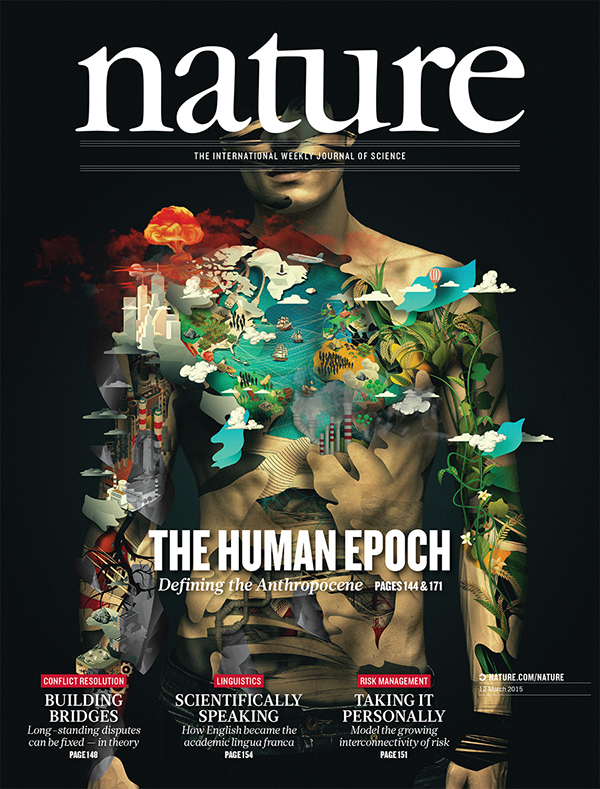
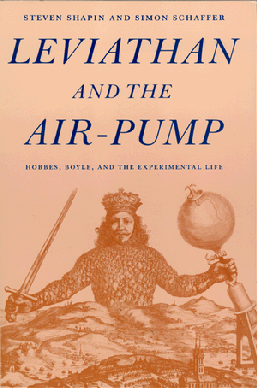
The lecture began with a visual comparison of Hobbes' famous frontispiece with a recent front cover from Nature.


Both are monstrous but in totally different ways. The Anthropocenic human juts out randomly, stupidly, headlessly. The Hobbesian sovereign is all measure, calculation and looming menace. This speaks to the real difference between them: Hobbes was proposing a solution to the problem of political order that had so drastically broken down in his time; Nature, on the contrary, is representing the problem of the Anthropocene, a problem of order – indeed, political order – without any apparent solution in sight. The problem of Nature's image, then, is precisely the disappearance of Nature as an organising principle of geopolitics in the fullest sense of that term.

This is one thing that I was trying to get at when I recently wrote at a fair bit of length about Latour's conception of geopolitics and, particularly, his reading of Gaia. The key feature of Gaia, taking James Lovelock's iteration somewhat creatively, is that it is not any sort of personal deity because it doesn't care one bit about the fate of any individual or species but, at the same time, Gaia is not Nature because it is not indifferent or external to human action – it reacts, it is perturbed, it is responsive. To quote myself:
"However, responsiveness is not responsibility. Gaia can summon no Leviathan; there is a Great Society but no Great Community [à la Dewey]. Of course, it is not that Gaia ‘lacks’ the appurtenances of a formalised polity per se – it is only we Earthbound that such a supplement impels; it is, rather, that Gaia, our past and our present, will only be our future – we will only have a future – if such an assembly is realised."
The image I had in mind at this time was precisely Hobbes' most famous image and the cohesiveness and unity of that ugly apparition looming over the English countryside. Nothing could be less true of the geopolitical predicament that Latour is addressing. There is no Global State – nor will there be. The things formerly known as natural do not bring unity; total knowledge of the Earth's surface in no way allowed it to be mastered (some of its occupants, perhaps, but this paramilitary victory was plainly overestimated); its complex spatiality greatly exceeds merely topographical imagings; the things formerly known as natural, in fact, disturb, destabilise and destroy the comforts of order and regulation, they do not and will never again give it a secure foundation. This realisation, to parrot Naomi Klein, changes everything.

Oliver Kessler mentioned in the closing panel of the conference that he wished that Latour had used the modified version of this image from Shapin & Schaffer's Leviathan and the Air-Pump.


That would have been an interesting connection but the point that Latour was making concerned political unity rather than the relation between science and politics per se. In any case, Latour's attempt to imagine a representative geopolitics of this Gaian situation was precisely the overarching theme of his lecture.

Representation in every sense of that word – political, scientific, artistic. And representation not in the vague, vain liberal sense of 'letting everyone have their say.' It was very clearly representation as a precondition of action. In other words, it was a question of collective will and adherence; of achieving the political infrastructures by which a collective could act – and a collective that is constituted by far more than just humans and their (delegated or imposed) spokespeople. A form of action that requires the alignment of actors of all kinds (and here the humanists leave the room…).

To self-indulgently quote myself again (because I can't think of a better way of putting it than this sentence that I spent months writing and re-writing):
"Gaia is not just the scene of politics, nor a violent interjection to it, but a dramatic, swirling convolution of world-convening relations – a collective constituted by all the constituents that she collects."
This is why Gaia is at the centre of Latour's geopolitics. It is not a unity. It is not a single, homogeneous, centred actor. It is not a totality and it is not nature. It has no one name. It is not something everywhere the same. It is impersonal but not indifferent. It is violent but not malevolent. It has intentionality but no teleology.
"There is only one Gaia but Gaia is not One."
It is, above all (and in more than one sense of that phrase), a sovereign. Here we see that, however 'flat' Latour's philosophy may or may not have been in the past, his 'Gaia-politics' presupposes an emphatic verticality; a power, a transcendence that vastly exceeds human actions but does not transcend them in the sense of being in any way exterior.

This must unground every sense of earth, terrain, territory on which International Relations, knowingly or unknowingly, has based its object.

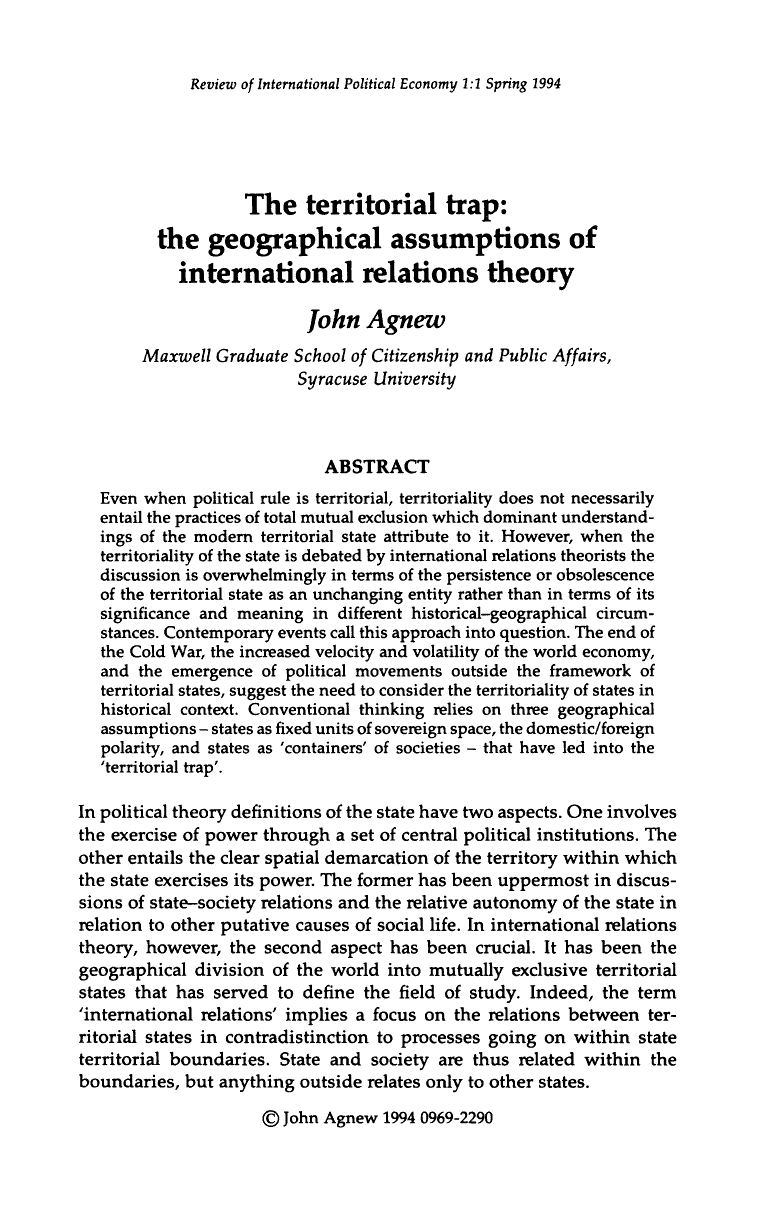
But here we should pause. Geopolitics is not IR. To re-hash John Agnew's famous article The Territorial Trap, IR has been consistently ignorant of the space, the materiality, the environments that its institutions presupposed.


Political geography was born as a discipline in the imperial struggles of the late nineteenth-century. Its reactionary extremes directed and enthusiastically served those ends – knowledge of the earth, its environments and climates was to found the efficient, ruthless administration of empire. This is, quite unambiguously, the root of 'geopolitics' (the word itself was coined, as 'Geopolitik,' in 1899).

Some would say that IR was born as a discipline in 1919 (at my home institution in Aberystwyth, from which I type these words); however, it only really got going as a disciplinary space and movement in the 1950s with sponsorship from the Rockefeller Foundation, among others. At this time, 'geopolitics' had all but disappeared from conversations in polite society as it had become had it become almost synonymous with Nazi expansionism via Karl Haushofer's association with the regime (a somewhat more complicated relationship than was recognised at the time but nevertheless).

Geopolitical ideas were soon revived by the likes of Henry Kissinger who reconstructed them for the new era of empires that the so-called Cold War brought about but human geography as an academic discipline on the whole lost its connection with international or global politics. IR, meanwhile, soaked as it was in the behavioural sciences and the realpolitik of its various émigrés, had little interest in the complexities of the ways that the world gets composed. The planet was, by this point, known rather well (or so they thought) and explanatory power was to be sought primarily in understanding the behavioural characteristics of human beings and their institutions. Their agenda was, variously, to secure peace and to overcome the non-liberal remnants of 'History,' in the Hegel/Fukuyama sense of the word.

This aside has a point, which I will now get to: 'environment' in IR has always been a special interest, a subfield, something to do with whales; 'earth' has been either an anachronism or an irrelevance; 'space' has been what you put satellites in.

Is there any discipline less prepared for what is coming than IR? I can hardly believe that there is. And yet, does this mean that IR must be brought to an end? Perhaps not.

Latour's lecture concluded with an overview of the 'Make It Work!' event – essentially a Latourised model UN – that was held in Paris this summer. The main point made by this event was that oceans, icecaps, forests, etc. – all these also require political representation, alongside corporations, NGOs and states.

And states. It is so very easy to denounce and demean this mode of geopolitical organisation, born out of the historical milieu that is encapsulated by Hobbes' towering phantasm. But let's be honest, the 'Westphalian state system is redundant' critique practically writes itself at this point, doesn't it?

"The old (but still useful) world of States" – this was on one of Latour's slides.

And this brings me to the Q&A session that followed the lecture. Two of the questioners made more or less the same point: Okay, so having non-state representatives representing beings other than humans is good but are we to believe that states do such a wonderful job of representing people? Verily, if (critical) IR scholars have achieved anything over these years it has been to demonstrate the vicious iniquities of state-based political complacency!

I was reminded at this point of the Olympics where stateless athletes are permitted to compete under an independent banner.


Of course, all of this raises questions of power. How does anything come to be represented politically? By demanding that it be so. In other words, through struggle. Or, to put it in more Latourian terms, how is a 'middle ground' ever formed from which diplomacy can begin? According to Richard White, this too is about power. All sides must be capable of compelling their other to meet on the middle ground rather than imposing a settlement from without.

But returning to my thread, if we are to extend representative politics to more than humans is this not a perfect time to reconsider how we represent human beings too? And is not a discipline such as IR not well placed to consider such a task? Well, perhaps. But not on its own. IR's ignorance of space and geography is well known but its connections with anthropology are not much better. The very concept of representation, for instance, was also born around the time of Hobbes – it is no more universal than 'Nature.'

Here it might be opportune to cast our minds back to Patrick Thaddeus Jackson's keynote at the Millennium conference last year:
"The way I understand it, the term ‘international’ picks out those aspects of anything that involves cross-boundary encounters with difference. The international aspect of a military manoeuver or a financial transaction does not simply begin at the moment that a formal territorial border is crossed, but as soon as the existence of some other—the alien, the foreigner, the stranger—is taken into account in the operation. Representations of otherness, which shape and structure what we come to regard as legitimate or acceptable or appropriate action towards or in reaction to those others, are the common thread connecting all of our myriad substantive concerns, and the ‘return’ of culture and identity to the scholarly agenda is better thought of as a clarification of what we were all already interested in in the first place."
This, to my mind, is a large step in the right direction but isn't quite there yet because it continues to pretend that other academic disciplines haven't been doing this for years and years in their own ways (and doing a very good job of it). It's still sectarian. What about anthropology, for instance? Cynthia Enloe was also present at this year's Millennium conference and was a perfect reminder of the importance of that connection to IR historically. But the larger part of these disciplines remain entirely estranged.

Plainly, there is a need for a complete re-evaluation of what the purpose of IR in this new world is. Reconsidering its relations to not only geography and Earth system science, etc. but also to anthropology and other forms of knowledge production besides. A comparative and interstitial sociology of social science.

Is there an appetite for such self-criticism within this most cloistered and jurisdictionally jealous of academic disciplines? Some, perhaps not enough. But it is a conversation worth having and a task worth attempting – and one that Latour's work will help us to initiate, even if he by no means has all the answers.

But perhaps I should end with the quote that titles this post. 'What's so wrong with arrows?', I hear you ask. Well, Latour tells us, you draw an arrow on a map when you need to account for something that the map itself (base map plus territorial outlines) says shouldn't be there – migration, movement, pollution, mess. In other words, if you need to draw an arrow it's because your map is inadequate to its representational task because it assumes a flat, stable base upon which everything else is projected rather than trying to capture the territorial complexes in motion and in their own complexity; that is to say, in the process of their ongoing assembly.

This is a difficult point to grasp without a thorough transformation of conceptual vocabularies. For example, this is how Latour describes 'territory':
"A territory is everything that you need to survive and that may suddenly fail you. […] Of course the territory does not resemble the nicely coloured geographical maps of our classrooms. It is not made of nation states – the only actors that Schmitt was ready to consider –but of interlocking, conflicting, entangled, contradictory networks that no harmony, no system, no ‘third party,’ no overall Providence may unify in advance. Ecological conflicts do not bear on the nationalistic Lebensraum of the past but they do deal with ‘space’ and‘life.’ The territory of an agent is the series of other agents that are necessary for it to survive on the long run, its Umwelt, its protective envelope."
To quote myself again, in attempting to think through this conception:
"[…] an economy does not distribute goods circulating across a given territory, it formats the territories themselves; globalisation has nothing to do with ‘levels’ or ‘scales’ but rather concerns intensifications and extensions of entangled dependencies; a Collective does not have a territory but rather as many territories as it has constituents; and geopolitics is not a matter of bickering over bounded surfaces but, rather, publicly contesting these polydimensional spaces."
What political agency such a kind of spatial formatting could have is questionable. However, it asks questions that are plainly unanswerable without a great degree of conversation between researchers and technicians with a range of different skills and disciplinary experiences – scientists, artists, theorists, ethnographers, programmers, organisers, and so on. It requires institutions such as Latour's own Medialab, for instance. (For all the talk of post-disciplinarity, let's not pretend that we can do away with institutions.)

That is an exciting prospect but not one that IR is well-prepared for. Nevertheless, I think we can most certainly all count ourselves as 'perturbed' – whether this way or that – by now. If nothing else, Latour is laying down a challenge that tremors right across the disciplinary landscape. To what extent it will uproot IR's usual comforts and homilies remains to be seen but it will be interesting to find out.

Monday, 19 October 2015

New materialism doesn’t exist and flat ontology is a red herring—first reflections on Millennium 2015

I've just arrived back from the Millennium journal's conference for 2015 at the LSE in London. The headline act was Bruno Latour and I'll post some thoughts on his lecture when I get time. But, first things first, I feel like I need to get this off my chest.

'New materialism' as a cohesive body of thought doesn't exist and 'flat ontology' is a monumental red herring. Andrew Barry made the former point very well in a panel on Sunday afternoon. He very much voiced what I was thinking but I will try to expand on that.

Saying that there are new materialisms might be a step in the right direction but it's still not good enough if the analysis then continues to proceed on the basis of lowest common denominators (many of which are erroneously identified). For many of the thinkers who are being frequently identified by that term, it is quite questionable whether they are materialists at all. The metaphysics of Alfred North Whitehead, for example, is often referred to as materialist (didn't hear that at this conference but have done in the past) but what can this mean when he did not base his ontology on a conception of matter but rather of events (or rather 'actual occasions')? Latour himself has flirted with the term 'materialist' but this is far from a simple relationship (he is comfortably more Whiteheadist than materialist, by any reasonable estimation).

Being not-an-idealist is not the same as being a materialist – it is not an either/or equation. The presumption that we must all choose between these two preset options is a death blow to the possibility of thought. It's just much more complicated than that.

The loose family resemblance that the term new materialism identifies cannot serve as a starting point for any meaningful analysis or critique. That requires grappling with particular thinkers in their particularity. And that is a much more difficult task than casting around vague aspersions but it's also the only way to actually say anything. (Of course, the pressures of the 10 minute conference presentation tend to work against any and all forms of incisiveness and subtlety but nevertheless.)

Having said all of that, there are a handful of thinkers who place themselves under the flag of 'new materialism' and I don't wish to disparage whatever that term is doing for them. However, as the term is circulating within International Relations conversations (and to a large extent within human geography as well), I think it is quite clear what that term is doing there: shoehorning a rather varied range of thinkers into a neat-ish box that can be broadly and abstractly discussed on the basis of a handful of alleged, half-articulated lowest common denominators. It is all about dumbing down the conversation.

That may be a bit harsh but only a bit.

(I should add at this point that I am not aiming these comments at anyone in particular but at the general level of conversation around these issues. Those promoting new materialism and flat ontology might be as guilty as those criticising these terms, in this respect.)

I hasten to add also that I have nothing against '-isms' and other heuristic devices that allow the complexities of intellectual affiliations and trends to be signposted and made navigable. However, academics have a deeply unhealthy relationship with -isms, turns and the like. In IR, in particular, there is a long history of obsessing over trends and movements rather than authors and arguments. It's never innocent and always involves the suppression of various aspects of the landscape of possible thought.

If that sounds like rather a 'poststructuralist' thing to say (it may well do) then that term itself, I would argue, is not at all exempt from these problems. What was at stake in privileging structural linguistics in the intellectual inheritances of those authors grouped under the term 'poststructuralist' (they were all much more than this)? I have my theories. The main one is that this made it easier to turn a complex set of ideas into a 'theoretical framework' that could be taught, textbooked and 'applied.' But I digress.

Secondly, flat ontology. Until recently I had forgotten that this was a 'thing.' It gets thrown around in a variety of ways without what it's supposed to actually mean being made particularly clear in any given instance. More and more it seems to be used as a polemical tool which suggests that the likes of Actor-Network Theory flatten out all forms of hierarchy and have, therefore, no perception of or interest in questions of power and inequality (although see also). This rests on a conflation of ontology and method.

In ANT (itself a somewhat diverse array of scholars but, I think, just about cohesive enough to make the designation meaningful) it is an important principle of method that one does not presuppose that which one is attempting to account for. Thus, ANT effects a flattening of the social field in the sense that pre-established hierarchies and verticalities are not what is used to explain events on a level of generality but what is to be explained in terms of the specificity of each observed hierarchy.

Take a scientific fact. A fact that has won out over its rivals and been enshrined in textbooks, encyclopaedias, people's general knowledge, etc. Plainly, the situation I am describing is not 'flat' in the sense of there being no hierarchy. It is precisely because there is hierarchy that one should not take hierarchies for granted. The hierarchy is the thing that one wishes to explain and this explanation comes from an intensive description of the process by which human and non-human agencies are criss-crossed and assembled, each affecting and perturbing the overall formation as they are enrolled into it. That is, the hierarchy is assembled from a heterogeneous array of forces that one can never a priori place in a pre-given hierarchy. The field that is to produce the descriptive explanation is flattened insofar as order is not to be taken for granted and no one case is to be made the archetype for all other cases. That's all.

That doesn't mean that this approach is necessarily right or that it is universally applicable (I don't think that it is) but that it should be understood for what it is – at least as much about method as about ontology per se.

Relatedly, this is what Latour has to say about power in a recent interview. They don't use the term flat ontology but it could be easily read into the question.
– VD: We want to ask you about power. If we assume that ontologies are multiple and relational, where do we locate differences and power asymmetries? There has been a lot of criticism, especially in Latin America, that this idea of multiplicity erases conflict, hegemony, domination and asymmetries. So how would you answer to this criticism and include questions on asymmetries and power? 
– BL: I think you have to reverse the question and ask: when do people use the notions of power and asymmetry? What is the landscape that we imagine as the ideal? I always suspect when the landscape we imagine as the ideal is flat, where there would be no power relations and where all relations would be symmetrical. Behind the notion of power is the idea that power is something that should not be carried out, that it is a sort of deviation from the path represented by something we have in mind that is probably reason, or solidarity, or peacefulness. However, people like me never believe in peacefulness as symmetry. I don’t use so much the notion of power, because asymmetry, in the landscape we try to describe, is everywhere. If you describe a mountain from here to Buenos Aires, you will need to follow one calibrated instrument and describe how this one instrument registers differences, what in my work is actor‑network theory (ANT). For example, we think the pampa is very flat and then we see it goes up and down! So, to register asymmetry you need a notion that doesnot use the word power because when you use power there is always this idea that you could actually get rid of it. That power has to disappear, that it is abnormal. But asymmetry is the nature of the landscape you are describing. Moreover, if you mean by multiplicity association in the ANT sense of the word, that is as heterogeneous connections, which have to be composed, it means you have to be amazingly precise on the nature of the asymmetry. That is, this man here or this woman there is actually producing, in this specific place, a pattern which is spreading in this way and which has to be attacked. Is this power? Yes, of course it is power. But power doesn’t add anything to that description. The primary problem of the notion of power is that it withdraws something from the description, because it says: “Ideally, we could do without power”. So power is a drug, it isa sort of poison that is used because people feel good about doing so, “Ah, I’m describing power relations”. But the problem is that they never do it because in fact they replace the analysis of the asymmetry in a specific place, where specific effects have been produced, by this sort of overall ideal. They assume that if they speak about power, the work already is done. But as long as you are not able to identify where danger is being produced and modified, abstain from using the notion of power. That is why I’m very suspicious about people who use power. It is basically a left over from the Left, an old idea that assumes that we should address power because they imagine that they could get rid of it. 
– VD: Is it like a shortcut? 
– BL: Yes. Could you imagine describing a landscape where there would be no power? Actually, I put power at the heart where it was not supposed to be: in science! So, I’m not impressed by those criticisms. Others put power everywhere, but not in science. And in science, where we show it, asymmetry is everywhere, the scientist that published this here and not there, etcetera, everything is completely asymmetrical in science. But then, it doesn’t mean that you have to add the notion of power. Because if you add it, what do you add? This is a question I have never understood. What is added by adding the notion of power? Yes, it is asymmetrical. It is like saying the Andes are high. Yes they are high. Now, if you want to walk it up and down you need lots of trucks. Where are the trucks, how do we mobilize them, which road do we take, which tools do we need to walk it up. These are the questions we have to ask.
For Latour, power doesn't add to the description and is politically misleading, so out it goes. (Now, I think that there is still a need for a concept of power as a risk that any actor undertakes in channelling forces that might capture it but that's a topic for another day.)

What the ANT-type position does refuse at a properly ontological level is the dualist separation of nature/society, substructure/superstructure or anything of that sort (if that's what a 'flat ontology' is then, yes, it is flat – although it would be more accurate to say non-dualist). The critical realist separation between transitive and intransitive, for example, is, from this point of view, just another instance of the same old modernist bifurcation of nature, with a bit of a tweak. It is a depth ontology that operates on the basis of images of surface and subsurface, soil and bedrock, veil and reality. It's more of the same: the shallow ephemera of perception vs. the immutable depths of reality.

It is not so much that ANT et al. are 'flat' but rather that critical realism et al. are dualist (even if they sometimes claim not to be). The metaphor of depth carries within it the critique of flatness. To promote 'flat ontology' as a good thing is rather to promote a term of abuse. Neither flat nor deep – refuse the imposition of the choice.

So, yes, there are real and important differences to be identified and picked apart here, undoubtedly. But phrases like new materialism and flat ontology aren't nearly good enough to get at them. It's like trying to do heart surgery with a shovel.

Probably the principal difference to be picked apart, in my opinion, is the insistence upon empirical, idiographic, casuistic and descriptive studies. That is to say, the insistence that theory be what facilitates empirical research rather than being what substitutes for it, overlays it or provides the explanatory supplement that the things themselves lack; that studies focus intensively upon particular cases and attempt to understand them in their specificity, while at the same time accommodating their wider connectedness and historicity; that the only form of explanation should be a well-constructed description and that generalisation should be undercut at every opportunity.

These are principles that are eminently contestable and that would make for a conversation worth having. However, until we can get past such poorly constructed concepts that don't even make contact with the real disagreements, this will not happen.

Monday, 5 October 2015

Reflections on EISA 2015—Collated and concluded

I don't intend to do this for every conference I go to but writing up these summative posts has been very useful for the mental processing of my conference experience:

Day 1 (part 1)
Day 1 (part 2)
Day 2
Day 3
Day 4

It should be added that reconstructing these snippets of very complex talks days after the event from my very sparse notes and even sparser memory may have resulted in mistakes and misrepresentations, although I hope not. Undoubtedly I missed whole chunks of what was said at the time and even more from the later stages of translation. Nevertheless, hopefully this has given whatever brave (or perhaps foolhardy!) readers have managed to trawl through my scribblings some idea of my week—and the inchoate thoughts that are scrambling to get out of my head as a result.

I don't think that I have much else to say about the event as a whole. As I wrote in my day 2 post:
[Before the conference, I had wondered] how well my own interests, which have meandered rather a long way from traditional IR in the past few years, would fit into the state of this discipline today. I needn’t have worried. By the end of day 2, I had realised that my epistemic idiosyncrasies were amply accommodated within what this discipline has become, at least in some quarters: an open-minded forum for ambitious intellectual work that is connected more by shared passions and concerns than by the strictures of method or domain.
That pretty much sums it up. Bravo, IR! Roll on Sussex in December.

I can only echo the widespread praise for the organisers (one of whom is, in the interests of full disclosure, my supervisor but from whom I swear I have complete editorial independence!) and look forward to Izmir in 2016.

Reflections on EISA 2015—Day 4

As the EISA 2015 conference ebbed towards its conclusion, I am happy to say that the level of interest did not.

Saturday commenced, for me, with a session on ‘Securing the Atmospheric: On Shifting, Melting, Rising and Geo-Engineered Boundaries,’ chaired by Lukas Pauer of RMIT University.

The first presentation was my old friend Marijn Nieuwenhuis from whom I have heard about half a dozen papers in the last eighteen months, including one earlier in the week. (Once I’ve finished scribbling these posts I have to get on with an essay that I’m due to write for a collection Marijn is putting together—tick-tock, tick-tock…) He spoke about the need for re-engaging elemental concepts, particularly reconnecting with a geopolitics of the air before moving on to the subject of law, particularly the principle from property law: Cuius est solum, eius est usque ad coelum et ad inferos (whoever's is the soil, it is theirs all the way to Heaven and all the way to hell) Paralleling the work of his Warwick colleague Stuart Elden, he talked about “territory’s volumetric cone” and the inherent absurdity in geometric-legal partitions of space that are constantly undone by the forceful dynamics of the pluri-elemental Earth.

I must admit that the conceptual vocabulary of elements leaves me a little cold, although I am gradually warming to it. I find it difficult to extract the classical elements from a sense of purity and essence. If all we encounter is mixture and if air is unthinkable without combustion, oxidation, photosynthesis (to name but a few processes), then what sense does it make to speak of ‘the elements’ in this older sense? I think there is a strong case for looking at how these concepts are embedded in our (European) languages and seeing how this structures our thought. I am sceptical as to whether it makes sense to appropriate them positively as useful concepts in their own right. That said, the use to which Marijn is putting these concepts is an interesting one. I am just left wondering whether elementalism is, on the whole, a plausible avenue for creative thought (but I may be alone in this).

The second paper came from Elizabeth Reed Yarina, ‘Post-Island Futures: Mobility and Territory for Tuvalu’s Sinking Atolls.’ This was certainly the most visually impressive presentation that I’ve seen in a long time, as you might expect from an architecture student at MIT (see this paper of hers for another example).

Finally, Janelle Knox-Hayes presented the work of her collaborator Alyssa Maraj Grahame on ‘Resources of Recovery: Connecting Crisis and Arctic Economic Governance’—a fascinating tour through the recent political economy of Iceland in all its multi-faceted complexity, touching on the incredibly fast recovery from its recent financial and political crises, its heated (if you’ll pardon…) national debates over its geothermal engineering projects and its tendencies towards protectionism against building an export economy.

For the last two sessions of the conference, I joined the section organised by Delf Rothe and David Chandler. The penultimate of these: ‘Environmental Terror: Complex climate change, disasters and resilience.’

First up was Harshavardhan Bhat, another architect who talked about ‘Open hegemony: In anticipation of forgetting architecture.’ This was followed by three German scholars whose papers chimed together, as I heard them, rather well.

Maximilian Mayer in ‘Reducing the complexity of climate change? A comparison of diverging co-productions of planetary order’ spoke about the epistemic technologies—infrastructural and conceptual—that render climatic complexity an actionable object of knowledge. He also mentioned the various political contestations and contradictions surrounding such technologies, particularly around Green politics in Germany; for example, environmental activists resisting the construction of wind turbines for the sake of birds. Delf Rothe in ‘Seeing like a satellite: Of plants, carbon and other securitizing actors’ (great title) spoke about the emergence of these same sorts of technologies from Cold War geopolitics before moving on to discuss planetary emergency, the commercialisation of remote sensing and more besides. Finally, Stefanie Wodrig in ‘Science and emotions as a response to complexity: First evidence from anti-fracking protests in Northern Germany,’ talked about fearful reactions against technologies such as fracking and how these emotions enter into matters of scientific knowledge, the production of expertise and, ultimately, governance.

One crucial thread that was, for me, connecting at least the final three presentations and perhaps all of them was the question of modernisation, something that has been back on the agenda recently. What was in Europe in the 1990s called ecological modernisation theory has been given a brash, slick new makeover for the US market in the form of ecomodernism (on this connection see for example). The principal target of the ecomodernists has been the traditional, allegedly techno-sceptic wing of environmentalism. Against this, the ecomods advise ramping up technological innovation, lassoing capitalism via intelligent state regulation and getting out of the ecological and demographical crises by producing enough wealth that family sizes dwindle and production is concentrated onto industrially intensified portions of the earth. More technology, more capitalism—less environmentalism. Regardless of the pitfalls of this thinking, an echo of this resonated in these papers, even if negatively: the question of modernisation, its varieties and its alternatives.

The simplistic critique often levelled at Greens that lumps anyone who doubts the power of technology to liberate humanity from any- and everything into the same category as anarcho-primitivists is silly. But it is not always without some evidential basis. Very well, so wind turbines will harm birds—but then where, what, when, how? There is no technology without downsides—there must be decision, a cutting off, a cutting out.

I cannot resist quoting Alfred North Whitehead at this point:
“In a museum the crystals are kept under glass cases; in zoological gardens the animals are fed. Having regard to the universality of reactions with environment, the distinction is not quite absolute. It cannot, however, be ignored. The crystals are not agencies requiring the destruction of elaborate societies derived from the environment; a living society is such an agency. The societies which it destroys are its food. This food is destroyed by dissolving it into somewhat simpler social elements. It has been robbed of something. Thus, all societies require interplay with their environment; and in the case of living societies this interplay takes the form of robbery. The living society may, or may not, be a higher type of organism than the food which it disintegrates. But whether or no it be for the general good, life is robbery. It is at this point that with life morals become acute. The robber requires justification.”
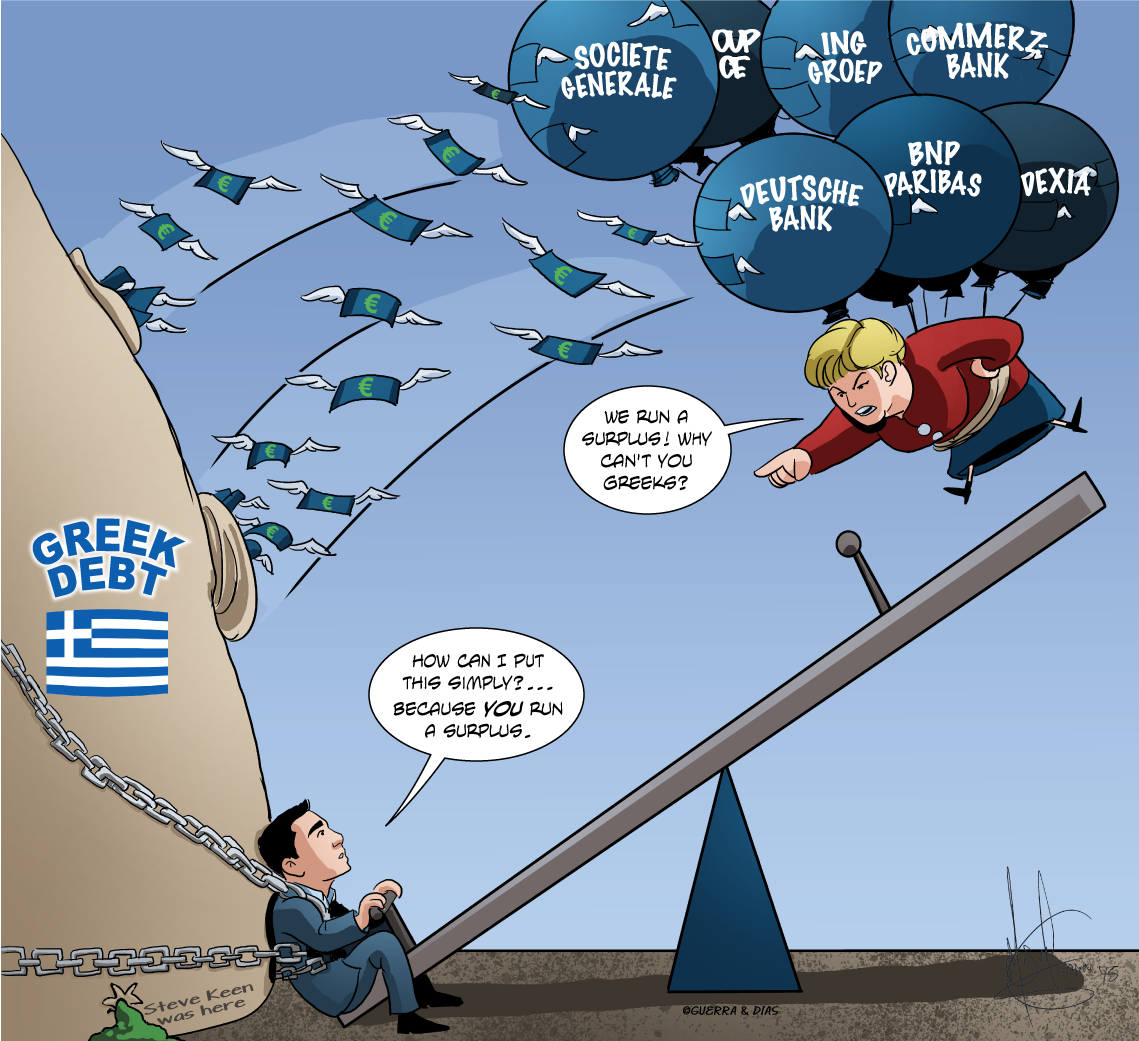
And this all got me to thinking about Germany in particular. There is no country in Europe that has based its economy so heavily on engineering and technology—and few in the world (even a scandal of the magnitude of that consuming Volkswagen is unlikely to shake this). Certainly from a British perspective, where finance capitalism has been politically dominant for decades now, this is particularly striking. Likewise, there can be few countries in the world who are so manifestly proud—this is how it is projected abroad at least—of their economic productivity. This work ethic self-righteousness plays a large part in setting the political agenda for the whole of Europe, as was demonstrated so starkly during the the ‘negotiations’ with Greece this summer. The German Ordoliberal ideal of balanced budgets and fiscal austerity rests upon the material basis of a technologically sophisticated, export-based economy, something that is not easily replicated.


And yet the general consensus is that the German attitude towards technology is, and has perhaps always been, markedly sceptical (although see this for another view). Germans are understood to be among the most hostile in the world with regard to nuclear power, fracking, geoengineering and so on. The roots of this undoubtedly run deep—the whole early-to-mid-twentieth-century thing springs to mind (Heidegger!)—but the entire history of romanticism long before that, also.

I should add that I know very little about political economy and even less about German political discourse. My impressions are very much made from afar. However, the point I am trying to make is this: Germany seems to embody in a particularly pronounced form a contradiction broadly evident right across the Euro-American world (and perhaps beyond), a contradiction that the likes of the ecomods capitalise on. I have little sympathy with their politics—their strategy is consistent: demonise those to their left, build bridges to those to their right—but they are asking some of the necessary questions.

So, having said all of that, the last (but by no means least) panel of the EISA 2015 conference that I attended followed right on from this one and was chaired by Delf Rothe. ‘Critique in an Age of Complexity’: this is how my conference was concluded.

The four papers presented were: ‘Resisting Resilience?’ by Chris Zebrowski; ‘Warring in the Mind: Ideology, Truth and the Neuromarketing of Hope’ by Claes Richard Wrangel; ‘Assemblages and the Positives of the New Materialism’ by Jonathan Joseph and Robert Carter (only the former of whom was present); ‘Complexity and “critical government”: Kantian legacies, critical disjunctures’ by Regan Burles.

Chris, drawing on his recent book The Value of Resilience: Securing life in the twenty-first century, talked about hybridity as immanent critique and how resilience depreciates the non-adaptive. Claes, drawing on a broader research project on hope, discussed the neuroscientific conception of the mind as an adaptive system and how this, quite peculiarly, leads to new forms of politically questionable subjectivism. Jonathan levelled a scornful critique at ‘new materialism,’ particularly taking exception to the alleged levelling of human and non-human agencies in the ‘flat ontology’ of actor-network theory. He mentioned that the concept of assemblage might have some value as a tool for diagnosing neoliberalism but that was about the best that could be said of it from his critical realist point of view. Finally, Regan drew more from the Kantian legacy. To be honest, by this point my brain was fried and I can’t really remember what he said—but it was good!

On the new materialism point, Delf, as discussant, commented that perhaps Jonathan and Robert would be better off aiming their critique at one particular author rather than the group as a whole since this term ‘new materialism’ masks a lot of important differences (a point that I have made previously). From my point of view, Jonathan’s critique was nothing new and mostly relied upon only half thought through reductiones ad absurdum—however, having not read the full paper perhaps I should hold my tongue/fingers.

The question that stuck in my mind at the end of this session was the relative obscurity of ‘critique’ as a term that is constantly used within academic discourse but is used in a variety of different ways. From the strict Kantian sense of interrogating transcendental conditions of possibility to the more deconstructionist sense of ‘problematising’ and ‘destabilising,’ there are clear commonalities and shades and degrees in-between but critique remains, to my mind, a concept that is used almost invariably without any qualification and clarification and, perhaps it’s just me, but I am often left wondering what precisely it is supposed to mean—not that it is meaningless but that it is rather fetishised. I did raise this question in the final Q&A but was left none the wiser.

And so concludeth the conference.

Saturday, 3 October 2015

Reflections on EISA 2015—Day 3

My Thursday at EISA started off with a panel on ‘Kinship in Historical International Relations and Beyond.’ This session was organised by the Norwegian Institute of International Affairs (NUPI).

My notes are, once again, a bit sparse for this session and with the air-con on full blast (the room was sweltering) it was difficult to hear some of the discussion (my hearing isn’t the best, anyway)—plus there were some noisy aircraft making a nuisance of themselves overhead, preparing for the airshow the next day, which made negotiating the discussion-space even more interesting.

In any case, Iver Neumann, formerly of NUPI but now of the LSE, introduced proceedings by reflecting on matters of kinship in IR, particularly with regard to early state formation. Jan Harald Sande Lie gave a very short and very useful introduction to the history of kinship within anthropology. Ole Jacob Sending discussed how kinship is constitutive of international actors, drawing (to the best of my recollection) to a large extent on political theory circa Hobbes. Finally, and most usefully for my own thinking, Halvard Leira talked about kinship in diplomacy. He noted that diplomacy does not invent new forms of organisation but derives its rites and routines from the world around it. ‘Diplomatic culture,’ in other words, derives from the culture of the world(s) with which it is entangled. This is particularly apposite when considering how, before formalisation and professionalisation, ambassadors were quite often quite literal kin.

I am interested in the relationship between IR and anthropology in general and how these differing traditions and disciplines have intersected, are intersecting and could work together differently. Kinship is an excellent focal point for thinking this through and I’ll look forward to the book that is apparently forthcoming on the subject. As mentioned, I gave particular thought to Halvard’s paper. I wondered how European kinship traditions, as embodied in diplomatic institutions, functioned when coming into contact with non-European diplomatic cultures. Kinship was, for example, a key component in French North American colonial relationships with the Iroquois and Algonquian alliances. As Richard White has argued, lacking a common culture as such, Europeans and First Nations negotiated a ‘middle ground’ based not on mutual understanding so much as mutually beneficial misunderstandings. Differing conceptions of kinship, particularly fatherhood, structured the French and Algonquian relationship by providing a common (or rather ‘middle’) vocabulary with which to reach agreements (usually temporary, fragile and fleeting).

White’s book demonstrates diplomacy occurring on multiple levels at once: not only formal and institutional but also familial, sexual, cosmological and more. (This is something that I hope to explore in my thesis.)

I don’t have as much to write about Thursday as previous days (1.1, 1.2, 2), in large part because the two sessions I went to in the afternoon were roundtable discussion sessions and, consequently, didn’t have a structure or rhythm conducive to note-taking (also, I was beginning to feel somewhat fatigued at this point!). They were, however, very interesting.

After lunch, I went to the concluding session of a section organised by my new friends at Aberystwyth on methodological challenges in research. We talked about the epistemic and institutional difficulties in doing research, particularly as PhD students subjected to the often dogmatic Research Council-imposed demands of research training modules and the ever-emphasised need to have a ‘framework’ clearly distinct from (and sometimes even hegemonic over) what one is studying. It seems to me, and happily I am apparently not alone in this, that these ways of framing and carving up the research process place limitations upon what can be researched.

Against this, how can mess, as John Law has written about, be not only accepted as a legitimate methodological mindset but also recognised as an inevitable part of any research project and even as something that needn’t be covered up as though it were some dirty, unfortunate secret?

Writing styles and methods of textual construction were also mentioned, including matters of reflexive writing, which got me thinking about my own projects ahead. I enjoy writing and like to approach it, whenever and wherever possible, as a creative activity. While my research is primarily historical and philosophical (in roughly equal measure), I spent much of my journey home to Wales thinking about how to wrap my own authorial voice up into my writing, to locate my subject-position not just by way of preface (as is common practice) but throughout the process, and to take the experience of research itself as a creative, structural principle in writing. This is easier to do with ethnographic or similar forms of qualititative research as these, quite often, involve a literal journey (or journeys) of self- and other-discovery. But all research is a journey of sorts.

I am drawn back to the idea of theoria, which at the time of Herodotus meant a voyage abroad in search of knowledge. In Plato this meaning is also evident (particularly in the Laws) but also slips into what we recognise today as ‘theory’: when one no longer needs to travel or even to move because one apperceives Ideas, which are placeless, timeless and fundamentally external to any fallen, earthly derivation. Historians and philosophers also go on journeys, also move, also transform and are transformed. How can this not only be accepted as part of the mess of research but also be taken as a principle of narration—as a part of the very fumbling, stumbling world-bundling process in which we are engaged? These are things that I need to think through and experiment with.

Following on from that, the final session of the day for me was also the final session of a section on ‘Diplomacy and Symbolic Violence.’ The panel included Paul Sharp, Costas Constantinou, Alisher Faizullaev and Marcus Holmes.

Costas (who, incidentally, taught me at Keele University all of a decade ago and whose On the Way to Diplomacy is what inspires my inchoate thoughts on theoria, above) began by affirming that one needn’t represent a territory in order to be a diplomat; that we are all diplomats in our own ways as we all negotiate relations of otherness in a world without certainty, simplicity or readymade sovereignty. The discussion touched on formal diplomatic relations but also diplomacies (and symbolic violences) of the everyday.

I was left thinking (although, having only been to this final session and not the ones that preceded it, I should throw a caveat over this) that the concept of violence probably needs a clearer and more carefully considered articulation. It is very easy to expand the concept to such a degree that more or less anything can be understood as ‘violent.’ I would prefer to relate violence necessarily to a conception of harm. An act is violent to the extent that it is harmful. One thing that did come up was the indeterminacy of symbolic violence—something may or may not be intended to be violent; whether or not it is will depend on how it is received by an other; this gap, this fissure is ineliminable. Consequently, we might say that no symbolic act is without violence or that we can never discount the possibility of an act (symbolic or not) being violent; however, not every act that exerts a force need be violent to a notable degree and nor should all acts that do cause harm be lumped into one category as there are ranges and degrees of violence. I see little to be gained by this critical slippage.

In any case, it was another interesting day and one that I am feeling tired simply by recounting! By around this point in the week the weather was turning, getting cloudier and more humid. Practically everyone at the conference was covered by mosquito bites. Many had also quaffed a fair quantity of the hyper-plentiful local wine (sold by the litre) the night(s) before. The fact that the debate remained so engaging and energetic is testament to the stamina and determination of all those involved!

Friday, 2 October 2015

Reflections on EISA 2015—Day 2

The first panel of the EISA conference on Thursday morning (after the Wednesday plenaries) that I attended was ‘Geographies of Violence—The Political Ecology of Violence,’ chaired by James Andrew Tyner of Kent State University.

Connor Cavanagh kicked off proceedings by talking about the history of the Ugandan protectorate and the imperialist knowledge produced by the likes of F.J.D Lugard, an Indian-born British colonial administrator and author. Connor also mentioned the POLLEN political ecology network, which I will have to investigate in more detail.

Second, the chair himself, James, gave an outline of his project of “the biopolitics of geophysical transformation,” particularly looking at the agricultural and canal building projects of the Khmer Rouge. Against the stereotype of the Khmer Rouge as being anti-technology and absurdly naive with regard to the agricultural possibilities of the land, James showed the importance they placed on engineering projects as part of their Great Leap Forward and also that their overly optimistic expectations with regard to agriculture were based, at least in some part, on US and UN research.

Esther Marijnen outlined her work on the Virunga National Park in the Democratic Republic of Congo and, particularly, the Oscar-nominated 2014 documentary film Virunga; tagline: ‘Conservation is War.’ She talked about conflicting perceptions of the work and position of the park’s director, the Belgian aristocrat Prince Emmanuel de Merode. Some see him as having appropriated the park but others apparently regard him as a saviour of sorts. She also reflected on her own position as a researcher, having been asked to go to Brussels to feed back discontent that local people were not able to communicate themselves, and on the difficulty of getting hold of the reports and documents being produced by international organisations.

Finally, Marijn Nieuwenhuis delivered a paper titled ‘Violence in the Air,’ which started off with Carl Schmitt’s definition of man as a “groundling,” that is, as essentially related to the earth (as suggested by the etymology of human). Interestingly for the work that I have been doing on environmental determinism, he then drew on the work of Paul Vidal de la Blache and argued for understanding eco- and geo-political relations through a conception of an emergent milieu rather than an Umwelt or environment. He concluded with a range of examples of how the air can be turned into an instrument of violence, through technologies such as tear gas and other bioregulators.

At every session there were at least 3 or 4 panels that I wanted to go to; however, next I decided to go  to ‘Environments of Violence,’ organised and chaired by Carolin Kaltofen of Aberystwyth University.

First up was Jakob Zahora who outlined the early stages of his research into the new architectures of Israeli checkpoints, comparing them to other kinds of systematised, rationalised spaces, such as factories and slaughterhouses (he was careful to admit the care needed in constructing this argument!).

Next, Jesse Reynolds gave a very useful overview of a forthcoming article, co-authored with Joshua Horton, on geoengineering. He lamented the lack of engagement so far by IR scholars in this crucial topic. It was an even-handed presentation of the risks, costs and potential benefits of these technologies.

Marta Abegón Novella and Matilde Pérez Herranz investigated the possible extension of the Responsibility to Protect (R2P) to environmental issues in a paper titled ‘On the Responsibility to Protect the Individual from Environmental Degradation.’ They argued that environmental factors are neglected within discussions of human security. They were careful to emphasise the risks associated with R2P discourse, particularly with regard to justifying military interventions, which, they stated, should only be used as a last resort.

Finally, Audra Mitchell took us to a much more speculative and philosophical place with her thinking on extinction, drawing on the likes of Claire Colebrook, Jean-François Lyotard, Ray Brassier, Quentin Meillassoux and Nigel Clark. She argued that, despite the popularity of discourses of extinction (e.g.), this is something that our received conceptual categories are currently unable to grasp. The philosophical relation between the ‘unthinkable’ and extinction was a thought-provoking one, although I think I’d need to read about it some more before I am quite convinced.

After lunch, I went to see ‘The Force of Lawyers: Authority, Lawyering and Expertise.’ I have no background in law but I wrote a little bit on it last year and am hoping to develop a project on it in the near future, so this was very useful for that. (I must admit that this session was in a very warm room, looking out onto the glistening Mediterranean and my note-taking noticeably waned as a result; however, I will see what I can recollect from the snippets.)

Gavin Sullivan of the University of Amsterdam (and soon, I believe, to be of the University of Kent) opened proceedings with a paper on ‘Global Emergency and the UN1267 Ombudsperson.’ Drawing on, among other resources, Annemarie Mol’s The Body Multiple, Gavin articulated a description of the actors creating the legal assemblage that constitutes the ombudsperson as a distributed entity. He particularly emphasised the role that some IR scholars have played in being branded as global security experts, playing a key part in the reconstitution of international regulatory regimes. Against some critical legal thinkers, he sees the processes he is researching as leading not to a loss of law but a jurisgenerative recalibration with regard to preemptive security logics.

Ioannis Kalpouzos talked about ‘New Weapons Technologies and the Administration of Violence,’ particularly with regard to the global administrative law of targeting. Immi Tallgren’s paper ‘The Birth of the Epistemic Community of International Criminal Lawyers’ wound a long and fascinating route between the many theoretical approaches that one might take in trying to understand the social and political place of the community of IC lawyers, settling, for the time being it seems, on the notion of the epistemic community.

Finally, Michelle Farrell and John Reynolds co-presented a paper on using linguistic and discursive analysis, understanding representative practices to be constitutive of legality. The first example they mentioned was the 'surgical strike' discourse of drone warfare. This immediately brought to my IR-trained mind works from the 1990s like James Der Derian’s Antidiplomacy: Spies, Terror, Speed, and War, which make similar arguments with regard to the representational techniques utilised in the 1990-91 Gulf War. As the discussant commented during the panel, it will be very interesting to see how this comes together in bridging IR and international legal points of view.

Finally, I attended a session run by more people from Aberystwyth University (my new institutional home from which I am typing these very words!) on ‘How methods shape how we know: The disciplining of knowledge production.’

Danielle Nicole Young and Andrew Davenport both presented papers on conceptualisations of history. Danielle asked ‘Where do you start?’, arguing that this question is crucial to the knowledge that results, particularly when it comes to origin stories such as, in IR, the infamous year of 1648. Her work comes out of training in medieval history but she is keen to stress that she is not interested in how to ‘do history better,’ as important as that question might be. Instead, she is interested in understandings of history as a construction that narrativises temporal experiences, opening and up and closing down various avenues of knowing.

Andrew, similarly, set out to explicate his critique of the use of history in IR. Particularly in his critical crosshairs was neo-realism and its systematic theorising. Drawing on Reinhart Koselleck, he is thinking about the invention of historical time and what happens at the intersections of other conceptual oppositions (inside/outside, time/space, agency/necessity, etc.) when notions of history are taken into account. His concluding words: “What relation to the past would a new global subject have?” I suppose everything hangs here on what is meant by ‘new.’ Undoubtedly, there have been subjects declared ‘global’—typically, one would assume them to be characterised by a self-conceived detachment from the past and an embrace of some sort of humanist universality. Of course, the word ‘global’ is also crucially enigmatic.

This was all fascinating for my own budding project, although I take a slightly different view of how modernist conceptions of history might be undone. I was left wondering what place the trace has within these understandings of history that place so much weight upon experience abstracted from the rest of the world. History is a narrative art, of course, but I would argue that what it draws together, ties in bundles and patterns and filigrees is not experience in the abstract but concrete, entropic, experienced traces of the past from books, archives, oral accounts and even, in some cases, tree rings and ice cores (mediated via the relevant sciences). That said, I have only heard about a very small part of these projects so far and I’ll look forward to hearing more over the coming months.

Finally, Laura Sjoberg and J. Samuel Barkin gave a preview of their forthcoming book on heterodox, critical and progressive uses of quantitative and mathematical methodologies (an article on this subject is available here [paywalled]), a most welcome and overdue endeavour in a discipline where methods tend to be divided up according to politics (to the detriment of both).

Having been away from IR as a discipline for a long time (since 2006, formally), this was a very exciting and reassuring day for me. While I am very glad to have received the studentship that I have and to have three years ahead of me in one of the best International Politics departments in the world, I did wonder how well my own interests, which have meandered rather a long way from traditional IR in the past few years, would fit into the state of this discipline today. I needn’t have worried.

By the end of day 2, I had realised that my epistemic idiosyncrasies were amply accommodated within what this discipline has become, at least in some quarters: an open-minded forum for ambitious intellectual work that is connected more by shared passions and concerns than by the strictures of method or domain. This conference was perhaps exceptional in this regard—by no means is everywhere so free-thinking! However, the fact that it happened and that it was so overwhelmingly successful (far more participants than previous years) was and is deeply reassuring.

Wednesday, 30 September 2015

Reflections on EISA 2015—Day 1, Semi-plenary

The second EISA 2015 event that I attended (after this) was a semi-plenary session that was run in parallel with two others. The panel featured Navnita Behera, Gurminder Bhambra, George Lawson and Arlene Tickner and was titled “After empire? New legacies for international thought.”

Navnita began by emphasising three problematic and interrelated Es: Empiricism, Epistemology and Eurocentrism. The phrase that stood out for me in her presentation, and that I noted down, was “every act of knowing brings forth a world.” She emphasised the multiplicity of cosmologies and the need to understand their heterogeneity from a non-hierarchical and non-hegemonic point of view. Who is entitled to know? How are knowledges produced? These, rather than the traditional epistemological questions of ‘what constitutes correct knowledge,’ are the questions that were urged to be pursued.

Arlene reflected on her complex status as a US academic working at an elite university in Colombia, as well as being a journalist and activist. Like Navnita, Arlene also emphasised the need to knock modern forms of rationality from their pedestal and to place them alongside, rather than above, other forms of knowledge. Against a “one-world reality,” in John Law’s words, should be posed a pluriverse of worldly, collective perspectives.

George, particularly usefully for what I’m trying to think about in my own work, articulated the need to reconnect and entangle forms of knowledge historically. He gave the examples of Hegel’s understanding of the revolution in Haiti and Adam Smith’s relationship to British trade networks. (This brings to my mind Simon Schaffer’s work on the crucial importance of British trade networks for gathering the data used to produce Newton’s Principia Mathematica.) He also affirmed very convincingly that no aspect of IR is without an imperial dimension and that imperialism should be researched more intersectionally in places where it is not generally recognised.

Finally, Gurminder spoke of the refugee crisis and the linguistic politics of posing ‘refugees’ against ‘migrants,’ noting the overwhelming absence of any consideration of how such movements of people are caused and how Western countries are complicit in these processes. She made a particularly interesting observation on the fact that in British political discourse it is often Ugandan Asians who are held up as the model for social integration and an example of British benevolence in immigration policy. Au contraire, the Ugandans were received grudgingly by the British authorities and only after much contestation. Against previous presentations, she argued for the necessity of a “single conceptual frame” rather than discerning between multiple cosmologies.

Perhaps the most memorable moment of this session was a passionate, indeed angry, intervention by a Turkish scholar from the floor during the Q&A. To paraphrase: How can we be talking about cosmologies when people are drowning in the sea and being herded around like cattle? The point was well made that those of us already settled in Europe are only talking about these people because they are “pushing”; because they are making an issue of themselves by walking thousands of miles and passing through the various precarious bottlenecks of the geographies that Fortress Europe hasn’t been able to close off altogether.

This certainly goes right to the heart of questioning what an academic conference is for and what responsibilities academics have to their matters of concern. I mentioned in my previous post that I found it thought-provoking that the conference was held on the edge of the Mediterranean, the sea that has so occupied news cycles recently. Is this ‘thought-provocation’ not a little pretentious and withdrawn from concrete political struggles, looking at it from a point of view of abstract intellectual interest rather than urgent, pressing need for activism? Perhaps. I plead guilty to over-fondness of abstraction and too little engagement with practical politics.

That said, this intervention also provoked me to think about the need for care and specificity with regard to the agenda for ontological and cosmological thinking in relation to geopolitics. In some circumstances these approaches are perhaps not so useful. However, in others I think that they are. For example, the missionaries who attempted to completely eradicate native cultures and turn the people into, to all intents and purposes, European Christians—a form of imperialism still in evidence in various forms today and touched on by at least two of the panelists in this session. Without understanding the clashing of cosmologies, we miss much of the mass of matters geopolitical. It is questionable whether such modes of thought would help to understand the refugee crisis; however, that should not, in my view, detract from the many situations where these factors are of considerable relevance.

Where all of that leaves my own thinking (and, perchance, acting) I’m not sure.

Monday, 28 September 2015

Reflections on EISA 2015—Day 1, Plenary

We were greeted in Sicily by glorious, blazing sunshine. As I write this, the lights are flickering and thunder is growling in the distance. The good weather did not last but this was, nevertheless, a wonderful venue for a conference. Sandwiched between the Mediterranean sea and the volcanic Mount Etna, the town and resort of Giardini Naxos was peculiarly quiet before the conference got going—bars and cafes packed with bright lights and blaring music but few customers. The town's cracked pavements and peeling paint suggest faded glories and a context of regional poverty. However, this did not by any means detract from the experience. Likewise, when, on Saturday, the Italian aircraft display team, the Frecce Tricolori, rattled the windows and drowned out moments of the last few presentations, this, if anything, made the venue an even more interesting match.

These elemental and techno-political interventions gave me the feeling that the venue was almost building us into a box of matters of concern—the deep, deadly sea, the monstrous looming geology, the crumbling edifices of poverty and the soaring spectacle of the military-industrial-entertainment complex: all contributed to a swirlingly texture-rich and undeniably pertinent place to discuss the conference theme ‘The Worlds of Violence.’

Wednesday 23/09 was given over to registration, a plenary speech and several parallel semi-plenaries. The main event, titled ‘What We Do,’ was delivered by Nicholas Onuf, Professor Emeritus at Florida International University.

Onuf, one of the principal innovators of social constructivism within the discipline of International Relations, introduced his talk as a reflection on 50 years of scholarly practice. Particularly, he was delighted that this conference had attracted such a substantial proportion of younger scholars and wanted to pass on what he had learned in his time.

He began with a consideration of culture—“the link between us and the world”—and with C.P. Snow’s famous ‘two cultures’ diagnosis. Beyond the cultures of the artists and scientists, Onuf, reflecting on his father’s experiences as an academic engineer, added a third: that of the practical arts and applied sciences. Next to the artist and scientist should, for Onuf, be placed the craftsperson.

What then followed was an exquisitely detailed philosophical reflection, drawing largely on Kant who, it was claimed, “got it mostly right.” Starting with individual sensory impressions and the fact of speech as a social activity, cognitive faculties were argued to be inseparable from their public exercise. Onuf's practice revolves, then, around “variously institutionalised social faculties.” Particularly:

1) Imagination
2) Understanding
3) Judgment

The discussion of these faculties was very rich and greatly exceeded my note-taking ability (and perhaps my attention-span). However, the overarching point seemed to be that no faculty is ever mobilised in a pure state. Scientists and artists are crafty; even mathematicians have their practical tricks and techniques. The pursuit of understanding—the scholarly endeavour—must, therefore, be linked to techne, to techniques and to the complex, overlapping, always public rules that mediate and enable any and all discursive achievements. Rules are unavoidable—even artists have their rules of thumb. The pressure to codify rules is intrinsic to the rationalising, professionalising and bureaucratising projects of modernity. Against formalism, we should recognise, through intensive self-reflection, the crafty character of our epistemic practices and thereby engage more seriously with the functional foundations of our rules and ways.

This may be a rather loose and incomplete paraphrase of Onuf's argument but this is what I took away from it.

Although not entirely intending to go first, I did put up my hand to ask a question and was, as it happened, the first in line. My question, perhaps best described as impertinent, asked what Kantian social constructivism could do for the matters of concern that are pressing upon us ‘youngsters,’ as we were called, today.

The geography of the conference venue, as mentioned, seemed to me a poetic illustration of the need for a thorough reconsideration of the ontological and epistemological categories that focus scholarly attention away from matters of ecology, geology and climate. More pointedly, I stated that “the last thing that IR needs is more Kantian social constructivism”—perhaps I could have worded this a little less confrontationally but it is a sentiment that I stand behind. Others in the audience also asked searching questions; several of these questions were informed by a sense that this was a rather apolitical vision of ‘what we do.’

Although I should speak only for myself, my feeling is that we ‘youngsters,’ however keen we may be to learn from the experiences of those in whose academic footsteps we are following, cannot find much but complacency in such visions. We are a generation riven with anxieties and uncertainties about the future. Of course, so were older generations (what can someone too young to ever know the fear of obliteration by The Bomb know about anxiety?). However, to disconnect a consideration of ‘what we do’ from the issues and entities that surround and motivate us misconstrues not only the political purpose of scholarship but also, I think, its day-to-day practice.

Onuf’s response to my provocation emphasised modesty: no, he admitted, not much can be said of such issues from this point of view. A more gracious reply than my comment might have received. It perhaps indicates the importance of pluralism—no mode of thought can deal with everything and nor should it be expected to. However, this nevertheless leaves me quite dissatisfied.

First, there is the question of the proverbial baby and bathwater—the sheer sophistication of the (broadly) Kantian principles are inspiring but I struggle to see how they can be sufficiently disentangled from their profound and inbuilt (one might say even purpose-built) limitations to achieve much of a conversation with more anthropocenically-sensitive and materialist points of view. It would be a conversation worth having but there has been little progress on that front, as far as I can see.

Second, Onuf's talk, although touchingly well-intentioned and kind-hearted, failed to sufficiently recognise its own situatedness as issuing from a position of authority. Believe it or not, we ‘youngsters’ are already encountering such modes of thought—indeed, they are “variously institutionalised” in such a way that they constitute a substantial portion of the rule-scape that we are obliged to navigate in order to justify the very existence of our own intellectual endeavours. In other words, the downwardness of this wisdom-transmission must be recognised. And the weather down here might be a bit different to how it is up there…

“World-making is collective and continuous,” said Onuf in conclusion. I certainly would not disagree and it is a point worth repeating. However, the range of entities admitted to that term ‘collective’ is contested—and, we might say, some entities are more ‘collected’ than others. That is, not every craft-doer gets to fashion the world with the same weight of privileges. This, too, is variable—and habitual ignorance of this fact is one among a vast litany of problems that have been handed down, alongside the rest of our inheritances. Indeed, amidst such a deep, dark sea of generationally-imposed problems, the wisdom we are grateful to receive can appear as little more than an island, perhaps even sinking beneath the waves.

Perhaps such dismissiveness stems from the arrogance of youth but, if so, it is an equal and opposite reaction to the arrogance of age. If only the former requires justification in relation to the disciplinary rule-scape in which we are embedded, well, that really proves my point.

A busy couple of weeks

A busy couple of weeks—but in a good way.

On Friday 11/09 I finished up the job that I’d been doing for nearly five and a half years. The following Wednesday, I upped sticks and moved from Bristol to Aberystwyth, five days before the start of term. No sooner had I registered and attended the welcome events on the Monday than I was leaving for Sicily and the 9th Pan European Conference on International Relations in Giardini Naxos. The conference finished on Saturday but, before I head back to Aber to unpack all the boxes and suitcases that are still piled up all around my new abode, I have a couple of days to compose my thoughts (and catch my breath).

I’ll be writing a few posts summarising the conference day by day, sharing snippets of the many fascinating sessions that I was able to attend, before reflecting, rather more egocentrically, on my experience and what I’ve taken from the conference in general.

Sunday, 6 September 2015

Determinism, environment and geopolitics: a conversation initiated?

After much ado about many things, the session Determinism, environment and geopolitics: an interdisciplinary conversation finally went ahead in the last time-slot of the RGS-IBG conference on Friday. Being at the end of a very long week (and having been shifted around several times), the group that assembled to converse was, shall we say, select. However—quality over quantity!—, we had an excellent conversation and one that emboldens me to persist with this line of enquiry. Indeed, both the theme and the format were roundly appreciated, which bodes well for the future of this project.

Most pleasingly, around half our number identified as being environmental or physical geographers of some kind rather than simply social or human geographers (RGS-IBG tends to be overwhelmingly dominated by the latter).

Gwilym Eades spoke about his fascinating on-going work on place, naming and counter-mapping. With a background in physical geography and GIS, Gwilym is exemplary of the cross-boundary thinking that is possible within geography. He drew attention to the novels of Thomas Hardy, the interesting point of which here is that they were almost obsessively topographically planned out and mapped.
This fictional Wessex, very closely tied to but nevertheless distinct from the historical Wessex, has become a matter of concern for campaigners who wish to preserve the fictional-historical landscape. When these cosmopolitical clashes come to concern, for example, wind farms then we do indeed witness a very distinctive Anthropocenic politics coming to the fore—one that eludes any easily disciplinary categorisation.

What is useful about this, for me, is that it draws attention to the importance of representation and mass mediation for these debates. Determinism is as much about epistemic politics as it is about the workings of things. There Is No Alternative—this is the fundamental maxim of determinism. How do fictional-environmental matters of concern, fictive landscapes, come to compel assent to this or that political campaign? What possesses people to pursue this bond or allegiance and not that one?

One related issue that came up was that of affect and political passions. I am particularly interested in Albert Hirschmann's 1977 book The Passions and the Interests: Political Arguments for Capitalism Before Its Triumph. It seems to me that many discussions of affect in geography could benefit from a connection with this sort of work.

It is part of what I am trying to get at with the concept of 'possession'—what if, to quote the book/film Fight Club, the things you own end up owning you? That is, what if we become possessed by our possessions? This seems to me to be intrinsically tied to the problem of possibility and possibilism. Any reconception of possibilism must also reconsider property and properties (in legal-social and metaphysical senses, both). (See this wonderful article on the genealogy of spirit possession for the importance of this concept in relation to colonial geopolitics.)

This sense of being a container for something other than us (and yet not altogether other) is the unsettling experiential condition that derives from social existence and 'ecstatic' phenomenality (i.e. the sense in which, in experiencing the world, we are somehow 'outside' ourselves). There is a great deal of work being done on affect, emotion and phenomenal experience in human geography; however, little of it connects, as Hirschmann's work does, with considerations of mass mediation (cf. the geopolitics of Hardy's Wessex), mass manipulation and the basic concerns of war, peace and social order.

Among the other issues discussed were mental health and the pressure put on climate scientists by researching such frightening futures; the ways in which the discursive practices of consultancy combine deterministic and possibilistic statements (with apparent impunity to consistency!); the etymology of optimism (a concept that I have written about a little), emerging as it does in Voltaire's famous satire of Leibniz; the production of 'false' or artificially generated datasets in order to test algorithms against other worlds than this one (I know of this in epidemiology research but apparently it is also being undertaken in climatological research too); the limitations of 'assemblage' thinking with regards to overemphasising degrees of freedom.

There was more but these are the points that have stuck in my mind (and to my page)!

All of this brings me to reflect on my last post and the fact that, even in geography—as open to interdisciplinarity as geography is, perhaps more so than any other discipline—there is still an extreme pressure to specialise in this or that field, whether it is defined formally or by invisible lines that are navigated as if semi-consciously, as if by scent trails!

It has been repeated to (and perhaps beyond) the point of cliché that the Anthropocene razes old disciplinary distinctions and compels much greater communication between specialisms. We are definitely not there yet. However, there are enough talented scholars that recognise the problem to convince me that we might get there in the coming years.

One final thought that comes from one of the participants who remarked that human geographers can be very intimidating to those coming from the outside. I hope that the way in which I have presented my ideas was accessible—albeit idiosyncratic and of course slanted towards my own peculiar interests. However, I think that it is an important point. (It also came up in a less explicit way in the Verticality and the Anthropocence: politics & law of the subsurface [in collaboration with the British Geological Survey] sessions on Thursday.)

There is also great pressure amongst human geographers (and those working in the humanities and social sciences generally) to cultivate a kind of aura of supreme intelligence (which often leads, ironically, to supreme unintelligibility!). Perhaps because we can so rarely point to experimental objects, hard numbers or established principles, we adopt a form of sublime self-justification, in the sense of the sublime described by Iver Neumann in his article on Sublime Diplomacy: Byzantine, Early Modern, Contemporary. We attempt to create an effect (and indeed an affect) of knowingness that can, in fact, get in the way of talking with others who justify their works in quite different ways. (On Justification: Economies of Worth by Luc Boltanski & Laurent Thévenot might be useful on this point.)

There is a degree of self-criticism needed here that recognises the distinct truth regimes involved and attempts to find ways to, as Isabelle Stengers would put it, make them 'contrasting rather than contradictory.' This diplomatic work is extremely difficult but I am surer than ever that it is worthwhile.

How have conceptions of earth, environment and otherness changed over the years in relation to conceptions of politics, science and truth—and how might these conceptions and connections be thought through differently?

A truism of PhD study: you've got to have a question! I've known this for some time—and already lost count of the times that I've been prompted for it—but struggled to come up with a question for my own project. Not so much because I couldn't boil my interests down to a simple sentence but rather because I hated what that residue looked like and couldn't quite bring myself to repeat it!

Having spent the last few days at the 2015 RGS-IBG conference, listening to ever so many interesting presentations of ideas by researchers of all ages and stages struggling with many of the same issues as I am, it now seems clear (in fact I somehow woke up this morning with these words rumbling around my head):
How have conceptions of earth, environment and otherness changed over the years in relation to conceptions of politics, science and truth—and how might these conceptions and connections be thought through differently?
Okay, so that's two questions, strictly speaking, but they're really two sides of the same coin. Also, it is still extremely ambitious and far-reaching. However, I think that, from now on, every time that someone remarks, with a half-masked air of incredulity, that this is an 'ambitious' project, I will simply reply, with as sweet a smile as I can muster: yes, and?…

That is not something that I feel the need to justify. I claim it by right—for myself and for anyone else who wants it! Perhaps such grand plans will fail, perhaps they will not. In any case, I will not allow them to fail due to the doubtfulness or lack of imagination of others. It will take more than a slightly flippant smile to navigate the rocky waters of academic conservatism but I think that, suitably bedecked, it is possible.

If anybody is allowed to ask Big Questions, everybody must be allowed to ask Big Questions. The gerontocratic settlement that has Youngers do the plodding leg-work so that Elders can do the far-seeing speculation is not only unjust—it just doesn't work…

All of which is not to suggest that the last few days have been discouraging—quite the opposite. I've been extremely encouraged by the generosity and good-heartedness of those I've been able to meet and to see again. Particularly, Lauren Rickards, Simon Dalby and Rory Rowan but I could easily list a dozen others.

This week has also brought home to me just how much work there is to be done—not only on my own project(s) but also in taking on the many assorted inadequacies concerning how various forms of knowledge are supposed to be made conversant. Geography is a strange discipline in this respect: it is so very good at providing space within which questions that cut across traditional dividing lines can be asked but so very bad at recognising its own informal fissures and striations that carve up the epistemic field in manners no less arbitrary or effective.

As a concluding aside, this blog has been a little quiet over the summer. It has been an extraordinarily hectic one for various reasons, not least of which is that I will be uprooting my life and moving to Aberystwyth in a couple of weeks. Five days of work left in which to tie up five years of loose ends (from my current job). Then packing!

There will be more blogging on the other side… (Particularly at EISA, which I am very much looking forward to!)